Thursday, September 17, 2015

The reverse approach to transit: TOD first

In the face of all the hand-wringing about the loss of the $3 billion Baltimore Red Line I have proposed a few times to take a reverse approach and do TOD first for a better chance to get good transit later. A few plans that were developed as part of the Red Line planning process but that were not funded for realization by the Red Line budget anyway, could be built now regardless, some are parking lots, but much would be TOD. So many community working groups (SAACs) planned better communities around their station areas: These visions and plans should not be orphaned, forgotten and neglected. Instead, Baltimore City and Baltimore County should double up, adopt these community plans from Security Square Mall to Highlandtown/Greektown and make them a reality!

That this reverse approach to transit is not just a pipe-dream is demonstrated with the Beltline in Atlanta:

Atlanta Advances TOD Planning

TOD advances in Atlanta


MARTA and the Atlanta Beltline have been chosen to receive federal grants to help spur denser development around future transit lines, the Federal Transit Administration announced Tuesday. MARTA was awarded $1.6 million, while the Beltline received $500,000 as part of a pilot program of the FTA to encourage transit oriented development and infill in under utilized areas.

The money must be used to plan and promote future development of businesses and homes along proposed transit lines - the kind of development that will attract built-in customers for those transit lines one day. (Think high-rise office buildings, condos and apartment towers.)

Transit-oriented development or "transit supportive development" is helpful in obtaining future FTA grants, because it demonstrates that the new trains or streetcars would be able to draw riders, said Janide Sidifall, a senior project manager for MARTA.  Story

Here all about Atlanta and the Beltline at our upcoming TOD Conference. Atlanta Beltline's CEO Paul Morris will be speaking at the event!  More
Baltimore's needs persist just as much in community investment as they in transit. It was envisioned to use $3 billion transit money to leverage community investment. With that money gone, though, the community needs remain in Edmondson Village, in Rosemont, in West Baltimore, in Harlem Park and in East Baltimore where Eastern Avenue does more to separate Highlandtown from Greektown than to connect it.
West Baltimore TOD plan.
With MARC, transit is already there!

 The SAAC plans were developed over a 18 month inclusive process by hundreds of citizens and stakeholders with participation of city and county agencies. What would be more obvious than to let this work come to fruition? Instead of a rail station we will have to imagine enhanced bus stations and stops, maybe some transit hubs, intermediate steps in transit maybe, but the developed places in the community would be permanent. 

Klaus Philipsen, FAIA
see also these more detailed articles about possible pre-Redline TOD (here and here)

Rodricks resigned from Midday

Starting in October WYPR won't be the same. Dan Rodricks, host of the popular show Midday, has given his notice of resignation to WYPR. His last show will be Oct. 2. Rodricks still intends to be behind a microphone, though.
The plan is to develop a podcast for the Baltimore Sun starting with three one-hour podcasts per week. According to Rodricks, the show would be styled very much like Midday in choice of topics and guests, but with more "attitude."
Dan in his spot in studio 1 at WYPR

Rodricks, through his Sun column and through his radio show, is a fixture of information and opinion in Baltimore and across Maryland. Midday is a two hour daily radio talk show and successor of the Marc Steiner show which at the same hour had provided a venue for local information before. The exact circumstances of Steiner's sudden departure were never made public. Steiner now hosts a show at Morgan's public radio station. 

During the last two years I have become a regular contributor at Midday on matters of urban design and transportation. I have found Dan to be very talented behind the microphone. With a quiet and calm professional attitude and a pleasant voice he seemed to be born for radio. He was always well informed and still left his guests plenty of space. He treated everybody with respect but kept belligerous or disrespectful callers at bay. He always seemed to love his topic, no matter what is was given the very diverse range that is testimony to his broad set of interest and knowledge. 

Although the reasons for his departure are not public at this point, Rodricks did indicate at times that he felt he did not have access to  the kind of  resources he would have liked, for example for on-site radio shows or stronger staff support in preparing his shows which appeared to become an issue after his producer Nikki Gamer left the station.

His daily presence on the air will be sorely missed.  As one listener wrote to him:
I was very sad to read today that you will be leaving Midday on WYPR. I am a relatively new resident of Baltimore, having moved here about a year ago, and your program has been a cornerstone of my acclimation. Your daily voice will be missed.
Let's hope for Baltimore and the region that Dan's voice will remain on the air. One way or another. 

Klaus Philipsen FAIA

updated from the original smart phone produced story

BBJ article
City Paper


Is the new "South Baltimore Gateway Plan" really a guide how to use casino proceeds?

The casino discussion brought about many deals including a community benefits agreement. Many predicted that the benefits from a vice like a casino will be fraught with the burden of their origin.
From the pockets of people back into the
community?

Maybe that is an overly moralistic view, but now with the casino operating and producing large amounts of money (although somewhat less than predicted) the community benefits are much harder to find than the casino itself. Instead there are squabbles and diversions, such as casino benefits money being diverted to pay for the relocation of utility lines under Warner Street, a public street that was taken out of commission for the sole benefit of the casino. The utility relocation was a direct result of that closure. So the casino should have paid for the relocation as the entity that benefits. But the money was taken from the community benefits kiddie. With that as the beginning, one could only wonder what would be next. Many were kept wondering since the modus operandi of the Local Development Committee remained a mystery for many. It oversees the community proceeds from the casino and also guided this plan.
the plan area is also the extent of the community benefits area
From the report

The genesis of the South Baltimore Gateway Plan is somewhat telling in that context: A request for proposals (RFP) was issued in 2014 and consultant was hired to develop a masterplan with what many considered an insufficient budget for a task this large. The masterplan fee was budgeted out of the estimated casino proceeds for the first year which had been apportioned without much debate. Nobody could explain exactly why masterplanning had a much smaller budget than streetscaping, for example, when obviously, streetscaping should be the result of masterplanning and not a stand-alone entity funded separately .
Warner Street was closed for the casino

Now the masterplan is public in draft form and is open for comment. It has 157 pages (not counting the appendix) and one can safely say, it includes much fluff. Full page pretty pictures and 42 pages are used to describe what is there. The balance of the pages is devoted to a set of goals, strategies and proposed improvements whereby only the last element has any specificity. The goals, visions and strategies divided in nine areas from transportation to infrastructure are so general, so motherhood and apple-pie that they could have been written up without ever having a community meeting, a workgroup session, a site visit or any kind of analysis.
Table of contents: 42 pages for a description of what is

This may sound like a very unkind evaluation of the result of 18 months of toiling by countless volunteers guided by city staff and consultants. Possibly the analysis-paralysis syndrome set in and it is precisely the committee approach that prevented a more concise plan that would guide and channel money in immediate and near term investments. Hard to tell without having participated in the process except for the kick-off meeting. What is lacking are actual concepts, designs, innovative ideas or overarching themes that are either specific to these communities or would make South Baltimore even more special. The Middle Branch as a second Baltimore waterfront,  the BW-Parkway linking this area directly to the airport and Washington and the many sites in the industrial belt ringing the southern gateway of the city that are underutilized present a huge opportunity to cast a new identity fueled by a presumably steady flow of casino money.

Check out the report yourself and see if you think this masterplan is a real blueprint for action. A real blueprint with strict guidance and not just a set of ideas is precisely what is needed to protect communities and get maximum benefits from developers pushing into the area in the wake of the casino such as Caves Valley in Sharp Leadenhall.

Klaus Philipsen, FAIA

The list of goals, each goal followed by strategies, recommendations and implementation charts

All goals are as much motherhood and apple pie as this one
and this one


Theproposed improvements like here for  transportation are bit more specific


The implementation chapter consists of tables listing the strategies and who is in charge
The southern gateway leaves much to be desired. In spite of the casino and the two stadia it is still
a very sketchy exerience and could use a strong master concept as part of a strategy to
draw Washington DC tourists up to Baltimore along the spine of the BW Parkway 


South Baltimore Gateway Plan
Gerald Neily also wrote about the Gateway Plan here

Wednesday, September 16, 2015

"Oh, that's an overnight trip" - WBAL Jayne Miller about transit in Baltimore


That observation was made by moderator Jayne Miller when BDC chief Bill Cole spoke about how hard it is to get employers to Sparrows Point, the largest industrial redevelopment side on the East Coast. Miller, guiding a panel discussion, probably meant the trip for future employees, after access to jobs emerges as the major theme of the post Red Line debate. It also dominated CPHA's "Red Line: What Now event" which took place Tuesday afternoon at the UMB Biopark on Baltimore Street in an auditorium filled with transit activists and community leaders.

Several speakers and panelists tried to brighten the look into the abyss after the $3 billion project had been taken away from the core region of the State.

County Executive Kevin Kamenetz demanded an approach in which more partners in the region would  have"skin in the game", Dru Schmidt Perkins called the Purple Line "Lavender Line" after its State funding got shrunk to 20% of the original volume, someone in the audience noted that the  gas tax what was not increased "so we can build a highway in Garret County", and Delegate Brooke Lierman even considered a subpoena to get the previously considered BNIP bus  improvement project plan which the current administration won't release, presumably as Lierman speculated to issue it as their own in a simpler form as "BNIP light". 

Senator Catherine Pugh rejected MDOT Secretary Rahn's assessment that "Baltimore is a bus city", Councilman Nick Mosby recalled the times when his mom had to get up at four in East Baltimore every morning just to reach her job at the Social Security Administration, a 14,000 employee job center that would have had a Red Line station on its campus. 

Brian O'Malley of the Central Maryland Transportation Alliance (CMTA) provided some background about the area's rail plans going back as far as 1968 and listed a whole bunch of cities that went forward with ambitious rail expansions even in difficult fiscal times, among those listed were Dallas, Denver, Phoenix and Seattle which is building LRT in a tunnel.

Lierman told the audience much to everybody's delight that she had reminded the MDOT Secretary that the MTA was "a dual function body", running transit and making transportation policy, so that he, Rahn, "had to ask himself what the alternative plan would be" after the Red Line. Schmidt Perkins tossed the request out "to get rid of the fare box recovery requirement" (which currently requires the MTA to collect 35% of its operating cost via fares).

The statements got more colorful when the floor was opened to questions from the audience. "Baltimore City and the County frankly too, they both got told "f** you" Richard Chambers opined from the back of the room. Transit advocate Jen Fischetti asked how the political equation can be altered so that Governor Hogan would have to listen (eliciting the comment from Delegate Lierman that "elections matter"). 

Cynthia Shaw, community leader from the Edmondson Village area, asked what will happen with all those plans developed by communities around station areas in 18 months of deliberations and noted "that with the MTA community liaisons gone there is nobody to address anymore."

The discussion ended with Rich Hall, former Secretary of Planning and now head of CPHA, admonishing those present that it would take "many voices"  to make progress with transit in Baltimore,  but that the current condition requires "to speak with a unified message". 

To this end two large screens were rolled down and anybody in the audience with a smart phone could vote on a set of options provided by CPHA as a nifty tool to erudite the priorities of those present.

Jayne Miller's question who the leader in the effort of a new transit strategy would be remained unanswered.  But it was a smart move to give Baltimore County Executive Kamenetz a forum in which he could display his obvious ambition to fill the void that was created by the cancellation of the Red Line. His regional approach "is spot on" as Bill Cole called it.

Chris Merriam, a bike advocate stated on Facebook about the event: "I got three solid laughs. It was a good day". In Baltimore these days, that is a good balance to have. To boot, with Miller the MC WBAL did a nice segment of the event in their evening news.

Klaus Philipsen, FAIA
The article has been corrected for various name spelling errors. 

WBAL clip of the evening news:
http://m.wbaltv.com/news/red-line-supporters-ask-what-now/35289960
BBJ article

County Exceutive Kamenetz demands transit alternatives that are regional
Panelists from left: delegate Brooke Lierman, BDC CEO William Cole, CMTA Exec. Dir. Brian O'Malley
and 1000 Friends of MD, Exec. Director Dru Schmidt Perkins
City Councilman Nick Mosby and Senator Catherine Pugh, both mayoral candidates

CPHA Director Hall summarizing the meeting


Smart phone real time polling on transit options

Tuesday, September 15, 2015

Morgan's new flagship building - the Graves School of Business by KPF


The college building boom continues unabated and what better example than Morgan State University's (MSU) rapid campus expansion and its latest building, the Earl G. Graves School of Business and Management? It not only jumps across a major artery (Hillen Road) that used to confine the campus, it also jumps in scale and ambition beyond anything the school had built before. With $80 million cost it is smaller than  the Peter Angelos law school of UB but certainly as ambitious.
The new business school is the lone outpost west of Hillen Road (#53 on the map)

The 138,000 GSF building provides space for the school’s seven academic departments (Accounting, Finance, Business Administration, Marketing, Management, Information Science and Systems, and Hospitality Management), outreach centers (Entrepreneurial Assistance & Development Center, and Center for Entrepreneurship and Strategy) and the school’s two new programs (Project Management and Entrepreneurship). (KPF website)

While there are details to quibble about, most notably the facades (materials, proportions) and the shed-like cheap upper level metal cladding as well as a lack of precision in the execution of the ambitious details on the inside, Kohn Pederson Fox, a world renowned firm with a stellar reputation, has delivered an instantly memorable icon that surpasses anything else the Morgan campus has to offer, including the new and also not shabby architecture and engineering building. Ayers Saint Gross is the local partner firm.

In keeping with many new campus buildings such as the UB law school and the Coppin school of health, KPF devoted much space to impressive and soaring internal volumes without much function other than creating a strong "commons". Maybe involuntarily commenting on current economic affairs, a floating contraption hovering ominously like a spaceship above the commons houses the business schools mock trading floor. Here, like in the New York stock exchange, derivatives and stocks reign the world via giant screens and ticker lines with a clear view into the gathering space below and all the glazed team and group meeting spaces.

Klaus Philipsen, FAIA

See below virtual tour. The school opened for students at the begin of this semester. Final construction is still in progress, especially site work.

The stilted proportions and the vertical slot windows take getting used to on the southwest (the plaza is still under construction (photo: ArchPlan)

and the southeast (photo: ArchPlan)

Not visible here: the top level is painted currogated steel (photo: ArchPlan)

the building has two entrances, the southern one under this arcade (photo: ArchPlan)

The trademark south pointed corner (photo: ArchPlan)

the hovering starship above the commons is the trading floor (photo: ArchPlan)

the hovering starship above the commons is the trading floor (photo: ArchPlan)
The trading floor in the space capsule is not yet ready for use (photo: ArchPlan) 

View from the "trading floor" (photo: ArchPlan) 

A well equipped auditorium is part of the program (photo: ArchPlan)

The building is applying for LEED gold (photo: ArchPlan) 

the south-east stairway overlooking Hillen Road (photo: ArchPlan)

Plenty of glazed small group rooms allow for collaboration (photo: ArchPlan)

this corner looked most dramatic when the building had just been framed (photo: ArchPlan)

the next project already broke ground: The Jenkins Behavioral Science Building by HOK with  Cho Benn Holback
(photo: ArchPlan)

Monday, September 14, 2015

Baltimore and Munich: Why mayors can't cope with what they are dealt

Baltimore the day after the riots and Munich this past weekend, what would they have possibly in common?
Volunteers clean up in Baltimore after the riots

Munich isn't a city with large disinvestment and abandonment, as Baltimore is. Like Austin, Texas, Munich is a liberal bastion in a conservative state (Bavaria, Texas) that flourishes as a mecca of IT industries (Munich: Siemens, Austin: Dell) and attracts young creative talent with a high quality of life. But Munich is also Germany's entry point for refugees from the Middle East coming in via train from Hungary and Austria.

This last weekend 14,000 refugees arrived in just two days. Like Baltimore on the day after the riots discovered its better side with scores of volunteers descending on the sites of rubble and loot to help and clean up, so Munich discovered its better side after the German chancellor had declared Germany as a country where refugees are welcome, compared to Hungary where they clearly were not. Thousands descended on the central railway station to help during last week.
Volunteers provide food supplies at Munich's railway station

But yesterday Munich's  Mayor Dieter Reiter called on the federal government to pull the emergency break. Munich couldn't cope with the influx anymore in spite of 1,500 volunteer helpers that had manned the train station alone to supply assistance in the shape of food, blankets, smart phone SIM cards and cots. With so many jam-packed trains arriving in succession the city's best attempts to move the refugees from the station to gymnasiums, barracks and other shelters began to fail and refugees had to sleep in the station just like in Hungary.

It turns out that cities always bear the brunt of failed national and international policies. In Baltimore, in New Orleans and in Budapest and Munich. Even equipped with moral support and an abundance of resources (Munich is one of the richest cities in Europe), 14,000 people arriving with nothing but a suitcase and a few belongings on their back represent a massive problem, especially if they are followed by thousands more every single day. To disperse crowds like that, find housing (it is getting already cold at night in Germany) and eventually even jobs to avoid large concentrations and camp misery is an almost impossible task.
This way Munich gets in one weekend what Baltimore had hoped to get in 10 years! (Munich processed 63,000 refugees since the end of August!)
thousands arrive on packed trains every hour at Munich railway station

Refuges flooding Munichs Streets

Baltimore and Munich both show that citizens can very well rise to a task for a day, a week, maybe a month. But then they tired, resentments set in and the finger-pointing begins, no matter that the root causes don't sit with the young men that vented anger and frustration in the streets of Baltimore nor with the refugees streaming across Europe, no matter that there are always some who abuse the situation, take advantage or are plain criminal.

Yesterday Germany re-introduced border controls, a turn-around of the "all are welcome" policy. It is not clear what effect that will have if any other than more anger.
Munich's Mayor Dieter Reiter on Saturday with a chart of
refugee arrivals in the background


Baltimore has armed its police better, it remains to be seen what effect that has other than more anger. For a moment Germany's Chancellor is heralded by refugees as the benign "Mutti" who takes care of them (quite the opposite of what the Greeks said just a few weeks ago).

Baltimore's Mutti, SRB was not so lucky, nor was her police commissioner Batts.
SRB announces that she won't tun again
as mayor
We are already in the scapegoat stage. But unlike Merkel, SRB (or whoever will be her successor) has little power in dealing with the cards dealt to her, and that she shares with the Mayor of Munich.

Klaus Philipsen, FAIA

The Telegraph: Migrant crisis: Refugees welcomed in Germany like war heroes as Berlin expects 10,000 in one day


Munich soccer fans showing their better side last week

Friday, September 11, 2015

Can the MTA be reformed?

Freshman Delegate Brooke Lierman floated a big bill right in her debut term: The creation of an MTA Oversight Board with the purpose of making the MTA more effective and more accountable.
In a paper that summarizes her idea Lierman states:
The buses, light rail, and MARC trains that MTA operates routinely offer subpar service to Maryland residents. MTA complies with no reporting or planning requirements related to service quality that are specifically responsive to customer feedback. MTA’s inadequate service and operation means Marylanders are paying for busses that show up late or not at all, MARC trains that routinely break down, and unsafe light rail experiences. MTA can and must be held to a higher standard: it must do better. 
After the cancellation of the Red Line, with a new Governor and a new MTA Administrator Democrat Lierman sees her bill which didn't make it out of committee picked up by the new administration with gusto. Paul Comfort sounds as if he is hell bent to do just what Lierman intended, making the MTA more accountable and more dependable and efficient.

Comfort's strategy of increased efficiency fits nicely into a budget situation where none of the State moneys saved from the Red Line are made available for Baltimore area transit. Efficiency is the only way to make transit better without money. As I have pointed out here before, though, no system that is squeezed to the max can actually run efficient. For efficiency margins are needed in personnel, fleets and maintenance, otherwise every sickness or every broken down bus cause a ripple of poor performance across the system.
MTA Administrator Paul Comfort laying out his vision for the MTA at State Center's auditorium yesterday

Yesterday in the third of those MTA Regional Stakeholder Meetings Comfort again displayed his enthusiasm and a diverse audience their skepticism, ideas and occasional distrust. Lierman as well as other delegates and Senator Catherine Pugh (who is now running for Mayor) came to listen and occasionally speak, just like the regular folk unsure what to make of MDOT and MTA after the $3 billion for the Red Line are off the table, the MTA is subjected like all other agencies to across the board budget cuts, and the Governor steadfastly maintains that roads are needed to solve transportation problems.

For now, MTA's Comfort focus is on three metrics that the Maryland Legislature prescribed for him:
Ridership, on-time performance and fare-box recovery, He showed charts that seemed to indicate that under his now 100 day leadership these metrics are already looking up.

The attendees certainly support the first two metrics, but the third, the ratio of operating cost mandated to be recovered by transit fares and set at 35% by law, is in much dispute because it includes factors influencing the cost of operation which are beyond the control of MTA and the ratio in itself suggests that the purpose of transit is that of a business when in reality it has a broader public purpose with many external benefits not counted in the simple recovery ratio.

The laser like focus on efficiency could easily mean to look at the MTA in isolation (like the book-keepers certainly do). In the last three decades the transit conversation has expanded to see transit as an element of healthy communities, as a community builder, a tool for economic development and as a way to lift neighborhoods whose biggest economic stranglehold is lack of access to opportunity (See report of the Community Collaborative). We cannot go back to just caring about how transit operates by itself.

Paul Comfort agrees. "Transit can be the solution to so many things" he says. It remains to be seen, how the MTA can become a true partner with the City and the surrounding counties and tackle the many issues that can throttle good transit and are beyond the control of the transit agency such as:

  • Poor land use around where the MTA has fixed assets, namely rail stations like those along the Metro where each of the stations is surrounded by disinvestment or low density not transit supportive uses from Owings Mills to Hopkins (at EBDI there is at least a plan to remedy that situation and at the Charles Center Station the uptick in development has almost eliminated vacancies)
  • Lack of space for transit stops and transit hubs resulting in bus stops without amenities which are squeezed onto narrow sidewalks with buses barely having enough curb-space to service the stops
  • Practically no bus lanes (there is one on Lombard Street which nobody seems to heed). City DOT chief William Johnson apparently promised Comfort to be favorable to installing more)
  • No signal priority anywhere for buses
  • Extremely poor pavement conditions espcailly in curb lanes guaranteeing a "rough ride" for all bus riders 
  • No attention to "last mile" issues that include how to get to stop and making walking, biking, getting a Zip car or catching a shuttle a well organized option at all major transit hubs
  • Poor integration with the other transit modes by other agencies such the Charm City Circulator, the Harbor Connector (water taxi) and Amtrak. 

A good look at any of these issues shows that a lot of synergy is lying fallow here waiting to be realized. That, too, is efficiency, but it requires attention, resources and true collaboration.

The MTA and MDOT are working towards an October meeting for which MDOT Secretary Rahn has promised a set of plans and ideas on how to improve transit in the Baltimore area. As I noted before, even without the Red Line, there are many places for improvements. Some were planned as part of the Red Line and should be realized as part of improved east west transit including:

  • the Bayview MARC Station and its park&ride lot
  • the Canton Crossing park&ride lot
  • the West Baltimore redevelopment around the Ice House
  • the I-70 park&ride and trailhead
With those intercept parking lots at the east-west gateways to the city drivers could become riders served by high frequency, priority bus lines on east west corridors such as on the west side on Frederick Avenue, Edmondson Avnue (the current QB 40), North Avenue and on the east side on Orleans Street (or Fayette), Eastern Avenue and the Boston -Aliceanna Street corridor. Those lines (especially the one on North Avenue running on the east and the westside) could become the opportunity lines that make access to jobs easier.

Lierman's bill and Comforts ambition would have a good outcome, should those capital and operational investments be made within the next year.


Klaus Philipsen, FAIA

Thursday, September 10, 2015

520 Park Avenue now with Coffee Shop, soon with Market!

520 Park Avenue, the conversion of a former Hochschild Kahn warehouse into apartments sits south of Center Street, technically not Mt. Vernon. Of course the developers like to call things "Mount Vernon" rather than "Westside" and that is fine by me as long as there is progress. And as I pointed out before, there is indeed!

Right after the Hotel Indigo added a very fine restaurant and bar at its Cathedral Hill location, catty corner from the Pratt Library on Franklin Street, 520 Park Avenue two blocks to the west, opened a very well designed coffee shop. And their next opening, the "Mount Vernon Marketplace" is right around the corner!

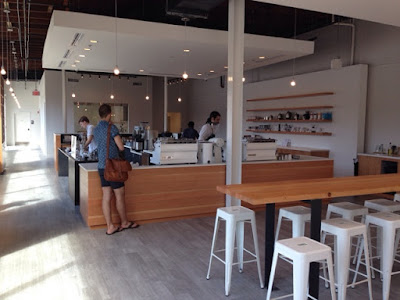
The Ceremony Coffee Roasters hail from Annapolis where they operate a coffee shop and coffee roasting place. Operations here started this week. The very clean interiors are bright and designed around share tables. A special enclosed room is designed for workshops and "cafe training" sessions.

This opening marks another frontier in the never ending coffee shop craze. Thanks to the soon to be opening market, the already operating Trinacria Cafe across the street and the planned cafe at Franklin and Eutaw, this long neglected area is no longer a coffee or gourmet desert.


Klaus Philipsen, FAIA

see below photo tour (all photos ArchPlan Inc.):

The entrance from Park Avenue allows for some outdoor seating
View from the door
The southeasterly view out the windows shows the Library for the Blind (part of the Pratt), the highrises of Charles Plaza, the BGE Building and the golden top of the former Nationsbank Building in the distance. The steeple belongs to the St Alphonsus Church at Saratoga Street
Clean lines and bright light
the Roasters offer a wide variety of beans


The cafe training workshop
.