Wednesday, January 20, 2016

Does Towson need its own transit?

In Towson the political fronts seem reverse from the usual, a Republican councilman who is requesting transit and a Democratic Executive saying it isn't needed.
We should never be afraid to try out new ideas. What we should fear is the gridlock that might occur without a real solution to Towson's transportation challenges. (Councilman David Marks)
"The expectation is that people will be able to walkI think right now, it’s quite manageable. We don't have any failed intersections. It seems to work pretty well. At first glance, [the circulator] seems like a good idea, but when you drill down, maybe it isn’t." (Executive Kevin Kamenetz)
Who is right? One answer can be expected from a MTA study which has not been published yet and is overseen by former Baltimore County Planning Director Pat Keller, now with MTA. In many ways the question of transit is reflective of what has happened with the once rural County surrounding the City like a vise.
Baltimore City Circulator: The right model for Towson?

Baltimore County is often seen in some kind of competition with the City not only because of the geographic configuration in which the City is locked into place by the surrounding County with no chance to grow. Perception is strongly tainted by the fact that many people who were fed up with urban living resettled in the County, a pattern that has fueled the decline of city and the growth of the County for decades until at the turn of the century the County surpassed the City in population.

Since the County itself limited its own expansion by a growth boundary (URDL) with the objective of preserving rural lands, the communities inside the URDL began to urbanize, a fact many County residents still have to fully grasp. Transportation is one of those issues. Except for the old streetcar villages such as Catonsville and Towson (both towns were once connected by the #8 streetcar), much of the County is laid out in the familiar suburban manner which is entirely relying on the car for access and mobility. Consequently that Towson transportation question is bi-forcated: Yes, one can certainly get around within downtown Towson by walking as the Executive says, but one cannot walk to Towson from the surrounding communities.

For the circulator bus that means, it would make the most sense if it doesn't just circulate around within the Towson core but would ferry people in from the surrounding areas. That, however, should be done at least in part by MTA. Poor transit access to Towson is a longstanding complaint that MTA is well aware of.
Boulder Skip, Hop and Jump buses replaced parking

Meanwhile following trends of large and small cities nationwide, downtown Towson sees a boom of new apartment construction that will bring finally day round activities to the core. It is likely that those new urban residents won't all get into their car to go to the town-center mall or the restaurant around the corner. Will they clamor for a transit alternative to walking? The experience of smaller towns is mixed. Boulder, Co was very successful with instituting bus transit (Hop, Skip, Jump) by re-channeling resources from parking to bus (developers were required to pay towards the bus instead of building parking). Small towns like Blacksburg sustain their 50 bus 30 route municipal transit system with the help of the local university (95% of BT riders are university related). The extensive service runs a lot of empty buses through a downtown which is largely depleted by suburban sprawl.

Kamenetz is probably right: Before Towson can embark on a new transit system it should install a sustainable funding mechanism and it should get the support from Towson University which currently runs its own shuttle system. For funding the County could take a chapter from Baltimore City which created the very successful circulator largely funded by a surtax on parking. (It runs a deficit now because it bit off a larger network than the surcharge can support). In principle an excellent solution if combined with regulations which restrict new parking garages in the core and place parking at the periphery with the bus as the connector.
Blacksburg Transit: A public system transporting students

While the MTA and the County are further studying the issue, immediate steps need to be taken to reduce parking in the core area, making downtown Towson even more pedestrian friendly and creating a walk and bike trail and greenway system that bridges the forbidding downtown by pass traffic sewers and reaches deeper into the surrounding neighborhoods and the Towson University campus. Better transit in Towson is certainly desirable.

Klaus Philipsen, FAIA
Towson  University shuttle: Exclusive transit

Suggested articles on Community Architect:

Free Downtown Bus Transit - Community Asset or Yuppie Shuttle?

Tuesday, January 19, 2016

Is a West Baltimore Innovation Village the right idea?

Announced on Martin Luther King Day the newly minted Innovation Village can be seen as a bold and innovative step to revitalize the area along North and Pennsylvania Avenues, two street names now known around the world as symbols for impoverished inner city neighborhoods. But before the surprise of this announcement has even sunk in, critics such as community leader Cheatham are already on record. According to the Sun he had this to say:
Pennsylvania Avenue corridor
"What gives them the right to come west? Something is very suspicious here. Folks are throwing around money to groups and organizations that weren't directly affected." (Marvin Cheatham Sr)
The suspicion about anybody taking advantage of the dire conditions is even bigger than the concern about the conditions themselves. The problem of lack of inclusion regarding the idea of an innovation district should be easily overcome, but it is also indicative of a larger problem: Simply declaring one of the most dis-invested areas an Innovation Village is not akin to real change. It is more smoke and mirrors than substance.

Baltimore certainly knows from experience that naming a district such and such zone doesn't make the district different, just think Empowerment or Enterprise Zone. Almost like suburban developers name their subdivision after what they killed with its construction, the economic development designations often stand for what's absent in the zones: empowerment or enterprise, for example.

Innovation districts typically rely on strong stakeholders or "anchor institutions". But not all institutional stakeholders are equally strong or trusted. MICA may be strong but lacks the trust of community leaders such as Cheatham. Coppin, the historically black university, may have more trust but it is better known for promises than action. Struggling with continued low enrollment in spite of a massive campus expansion and with one of the lowest graduation rates in the country. Coppin isn't exactly a powerhouse that can take on a lot of external tasks, in spite of best intentions. The public is still waiting to hear from the new Coppin President about her ideas how to tackle those fundamental problems. 

Once can get the impression that innovation districts are the newest darling of planners and economic development officers. The Brookings Institution has picked up the scent and began tracking innovation districts. They define them as compact, transit-accessible geographic clusters of anchor institutions and companies packed with connections between anchors, startups and business accelerators.
Innovation District Boston

A district that fits that description is the Boston Innovation District, widely considered successful. It is the formerly industrial south Boston waterfront district where the city placed their new convention center. The idea was to combine hotels, conferences, incubators and start ups in a large area that was sitting fallow as a result of industrial decline. According to Boston's own website, this is what happened in the first three years since the zone was initiated:
Added over 5,000 new jobs in over 200 new companies
- Technology companies have contributed 30% of new job growth
- 21% of new jobs are in creative industries like design and advertising
- Greentech + life sciences are growing, with 16% of new jobs in these sectors
New Companies
- Of the new companies, 11% are in the education and non-profit sectors
- 40% of new companies are sharing space in co-working spaces and incubators
- 25% of new companies are small scale, with 10 employees or fewer
The closest approximation to Bostons innovation district in Baltimore would be Port Covington with Under Armour as the engine in lieu of a convention center. Of course, we have our very own East Baltimore Development Inititiative (EBDI), a giant redevelopment effort based on the linkage of innovation (bio-tech) and redevelopment (affordable and market rate housing) fueled by the Johns Hopkins hospital and by the Goldseker Foundation. EBDI was never called an innovation district but operated on many of the same  premises. It is well known that only a few would call EBDI an unmitigated success at this point. It has become obvious, how hard it is to achieve the right balance between new technology jobs and social equity.

Sure, why not go a step further and target African American entrepreneurs and innovators and use anchor institutions such as MICA and  of Coppin as the engines? Doesn't it make sense to begin another big and bold project on the westside of town?
Plenty of former commercial and industrial sites

The Mayor had targeted Pennsylvania Avenue already in her commercial corridor initiatives (LINCS). Several local organizations who still need to get included into the new idea, such as the Druid Heights CDC, have already developed their own incubator ideas. Even though the targeted area in Baltimore doesn't have freeway or water access, it has two stations on Baltimore's only real subway line and is fairly close to I-83.

Brookings is working on a set of metrics that should help local decision makers to assess if an area is appropriate to be designated as an innovation district, and measure progress after the designation was done. Last July Brookings Fellow Jennifer Vey told "DC Inno" (a website in DC that reports about Washington's innovation district) that these items caught her attention as criteria or metrics:
Clearly, you need critical mass. You want to know something about your competitive advantages. What do you do well – particularly in terms of your sectoral advantages?
How diverse are you? How diverse is your economy? While you want to play to your strengths, the best places are probably those that are pretty diverse in terms of economic activity – and diverse in terms of the kind of people who are there; that speaks a little to the inclusion.
How well are your assets aligned with one another? And that leads into the connectivity and collaboration.
How many opportunities are there for connectivity and collaboration?
Finally, there's a quality of place point.
Bruce Katz, Julie Wagner and Jennifer Vey conclude in an article published at Brookings:
There is one unfortunate trend in the rising use of the "innovation district" lexicon. In a number of cities, local stakeholders have applied the label to a project or area that lacks the minimum threshold of innovation-oriented firms, start-ups, institutions, or clusters needed to create an innovation ecosystem. This appears to result either from the chase to jump on the latest economic development bandwagon, the desire to drive up demand and real estate prices, or sometimes a true lack of understanding of what an innovation district actually is.
MICA has included social design into its curriculum and operates a branch facility in the EBDI area. It has successfully intervened  and invested in the Station North arts district. The institution has sound credentials. But can it go the next step and reach that far west? Can Coppin go so far east? Are there enough elements to create critical mass? Is there a diverse economy at all? These are all very tough questions. 

From all appearances the are needs to some more work first. It would be necessary to create some sustainable "virtuous cycles" in West Baltimore that are less based on innovation and more on basic job creation and workforce development. For example through simple services such as "deconstruction", labor intensive manual demolition by local currently unemployed residents, combined with recycling of building materials. That could slowly build skills towards rehabilitation and construction. All that could be fueled by the Governor's new demolition funds and be integrated into "vacants to Values".

Blaize Connally Dubbins who provides health services and transitional housing on Pennsylvania Avenue near North Avenue has a bunch of ideas how folks graduating from detox and transitional housing could find a job in healthy food services or in deconstruction. This could provide a steady stream of long-term renters or even first-time home-buyers that would gradually fill the vacant houses of the area. Roscoe Johnson of the Druid Heights CDC has blueprints for a youth center that includes job training and for an incubator space into which folks from the youth center could step up to. These efforts and plans need to be supported. Maybe these could be the first start-ups. 


Klaus Philipsen, FAIA

Links:
Baltimore Business Journal
Baltimore SUN
Brookings article


Monday, January 18, 2016

Celebrating Martin Luther King's birthday on a bypass

It has been noted that in most cities the streets and boulevards that have been named after Martin Luther King are not the prettiest and they are not located in the "better" parts of town but in struggling areas. Baltimore is no exception.

The parade begins at the intersection of Martin Luther King, Jr. Boulevard and Eutaw Street near State Center and proceeds south on Martin Luther King Jr. Boulevard to Baltimore Street. Spectators are invited to view the parade from along the route or near the reviewing stand at Martin Luther King, Jr. Boulevard and Franklin Street. That make it not only a short parade but also one that happens only on one half of the divided highway named after civil rights leader with cars, trucks and buses roaring up the northbound side separated from the parade only by a median.
Drumming for equal rights and justice

So it is not only the usually frigid January temperature that puts spectators and participants into a rather uncomfortable position. Chilling is also the fact that the route can only on one side be safely lined by cheering crowds and that the stage is positioned awkwardly on a major intersection with a freeway overpass casting its shadows and providing another set of roaring vehicles. 

Baltimore's Martin Luther King is neither a real boulevard nor it is a historic street. It defies the historic street-grid and has been blasted as an arc into the urban grid fabric as part of urban renewal that brought also the string of public housing projects of Lexington Terrace, Murphy Homes and McCulloh Homes as well as the State Center office complex. The thus created roadway is the western part of a somewhat disjointed and incomplete ring-road that serves as a bypass around downtown (the eastern part is President Street, the southern is Pratt Street and the northern is Mt Royal Avenue). In many ways MLK also acts as a moat around downtown that is both a visual and a physical barrier for pedestrians that want to move back and forth across the divider.
This is not an urban boulevard! (ArchPlan) 

It is not my place to suggest alternative parade routes, yet it is tempting to imagine the parade beginning at Penn and North winding down to Franklin with a terminus at the Lexington Market with the food vendors selling hot soup at stalls temporarily erected on that surface parking lot next to the market. For all its disinvestment and disrepair, Penn Ave would be a real street with a great history very well suited to the legacy of Dr. King. That would also work well with the idea of the Innovation Village announced today. 

As far as Martin Luther King Boulevard, it is time to reduce its disruptive impact and tame it as a truly urban boulevard. 

Klaus Philipsen, FAIA

See my article about urban repair at the former Social Security offices at MLK and Mulberry/Franklin

See also Gerald Neily's articles about MLK here and here.
Innovation Village: Partnership aims to revitalize Central West Baltimore
http://bsun.md/1Ss6wMR


All pictures of the 2016 parade ArchPlan: 


Add caption

The Mayor out on foot

Add caption

Add caption

Add caption
A sketch of urban infill that could help to make MLK a real urban boulevard
(graphic: ArchPlan)

Sunday, January 17, 2016

Suburban home builders in the City: Like K-cars with faux wood panels

The good news of suburban tract home builders directing their investments to the City is that not as many pristine landscapes will be lost to sprawl and pseudo-urban ersatz "townhouses" strewn around in chunks of nine (or whatever zoning allows) while the City gets new residents and tax payers.
Anything but a place (Photo: ArchPlan)

The bad news is that those inflated row house imitations are now springing up in what presumably would be their native habitat. The result is similar to serving Coors Light at the Munich Octoberfest.

Next to the historic originals the whole architectural charade of the builder homes becomes plainly obvious: The arbitrary use of plastic cornices, inserted fake window mutins that even in their proper execution were hardly ever used on actual Baltimore rowhouses, the faux keystones, the tired brick/beige color mélange, all that could be chalked up to clumsy  flattery.

But the fact that these new "row-houses" are wildly out of proportion, that they are bloated like athletes on steroids, that their first floors sit too low, that they are four stories tall and still have penthouses, and that they don't form streets and alleys but line cul de sacs that are nothing more than parking lots, that they don't have a clear front and back orientation, all that is inexcusable. 
The four story "town-homes" plus penthouse  tower over the small historic houses (Photo: ArchPlan)

One would think that fifteen or so years after the first foray of mega suburban Homebuilders into Baltimore (Pulte into Federal Hill) the design vocabulary would have evolved and found a 21st century, urban expression that speaks to Millennials and retiring modernists alike. 
Adoring the water and the Domino Sugar sign. The main view line.
(Photo: ArchPlan)

But no. What Richmond American Homes puts up near Key Highway oriented towards the Domino sugar sign like magnets facing north, is precisely the same vocabulary with which the historic Koppers foundry was rebuilt as Camden Crossing and with which Locust Point began its renaissance through the Towns at Locus Point development.

The tone-deafness of those mass production builders is doubly sad considering that examples of contemporary and yet contextual infill had been around even before the productions builders rode into town. Just think Bolton Hill, Otterbein or Grindalls Yard in Federal Hill.
Zig-zagging layer cakes along Covington Street (Photo: ArchPlan)
The homebuilders designs are as if Chrysler would still roll K cars with wood paneling off its assembly line or how a North Korea would design a smart phone. 

Why can't there be a new esthetic? Why does all the cool new contemporary design have to be quarantined in cities like Denver, Austin, Atlanta or San Diego?

The new urbanistas wouldn't want to be caught dead with a flip phone in their pockets or suede shoes on their feet. Why do home-builders still think that their target market still shops for transistor radios? Why the grotesque inflation of scale in a time when the tiny home is the new black? Why the lack of meaningful public space when share space and commons are all the rage?

Maybe I am missing the point entirely and it is the cheesy imitation that is precisely what makes Baltimore authentic, from Tin-Man to form stones. But that guy standing on the stoops of his formstone home across from the new Federal Place did not think so.

"I will move out", he said taking one of his I-phone ear plugs out and pointing to the massive vinyl back side of "Federal Place" across from his house, "I will just move a few blocks up Gittings Street, where I don't have to look at this."


Klaus Philipsen, FAIA

Parking lots instead of streets (Photo: ArchPlan)


Related article on this blog:
Sad looking rowhouse facades

Visit the weekly in depth article on the Cities, Architecture and Planning blogs "Community Architect" 

1983 Chrysler Town & Country woodie wagon in Denver junkyard
Chrysler K car wagon
Historic Gittings Street in Federal Hill (Photo: ArchPlan)


Friday, January 15, 2016

Rewriting Baltimore's History? About Monuments and Museums

Tearing down Saddam Hussein's statue was a pivotal moment in the history of Iraq. Hitler's statues didn't survive the end of World War by more than days, not so much because liberated Germans toppled them but because the Allies blew them up.
Jackson and Lee (photo: Baltimore Brew)

In Baltimore in 2016 we still fight the Civil War 150 years later which makes it less surprising that we are still in the middle of civil rights struggles more than 50 years after the landmark legislation passed. So it happens that today's SUN reports about the votes of Baltimore's Monument Commission and about the problems of the Reginald Lewis Museum of African American History and Culture in the same issue.

The legendary Maryland law professor Larry Gibson argued for relocating at least two statues celebrating figures that have a strong legacy of racism:
Gibson [..] argued that Baltimore has a disproportionate number of monuments to the Confederacy on its public property. He said that more than twice as many Marylanders fought for the Union as the Confederacy during the Civil War, but the city has only one public monument to the Union.
The Lewis museum has had 30,000 visitors in one year, by comparison, the BMA had over 200,000.
Reginald Lewis Museum of African American History and Culture

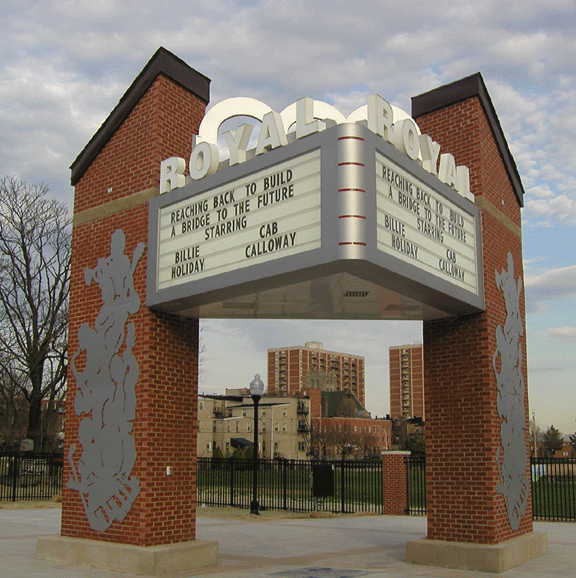
None of the three arts and entertainment districts in the city is especially devoted to African American art and entertainment even though the Bromo District ends right where Pennsylvania Avenue begins, once Baltimore's premier African American entertainment district. On the Avenue the once famous Royal Theater has been demolished with only a canopy standing while Robert Lee and Stonewall Jackson keep riding their horses almost in front of the BMA (which has nothing to do with their placement).  One of the most famous cultural products by an African American in 2015 is Ta Nahesi Coates' book Between the World an Me. Coates writes about his youth in Baltimore, he lived here until recently.
Roger B. Taney Monument on Mount Vernon Place

Such is the state of affairs in Baltimore, that racial tension can set parts of the city on fire. certainly there isn't the distance needed to debate art in the calm scholarly manner preferred by art historians. Nor can monuments be discussed solely in the context of urban design which thrives from the layering of styles, cultures and expressions that generations of people piled up in that big jumble we call cities.

The views reflected in the commission nicely mirror the public discussion. Most residents and visitors just see the monuments as art in the abstract way as sculptures of  people on a horse or a guy sitting on a pedestal, items that are always there just like a chair at the dining table or the pictures on the wall at home. One forgets about any meaning and just sees it as decoration. Others see them a pieces of art, others as witnesses of history.

But if you are a member of the community which these historic figures represented in the sculptures had set out to actively suppress, then you can't afford this disengaged view. Neither can anybody who becomes aware, as I did one day some years ago when leisurely walking by, I studied in more detail who the folks on the horse actually were.
What is left of the Royal Theater

Even then, there could be good arguments for leaving monuments in the places where they sat for a long time; just as we expect them to be in Rome, Paris or London, regardless how ruthless those depicted tyrants once were.

Maybe that is preferable to the purged state of Berlin where big efforts were made to cleanse the place of nationalistic statues way beyond those of Hitler. The discussion itself is healthy. More importantly, though, there should be new and additional public art celebrating those cultures of which we see much too little.

Klaus Philipsen, FAIA
Edited by Ben Groff, JD

Links:

SUN article about the Monument Commission

Ed Gunts in the Baltimore Brew about the work of the Monuments Commission (Sept./2015)

SUN article about the Reginald Lewis Museum and resigning Director Skipp Sanders

Thursday, January 14, 2016

Another run for gondola transit in Baltimore

The last time Baltimore City was abuzz with talk about a gondola at the Inner Harbor was in 2008 when they even presented at the Design Review Panel UDARP.
Gondola simulation Round Rock, Texas

Now, after the Red Line was cancelled, the Winstead brothers (sons of former Maryland Secretary David Winstead) feel that they have another chance to promote the idea of having something that people know from their ski vacation as a serious mode of transportation in the City.
Leitner gondola Medellin, Columbia

They adjusted their alignment to somewhat track the Red Line alignment and deal with the city's biggest congestion headache, the streets of Fells Point, Harbor East, President Street and the Pratt Lombard pair. To provide relief the gondala cable car system would start at the Camden Yard transit center, go straight east, jump over the water at HarborPlace, land at Pier six and then follow Fleet Street occupying the air rights above the city right of way to have a station at Broadway Market. The system would turn where Fleet and Boston Street intersect to follow Boston Street with a terminal station proposed just east of the American Can company complex.
The six station Baltimore system proposal


Just like on the ski gondolas, the Leitner manufactured eight person cabins would hang on suspension cables that can span over considerable distance. At stations they would come to a crawl and bunch to allow boarding (sliding on the always moving cable) to then gain traction again and move with 12mph about 25' above the street.
Doppelmayr gondola, Caracas Venezuela

The brothers now have Nate Pretl (who works with AB consultants during the day) as a partner in their endeavor.  They estimate that their six station system would cost about $50 million to construct as a "design-build-operate" private undertaking that with $3 all day fare for residents and $10 fare for tourists would even make a slight profit.

The team presented the revamped concept today to the transit advocacy group Transit Choices as the beginning  of their second push of selling the idea. Maybe, in the time of Kevin Plank promoting thinking big and bold, the system can gain traction, this time around. (It would have a better chance with Plank if it would serve his new proposed global headquarters in Port Covington).

Having graduated on the topic of cable cars, Trey Winstead is not about to give up on the concept which has some precedents around the world, most notably a six station urban system in Medellin, Columbia (the city has two additional system in operation and others in planning).

UDARP in 2008 was not too impressed.
The location of the four stations and the twenty masts that are proposed invade the urban structure of this part of the city and represent conflicting design elements with the current urban design goals for this area. Greater design investigations would be required to develop stations more effectively integrated into the existing urban fabric and a further analysis into the number and height of the masts would need to be undertaken
Winstead says his system can move up to 3000 people per hour (assuming a maximum set of gondalas arriving at stations in 10 second intervals) and would be with that capacity on par with the two car light rail trains that the Red Line had envisioned.
Not so ethereal: Gondolas entering a station

Speed and capacity may be there, but the equity issue, the problem of connecting dis-invested communities better to jobs, and the goal of getting more people than the immediate neighbors of a short cable car line out of their cars, are harder to come by with the suggested line.

But then, the system could always grow and if $50 million is a halfway realistic number, the low cost is impressive. And UDARP? It has all new members.

Meanwhile the two globally competing gondola manufacturers, Leitner and Doppelmeyr (Austria and Switzerland) are in a worldwide competition of selling their ski-lift systems to cities; a smart move in the time of global warming. The sheer number of papers on the topic show, they had some success.

Klaus Philipsen, FAIA
Gondola station New York (Roosevelt Island Line)

Transit Planner look to the Sky with Cable Car Gondolas. ULI Urban Land.
Gondola Project. A primer on cable car transportation
The Golden Age of Gondolas Might Be Just Around the Corner (CityLab 2013)
Cableways as urban transport systems
The past, present, and future of urban cable propelled people movers (book)
Téléval (Métrocâble) est un projet de téléphérique urbain au cÅ“ur du Val-de-Marne. near Paris the suburb of Pointe du Lac
Nationspark Lisbon, Portugal


Wednesday, January 13, 2016

Bikemore's Breakfast Chat with Liz


Bikemore Coffee Club

Bicyclists can be hardy people. It's barely 20F when they lock their bikes outside the posh Ceremony coffee shop to hang out with Liz Cornish, Bikemore' Executive Director for the first meeting of the new monthly "Bikemore Coffee Club".
Liz Cornish talks about Baltimore's bicycle plans while Curtis
Johnson listens (photo ArchPlan)


Curtis Johnson came in suit and tie. He is a transportation planner with MDOT and decided to run for the City Council seat in district 11 currently held by Eric Costello. Greg Hinchliffe, never far when the topic is bicycling was also there. He represents Bikemore on the Mayor's Bicycle Advisory Committee.

Most of the others attending were bundled in layers of clothes: the young and diverse group of people that urban planners like to refer to as the Millennials. People who care about a healthy lifestyle and prefer to ride their bike over a SUV, a far cry from the more militant bicyclists who represented bicycle interests a decade or two ago when Critical Mass was en vogue, activist bicylists seeking confrontation with motorists by taking over city streets for an evening a month in many US cities. Today the more common way of celebrating bicycling are monthly "bike parties".
Cyclist on Maryland Avenue
Bicycling on Maryland Avenue today. (Sun photo)

The State of Bicycling in Baltimore:

So what's cooking for bicycling in Baltimore, a city that is far behind when it comes to visible bicycle facilities in spite of a steady increase in bicycle usage?

Liz Cornish issued several updates on the Bikemore blog which I summarize below:


  • The downtown bike network. A Request for Proposals (RFP) to construct an about $3 million set of bicycle facilities on Maryland Avenue (north south), and various east-west connectors on Centre, Monument and Madison Streets  (a cycle track) and various other striped bike lanes is supposed to go out any moment now with an expected begin of construction sometime in the spring. This project has been in discyssion for years and has been delayed several times, in part because of additional engineering needs resulting from SHA oversight on projects that use federal funds. 
  • Baltimore's bike share program. The program has also been delayed several times, in part because the initially selected provider went bankrupt. Another RFP went out last fall, responses are currently under review. After the success in trailblazing cities such as New York, Chicago, and Denver, most second tier cities comparable to Baltimore have such bike share programs already in place including Minneapolis, Kansas City, Indianapolis and Forth Worth Texas (just to mention a few places where I tried bike-share out). The State awarded $500,000 in addition to the City's $2.8 million budget to add bike share at critical transit hubs. It isn't clear when the contract will be awarded, apparently this depends partly on finding sponsors to underwrite operations.
    Bike share docking station Forth Worth, TX (Photo: ArchPlan)
There is hope that under a new Mayor and a re-constituted City Council Baltimore's decimated Department of Transportation will be completely re-staffed to take a more aggressive role in revamping Baltimore's ancient transportation system.  The way it presents itself in 2016 that system still boasts many features put in place in the fifties by Baltimore's Robert Moses, traffic Commissioner Henry Barnes. Those features include a pervasive system of one way streets, signals timed to facilitate speedy exodus out of the city, too many traffic signals installed based on the needs of a city of nearly a million residents, rush hour parking restrictions (which turn a parking lane into a driving lane at rush hour) making bike lanes nearly impossible. And judging from the rump racking pavement conditions, much of the pavement dates back just as far.

Klaus Philipsen, FAIA 

Lagging behind other cities, Baltimore Sun article  about the state of bicycle facilities in Baltimore published a year ago

Tuesday, January 12, 2016

Hogan's Secretary of Commerce reports from his first year of work

"It's more fun to be a pirate than join the Navy - That is us!" With this not stuffy or Republican adoption of the Steve Jobbs quote Governor Hogan's
Secretary of Commerce Mike Gill concluded his remarks in Ballard Spahr's series of morning talks over breakfast.
Secretary of Commerce, Mike Gill: High energy 

Grey corporate suits aplenty, the view of the Harbor splendid, and many of Maryland's past and present power players in the room such as Ken Holt, the Secretary of Housing, the former Secretary of Transportation David Winstead (now with Ballard Spahr), former Mayor and now university President  Kurt Schmoke, UM VP Jane Shaab, Council President Jack Young, Under Amour Real Estate VP Neil Juergens, VP of the Maryland Building Industry Josh Greenfeld, developers Caroline Moore, Richard Manekin, Doug Kington and about sixty others, Mike Gill felt like he was "being with the home team".

His bio and his audience made his remarks sound like the can-do tone one often hears from better corporate board officers.

Up on the 18th floor of the Pratt Street Tower overlooking the Inner Harbor mingling over coffee, fruit and croissants the outlook was rosy and the optimism was thick that comes from a new beginning and just completing the first year in office with high rating in the polls. 
Bullish on Maryland 

Just returning from a red eye trip to Phoenix, Gill didn't seem tired at all. He isn't the guy who would stay behind the podium; equipped with a clip on mike he wandered deep down the aisle, took his jacket off right away and warmed the audience with a bunch of stand-up comedic stories. " Maryland is even better than I thought it was" he says and recounted that in his first year he feels like he has met all 6 million Marylanders except 150, and those 150 were the residents of Smith Island.

In a free stream of consciousness he talked energetically about the last legislative session as one without any new taxes as a success, he mentioned the $40 fee one was presumably required to pay to get welfare stamps that was removed, the retention of McCormick ("they smell really good") and his awakening to the fact that he had to wait what the Governor says before he can opine about something. He did opine that Maglev really is going to happen. "We need to go beyond Red Line, we need to go Maglev" he said as if was aiming for a bigger trophy. 
The lofty perspective from Ballard Spahr's conference room

"In November we ranked 13th in the nation in job growth, we had 50% more growth than Virginia" he exclaimed, followed by a dry: "Virginia is overrated". "Maryland is back in the game. We have all these great assets".

He mentioned the Port as #1 in auto and #8 overall. He noted the tens of thousands of employees at Fort Meade, Port Covington and the I-270 corridor. There was an asset in Baltimore as well: "We are among the top three in the country with Millennials in the city".

He noted that Senate President Miller's Maryland Economic and Business Climate Commission dubbed the Augustine Commission, put a report together with "really cool stuff".
The name change from DBED to Department of Commerce is not just a new name but a program and a culture, he says, the culture of moving not just one thing but everything forward, not just economic development anymore. To stress the inter-connectedness a sub-cabinet for commerce was formed. He explained that "customer service" is not just a department at Southwest Airlines, but a culture. "Many things in Maryland had gathered cob webs", he observed. We want to "get all 24 jurisdictions to come into play".  "Everybody needs to win".  

He recounted that all 16 business leaders in a recent meeting named workforce development as their biggest challenge for 2016. It wasn't immediately clear what his response would be.

"There will be a story in Time Magazine" he predicted and "it will be titled "The renaissance of Baltimore". That must have sounded quite familiar to Kurt Schmoke, who as Mayor, had issued a report under that very same title some 25 years ago.

Someone in the audience who worked in Sandtown wanted to know how Gill's department could focus investment on job training in the dis-invested community. Before Gill gave his answer he took a longer breath. Then he observed that it feels "like chaos, too many initiatives" and that there is "no team captain". There was the sense again that leadership can solve just about anything.

A Strategic Plan for the Dept of Commerce  will come out in a couple of weeks after a committee chaired by "Jim no holds barred Brady" (one of Gills predecessors) puts the final touches on. Gill wants to see Maryland being competitive through the right attitude, streamlined regulation, and less taxes. You need people who get it from the top down. He likened government to a "closet where everything gets thrown in". We are cleaning out the closets. 
His principles are "Best is the standard, dream big and have a sense of urgency", each of which there is little to quibble with in the abstract. 

Gill summarized his talk this way: "We have a good story to tell but it has been a long time since it was told." Given how little traction O'Malley gets with his own version of the story, one tends to agree.

Mike Gill is a good story teller, indeed. There was no yawning and no texting in the room just rapt listeners! "I start every answer with yes" he said, "and work from there backward".

But when asked about State Center, there was no yes. He remembered then that he can only say what his boss is saying and mumbled something about $50 rents that were being studied. Now the sense of urgency translated into: "There will be a decision in the first half of this year, or maybe in the second, but not outside of this year". This isn't exactly "open for business" from the view of the team that has invested in the State Center Plan and has been waiting and waiting for a decision after Governor O'Malley left this one to his successors.

But Josh Neiman got a yes when he asked if the Secretary would support to increase the funds for Maryland's historic tax credits, at least a yes for a meeting to discuss it .

Urban policy and State Government is more complicated than founding a company and making tough board decisions as a CEO. That doesn't slow Mike Gill: "If we fail," he told a group of his advisers, "I will found a company and I will hire you all". Meanwhile his boss, the Governor announced tax breaks for businesses today. 

Klaus Philipsen, FAIA

Sunday, January 10, 2016

Why that 4-lane bridge to Harbor Point is a costly mistake


In 2016 Baltimore City will add a brand-new "Bridge to Nowhere" to its already infamous "Highway to Nowhere" . The new bridge will extend all four lanes of Central Avenue onto a 26 acre peninsula with no other place to go.  That peninsula formerly housed the Allied Signal chromium plant and is now known as HarborPoint, the home of the almost complete new Exelon headquarter and a new section of town slated for a total of 3 million square feet of development.
The HarborPoint Peninsula with the narrow City Dock waterbody
on its northside. 

On the face of it 3 million square feet of development are not "nowhere". That much development surely creates a lot of traffic and it sounds very plausible that the sole access that currently exists on Caroline Street cannot support all that new development. After all there are more than 3000 new parking spaces planned for all the new offices, shops and residences, those cars have to get safely in and out, not to mention emergency vehicles.

So why should a new street bridge be a mistake? The City certainly didn't think it would be a mistake and included eight million dollars of total bridge cost into its big $115 million TIF fund package for HarborPoint. The City has defended its access strategy in a long-drawn battle with the Living Classroom Foundation whose marina gets virtually destroyed by it. After that issue has been settled, the bridge is expected to be constructed soon.
The narrow City Dock body of water that will be choked off with a massive
four lane bridge extending Central Avenue

To declare the four lane vehicular bridge a mistake one has to take a broader view at urban transportation and  Baltimore's transportation strategies in particular as well as the specific circulation issues in the Southeast area around Harbor East, Fells Point and Canton. The entire area suffers from significant congestion in large part from its decades of being an unmitigated success. New offices, residences, restaurants and entertainment destinations line the entire stretch along the water from Harbor Place all the way to Canton Crossing with the special little kink that the main waterfront arterials on the west (Pratt and Lombard Streets) is offset from the triplet of main arterials on the east (Eastern, Fleet and Aliceanna). That offset leads to several directional turns of the east-west traffic flow which chokes President Street  over many hours of the day. Central Avenue as a relief valve will not do much to change that congestion, signs trying to direct traffic that way have been in place for years, long before Central Avenue became constricted by the construction that will give it a new shape.

In other words, the bridge is an attempt to add capacity on the last capillary of a system of choked arteries. It amounts to surgery on the blood flow of the pinky finger in a case of congestive heart failure.

Many cities have long realized that they can't build their way out of congestion by adding roadway capacity. The bridge at Central Avenue should be no exception. It may allow the car driving users of HarborPoint to get in and out of their garage and off the peninsula in a jiffy, but immediately thereafter they will be stuck in gridlock.
Early phase of the Exelon Tower construction at HarborPoint

Portland, Oregon has led the way in innovation for decades. Last year the city opened the first new urban bridge in America designed and built only for transit, pedestrians and bicyclists. Portland's long-standing policy of pedestrian first, transit second and car third is the way urban transportation investment has to be directed in other cities as well.

By the time HarborPoint will be built out, at least three major disruptive transportation shifts will have played out. All three are currently only visible as a tip while the iceberg is still concealed from a clear view.
  • The shift from ownership and single person occupancy to car sharing as it is known from ZipCar and Car-to-Go to Uber has just begun and is certain to continue and grow. 
  • It will overlap with the also certain onset of self driving or autonomous vehicles (AV). These two trends together will drastically change urban mobility and assignment of urban public space. The single occupant vehicle driven under 5% of its life and being parked all day and all night will almost certainly become a relic on the trash-heap of history, mostly for economic reasons, namely the high cost per household to maintain and park it, the even higher cost for developers to construct those parking spaces that in when constructed in parking garages cost on average more than the car itself,in part also for environmental reasons.
  • the third trend, the preference for an active lifestyle, high quality of life and urban social life.is in view for some time. Being fueled by America's largest demographic cohorts, the baby boomers and the millennials, it is not expected to subside any time soon.

A model of the final build out of the 3 million square foot HarborPoint
Development
The employees and residents at HarborPoint want to be there because of the water and the spectacular location on this half-island surrounded by water on three sides. Choking the sense of island off with this bridge which will essentially take away the sense of separation that the bobbing boats suggests, weakens the very underpinning of this locational advantage. The massive marinas there already have diminished the experience of the water on this peninsula. The waterfront expreience of the development along Lancaster Street overlooking the tenuous body of water of City Dock (the Eden) will also suffer.

Bill Struever and Michael Beatty have called the Allied Site one of the most spectacular brownfield redevelopment sites in America. The design review at UDARP has carefully calibrated the balance of private and public space.

The bridge as part of the public space is a clunky uninteresting design that will not only do nothing to enhance the pedestrian experience of walking along the waterfront promenade, by covering up the tenuous narrow body of water, it will become an actual liability without serving the intended transportation purpose.

What should have been designed here is a light arched pedestrian and bike drawbridge that is an attraction in itself.  The access problem should have been solved with the Red Line but, to the extent an access problem remains in spite of a new age of transportation, it be mitigated by far less on-site parking combined with a substantially beefed-up water taxi, good bus service and attractive "active" transportation.

I have made these points for years. I wished a new Mayor could still put the breaks on the bridge to nowhere before it is truly too late, but the construction contract will be awarded this month.

Klaus Philipsen, FAIA

Updated for more accurate construction contract schedule. 

Link:
SUN article Bridge to Harbor Point means big changes for Living Classrooms
Excessive Parking causes more driving (CityLab)


Friday, January 8, 2016

Big, bigger, biggest: "Plank-Town" at Port Covington

While Baltimoreans, in what has been one of our favorite past times for decades, rip out their hair about what ails this city, investors announce one project after another, and one bigger than the other. Before long we should hardly be able to recognize the place.
TV cameras are unusual at UDARP proceedings (photo ArchPlan)

When Under Armour  shares their design for "Plank City", a whole new section of town replete with 40 acres of parks, a light rail line, water taxi stops, retail, housing and offices with no name yet, the city's design review panel (UDARP) and the Planning Director are in awe, the hearing room is packed, media coverage is abundant and even a TV camera jostles for space among the journalists.
The presentation included depiction of a set of standard street
sections for "Gateway Boulevards, A Streets, B Streets and
curbless Streets"

With its 266 acres the planned area is bigger than Harbor East, Harbor Point and Canton Crossing combined. With 9 to 13 million square feet of possible development, the same is true for the gross development area.

Not to forget the main reason for the endeavor, the "global headquarter" of Under Armour about which was practically nothing said.

It alone is with 50 acres about the size of Harbor East and HarborPoint together, the planned 3 million square feet are about the same as all development planned for HarborPoint.

No wonder that the UDARP panel and the Planning Director needed some time to gain their footing again after the Sagamore team was done presenting their ideas using slides that were titled
"We are from this city. Of this city. We are going to help create something great in this city"
Caroline Paff, a VP at Sagamore who represented Under Armour at UDARP summarized her team's design presentation with this vow:
"we are in" "we made this commitments... we have the mass to make critical pivots in transportation behavior not only for Port Covington". 
It looks like Under Armour has not only the power to change Baltimore's transportation (Plank Line instead of Red Line?) but to create a number of other critical pivots: The City's Planning Department is finally relinquishing all pretense to be the masterplanner for Baltimore. When Planning Director Stosur  concludes that he
".. can't imagine a more auspicious start to one of the greatest development opportunities the city ever had"
and kindly asks the developer to be inclusive and allow diversity, he admits that he not only doesn't sit in the drivers seat, he may not even be in the car. (To be fair: The City does have a Middle Branch masterplan, but it isn't clear to what extent it has any standing in this Sagamore plan)

The City used to be in der driver's seat: Charles Center and Inner Harbor, a probably about equal size redevelopment undertaking, was done under the auspices of the semi-public Charles-Center and later the Inner-Harbor redevelopment agencies. It was the City that established the expectations and the ground-rules. It was  Mayor Schaefer who conceived of Harbor East as Baltimore's next frontier and pushed the reluctant baker John Paterakis to become a developer. Those times have changed. The next big developments that followed, the former Allied site (now Harbor Point) and Canton Crossing were master-planned entirely by the private side. Only the billion dollar urban renewal north of Hopkins is still overseen by a City conceived development agency (EBDI). It is about to fade into the background after masterplans and development frameworks are in place and master developer Forest City is half way through the redevelopment.

The interesting thing, though, is that the developer vows to do all the right things without a city imposed framework plan or set of rules: Green development, public access, walkability, transit, public parks, mixed use, mixed income housing, waterfront promenades, all this is presumably included in the concept designed by Elkus Manfredi Architects of Boston. Why? Caroline Paff put it this way:
"We want the best people in the world to work here".
The more enlightened corporations and development entities understand that today design and a high quality environment are key to success. To be competitive in a global marketplace in a time when creative employees are a company's greatest asset, and employees can allocate anywhere in the world, standard stuff just won't do. It looks like that in the current time corporations are frequently more enlightened, more progressive, innovative and cutting edge than government. Clearly, relying on that is very risky since the corporations are not accountable to the public, can change their mind on a whim and often wield too much power already. Besides, the gilded age happened already and we should not repeat it but learn from it.

The most important pivot, though, may be the courage to think big and act big. Instead of not raising expectations (the past mantra of city planners) now having the highest expectations is the new normal. Instead of the "we can't do this in Baltimore" it is a new attitude that is taking root: An attitude of not only "can do" but one that says we as a city deserves the best we can get. With those new attitudes Baltimore could finally reclaim its rightful position in a prosperous and growing region.

Further probing of the so far very general concept plan will show whether Under Armour's new town can, indeed, deliver on the very high expectations.

On first blush the framework seems to start on the right foot even though it doesn't seem to contain any specific "wow-effect" or innovation. It doesn't have a goal of being carbon-neutral or "net zero" in terms of energy, nor does it contain anything about renewable energy production or the like. As UDARP panelist Pavlina Ilieva correctly observed, the design doesn't even seem to anticipate that automobile parking would drastically shift in the next twenty years when autonomous vehicles should become common. The team showed massive amounts of parking in large six story parking podiums along I-95.

Other comments of UDARP panelists Bowden and Burns questioned the size of some of the blocks along the edges which would not be permeable enough to allow good waterfront access, the lack of a water edge promenade around the area designated for the corporate headquarters, and a certain monotony if proposed development would be mixed use along all streets. It was suggested that maybe some streets should be quieter and reserved to residential use as in Manhattan's northern sections, when one turns into side streets off Broadway.

But maybe the lack of flashy eye-popping design gestures is for the better, especially in a presentation of a framework plan for such a huge area: Building a normal city with varied streets and blocks and plazas will much more likely stand the test of time than futuristic plans which in the past always have been proven wrong as soon as their ink had dried.


Klaus Philipsen, FAIA

updated for paragraph on "attitude" 1/8/16 11:00am

Press about the plans:
Baltimore SUN
BBJ
SouthBaltimore.com

The masterplan layout (screenshot)

The transportation and transit overlay by STV consultants (Screenshot)