Tuesday, June 21, 2016

A sudden reversal on the McKeldin Fountain design

Around noon today Melody Simmons of the Baltimore Business Journal reported a significant change in how the Downtown Partnership approaches the design of the McKeldin Fountain.

According to the BBJ  DPoB spokesman Evitts said that the design for the redevelopment of the fountain of the plaza and fountain "was scuttled" after UDARP had little good to say about it. Instead of pushing the design by Mahan Rykiel and Ziger Snead "there is a conversation going on about" a design competition. Tom Stosur seemed to acknowledge that new direction and stated that his department would help such a competition.
McKeldin Fountain during Light City Baltimore

Meanwhile, DPoB has filed for a demolition permit for the existing fountain and the skywalk traversing it and Light Street. According to Evitts $4 million are "budgeted" for the demolition and a "temporary landscaping".
Once the skywalk is gone, demolition can begin on McKeldin Fountain, said Mike Evitts, a spokesman for the Downtown Partnership. The organization has a goal of removing the fountain by the end of 2016, Evitts said. (BBJ)
As I have stated many times in this space, demolition before an approved and funded plan for a new design makes no sense whatsoever and just continues a bad policy of creating holes in downtown that will sit around for decades until finally a new design comes off the ground. Exhibit one for that failed policy is the old News American site on Pratt Street (a surface parking lot), the McCormick site (for decades a parking lot and now finally under construction) and the destruction of the north side of Lexington Street (a lawn with a few scrubby trees).

This is good news in that the design competition promises to be a more public and inclusive process. But it moves a new McKeldin Plaza with a supposedly better design even further into the future. This makes demolition in the fall of 2016 not only scarier than before but also extremely misguided. The few private parties that seem to be bent on taking the fountain down as quickly as possible come hell or high water should not have the last word in this matter.
This photo shows why the 3-dimensional sculptural quality of the current
fountain is so important th hold its own as a fortress in a sea of traffic.
(Photo: Val Seaberg)

The City should not provide the demolition permit before the competition results in a selected design, a thorough review of it at UDARP and complete funding for its construction. Additionally the City Council should withhold the public funding  component for demolition that is included in the current City budget until a new design is firm.

Klaus Philipsen, FAIA

BBJ article

Related articles on Community Architect Daily: 

The McKeldin Fountain Folly Continues
McKeldin Fountain back to UDARP
McKeldin Fountain catches Council President's Attention
New McKeldin Plaza Design Unveiled
McKeldin Fountain Its Fate is Sealed

From asylum for the insane to psychiatric hospital: 222 years of history on Spring Grove

As announced Friday last week, the quadrennial Baltimore County rezoning process and one of its larger parcels proposed for rezoning merit a deeper look into the now decades old saga around Spring Grove, the proposed Promenade Project and what makes southwest Baltimore County tick.

This article is about a truly amazing piece of land that makes insiders yawn because of the hundreds of hours in meetings spent discussing its future. But everyone who sees it for the first time hops with excitement.
Spring Grove: Historic campus  (Photo: Philipsen)

Between the yawing and the giddiness about this site, there seems to be little real progress.  As any good planner would suggest, it would be advisable to look at a site in a holistic way before one leaps into issues of subdivision, surplus declaration, land disposition, re-zoning or competing uses. Sure, there have been a number of reports, charrettes and task forces, but their focus was on what the State would need to continue to run a viable hospital and what lands it could dispose of "for development". A 2011 report even gets at some of the bigger questions, such as Maryland's role in the innovation economy, the relation of those upstream lands to the health of the Bay ("Land-Bay concept plans") but never integrated those questions in the recommendations for redevelopment or a real masterplan.

Nearly 200 acres owned by the State of Maryland in an urbanized area, that in itself is a rarity and should warrant a big picture approach. What is on it, how does it look, what does the site tell us? What role could this architecturally amazing site with its rich cultural history as a landscape play in the context of the redevelopment and re-invention of the older inner ring suburbs of Catonsville, Arbutus and Landsdowne? A site with a history which goes 222 or at least 164 years back, depending on what one uses as the starting point.
Spring Grove campus map

Anyone looking at Spring Grove for the first time is struck by the beauty of the land, the history and the buildings as well as the obvious neglect and the utter disrespect for the site's integrity.

There is no historic landmark designation, no historic district, no integration of the site into any historic tour or even into a recreational network. Worse, hawking off this unique piece of land parcel by parcel is already in full swing without consideration of a larger picture or the potential this site would offer if its integrity would be maintained. That is a shame and the blame doesn't go to those who take advantage of what they can snatch up but to the land-owner (the State) and the jurisdiction responsible for big picture planning (the County).
Of the 189.7 acres, approximately 41.9 acres are natural stream valleys and associated forest buffers as defined by Baltimore County and/or Maryland Department of the Environment and must be preserved.  A stream valley associated with the West Branch of the Patapsco River divides the site into multiple parcels.(2011 Redevelopment Plan)
There are very few places in Maryland that date as far back as 1794. Even fewer that are over 189 acres large. (The 425 acre farm belonging to Spring Grove became what is UMBC in 1963). Still, Spring Grove in Catonsville is such as site, it is the home of the second oldest psych clinic in the US (the oldest is in Williamsburg). (History). In spite of its size and age, few people today know about this site, its historic building, its specimen trees and the rolling campus. Partly this may have to do with repressing a bad history of psychiatric polices and practices that were only abolished in 1949 at a time when the hospital grounds were most crowded with 3,400 patients.
Original Spring Grove design

It hadn't started so bad, and the initial hospital was not located on the current site.Initially founded as a retreat for ailing mariners the initial hospital was Baltimore's first and tended to stressed out soldiers but also general medicine. Three years after the founding of the Retreat, the City of Baltimore was founded and one year after that the land area of the retreat (6.75 acres) became part of the City when the land was purchased from a Captain Yellot under a State bill. Thus, interaction between a private citizen, the State and a local jurisdiction goes back 218 years. Then and now State bills seem to have been designed to benefit a private citizen.
"The original mission of the new hospital, as established by the General Assembly in 1797, was to provide "for the relief of indigent sick persons, and for the reception and care of lunatics" (DHMH History site)
When the hospital building was completed sometime between 1798 and 1800 it was called the Public Hospital at Baltimore and several outbreaks of yellow fever were battled there. The original psyche ward was located on territory that is known today as Johns Hopkins Hospital.
Bucolic setting: Historic mansion  (Photo: Philipsen)

The move to the aforementioned 136 acre Catonsville site came only in 1852 when a piece of land near the town of Catonsville was purchased that was then known as Owings Advenure. A notable architect, J.Crawford Neilson, a co-founder of the American Institute of Architects in 1857, was hired as the architect, but construction of the new hospital facility was immediately hampered by the Civil War.
On October 7, 1872 the Maryland Hospital for the Insane officially relocated from its original site in Baltimore to its current site at Spring Grove. On that date, it transferred staff and 112 patients to the newly completed building. (The original building at Spring Grove, known in later years as the "Central Building," and then as the "Main Building" or the "Administration Building" or simply as "Old Main," was demolished in 1964. However, what had once been the Main Building's powerhouse and gas works, a building that was built at the same time and was originally adjacent to, but not part of, the Main building survives today as what is known as the Laundry Building. In addition, several buildings that were built at the site a matter of only several years after the Main Building opened are still extant. These include the original firehouse; and several other outbuildings(DHMH History site)
Clearly, Spring Grove is one of the large puzzle pieces with the "town" of Catonsville and the UMBC university campus being the other ones. Those large puzzle pieces should be carefully calibrated so that they enhance each other, provide synergy and be together larger and better than on their own. Whalen properties, which has amassed significant land holdings around Spring Grove in hopes for its Promenade Development, is now an additional player adding yet another puzzle piece.
Granite campus buildings  (Photo: Philipsen)

Done right all these unique pieces of land and developments could lift Southwest Baltimore County to an all new level. But for that to happen the piecemeal, small parcel by parcel, slice by slice opportunity-approach to development has to stop. Not only will it destroy a historically valuable resource, it will also destroy the potential that lies in an orchestrated and coordinated approach in which a bigger picture is considered. A picture that is bigger than the opportunity-development approach of of a ballfield here, a hospital facility there, sprinkled with a few hotels, offices and retail big boxes and a suburban university campus that has gained a significant reputation and status but is still quite awful to look at.
Forgotten: Decay on the campus  (Photo: Philipsen)

Baltimore County, with its industrial past, has extended White Marsh Boulevard from White Marsh to Eastern Avenue in an attempt to reverse or compensate for de-industrialization. The County designated a huge swath of land for warehousing, commercial and industrial use in the hope of recapturing jobs. That rather sweeping approach was dashed by a world that developed differently. (Recently mixed use and residential use was allowed).

 It is time to focus on the southwest in the context of the next economy. UMBC and its strong research component could be the driver. Spring Grove as the County's "Innovation and Eco District"?

Raleigh Durham's (much larger) Research Triangle is still economically successful but it's office park  style is not popular with young knowledge workers who are in search of authenticity and urbanity. A site with 164 years of history and a historic streetcar main street nearby could be an attractive location to re-invent the research park concept; not in the sterile glass and lawns manner of the Research Triangle, but in the style of the country's traditional university campuses. Just the kind of campus that UMBC currently doesn't have but that sits dormant, waiting for revival just a stone throw away.

In the next segment we will take a closer look at the Promenade Development concepts.
Spring Grove power plant (Photo: Philipsen)

Klaus Philipsen, FAIA
updated for various language errors

Links:
Facts about Spring Grove, Catonsville Patch
SUN archives Spring Grove


Monday, June 20, 2016

Innovation Village Baltimore: What's Next?

Lined up in front of the new Coppin Science and Technology
Center: Dignitaries describing the Innovation Village
as a "game changer" (Photo: Philipsen)
In a well attended public "press conference" long on speakers and short on specifics, Innovation Village, a private and non-profit undertaking got another boost in public awareness.

While the national media is still focused on the Freddie Grey trial, the Innovation Village concept looks to the future and to what is next under the theme "collaborate to innovate". Speakers ranged from Congressman Elijah Cummings to Steve McAdams from the Hogan Administration to an endless array of state and local dignitaries including One Baltimore chair Michael Cryor, Urban League President Howard Henderson, Sammi Hoi, President of MICA, Senator Pugh, Delegate Barbara Robinson, Delegate Keith Haynes, BDC CEO Bill Cole, Councilman Mosby and Leon Pinkett, III, Assistant Deputy Mayor for Economic and Neighborhood Development. Few speakers shed a lot more light on what exactly Innovation Village is, some seem to even confuse it with Coppin's shining new Science and Technology Center which served as the backdrop of the event, seemingly as testimony to the progress made on West North Avenue.
Presumptive Mayor Catherine Pugh: Innovation is
important for this city (Photo: Philipsen)
We are a partner because we share a vision of a sustainable creative community. Redefine the role of creative. Art and design can connect all of us. They infuse is with innovative spirit. Creative economy. Pathway of success and prosperity. (MICA President Sammi Hoi)
The most interesting announcements were the specific steps of bringing education, jobs and opportunities to West Baltimore. Jeff Cherry of Conscious Venture Labs asked: "What if entrepreneurs care as much about people as they care about profit?" He recounted how he had been enticed by former Howard County Executive Ken Ulman to come here from NYC and how Mike Pryor brought him to the City. "Our goal is to move [Conscious Venture Labs] to the City and invest in 300 Baltimore companies over the next five years", he stated. 

As proof how Innovation Village can be "challenging the minds of our young people and give them a chance to use their intelligence" (Delegate Robinson), Tamara Lucas of Moms as Entrepreneurs recounted how on one event on April 4 of this year 11 moms launched their own "mom owned businesses". Joe Jones spoke about the work of the Center for Urban families ("4000 households in just a few zip-codes in West Baltimore are owed $25 million in child support. They need a village"), Shedlon Caplis of the Food Hub stated his willingness to collaborate and reduce food insecurity.
"This is a faith event. It takes a village for a city to be healthy and children to be what they are meant to be. We finally have a model. We are under a microscope. How will we do in changing the trajectory of so many young people? ...Diversity is not our problem but our promise. We make sure we will be here for the launching" [of Innovation Village]. About that "all of Baltimore" should be rising: "I will say 'all' until I die". (Congreeman Elijah Cummings)
Tamara Lucas: Moms as entrepreneurs(Photo: Philipsen)
Lost in all the speeches was another specific step, the one to bring WiFi to the "WiFi desert" with the goal of providing connectivity to the citizens of West Baltimore so school children don't have to mooch school networks by crouching along school walls to do their homework. The earlier planned announcement on which buildings the Innovation Village would settle to create the first neighborhood hubs was further delayed.

Practically minded people in the community, people who have been in the trenches of actual community development work for years, ask what specifically the Innovation Village has done or will do. That is a fair question. Proclamations alone won't do. But the array of people in support of the concept is impressive and should help to get the last doubters on the same page as well.

Klaus Philipsen, FAIA


Elijah Cummings: Will all of Baltimore rise together?
(Photo: Philipsen)
Richard May: "the talent is already here"(Photo: Philipsen)

Friday, June 17, 2016

Does Catonsville need the next big thing?

Catonsville is one of the original exurban spaces. Its history as a streetcar settlement makes the not incorporated suburb a small town if not by right. Born from passenger and freight rail, Catonsville is historic, it has character and with UMBC it has a thriving university anchor nearby, but it rarely hits the news except in the local offspring of the SUN under the masthead Catonsville Times.
Catonsville: Main Street (Frederick Road)

 It's "main street ", Frederick Road has seen a notable uptick lately, besides the trademark music and swim wear shops there are now a few destination restaurants as well as well as a small Sunday farmer's market.

Still, the town isn't a thriving exurb like Philadelphia's Manayunk or Washington's Alexandria, not even a much smaller version of those bigger examples. In spite of a glut of retail along the highways strips to the north (Security Boulevard and the Baltimore National Pike) quality shopping is chancy, especially for clothes. Much of the area retail, restaurants and hotel accommodations seem outdated and not in a quaint and cozy way but  in one that communicates lack of resource, lack of attention or both. 
The Promenade: Aging graphics of a dream
There is not much debate about a long term vision neither by government nor by the local chamber of commerce. The last future plan that drew a crowd was done in the nineties under the moniker Catonsville 2000. The sequel, Catonsville 2020 is mostly a snoozer and hardly anyone can name an exciting idea in it. 
Catonsville’s Village should be a vibrant, visually stimulating focal point for the greater Catonsville
community. The Village should be a pedestrian-friendly center for entertainment, dining, shopping
and personal services. It should also offer a variety of housing opportunities from affordable to
upscale in mixed-use settings. The Village should also provide opportunities for civic and cultural
events. Finally, the Village should be a source of pride for all residents and businesses in the greater Catonsville community. (Catonsville 2020 report)
There is one idea that regularly causes excitement, but it isn't mentioned in the 2020 report, and that is the proposed dream development of local developer Steve Whalen called "The Promenade"; a big mixed use development stringing along the Westside of the Beltway originally including State owned land known as Spring Grove. Mostly the excitement is limited to vehement protest, especially against the use of any part of the Spring Grove complex. But in this year's quadrennial zoning hearings, opposition has turned to the developer's request of rezoning residential land to business so a smaller version of The Promenade could happen without State land.
Catonsville developer Whalen in front of the Professional
Center developed by him on Rolling Road
The mixed-use development would focus on office space, but could include hotels, retail, residential and other businesses to make it a "destination."
We think that a quality restaurant component is very important, and an entertainment component is also important (Whalen to the Baltimore SUN in March 2016)
Yesterday night, the final CZMP hearing in District 1 drew again opponents to testify against Whalen's rezoning request. Many Catonsville residents have long given up paying attention to the big dream project that has its roots as far back as the 1980ties. But the ingredients at play, a large State campus that Whalen hoped would be declared surplus property, a 1.4 million sq. ft. project with 250 residences, 2 hotels, 460,000 sq. ft. of retail and restaurants, 250,000 sq. ft. of office space, a national bookstore and cinema (as the Promenade was described originally), a historic community and a national debate about how suburbs can re-invent themselves to be more sustainable and livable are worth a closer look.
Spring Grove: The hidden campus
What should happen with the 190 acre Spring Grove Campus? What will a Republican Governor do with a developer that was friendly with O'Malley? What would be good for Catonsville? What is the future of the inner ring suburbs? These and other questions will be investigated in this space starting next week. 


Klaus Philipsen, FAIA

See also article on Community Architect: Smart Growth in Catonsville
Opinions, comments and materials are welcome.
Send to info@archplan.com

Thursday, June 16, 2016

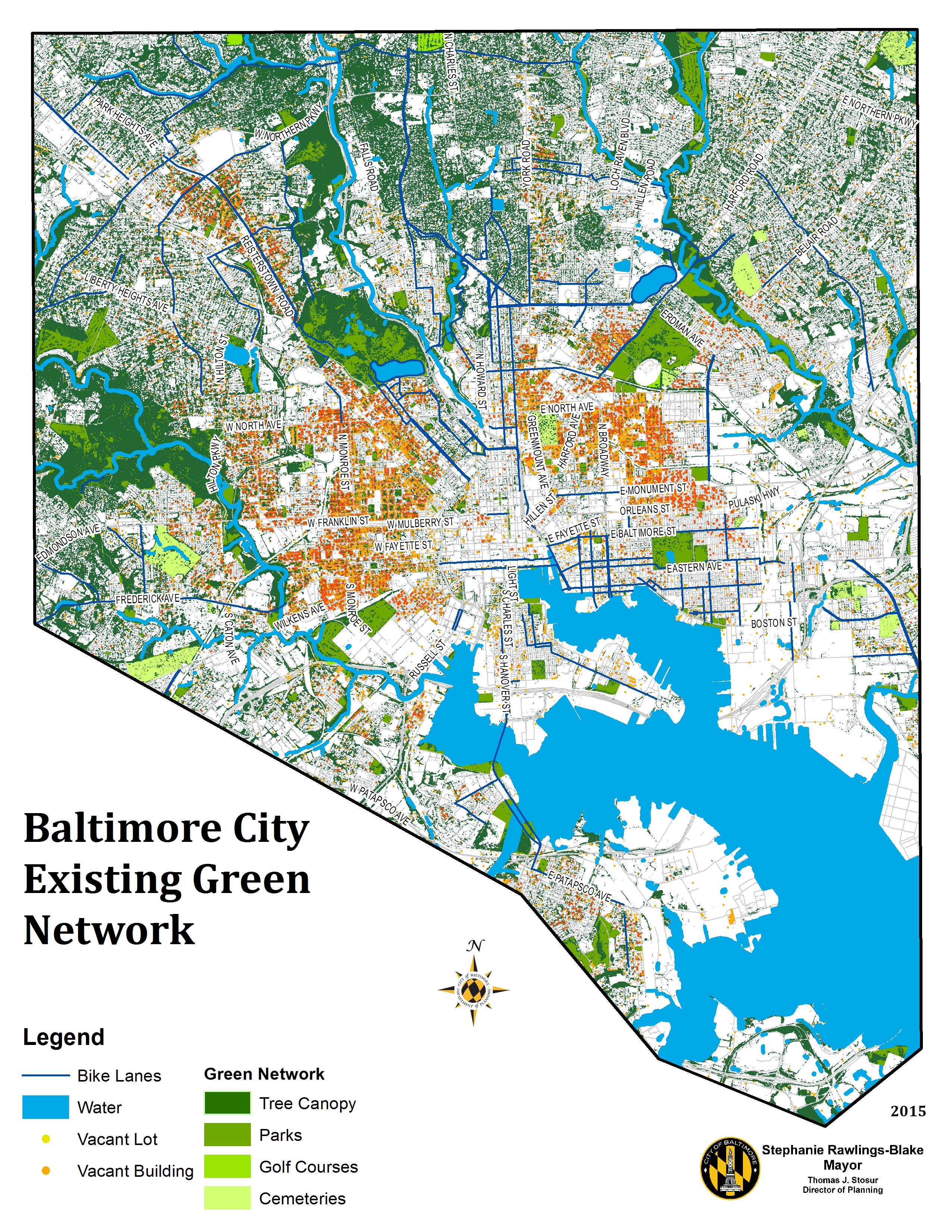
Green network or backdoor for demolition?

The value of green spaces is widely recognized. Lately a study even claimed that well maintained green spaces can help reduce crime. Green spaces improve stormwater runoff, recharge groundwater, filter the air, provide space for healthy outdoor activity, provide opportunity to observe nature, can serve as an urban garden for food production, can provide shade, reduce the urban heat island effect, provide a calm respite from urban bustle and increase property values. They can also be aesthetically pleasing. What else could one wish for?
 Green Network poster: Kickoff this week

No wonder then, that the idea of tearing old dilapidated houses down in order to create green space is popular from the Governor to the Housing Department and from landscape architects to local residents. As the City Paper's Michael Farley puts it in a scathing comment column this week:
The truth is, Baltimore is overjoyed at the prospect of getting more nothing, and by god our elected officials will fight tooth and nail to get the full $700 million of it. Most community groups are probably overjoyed at the prospect of demolishing "eyesore" historic buildings and replacing them with gorgeous vacant lots. "Amber waves of grain," or something. Nothing is Baltimore's largest export and our biggest import.
It may surprise those who associate West Baltimore with barren concrete, asphalt and abandonment (following the rule that that the higher the property values, the higher the amount of green space or the leafier the neighborhoods the higher the property values), that Sandtown Winchester and many other poor communities are actually dotted with a large number of open spaces. Those spaces range from small community gardens to urban farms and from neatly tended community lots to weedy demolition sites. True, no matter how many of those green patches there are, or how well tended they are, they never add up to what makes Roland Park or Guilford so exquisite.
Open space after demolition: Community clean up

The reason is that they weren't planned with vistas and termination of view corridors in mind. They are not complementary to the buildings or elegant ways of transitioning higher and lower terrain. Thery don't line grand boulevards and they do not form recreational pathways. They are just empty lots, even if they have shrubs on them, a bench and some fancy placque. They are lots of opportunity, created in reaction to building blight not based on need or any logic that is based on urban landscape architecture. These many sites are just a wild patchwork of empty lots, far from amounting to an open spaces system or network.

The City of Baltimore wants to change that with the Green Network Plan, an effort that kicked off last night with a public meeting.
The Department of Planning is working in partnership with residents, other City agencies, nonprofit organizations and other interested entities. A highly qualified consultant team led by Biohabitats is assisting the Plan development process, using real estate data, computer mapping and environmental planning techniques. To gather public input about the needs and opportunities in target neighborhoods, Planning staff and the consultant team will conduct a series of public meetings and fully engage communities in the process.
Green corners with exposed mural adorned fire-walls are not the result of
urban design
While these objectives are laudable, caution is advisable. The green plan could just be the Trojan Horse that hides the unbridled desire to unleash a huge demolition derby fueled by the Gov's new funds. Demolition that could much more likely destroy heritage, community identity, often beautiful architecture and the potential to re-achieve the cohesion that communities need to have to once again become successful than form an open space network.

On the other hand, if done right, a really strategically developed green space network put together with green infrastructure around watersheds, recreational pathways and eco systems could become a powerful tool for healthier and more livable communities and strengthen Baltimore's overall natural sustainability at the same time.
The most likely outcome of wholesale demolition: weed fields

For that to happen the "green network plan" which the City created as the starting point would have to go a long way. From all green spaces and the tree canopies marked equally as simple land use markings a true strategic network plan would have to rank the viability of all areas on the map in terms of social, environmental and economical needs. Community preferences would have to be explored and weighed regarding recreational, ecological or social priorities. For this network plan to be successful, it has to be strategic and use criteria of green infrastructure as the starting point, not the coincidental occurrence of blight. The potential value of sites in a network can be environmental (watershed, stormwater cleaning, forestation, plant and animal habitats etc.), it can be recreational (playgrounds, trails, exercise etc.), social (memorial gardens, meeting places etc.), health or education related (food production, open air classrooms about nature), but rarely can one space be all of it at the same time. Green infrastructure is in that regard comparable to transportation infrastructure where highways, bike trails, bus-ways, passenger rail, freight lines and ferry routes all constitute the mobility network, but rarely are all elements in the same space and never do they come about without a strategic vision about the desired outcome.
No lack of green spaces: Detroit (2013 image)

Baltimore has rich history of trailblazing landscape urbanism going back to the famous Olmstead green masterplan for Baltimore that was never fully completed. It also has a rich history of neighborhoods and opulent architecture. To find the appropriate intersection between those two is a tall task.


Klaus Philipsen, FAIA

City Paper 6/15/16 Charm City Demolition Derby

Wednesday, June 15, 2016

The Architect in the Community- Fred Scharmen: Invest outside the White L!

Fred Scharmen, a Yale educated architect, co-founder of the Baltimore D-center, previously a project designer with Ziger Snead Architects, is now a tenure track professor at Morgan University and runs his own design consulting firm named Working Group on Adaptive Systems. Fred is also a blogger on the site 765. He organized for years the D center's Design Conversations and has curated the Baltimore Modernism Project and published a catalog of the exhibit.
Fred Scharmen, City Paper 2015
In an article of the City Paper he observed in January 2015:
So much of our identity and loyalty is tied to our tiny neighborhoods, and our tight travel patterns between them, we hardly even leave our own familiar blocks, much less the city itself....As we all do more exploring within our city, let’s not let our preconceived notions about crime, race, and class prevent us from seeing what’s actually going on in a place. (Fred Scharmen, City Paper January 6,2015)
He is an astute observer of Baltimore who doesn't shy away from comment and intervention as an activist in the community. As I reported in yesterday's article, Scharmen recently wrote a letter Baltimore City Council members to urge them to withhold money from the budget that is dedicated for the demolition of the McKeldin Fountain.

Here the interview:
Fred Scharmen

At what age did you decide to become an architect?
Very early. My dad has been a carpenter and contractor all of his life, so I was on jobsites and looking through old industry magazines like Progressive Architecture all of the time. There were two things I realized before high school: that I liked to draw more than I liked to do construction work, and that buildings didn’t have to all look alike!
What was the main reason you picked architecture as your profession?
I knew I wanted to keep studying art, drawing, and space, architecture seemed to be the best way to do this. I’m lucky that I’ve been able to keep working with artists in my practice now.
What do you consider as your (or your firm’s) best project? Give one reason why? (Please attach one photo of the project)
Scharmen project: Green outdoor living room
We made an outdoor green living room on top of a rebuilt garage in Fells Point. The client is an illustrator who works from home, and she’s able to walk right out of her studio into this space. The material and tectonics contribute to a lightweight, airy spatial quality, and every surface acts like a filter, mediating light, views, and rainwater.
What is your favorite work of architecture worldwide? Give one reason why. 
The Halley VI Research Station by Hugh Broughton Architects and AECOM, on the Brunt Ice Shelf in Antarctica, it’s a modular structure on legs that can be reconfigured and moved as snow builds up and the ice shifts. Nothing is stable in this environment, and the project adapts some old futuristic ideas from the 1960s to respond to this.
Scharmen favorite: Halley VI station, Antarctica
How would you describe the state of built architecture in Baltimore based on what has been built in the last 30 years. 
There’s a sense that anything is better than nothing, and corresponding devaluation of critique and dialogue about what should be built and why.
Halley VI close up
Which is your favorite neighborhood in Baltimore?
I am fascinated by Harlem Park, it is a neighborhood with very serious problems, and very interesting structure and texture.
What single piece of advice would you give the new Mayor regarding Baltimore’s built environment?
I’m pleased that the Democratic nominee is someone who has an interest in design, both as an educational tool, and as a means of adding value to the city. I hope that any new Mayor we have can keep those principles at the forefront of their thinking about the city.
What do you see as Baltimore’s biggest problem. Name one idea how to overcome it.
Baltimore has a lot to answer for with regard to its legacy of using the built environment to segregate and discriminate against its black residents. This city was an innovator in using the real estate industry and urban design to create and maintain inequality. The city needs to focus on and incentivize investment in areas outside the “White L” centered on Charles St. and along the water. Transportation would be a good start, there are few easy ways to go east/west in this city. How about a cross-town circulator, if we’re not going to get the Red Line?
What would you like to be remembered for?
Hopefully, as someone who was at least an okay educator! I’ve been lucky to have the opportunity to engage with teaching at Morgan State’s School of Architecture and Planning, and along with service and research, that’s become a cornerstone of practice for me.
One final comment of your own choice.
To anyone out there reading this – get in touch if you’d like to be on one of the juries for my first-year design studios!

Klaus Philipsen, FAIA

Updated to correct employment status at Morgan to tenure track professor. 

Tuesday, June 14, 2016

Innovation Village chair Richard May: "As if the Ravens played with only three players"


In yesterday's post I described how radio interviews and a presentation of the Innovation Village concept at the Wind-Up Space had left me with many questions about what Innovation Village really is and how it is supposed to operate. Richard May is the chairman of Innovation Village and I was told to speak with him to get a much better explanation. Below my account and the interview:

Richard May doesn't show up at the appointed time, his phone voice mail box is full when I try to call him. I wonder about innovation, His assistant tracks him down and soon we sit across the small round conference table in the One Baltimore office, fully engaged in the perennial discussion what Baltimore needs to succeed.
Chairman Richard May

May had just returned from a trip to Saint Louis and its Cortex Innovation District.  The success of the St Louis district has impressed him, "half the size of Baltimore, twice the development", he reported referring to the development in the innovation district there. The half hour interview turned into a two hour conversation during which I became more and more convinced that the Innovation Village is not just fluff. May proved very well informed about innovation districts around the country and the world. He has the ability to see Baltimore from the outside and within.

He doesn't preach but conveys an aura of practical competence with the tendency of slipping into tech jargon. But he concedes that Innovation Village really isn't (only) about tech. He said that "the ingredients of a vibrant [innovation] eco system are talent finding capital and capital finding talent". Ostensibly that is the mission, but there is a strong emphasis on implementation and actual transactions.

The biggest difference to past efforts like the Empowerment zones is maybe, that this isn't a government driven effort. This is not a poverty program but an effort to bring entrepreneurship to a disenfranchised community. The response so far has been very promising and integrated the start-up community in ways it hadn't been before.
Start-Up Soiree: Fostering entrepreneurship

Innovation Village is not funded by a federal, state or local program, even though tapping into public grants and programs is certainly intended. Possibly May's strongest asset: He does not stay siloed in West Baltimore. There are monthly open community meetings that allow the effort to steadily strengthen and broaden its foundation within the community, but May doesn't shy away from speaking with Damien Coste of Under Armour about venture capital or assertively with Commerce Secretary Mike Gill from the Hogan administration about State programs. ("I can lay out the playbook for you"). Sometimes people ask him, "why do you talk with those [white] folks?" he muses. But that is part of the pragmatism that makes me believe that Innovation Village can, indeed, succeed.

Here the excerpts of the conversation:

Talk a bit about yourself. Where did you grow up, what did you do, how did you come to Baltimore?
I was born in the New York metro area and grew up in Baltimore area since I was 4 years old, my father's father had a big grocery chain in Philly. I also lived in Philly. my father studied microbiology and chemistry with Masters in both.. in the fifties..around the Brown decision..when he retired he started a transportation company, moving stuff I studied with two full scholarships at the University of Maryland..they had a study abroad program, at the time you couldn't go to East Africa..but I had some connections..and went to East Africa travelling to several countries there. I wound up with a sociology degree. Then worked for a large consulting firm on advanced technology transfer..am on a sabbatical right now to get the Innovation Village going.
You announced the Innovation Village in January, what has happened since then?
We were focused on getting the community engaged in the planning process and the programming side. The programming is about capital, real estate and talent, bringing those together. We identified the first development projects...We are close to closing on two buildings, one for the first innovation center. We asked "do you like where you live?"; everybody raised their hands. There are so many wonderful assets but also so many deficiencies. We've also organized a Global Air Media Drone Camp for kids  at Penn North Kids Safe Zone during Spring Break. Also  hosted three city-wide business startup networking events (at historic Arch Social Club, Shake & Bake, Columbus Center), Light City programs (including Kindling events in our Innovation Village's historic neighborhoods), a global business bootcamp sponsored by Conscious Venture Lab, and partnering with a host of incredible organizations in our historic neighborhoods.
The Entrepreneurship networking event at Arch Social Club. you mentionedHow did it go? Was there any follow up?
that was an overwhelming success. 300 people showed up.... it was the first Wednesday after the snowstorm..at the Arch Social Club, such as special space...many didn't know we had such a thing...it was diverse in every dimension...simply meeting people became transactional......the Start-Up Soirees carried this on, it led to the Soiree at Light City Baltimore with 500 people.. Moms As Entrepreneurs launched their first academy and had their first class of moms graduating with their pitch competition where we were a judge. They're awesome
Many community leaders in central West Baltimore were taken aback by the announcement that their communities are now an Innovation Village. Did you get their support now? How did you respond to their concern that they hadn't been informed first?
Dovecote Cafe Reservoir Hill: A place to meet
There were a couple of challenges...there is a lot of distrust in West Baltimore...but people now see the shared benefits..there is testimony from Start Up Soiree participants who said this has benefited them already...We did the drone camp with the Children Safe Zone...we focus on access and activation. Innovation is creativity plus delivery...There are talented committed people, it is a matter how resources are directed.. We're committed to helping all the great organizations on the ground who've been doing great work for years in these neighborhoods. We all need to help build capacity and not duplicate efforts. The needs are great and we're all stronger together.
In one of the interviews you mention the University City in West Philly as a model. What has University City achieved that you would want to emulate?
I wouldn't use University City as an example for economic inclusion. 
The jury is still out on an example. Presently there is no example where economic development did not result in displacement of black and brown populations. Innovation Village was resident sponsored, community driven economic framework that attracted multi-sector partners.  We live in these neighborhoods, have family throughout these neighborhoods, so it's about our home rather than emulating some other place.
You name Coppin University as one of the strong anchors. Coppin itself needs help, though. It has the lowest graduation rate in the country and sinking student enrollment, leadership problems and new science buildings for which it has no staff or students. Coppin's past attempts of providing services to the community have very mixed results. 
Coppin has incredible new assets and is in an important anchor in Innovation Village and is an historical institution serving the black community. When you have decades of disinvestment as in West Baltimore, all have capacity issues. Most of our universities have capacity issuesThis is a capacity issue. There could still be spillover benefits for everybody. Baltimore is very siloed. [The Innovation Village] is the first time in history such a broad coalition was achieved. The industry and university partnership is a challenge, still. St. Louis is much further along with that.
Your approach builds on entrepreneurship and is essentially the neo-liberal idea of people pulling themselves up on their own bootstraps. what do you call "conscious capitalism?"
Underground economy: Hacking, an early form of Uber
We want to be economically inclusive. Its about who is involved. There is nothing wrong with profit, but we want conscious companies, there must be some purpose other than profit.
How will you integrate the existing underground economy that exists in West Baltimore?
When you travel around the world, what people know about Baltimore is its underground music, its underground art, there is an eco system to be tapped into. I went to St. Louis and Ferguson. I saw what they did with Ferguson 1000 since the unrest. It is phenomenal. In Baltimore the perception is that we usually don't support the majority of the population. Seven out of 10 self identify as a person of color - the City is 64% black. We have to ask, does government and philanthropy always work for the benefit of all? I like to say, it is like as if the Ravens would play with only three players. To be competitive we can't leave 70% on the sidelines. We have to build more structure around the existing talent in underground economies, create businesses that create sustainable jobs.
Thank you for the conversation 

Klaus Philipsen, FAIA
Underground art, Baltimore

Links:
Innovation Village Pitch Competition Tuesday June 7, 2016

"It became very clear that the creative class and innovation economy was really our core competency here in this part of the city and what could really generate the biggest outcome for our future," Dale Terrill,vice president of the board of the Mount Royal Community Development Corporation (MRCDC)

University City, West Philly
University City District is a partnership of world-renowned anchor institutions, small businesses and residents that creates opportunity, and improves economic vitality and quality of life in the University City area of West Philadelphia. Our primary mission is community revitalization. We work within a place-based, data-driven framework to invest in world-class public spaces, address crime and public safety, bring life to commercial corridors, connect low-income residents to careers, and promote job growth and innovation.

Monday, June 13, 2016

Staying the course; The KcKeldin fountain folly continues

According to an article in the BBJ, the fact that the McKeldin Fountain had been successfully integrated into Light City Baltimore and that it is just this very minute happily cascading water over its concrete cliffs doesn't mean that the Downtown Partnership or the businesses funding its removal had an epiphany.
McKeldin Fountain this afternoon

Instead, they are still full bore on their path towards demolition, no matter that there is no completed or accepted design for what would replace the fountain, let alone a resolution on the question if the original idea of closing the 5 traffic lanes diverting traffic from light to Calvert Street could be eliminated and the McKeldin Plaza successfully hooked to the HarborPlace territory. Needless to say, cost or funding for the complete project isn't available either.

As Morgan Professor and architect Fred Scharmen wrote in a letter to the City Council budget committee:
City of Baltimore Council Bill 16-0663, an Ordinance of Estimates for the Fiscal Year ending June 30, 2017... includes a line item, 607-001, appropriating $500,000 to the Downtown Partnership of Baltimore for work at McKeldin Plaza.
These funds will be used by Downtown Partnership to further efforts to remove the historic and architecturally significant Fountain at McKeldin Plaza. The effort to remove and replace this landmark has not been approved by the Baltimore City Planning Department’s Urban Design and Architectural Review Panel, which has oversight over actions that affect architecture in Baltimore, it has not been approved by the Baltimore Public Art Commission, which has authority over Baltimore’s collection of public art, including the Fountain, it has not been approved by the Waterfront Partnership of Baltimore, the organization charged with overseeing assets at Baltimore’s Inner Harbor. 
This effort is part of a masterplan endorsed by Downtown Partnership, that has not been adopted by the City Planning Department. This is being advanced in order to make changes to the downtown traffic pattern that have not been approved by the Baltimore City Department of Transportation. There are no funds allocated for the traffic reorientation, there are no funds allocated for the masterplan as a whole, and there are no funds allocated for the replacement of the Fountain, which, if it were to be removed, would leave behind a hole in the city fabric right at the entrance to Baltimore’s heart. This is not the highest and best use of City time, energy, and money.
The new zoning code prohibits the demolition of buildings before a replacement is designed, approved and funded. It isn't clear why that logic shouldn't apply here, too. What could possibly be worse than a half-baked underfunded provisional open space? Those who contend that even such a provisional condition would be better than the current fountain have either "I hate concrete" blinders on or a narrow private business interest.

The current fountain has the heft and scale to holds its own in a sea of traffic. The cascading water provides a sound that neutralizes the traffic noise to some extent; the steps, bridges and structures make it a walkable big sculpture and offer many surprise views,  The illumination at Light City Baltimore showed how easy it would be to spruce the fountain up, especially at night. No doubt, a better design is possible, except it hasn't see the light of day, yet. McKeldin Fountain in its current form is an important public space and its disposition should not be left to private entities, no matter how laudable many initiatives of DPoB are or have been.

That the fountain leaks or is often not turned on are not good reasons for demolition but lame excuses for poor maintenance and upkeep. Spending missions on the demolition of this original  artifact of the important Inner Harbor renewal always was and remains another folly in the long line of demolition follies this city has committed before. Except, this one could still be prevented.

All that is needed is that the City Council withholds the City funds allocated in the proposed coming budget, a budget that the council threatened already not to pass because of the lack of recreation money. It could be one of the bold moves that this outgoing council could still engage in.

Klaus Philipsen, FAIA

Sunday, June 12, 2016

On my way towards understanding the idea of the West Baltimore Innovation Village

Innovation Districts are sprouting in almost all major US cities and it would easy to brush them off as yet another fad in the never ending list of ideas on how to kick-start the US city again which, although buoyed by Millennials flocking to cities, is still in a precarious state as a result of decades of anti-urban federal policies and the rapid de-industrialization of America.
Innovation Village Baltimore

So when in in January of this year at the morning of the Martin Luther King holiday a group announced the West Baltimore Innovation Village the announcement caused interest mostly because anything that dealt with West Baltimore  in the wake of the Aril 2015 unrest caused a stir. Governor Hogan announcing extra money for demolition in West Baltimore was better understood by many Marylanders than how, of all places, West Baltimore should be a center of innovation. After a while the media returned to legal proceedings around the case against the police officers that had arrested Freddie Gray with nary any further mention of the Innovation Village.
Mayor Stephanie Rawlings Blake at the Innovation Village announcement
in January: Not a government initiative (SUN photo)

When finally a conversation about the Innovation Village  had been set up at the Windup space, the discussion left more questions open than it answered. There was a lot of rather lofty talk such as that the Innovation District would align the assets and bring collaboration. That it would be looking for public and private sources of funding, that just getting to know each other, was building trust. The potential central West Baltimore has, "the assets are amazing. This isn't about housing, it is about jobs and economic development." The presenters explained that 50% of the jobs we see today won't be there by the mid 2030s but it wasn't clear how that knowledge would help. The presenters said they would want to act as an activator and that the framework for people to plug into was missing. That the mindset needed to be changed and so forth.  One coulkd say that the problems were described, but how change would come was much less clear. Delegate Mary Washington, who attended the presentation at the WindupSpace, told me that Richard May had given a presentation to the legislators and he did a real good job explaining the Innovation Village.

Armed with a set of critical questions I set off to to ask Richard May myself, exclusively for the Community Architect Daily, as it were. Richard May is invariably described as the guy who is leading the effort of the Innovation Village, even if its precise organizational structure  remains shrouded in some degree of mystery. The Village's "fiduciary agent" is the Reservoir Hill Community Development Corporation. Some of its business is apparently conducted out of Michael Cryor's One Baltimore office, located in A&R's Symphony Center. At least that is where my appointment took place. This struck me as a really odd place for anything about innovation, because Symphony Center, although billed as transit oriented development, is not very innovative at all. Its architecture is banal and way too much space is devoted to parking.
Richard May speaks at the announcement in January (SUN photo)

But Tony Rodgers who runs A&R is a minority developer in the footsteps of his father, Theo Rodgers who had, together with Otis Warren, put one of the first new developments on Howard Street as far back as 1990 (when the team was selected). The 430,000 sqft Crescent Federal office building had been innovative and in that it was minority driven, large and happening on the Westside where not much happened at all. For the Innovation Village to seek ties to a proven African American developer makes good sense, after all, the approach to the Innovation Village being not one of the many previously failed government program (remember the Empowerment Villages?) but a business driven approach of inclusion.

Tony Rodgers of A&R consequently had been a member of a temporary steering committee giving the Innovation Village initial guidance. The One Baltimore office space is the last door in a narrow dead end corridor next to the emergency stair and an electric closet. If everything goes by plan, a more suitable accommodation will soon be announced as the first development opportunity that the Innovation Village will make public shortly as the home of the first innovation center.

I will publish the interview and conversation in tomorrow's blogpost. Stay tuned and find out how the two hour discussion with Richard May turned me from a skeptic to a believer in the concept.

Klaus Philipsen, FAIA

Sun article about the creation of the Innovation Village

Constituting organizations collaborating on the Innovation Village:

ANCHOR INSTITUTIONS

Mount Royal Community Development Corporation (MRCDC)  
Maryland Institute College of Art (MICA) 
Betamore
Coppin State University 
Harbor Bank 
Startup Soirée 
Baltimore City Community College (BCCC)
Maryland Department of Commerce
TEDCO
Greater Baltimore Economic Alliance
One Baltimore
Emerging Technology Centers 

COMMUNITY BASED ORGANIZATIONS

Baltimore Corps
Center for Urban Families
Coppin Heights CDC
Friends of Druid Hill Park
Greater Mondawmin Coordinating Council
Harbor Bank CDC
Madison Park Neighborhood Association
Marble Hill Neighborhood Association
Maryland Food System Map
Mount Royal Improvement Association
Multicultural Prayer Movement
Penn North Resource Center
Penn North Neighborhood Association
Penn North Kids Safe Zone
Reservoir Hill
Rowdy Orbit Impact
St. Francis Neighborhood Center
Union Baptist Church

COMPANIES

Avenue Bakery
Bithgroup Energy
Carbon Fibre Media
Cornerstone Capital
Conscious Venture Lab
Dovecote Café
Emerging Technology Center (ETC)
Global Air Media
Good News Baltimore
Horsetail Technologies
LTN Global
Pixilated
Startup Maryland
Six Point Pictures
The Startup Nest
Yet Analytics