Friday, November 11, 2016

Driving and parking dominate UA campus design review

A massive 1500 car 800' long and over 100' tall parking garage designed by Bohlin Cywinski Jackson raised concerns with UDARP members reviewing the first massing concepts for Under Armour's new headquarters campus on Thursday. So did the fact that the part of the perimeter park along the waterfront that falls into the section of the headquarters couldn't be reached by car once the company campus has been fully built out.

Masterplan with company campus bottom right,  Brian E. Miller, 
Director of Corporate Real Estate, Under Armour presenting to ULI 

Thus the debate about Port Covington has come down to what is a subject of concern in almost anything that is discussed in Baltimore, transportation and especially cars and parking. It is time to shift the focus. Sagamore made a good start. Their proposed masterplan includes enlightened aspects of sustainability and through the community benefits agreements also of inclusion and equity. On transportation the design team established the objective of a 50% "mode split", meaning 50% of all travel would be by means other than a car. However, it isn't quite clear if that meant circulation inside the planning area or also to the Port Covington Development. Marc Weller, president of Plank's private real estate firm, Sagamore Development pointed out that Baltimore would need a lot better transit for a less car dependent development. An application for federal funding for a light rail spur onto the Port Covington area didn't make the cut in the last round. It is unclear whether the chances of success in the coming round will be any better given the new winds in Washington.
 
Company campus in full build out as seen from the water (Sagamore Development)
Progressive transportation options are essential for the Sagamore plans to succeed. Better options than building giant parking garages should be possible, given that a transportation revolution based on semi and fully automated cars, trucks and buses is just around the corner. A development that is laid out for a 45 year term must not only anticipate but shape this revolution.

What could be done in Port Covington?
Phase 1 headquarter campus: Courtesy: Under Armour
The proposed 250 acre urban masterplan and the corporate headquarters on about a fifth of the area can become beacons and precedents for America's urban transportation just as Under Armour's Lighthouse is intended as a beacon for manufacturing. Port Covington could be a small city without individually operated combustion-engine cars. Sounds fanciful? Such a car-free small city already exists for some years outside Freiburg Germany. Port Covington allowing only semi and fully autonomous electric vehicles inside its HQ campus (and later the entire area) could save enormous amounts of money from not building structured parking and reduced capacity on all those streets. Instead the development could aim for so called "naked streets" which rely on a full and safe co-mingling of walkers, bicyclists and vehicles on shared spaces. These type streets are no pipe-dream either, they existed in some places in Europe and in some downtown applications even before AVs were introduced or discussed as an option and have shown to be safer than streets with designated lanes, curbs and barriers.

Olli "proof of concept" AV mini-bus (Local Motors)
Given that AVs are not widely used at this point and UA needs to begin construction next year, how is the AV supposed to help now? 

Certainly, temporary solutions and a soft transition are needed. Given that UA controls over 200 acres and that phase 1 of construction plans for about 1500 workers (in addition to those about 300-500 that are already working at the converted Sams Club or could be placed there), there is plenty of space to park vehicles outside the campus on the periphery of the Port Covington planning area, preferably right at the I-95 ramps where traffic would come in.

Self-driving electric van shuttles are tested for service in Helsinki, in the US Local Motors has produced several prototypes with the hope that they be tested here. Just in the same manner as UA and Sagamore Industries stepped far out and not only bought the water taxi company, but commissioned an all-new vessel, land-side traffic needs the same kind of innovative thinking. Autonomous electric shuttles would find an ideal running circuit in Port Covington, provided the roads there are generally closed to traditional vehicles. AV buses would be an instantaneous branding success for a brand that thrives on challenge. The concept would attract creatives globally by showing that Baltimore is not only a place where new things being reserached and talked about but where they are in actual service. 

Port Covington would teach Baltimore in a real world setting on how to deal and manage AVs so the policies and experiences could eventually be expanded to all of downtown. Experts expect fleet based AV transportation operating like the Uber Pool service to free up to 30% of urban space either for development or parks and plazas for people rather than cars. This very desirable future would be a leap forward in urban quality of life. But it won't come by itself. It needs risk taking, initiative and experiment, all qualities fully embraced by Kevin Plank in everything else he does. 

With the new Mayor and administration coming into office, Baltimore has a unique opportunity to ramp up its urban transportation policies. Approaching transportation in Port Covington in a daring way not only by water but also on land would set a new standard that hopefully will be followed by a much more efficiently operating MTA bus network in June 2017 and a revamped Charm City Circulator as well.

In the next session of UDARP the garage should be replaced with a staging area for AV's, demand based transit and storage for shared vehicles such as ZipCar and Uber Pool and a state of the art bike facility. Such a facility would be so innovative and so much smaller that UDARP wouldn't fear its urban design impact any longer. And the notion that something isn't a park if one can't drive to it, forget that. 

Klaus Philipsen, FAIA

BBJ article about UA campus plan UDARP review
Baltimore SUN article


Thursday, November 10, 2016

The case for hand counted paper ballots

In light of the shocking outcome of the federal election it seems frivolous to talk about the method in which ballots are cast, yet, in search of something lighter than the consequences of our general election, here it goes:
lines at the scanner (SUN photo)

After years of touch-screen voting, Maryland  voting was once again conducted by paper ballots. But the State didn't renounce finicky electronics altogether:  At the end of voting the paper ballots had to be fed into a scanner that also acted as the ballot box.  This last step also turned out to be the slowest element in the procedure of checking incoming voters, handing out the ballots and actually filling the ballots by hand. The only automated element the voter came in contact with was also the bottleneck. With usually just one scanner per precinct, this was the achilles heel, the most vulnerable part. Failure would bring a whole precinct to a halt until a replacement was installed. The scanner, scanning both sides of an odd shaped piece of paper at the same time, is also a fairly specialized piece of electronics, not something one can buy at Best Buys.
Emptying the ballot box in Germany

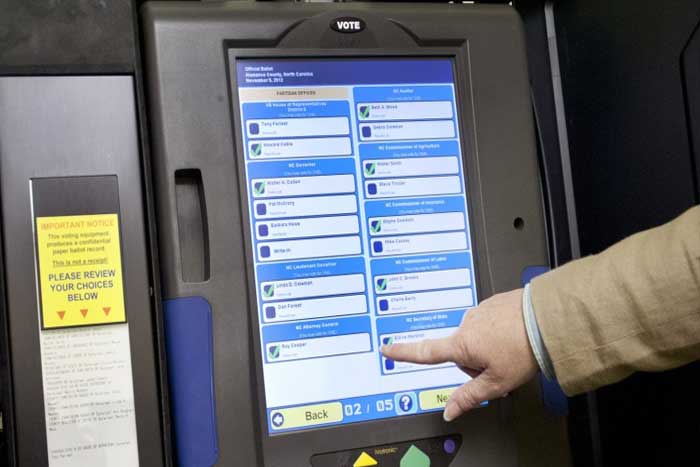
When I lived in Germany I was selected as a election judge for almost all elections during my adult time there. Based on  that experience and my years of voting in the US with various types of machines, I have concluded that voting is one of the very few cases were the past can really be a guide for the future. I.e. the low-tech paper ballot marked with a pencil and deposited in a simple ballot box persistently outperforms any mechanized or electronic contraption supposedly in place to aid voter access or increase reliability or speed. Punch cards ("hanging chads", touch screens (no paper trail) and scanners (lost thumb drives) all had hick-ups large enough to question their utility. And that is even before one factors in cost.
electronic touch screen voting: safe?

The expenditure for voting machines is significant and the money sits around as dead capital 99% of the time, even if the machines would work perfectly. Given the speed in which anything electronic is out of date, the investment is even more questionable.

Countries that vote and count by hand almost always out-perform countries using mechanized and electronic machines in terms of election judge training and efficiency, opening and closing on time and having an overall flawless process. Surprisingly, hand-counting outperforms electronic tallying as well. The reason? Hard to tell. In spite of the result being instantaneous after retrieving a memory stick from a scanner and sticking it into a computer, precinct reporting in Baltimore City took hours in the last Primary and General Election. As we know, various issues even brought about a decertification in the primaries.

By contrast, when I counted ballots by hand, we usually telephoned in the results withing 20-40 minutes after turning the ballot box over. And sometimes we had complicated local election ballots with 60 or more candidates in which cumulative voting was allowed. The precinct results, though, were fed into a computer by information crunching companies that tried to predict the results based on statistically relevant samples. The relevant sample precincts were informed ahead so they would count fast and call in fast. A more precise second count tallying the official number would follow. In this manner overall election results with just 1-2% margin of error were provided to the public withing one hour after the precincts closed, even in the seventies far faster than most jurisdictions in this past election when results trickle in straight up with no regard for their statistical relevance.
returning with the ballots

Checking in: Searching the electronic records

My appointment as election judge was like for jury duty, it wasn't entirely clear how the selection was made, but once on the list, it was hard to get off. Like for jury duty, one needs a really good excuse to not show up. Excuses are harder to come by because the German elections are held on Sundays when schools (the most common polling stations) are closed anyway. So elections don't cost too many lost work hours and no lost learning time.

Manual voting and counting is widespread in Europe and across the world to this day. Many countries in Europe experimented with various types of electronic voting machines on a limited test base only to reject the method at the end, mostly due concerns about hacking, privacy and potential for fraud.

I think it is time for the States in the US to consider the simplest way to have a voting process free of hick-ups. Hand counted paper ballots is just the right ticket. Low cost, low maintenance, low training, fool-proof and repeatable on demand. It beats everything else on all counts. Maybe one day when Internet voting is safe and one can use common daily devices like a smart phone, the use of electronics will make sense. In the meantime, buying voting machines of any kind  seems like a waste of money.

Klaus Philipsen, FAIA
paper ballot: fool proof, time tested

Wednesday, November 9, 2016

A new chapter for Baltimore

With Catherine Pugh as Mayor Baltimore will enter a new chapter. In a city that has seen its first elected African American Mayor in Kurt Schmoke in 1987 and its first female African American Mayor with Sheila Dixon in 2007, neither a female Mayor nor an African American is any longer a novelty. We are much further than the nation in this respect.
Catherine Pugh at today's transition team
press conference (Photo: Philipsen)

Pugh and Schmoke (same age) both draw far across racial and gender lines through intelligence, ideas and a firm grasp on urban issues. However, Schmoke eventually turned out to be rather bookish and sluggish in turning his ideas into reality. Pugh, by contrast, is known for tenacity and the perseverance of the Marathon runner that she is. Goal oriented and in for the long haul. She achieved a remarkable list of things as a member of city council, from bringing the Marathon to Baltimore to having the first brand-new City school to Baltimore which didn't cost the City a dollar to build.

As a Senator her list of bills was always a mile long and she hardly lost any of those she sponsored. Pugh doesn't tolerate excuses, she can be tough even with those close to her when she senses that people get off track or slack off. She gets along equally well with university presidents like former MICA President Fred Lazarus, with her constituents in the 40th District, with her neighbors in Ashburton and Congressman Elijah Cummings. Her allegiance to Baltimore is second to none, even though she was not born here and is quite familiar with what is going on in other cities. She doesn't believe that she knows it all and surrounds herself with advisers who can provide information as well as supporters who can provide the funds needed for a campaign in modern America. After the primary Pugh sought advice from the urban experts of Hopkins' Bloomberg School of Government, clearly a think tank familiar with best urban policies and practices  around the world.

Members of the new Pugh administration can't expect that she will give them slack. She expects them to live in the City and she will expect from  them nothing less than she gives in her own relentless pursuit of a goal until it has been accomplished.
Pugh and some members of her transition team (Photo: Philipsen)

The fact that Pugh reaches out to the rich and powerful, including Republicans, has been seen by several as something to hold against her. Sheila Dixon tried to harvest in that populist furrow and so did her formidable opponent and green candidate Joshua Harris. Hopefully Harris can use his skills in achieving the emerging agenda in some capacity.

Her ability to reach out across party, class and racial lines will prove to be a great asset in the new world in which Republicans control the House, the Senate, the presidency and the Governor's Mansion.

Cities will be harder to run under Trump as President, no doubt. At the same time their role as safe harbors for the other America will increase. Now more than ever it will be left to cities to deal with global warming, climate adaptation, refugees and with the health and education issues of its citizens. Baltimore is currently humming with investment and is well embedded in the national economic recovery.

The last time when investment and growth seemed to have finally come to the shores of  Charm City was in 2007 when the financial crisis and the big recession beat the City back, most noticeable with a flood of foreclosures which are destroying community wealth to this day. Meanwhile Baltimore in the wake of the unrest of April 2015 had to find its own ways of including those who were disenfranchised and neglected for too long. One can only hope that the Trump presidency will not shock the economy into another recession.

For the first time ever the powerful players in town have realized that their interests are at stake when enrollments plunged and investors became gun-shy after the unrest. Countless initiatives have since sprung up, many with funding and support of institutions, corporations and non-profits, initiatives that for the first time don't simply provide hand-outs or job-training so the unemployed can find menial low paying jobs outside their communities enriching others but build actual capacity inside poor communities. Sarah's Hope is just one example.
Vincent de Paul center Sarah's Hope, a symbol of a public private partnership
Weinberg, Under Armour, State and City. (Photo: Philipsen)
In her victory speech after the election last night Pugh mentioned Sandtown, Park Heights and the homeless. Her press conference this morning took place at Sarah's Hope in the center of Sandtown across from the Western Police Station.

There she announced her transit team which includes a selection of people from all walks of life with roots in Baltimore. A Healthy Neighborhoods Committee will be chaired by Ellen Janes, Transportation by Don Halligan. other committees include Education and Youth, Public Safety and Economic and Employment Development.

There will also be a agency review committee especially for permitting, sanitation and BDC and a PughforBaltimore.com website for public input. "We want to be open and transparent" Pugh emphasized. "Baltimore is a City of great opportunity, Pugh said, what happened in Federal Hill and Hampden we also want to see in Pigtown and Ashburton".

Asked if the Trump presidency would constitute and obstacle for getting aid from Washington, she responded: "no, I will be able with this [congressional] delegation to go to Washington DC and ask to help us for this city of Baltimore to be the best it can be".

Klaus Philipsen, FAIA


Tuesday, November 8, 2016

Tradepoint Atlantic - missing an opportunity?

Good old Sparrows Point is now Tradepoint Atlantic, all 3,100 acres of it, except for a small sliver occupied by a shipyard that is still Sparrows Point or at least not controlled by Tradepoint Atlantic. Its a good thing there is a new name because almost nothing is left of the 125 years of steel-making here. In fact, the area looks like a big bomb had detonated and left only piles of rubble and a few fragments of recognizable things.
Sparrows Point in 2015 (BBJ)

Of course, this isn't how the young, energetic and optimistic sales team of the Tradepoint Atlantic group  sees it which consists of the two investment firms Hilco Global and Redwood Capital. They see the brownfield site that is bigger than Port Covington, Harbor East, Harbor Point, Canton Crossing, the Inner Harbor and the old financial district combined as a wonderful resource to capture some of the logistics market here where land normally is scarce. Logistics is distribution warehouses especially for the growing e-commerce market which is very land hungry with warehouses often reaching the size of a million square feet or 20 football fields. That is how representatives Eric Gilbert, Executive Vice President of Development and Justin Dunn, Director of Engineering & Planning explained their project to a recent tour of developers, investors and professionals organized by ULI,

What Tradepoint Atlantic's representatives radiated in personal energy the masterplan itself lacks in imagination, though.
Masterplan (photo: Philipsen)
Really not a masterplan in a strict sense,  the plan has a marine, a land and a rail component. For land it shows wall-to-wall big-box distribution warehouses, bulk storage, shipping containers and yards, in short,  a paved world erected under the flag of e-commerce that looks quite like warehouses have looked for a long time, just bigger.

One needs to only fly into the major airports in America to see the square-miles of warehouse roofs and truck loading docks that surround airports just like they do seaports. The bricks and mortar side of logistics appears to be a world without creativity or aspiration. It isn't enough to build on one of the most astounding sites on the entire east coast.

Sure, old Sparrows Point will be and probably should be mostly an industrial site, after so much industry and so many jobs left. It has railroad access, deep water access and all. But this is a spectacular piece of real estate with historic buildings, with water on three sides, a large environmental burden and huge potential. Even industrial parks shouldn't ignore some basic principles of planning, design, sustainability and place-making. A few obvious items come to mind:
  • Shouldn't a site that operates under EPA oversight for clean-up and remediation include all kinds of best practice tools for stormwater, groundater, soil recovery and adaptation to rising sea-levels especially on a site that in the past contributed so heavily to the pollution of the Bay?
  • Shouldn't the large roofs of warehouses contribute to stormwater mitigation and run-off improvement, or be used as solar farms to create renewable energy on a scale that can hardly be found elsewhere?
  • Shouldn't a gigantic area of 3,100 acres allow a few hundred acres of public access in the shape of a promenade along the water (except at the shipyard and port area) and a habitat restoration project at the edge that can help mitigate continued pollution seeping out from groundwater and run-off and help clean the Bay?
  • Shouldn't employees of this huge site have amenities beyond a traditional open air shopping center planned for the fringe?
  • Shouldn't a site like this be more than a one-trick-pony betting mostly on e-commerce? Trends towards local production, shrinking global trade and "local for local" production (Under Armour slogan) are already on the horizon. Hasn't the steel history shown that a mono-culture for such a large area creates hazardous economic conditions?
  • Shouldn't an entity that just last week opened a discussion of tax increment financed public support be held to preserving some structures such as the old Bethlehem Steel admin building that is still standing in a park-like setting as a perfect adaptive re-use opportunity?
Historic adminstration building (Photo: Philipsen)

Historic preservation, green design, Bay clean-up, place-making, mixed-use and public access seem to be all anathema to the Tradepoint folks. In that they appear to be operating in the Neanderthal age of planning even though they are talking about the long-haul and the future. That is not to say that the economic benefits of their investments aren't sorely needed, and they could be significant. (see Anirban Basu's economic impact analysis released last week).

The challenge for the Sparrows Point peninsula is nothing less than the design of the industrial park of the future. Tradepoint Atlantic can't simply follow a formula that was developed decades ago. Mixed-use came to the office park. It must also come to the industrial park.

The experience with the office mono culture, best exemplified by the Research Triangle in Raleigh/Durham, a  mono-culture that is now desperately trying to develop some urbanity because nobody wants to work there without it. After revamping office parks, the re-invention of the industrial park is next.

In a world in which work, production, commerce, transportation and logistics change at a rapid pace, it would be a travesty to create a development here that just lines up one warehouse next to the other. One wishes that Under Armour's presence there means that business as usual won't be good enough any longer.

Klaus Philipsen, FAIA

Sage Policy Group: Impact analysis


Sales office: Six containers. Design by Gensler (Photo: Philipsen)

warehouse mono-cultures (Jessup)

Sparrows Point before demolition as seen from Fort Howard (Photo: Philipsen)

post demolition (Photo: Philipsen)

Under Armour: planned distribution center at Tradepoint Atlantic


Monday, November 7, 2016

Water Taxi made in Baltimore

There are quite a few things associated with Under Armour already, from rye whiskey to a hotel in Fells Point, from Port Covington to Sparrows Point and now also Brooklyn, where today the expanding company showcased the object of their latest coup: The acquisition of the Baltimore Water Taxi company, Harbor Boating and the commission of a brand new taxi vessel made right here in Baltimore.

The first new water taxi vessel is already licensed for test rides
(Photo: Philipsen)
The new boat is made by Maritime Applied Physics Corporation (MAPC), a maritime design and manufacturing company located near the South Baltimore neighborhood of Brooklyn. The company is usually engaged in defense contracts and access requires a security check.

The ride down Frankfurst Avenue is a ride down into the fifties when Baltimore was an industrial city with miles of freight tracks, shipping yards and tractor trailers lining a bumpy four lane roadway that eventually closely hugs the Harbor Tunnel through-way.

The boat, by contrast, is modern production emulating history. Tailored after a 1920s Chesapeake bay "dead-ride" crab boat as gleaned from the Chesapeake Bay Maritime Museum the new water taxi vessel, is made entirely from aluminum, is 55' long, 15.5' wide, has twin low emission 38 hp Beta Marine (a subsidiary of Kubota) diesel engines and holds 49 passengers. It is a more robust vessel than the pontoon boats and small vessels that Mike McDaniel had taken over from Ed Kane's widow Cameron who had run the water taxi until 2010 after her husband's death in 2004.
The current pontoon vessels
The new boats have a Chapter T license from the Coast Guard, can go 8 knots and are licensed to go out on the entire Bay. The production of the hull in Brooklyn is an expression of Plank's "local for local" concept which he is also testing for his apparel in his Lighthouse facility.

Maryland's Manufacturing Extension Partnership ("where manufacturers go for solutions") is assisting in the match-making to bring in as many as possible local suppliers for boat components not made by MAPC. The Partnership has already been tested in the build-out of Sagamore's City Garage.
Mark Rice, the President of MAPC says Kevin Plank has had his hands in every aspect of the design and was the one who sent the team first to his farm in Baltimore County to check out local architecture and then to the museum to study the heritage of the Bay and its vessels. He is also responsible for the black hull and the use of the Baltimore flag for branding.
The characteristic stern of the historic dead ride
Chesapeake crab boat (Photo: Philipsen)

Sagamore Ventures is Under Armour's business arm for ventures of everything that's not their core business, can now reach the Middle Branch and the new company headquarters via water. A trip from the new waterfront hotel at the Recreation Pier in Fells Point to the new landings at Port Covington will take about 30 minutes. The initial stop there will be the distillery currently under construction. However, things won't happen instantly.
Nathan Baugher, MAPC Production Manager, Marcus Stephens,
Plank Industries Executive Creative Director and Demian Costa,
Sagamore Ventures LLC explain the new boat
(Photo: Philipsen)

The contract with the City regarding the taxi license is finalized but is still awaiting the City signature after the Board of Estimates approved the award of the water taxi license to McDaniel/Sagamore. The new route system with Canton Crossing and Harbor East as added stops won't begin operation until April 2017. The service to the Middle Branch expected to follow later.

 After Sagamore Ventures decided to buy Harbor Boating they wasted no time and worked with MAPC to craft a 55-foot ADA-compliant, bike-friendly vessel even before the City license was approved.

The new boats are designed to allow hybrid diesel-electric or fully electric propulsion at a later point. The first boat was presented to the public today, the second is under construction and 8 more are planned. By contrast a 2014 federal grant for a $850,000 electric boat provided to the City for the free Harbor Connector shuttle service has still not resulted in an actual boat. According to Demien Costa of Sagamore Ventures, who didn't disclose the actual price, his fleet is below the cost they had expected. The BBJ reports that the actual price per boat is $635,000.
spacey interior for 49 passengers (Photo: Philipsen)
The investment into the taxi isn't a far fetched distraction for Under Armour but part of the strategy of embedding the new Port Covington headquarters into a new town which needs access and mobility in spite of its somewhat isolated location. A robust water taxi service could become a key component in the mobility strategy and also help the community of Cherry Hill across the water from Port Covington. The current draft service plan developed by Michael McDaniel who will continue the operation of the water taxi anticipates a cross water service between Cherry Hill and Port Covington in 2018.

Klaus Philipsen, FAIA  updated


See also on this blog:

Next: Under Armour Water Taxi

(Photo: Philipsen)


The aluminum hull in production (Photo: Philipsen)


Aluminum cuts before welding (Photo: Philipsen)

the aluminum deck (Photo: Philipsen)


Friday, November 4, 2016

How to plan for the transport revolution?

Recently developer Michael Beatty sat down with transit advocates of the group Transit Choices to discuss the future of mobility on his site, especially after full build out. Shouldn't this site with congested access routes and a large dense development sitting on a peninsula consider fleet type autonomous vehicles and reduce the amount of parking he provides on the site?

Beatty is all for less costly parking that would allow him to build slender and light flooded structures instead of having to "wrap" garages with a one sided veneer of uses. But like any developer, he isn't in the business of pushing the envelope on policies. Instead he needs to find investors, tenants and lenders who build on his lots or lease floors. If they still ask for parking, a speculative promise about fleet operated AVs won't make them sign on the dotted line. He is not alone in planning large long-term developments with today's transportation needs in mind. Sagamore envisions thousands of parking spaces in massive garages along I-95 and COPT's Canton Crossing has already built some large parking structures. In Owings Mills the signature building along the Metro station is a gigantic parking garage.

But pouring money into 25 year investments such as parking structures in light of a potential transportation revolution that may only be 5-10 years away, seems foolish, especially if they are located inside a "wrap", having sloping floors or are otherwise not suitable for adaptive re-use.

Access challenged Port Covington

 What needs to be done to avoid costly blunders? Obviously, a wait and see attitude won't be enough. Whether private cars will be the prevailing way to operate AVs or whether the fleet model will prevail makes a huge difference for cities and developments and it will be decided by the policies that are put in place now. If private car ownership remains at current rates, with the only difference that new cars can drive themselves, all gains that cities made in recent years will be lost by the newly opened access to cheap new land currently too far from cities to be useful for commuters.

In that scenario AVs would make commutes less stressful and potentially even productive by using a vehicle  as an extended home office with no need to keep the eyes on the roadway. Congestion would be reduced by more efficient computerized flow management in which platoons of AVs move down a freeway densely packed and at high speeds.

However, if policies promote a fleet model in which AVs would transport and aggregate people on command similar to Uber Pool, the demand on road surface and car devoted spaces such as parking could be drastically reduced allowing cities to re-dedicate space in the order of 30% to better and higher uses and open spaces, giving cities an enormous boost.
Autonomous transit

To makes this future more likely cities should discourage parking and create transitional means of providing the necessary mobility . Consistently replacing excess car oriented spaces such as surface parking lots or extra lanes would allow local government to fund all kinds of subsidized transport through savings and new revenue sources.

We are currently promoting best practices such as "complete streets". AVs would make current best practices such as protected bikeways, designated bus lanes and complicated signal priority hardware superfluous. In a city of AV's neither pedestrians nor bicyclists would have to fear for their life because AV's would not speed or run them over. Cars could recognize approaching buses and free up a travel lane for them  without any markings. Automated pool vehicles would eliminate inefficient fixed route/fixed schedule routes in low density areas and provide on-demand mobility.

What should Baltimore do?
It is time to not let others take the butter off the bread. Why have automated Uber in Pittsburgh and not here? Why automated buses in Helsinki and not Baltimore? Why aren't Hopkins and MICA joining in research on the design opportunities the AV offers cities and on the various possible scenarios? Why not develop mobility models at BMC which already developed regional transportation models which were used to model forecasts for the Red Line.
Access issues: Harbor East

Port Covington is envisioned with "complete streets" and bike lanes. Why not as a mobility innovation district in which only AV's are permitted? That would make the infrastructure cheaper, reduce the TIF package and save huge amounts on the planned parking garages. During the transition period (if the development would be actually faster than the AV technology) the saved money should be used to provide employees and future residents free mobility passes for Uber, bikeshare, shuttles and innovative transit of any kind such as the already envisioned invigorated water taxi. The municipal Circulator system wouldn't be shrunk but boosted and run on 5 or 7 minute headways as the main way of getting around in the car-free district as is already the case on Denver's 16th street ped corridor with its electric shuttle coming by every 3 minutes or so. In the final build out a fleet based mobility system interfacing with trunk line transit would need a number of changes to streets and developments. Instead of large garages staging areas would be needed for fleet vehicles, car share and van pools. Maintenance facilities and remote parking of fleet vehicles need to be supported and encouraged.
Automated bus

Car free urban zones exist already around the world and represent next to their sustainability and environmental benefits a unique branding opportunity. Car free innovation district could use the "naked street" concept in which streets lose all that ballast that comes from traffic management and become the truly public spaces they once were.

All this could begin tomorrow (or at the latest with the new Mayor) and would put Baltimore on the map as an innovator.

Klaus Philipsen, FAIA


Thursday, November 3, 2016

Transit Bus Safety

It is an American specialty that lawyers parade victims in front of cameras at press conferences at a time of tragedy and mourning directing the discussion into the issues of liability and claims.

Baltimore's Billy Murphy, well known from frequent appearances on local TV screens, presented bus crash victim Michelle Kennedy a day after the terrible event that killed six when Michelle was probably still in shock and next of kin of the fatally injured, colleagues at MTA, and bus riders were still trying to grasp what happened.


2014 model MTA bus
Baltimore's Mayor chimed in with her hope "that something good" could come of this tragedy, hinting at bus safety standards. Although the exact cause of this worst public transit crash in Baltimore in decades is still unknown, it is safe to say that little in terms of regulations could have saved the MTA bus occupants from a truck-like vehicle slamming into its side at what appeared to have been a high rate of speed.

However this crash occurred, it should remain clear that public transportation is one of the safest modes available in the US. In all of 2010 there were 215 fatalities involving all modes of public transit nationwide (including pedestrians) compared to 32,885 road fatalities (including pedestrians and buses), a number that unfortunately increased to 38,300 in 2015. 44 people riding commercial buses (all types) were killed in 2014 according statistics provided by the Federal Motor Carrier Safety Administration.

news conference with crash victim
The NTSB has, indeed, looked into bus safety at numerous occasions with a special focus on motor coaches and school buses and other operations which are not subjected to a uniform standard of safety regulations. The issues were operational deficiencies such as unqualified drivers, drivers with hazardous medical conditions, inadequate maintenance practices, and the operation of buses with mechanical defects. Additionally, in 2016 FTA announced a final rule for transit bus for testing  of new bus types. It applies to tests buses are subjected to before they are admitted as eligible transit buses, i.e. if they fail those tests FTA funds cannot be used to purchase them. Federal law applying to transit buses are the Federal Motor Carrier Safety Regulations which Maryland has adopted in the Code of Maryland Regulations (COMAR).

COMAR 11.22.03 prescribes preventive maintenance standards for certain
vehicles, including passenger buses. These include standards for alignment;
suspension; steering; brake systems; tires; wheels, rims, lock rings, studs,
and nuts; accelerator pedal and air throttle; fuel storage and delivery system;
exhaust system; universal joints and u-clamps; frame, body, and sheet metal;
lighting; electrical equipment; emergency equipment; seats and seat belts; sun
visor; mirrors; glazing; windshield wipers and washers; defroster; automatic
transmission gear selector/neutral safety switch; speedometer and odometer;
brake and clutch pedal; and horn. 
MTA has developed fleet management plans and standard operating procedures (SOP) based on APTA standards, Federal Motor Carrier Standards, and best practices.(FTA Report). 

crash scene Tuesday morning (SUN photo)
It appears likely that the crash was caused by the school bus driver having been incapacitated before crashing into the transit bus either through a medical condition or through the preceding impact about 200 yards west of the transit bus. There, the school bus violently rear-ended a passenger vehicle which was stopped in the roadway turning left in front of the bus. Circumstances suggest that the driver had somehow slumped onto the accelerator making the bus go faster than it normally would on Frederick Avenue with a 35mph speed limit. It went on a straight line which led into the oncoming bus where Frederick Avenue follows a curve. Media report that the driver apparently had failed to provide the necessary health certificates and lost his commercial license effective September 1, 2016.

School bus 1955
Compared to transit buses, school buses are much more primitive vehicles. Driven by cost, school buses are bus-bodies mounted on the chassis of regular trucks. The bus bodies haven't changed much in 60 years or so. They are still riveted and still have those tiny vertical slide windows and a rear emergency door. Because of this construction method most have high floors, and a front engine whereas modern transit buses are low floor for easier boarding with the engine in the rear. The high center of gravity for school buses makes them more prone to tipping over. School bus operations are outsourced to a variety of private vendors with very different safety records, driver training procedures and fleet maintenance standards. Many school bus drivers are part-time retirees who took up driving commercial vehicles at an older age, potentially making them less practiced than typical transit bus drivers. Higher age school bus drivers would statistically be more likely to have a medical condition. (Airplane pilots have a mandatory retirement age).
school bus 1955

None of the usually discussed additional bus safety measures such as seat belts would have prevented fatalities in a violent impact such as the one that occurred Tuesday on Frederick Avenue. The National Safety Council NSC has advocated seat-belts for school buses.

What would prevent any type crash based on a failure of the operator would be autonomous vehicle (AV) buses if they would be operated in a setting where all other vehicles are also self driving. The future of AV transit has already begun in Helsinki where a few small automated transit buses operate in mixed traffic (they still have an operator during the test phase).

Tragic crashes have often provoked good additional safety measures. This terrible crash, though, doesn't seem suitable for a bus safety debate. It should cause sympathy with those who lost their mothers, fathers, husbands, wives and siblings and reflection on how suddenly life can be upended.

Klaus Philipsen, FAIA
Updated


Tuesday, November 1, 2016

The two Baltimores

If anybody ever doubted that there are two Baltimores, the news of the two penthouse type condominiums on the top level of Silo Point having sold for $2.6 million and $2.3 million respectively confirm it once again (BBJ article). By comparison, the median home sale price in zip code 21217 which includes Sandtown is $100,915.

The "black wings" represented as the red dots of vacancy, the "white L" is
the center and edge of the waterfront (City map)
One of the buyers of the pricey Silo Point condo is Kevin Plank's brother Scott who picks the urban option compared to Kevin who is constructing a $6.6 million 35,000 sf  mega mansion on his horse farm in northern Baltimore County which may be the largest house in Maryland.

The top listing price in Baltimore is another penthouse with almost double the Silo Point price: The condo on top of the Four Seasons tower at Harbor East: Price $12.5 million. This may seem low compared to Manhattan where the priciest condo goes for $120 million (two Rolls Royce Phantom models are included in the price).

But the matter isn't as simple as the black butterfly (wings) and the white L, a currently popular way of explaining Baltimore's discrepancieseven though those top price condos are part of the L.

The racial diversity map  shows diversity within the
"white L" (BNIA maps)
As Seema Iyer of the Baltimore Neighborhood Indicators Alliance pointed out to me when I used the butterfly analogy based on some maps that suggest such an image: the “white L” is more diverse then that name implies. There are heavy concentrations of Asians and Hispanics within the so called "white L. Additionally, Seema Iyer points out, there are are a good number of neighborhoods in the City that are  so well integrated that no one race has a majority. She names Greater Charles Village, Downtown/SetonHill, Patterson Park North/East, Brooklyn Curtis Bay and Washington Village/Pigtown.

The latter is probably the most inspiring news in a society that keeps self segregating long after red-lining, blockbusting and racially discriminating covenants.

Silo Point is an interesting story and by no means a "long hanging fruit" for developer Pat Turner who took a large risk in constructing it long before Under Armour made it big at the Tide Point facility and the old soap factory was still the center piece of Bill Struever's vision of a "digital harbor".


Living in the glass bowl: Penthouse at Silo
Point (photo: Philipsen)
Silo Point, designed by Parameter Architects (Chris Pfaeffle), is one of the most creative adaptive re-use projects in Baltimore and includes an innovative arrangement of preservation, new construction in which townhouse structures sit on the roof of grain silos and a glass tower springs up on the side. The property is surrounded by small Locust Point worker homes and railroad yards and sidings with the water in view from the upper floors.
The Silo Point penthouse bathroom (photo: Philipsen)

The 7.5 acres complex has 226 units total and a large internal garage as well as several restaurant. It had to weather the financial crisis  and endure slow sales contributing to the financial woes that forced Turner out of his next even more ambitious endeavor: Westport. One may see it as an act of irony among Baltimore's power players that a Plank bought out Westport from Turner and has now bought the last remaining unit at Silo Point.

Westport, as envisioned, would have done little little to reduce the imbalance of the two Baltimores, except for the neighboring historic Westport community for which Turner had planned some community benefits. Plank's Port Covington project, by contrast, committed to citywide investments as part of the recently completed TIF arrangement.
Silo Point: Luxury and silos

It is time that community empowerment and wealth creation happens in Baltimore's most disenfranchised communities, those of the black butterfly. The unrest of 2015 has created some momentum from the West Baltimore Innovation Village to a slew of workforce development and start-up initiatives concentrated in east and west Baltimore. This must be carried forth and have the support of the corporations in the so called white L.
Sandtown last week (Photo: Philipsen)
Klaus Philipsen, FAIA

corrected for the initial incorrect statement that Kevin Plank had bought the penthouse. It is his brother Scott Plank.

Friday, October 28, 2016

Stealth transformation

While all eyes are fixed on the big developments at HarborPoint and Port Covington another transformation is well underway and it is flying largely under the radar. There isn't even a name to pinpoint where it happens: Carroll Camden South? Sharp Leadenhall West? Spring Garden Industrial? South Baltimore? Casino City?
the view from the BARCS shoreline (photo: Philipsen)

The area in question is hard to burn into the mental map of anybody who doesn't live in the communities of Ridgely's Delight and Sharp Leadenhall and knows the terrain as an adjacent home turf. Bisected by an elevated interstate (I-395), elevated light rail, elevated Russel Street, MLK ramps, Ostend and Hanover Street viaducts, Camden Line train tracks, stadium lots, the Middle Branch and the South Baltimore incinerator it is in many parts a no-mans land that is temporarily usurped by tail-gaters, casino visitors, inter-city bus riders or folks that look for illegal parking spots during stadium events.  Of course, it is terrain in which Baltimore industries used to make stuff, and in spite of many vacancies, adaptive re-use and demolition, the feel of the area is still industrial. CSX Diesel engines are humming, trucks are lurching over potholes, abandoned or still active rail tracks poke through the asphalt. Warehouse, loading docks and chain-link fences dominate and then there is the City's animal shelter BARCS, long in play for some type of redevelopment.

So what is the stealth transformation? The biggest one has lately become highly visible from I-395 when entering the City. What are these huge structures sticking out of a sea of smaller buildings? It is Towson based Cave Valley's $275 million entry into South Baltimore. It has shot up to full height on two parcels in recent months, a third block tower is still getting taller. The new infill is truly big in small Sharp Leadenhall, a historic African American community squeezed between Otterbein, Federal Hill and the Casino which the Sun characterized so:
Established by freed slaves and German immigrants in about 1790, Sharp-Leadenhall was home to important institutions: large churches, the Baltimore Abolitionist Society and the first school for African-Americans south of the Mason-Dixon line. In 1890, more than 4,400 people lived in the area, which included what is now Otterbein. (article)
Parking on the waterfront: Casino garage (photo: Philipsen)
Other elements of transformation include the new Greyhound Bus Station and the attempt of the City to get back to the idea of an entertainment and recreation hub that was included in an older BDC masterplan before the Casino took over. Two lots right at the Middle Branch shoreline where BARCS currently operates an animal shelter and a surface lot sits idling are City property and apparently up for sale.

Ideas for how to transform "Baltimore's second waterfront" go at least 25 years back, when the AIA Urban Design Committee issued a Middle Branch masterplan concept promoting the shallow marshy waters as a biodiversity habitat for family friendly recreation. The idea then was to tether stadium money to the transformation of the disjointed lands and somehow cross over the CSX tracks in the process. Alas, the Stadium Authority didn't want to expand the Oriol Park masterplanning success south and rather built the football stadium expeditiously on the footprint the baseball stadium plan had already carved out for it.

The Baltimore Development Corporation meanwhile came up with another masterplan for the Warner Street area oscillating between its industrial obligations from the Carroll Camden industrial area west of Russell Street and bigger ideas of additional sports facilities where the Casino now sits. Of course, the Horseshoe gambling empire trumped everything and is the most visible transformer of the area. Dominating or almost preempting future waterfront ideas is the Casino's giant garage right at the shore, highly visible face to I-395 and I-95 especially at night.

The City had embarked on a larger Middle Branch masterplan incorporating Pat Turners gigantic Westport redevelopment plans but spending little thought on Port Covington. In the ongoing saga of most things coming out differently than originally planned, Sagamore has since taken over on a scale and ambition that dwarfs even Turner's big plans and lifted the Middle Branch masterplan to an entirely new level.
Big stuff: Caves Valley in Sharp Leadenhall. Historic preservation
affordable housing and protection of cultural heritage are issues
that need to be addressed (photo: Philipsen)


Casino proceeds paid for a very timid "Gateway Masterplan" that presumably dresses up the southern gateway into Baltimore coming in on the B-W Parkway. Alas the plan feel short of stirring any attention and is too weak and limited to really guide the future of the hole in the doughnut in which BARCS sits.

It is now time to expand to come up with a bunch of strong ideas for those no-mans lands. It is important to tie it all together in a way that could make the former industrial area as important as Portland's Pearl District. Access, connections and circulation are problematic and need improvements for pedestrians and bikes that are as sweeping as those freeway bridges.

The BARCS parcel and the parking lot next to the casino complex could be very attractive access points to this body of water most even don't know exists. These are key parcels that could make the future of the area a smashing hit or a dud. A golf driving range that has been mentioned would probably fall into the dud category.


Klaus Philipsen, FAIA


tracks, fences, industry and murals (photo: Philipsen)


BARCS, important but hardly the best shoreline use (photo: Philipsen)

surface parking behind BARCS right at the water's edge (photo: Philipsen)

A large surface lot for which Horseshoe apparently has options (photo: Philipsen)

Sharp Leadenhall West: The third Caves Valley block. View from Ostend Street (photo: Philipsen)
Caves Valley rendering of the third block as shown to UDARP in 2015 (Design Collective)

Re-purposed industrial building (photo: Philipsen)

More change will be coming for sure (photo: Philipsen)

Caves Valley apartments as seen from Cross Street in Sharp Leadenhall (photo: Philipsen)


the same corner in a rendering by Design Collective

South Gateway masterplan: Plan area