Monday, December 12, 2016

Leadership and Vision: The City Council

It This is part 2 of the question what is the vision for Baltimore? This article addresses the City Council's role.

The incoming class of eight new council members has been eagerly awaited. Finally a City Council that wouldn't be a rubber stamp, a Council that would be more progressive and do what needs to be done. The new members are Zeke Cohen in the 1st District, Ryan Dorsey in the 3rd District, Isaac "Yitzy" Schleifer in the 5th District, Leon F. Pinkett III in the 7th District, Kristerfer Burnett in the 8th District, John T. Bullock in the 9th District, Robert Stokes Sr. in the 12th District and Shannon Sneed in the 13th District.

As someone who has served for ten years in a local councilman's role in Germany, I have great respect for council work and believe that, indeed, all politics is local. But I also know about the dullness of some of the work, the theatrics that the dullness sometimes evokes and a desire to solve all the world's problems on the smallest possible level, the one of the council district. In a time when State and federal governments seem to conspire in turning the clock back and overturning progressive urban policies, it is easy to see why local government could either become defensive or cocky. Trying to create a bulwark against a hostile outer world.
Robert Stokes

Now with the new members sworn in and the new Mayor in office, a real assessment must take place: what should and could the council do? 

There are two immediate warnings against overblown expectations. The one is institutional and has to do with the City Charter and the distribution of power. David Troy who runs the very informative Baltimore Voters Facebook page described the power (or lack thereof) this way:
The Baltimore City Council can approve (or not) the budget, as put forth by the Mayor. Its second major power is its ability to direct public and Mayoral attention to specific matters; either with hearings or with resolutions. Resolutions, however, must withstand (or override) Mayoral veto. Baltimore is very much run by the Mayor, with the Legislative branch acting more or less in a support role. (David Troy)
The other and possibly bigger issue is self-made and has to do with a discrepancy what constituents  expect from their representative and what they take on, instead. This discrepancy is exemplified by the first actions coming from the class of millennial council members: The resolution to rename Columbus Day came from Brandon Scott, who has been a member of the Council since 2011 but as the youngest is often lumped in with the new millenials just now coming in. The other notable action: Ryan Dorsey's resolution to condemn the President Elect for his campaign rhetoric.  Neither issue was likely a high priority for voters. 
New Council member Shannon Sneed 

Those type symbolic actions are common in local politics and happen across the country.  Not that the underlying sentiment in either of these two resolutions would be wrong,  but they both have no tangible outcomes other than making those who sponsored the bills or supported them feel good for a day.

One can hope that after the initial theatrics the Mayor and the Council will collaborate for the best ideas on how to use the municipal budget and its discretionary spending in the most effective way so that the largest number of residents is gets the best services the City can provide. Good services, not a lofty aspiration but a common expectation. Even though good services means a lot of different things to different people. 

Or as the new Council member Zeke Cohen stated in his November 5 a Facebook post:
"Despite our physical proximity, our lived experiences create a chasm of misunderstanding.
It is hard to explain to residents living in a high rise in Harbor East, why people in O’Donnell Heights might fear the police. It is tough to tell a former Bethlehem Steel employee from Eastwood whose quality of life went away with our industry, that we need to invest more in West Baltimore. Or, try explaining to someone who was poisoned by lead paint in Perkins Homes, that we need to provide assistance to unaccompanied minors that came here from Central America.
This is the existential challenge facing Baltimore. In order to heal, we need to listen. Our struggles are interconnected.
I love our city. I am convinced that Baltimore is the birthplace of the great American comeback story."
Ryan Dorsey
In my previous article about vision, narrative and leadership I suggested that Baltimore needs a "narrative" that residents and those who would want to come to Baltimore would understand and support. A narrative that would give a higher purpose than the simple goal of good services. 

To become the great post-industrial come-back city that Cohen mentions we would have to knock some places that have already made great strides in this, out of there leading positions. Such as Pittsburgh (do I dare to utter the name of that city?), Chattanooga or Cleveland. But it is hard to develop a narrative that is 100 percent original even though our own approach needs to nothing but that.
Kristerfer Burnett

Baltimore has the right DNA to continue its come-back in a more coordinated and focused manner. Bring a thousand fragments of good and laudable actions and programs into sync until they add up to that great come-back that this city deserves. 

For that to happen Council and Mayor need to collaborate with each other and with the region. Feel good tactics of delineation and finger-pointing won't do it. Mayor Pugh is mature enough to understand that. Nor will bills and resolutions that address everybody else but not the City and its own departments.

Yes it would be good to have higher minimum wages, less sugary drinks, no plastic bags and no big box retail within the city limits. But all these bills suffer from looking for others to provide the heavy lifting and do better. Merchants, employers or the consumer in general. Aside from that these matters would be better resolved on the State or Federal level, they should come after the City has brought its own house in order. For example have a broader and better fiscal base, use the budget for the homeless more effectively, manage the public housing stock so tenants can live decently and without abuse, manage the public spaces, be it parks or streets so that citizens can enjoy them, get schools into shape (I am mostly talking about the buildings since the education isn't really in the Council's purview) and generally have efficiently rendered services and a well treated and well managed municipal work-force.

I am certainly not saying that all those areas are a mess today. Quite to the contrary, the City has made great strides in fixing schools, infrastructure, parks and streets and clean up the streets.  Many innovative strategies and measures have been taken, for example, in the health department. Even public works has had successes such as single stream recycling, hard trash cans provided by DPW and the action "orange cone" of repaving roads. Transportation has the Circulator and bike share.  Even Housing with vacants to value has had some success. But the outcomes are simply not good enough.
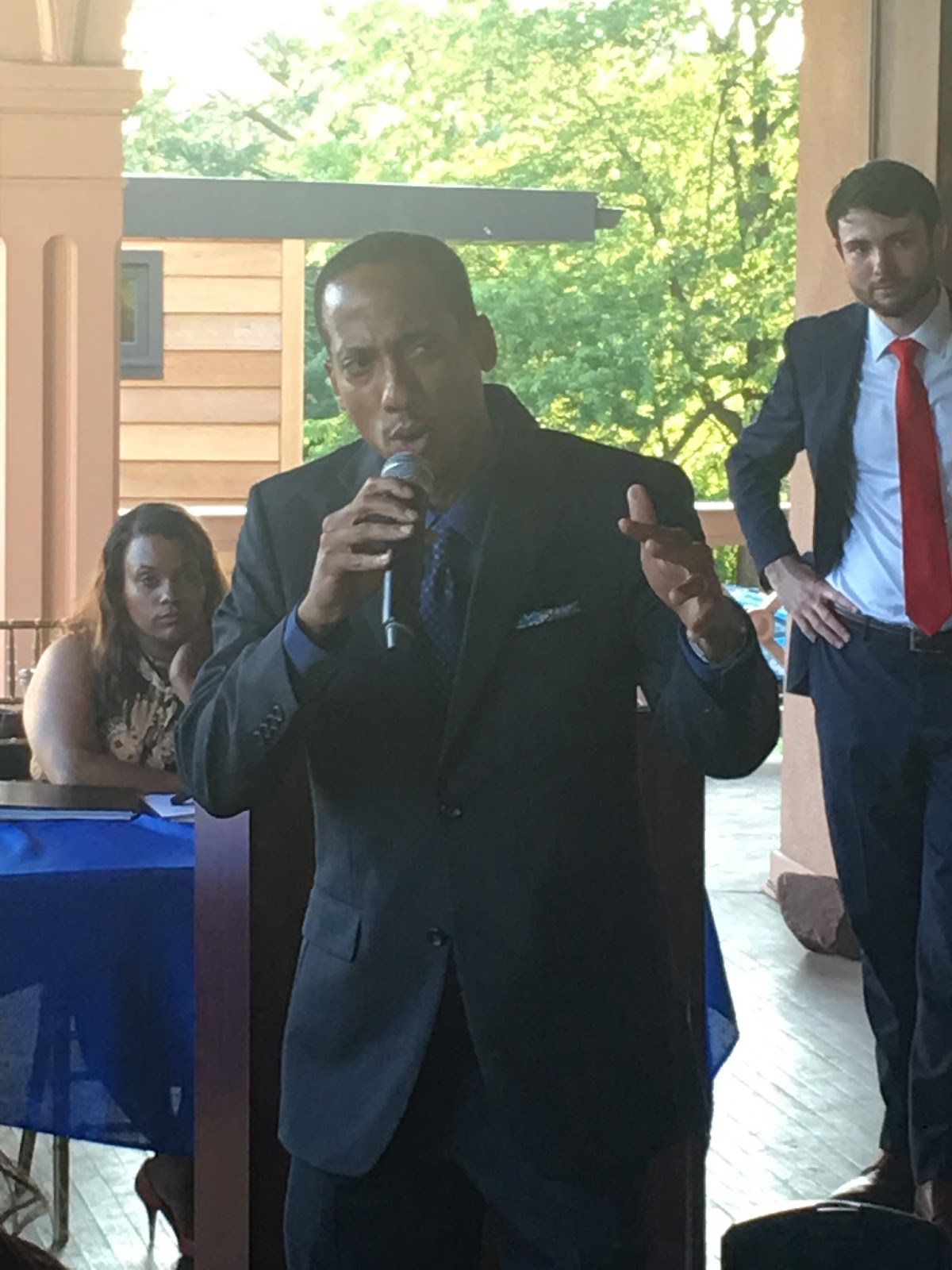
John Bullock

Clearly, it is easy to blog and hard to govern. No doubt, many people are working hard to make a difference every day.  Yet, in many cases the left hand still doesn't know what the right hand does, at times even within the same department, let alone across departments. In spite of best intentions, most departments are still in a reactive and not a pro-active mode. They are working on the cure and not on the prevention and therefore spend a lot more resources than necessary. Baltimore's infrastructure is a good example, so is policing.

It is on those areas where the new council should place its focus. As part of the checks and balances to the adminstration, in compliance with the City charter, and in a collaborative spirit the Council has an important role to play. I am extremely optimistic that there is a great opportunity ahead in the long story of Baltimore moving three steps forward and two steps back.  

Klaus Philipsen, FAIA

see also:

DMVDaily
The Washington Post about their relation between Council and Mayor
Cohen press conference on student busing. https://m.facebook.com/story.php?story_fbid=874931693125&id=41400368

Below the Committees, their chairs and their members (from DMVDaily)

BUDGET AND APPROPRIATIONS
Eric Costello – Chair
Leon Pinkett – Vice Chair
Bill Henry
Sharon Green Middleton
Brandon M. Scott
Isaac "Yitzy" Schleifer
Shannon Sneed
Staff: Marguerite Murray

LABOR
Shannon Sneed - Chair
Robert Stokes – Vice Chair
Eric Costello
Bill Henry
Mary Pat Clarke
Staff: Marguerite Murray

EDUCATION AND YOUTH
Zeke Cohen – Chair
Mary Pat Clarke – Vice Chair
John Bullock
Kristerfer Burnett
Ryan Dorsey
Staff: D'Paul Nibber

LAND USE AND TRANSPORTATION
Edward Reisinger - Chair
Sharon Green Middleton – Vice Chair
Mary Pat Clarke
Eric Costello
Ryan Dorsey
Leon Pinkett
​Robert Stokes
Staff: Marshall Bell

EXECUTIVE APPOINTMENTS
Robert Stokes – Chair
Kristerfer Burnett – Vice Chair
Mary Pat Clarke
Zeke Cohen
Isaac "Yitzy" Schleifer
Staff: Jennifer Coates

PUBLIC SAFETY
Brandon Scott - Chair
Ryan Dorsey – Vice Chair
Kristerfer Burnett
Shannon Sneed
Zeke Cohen
Leon Pinkett
Isaac "Yitzy" Schleifer
Staff: Marshall Bell

HOUSING AND URBAN AFFAIRS
John Bullock - Chair
Isaac "Yitzy" Schleifer – Vice Chair
Kristerfer Burnett
Bill Henry
Shannon Sneed
Zeke Cohen
Ryan Dorsey
Staff: Richard Krummerich

TAXATION, FINANCE AND ECONOMIC DEVELOPMENT
Sharon Green Middleton – Chair
Leon Pinkett – Vice Chair
Eric Costello
Ed Reisinger
Robert Stokes
Staff: Jennifer Coates
Larry Greene (pension only)

JUDICIARY AND LEGISLATIVE INVESTIGATIONS
Eric Costello – Chair
Mary Pat Clarke – Vice Chair
John Bullock
Leon Pinkett
Ed Reisinger
Brandon Scott
Robert Stokes
Staff: D'Paul Nibber

Friday, December 9, 2016

Leadership, Narrative and Vision

Stephen Goldsmith is a sought after advisor and expert of municipal government. He was mayor of Indianapolis, deputy mayor of New York City and is now teaching the practice of government at Harvard. When he spoke recently at an event about how to get infrastructure done in cities, he spoke as one who had demonstrated effective private partnerships in his time a mayor of Indy and as one who has written a lot about data-driven decision making.

I was surprised then, when he postulated that one of the most important things for urban leaders to promote was a convincing narrative. Taken his advice, I wondered how this can be applied to Baltimore. Clearly, a narrative is more than a slogan and it is more than a process. O'Malley, when he devised the slogan "Baltimore, the greatest city in America", didn't have a narrative, not to mention that the slogan was just too over the top to be taken seriously.  His insistence on a data driven process (CitiStat) did not describe a vision for a desired outcome but just a process. Goldsmith says "You have to sell the result, not the process".
Quirkiness as a vision? Baltimore's VAM 

Sheila Dixon also had just a slogan with "greener and cleaner", even though it described a vision, albeit a modest one. Stephanie Rawlings Blake wanted to grow by 10,000 residents, not a slogan but an outcome, although the real outcome that she desired was an increased tax base and fewer vacant houses. Even when we go back to Schmoke or Schaefer, it is hard to find a vision for Baltimore that would provide a robust or convincing narrative for Baltimore, one that would convince residents to stay or others to come here, let alone convince capital to invest here.

In an article from earlier this year titled the Power of Vision in Urban Governance, Goldsmith writes:
Mayors make their way into office by inspiring the public to believe that a brighter future is in store. Every mayor wants to be a "visionary leader," but they don't just wake up one morning with a vision. To craft an original and feasible vision for a city -- one that holds the promise of effective, efficient government that builds a city and inspires its populace -- public officials need help.
In his case he sat down with folks from MIT to refine the vision for Indy that his predecessor had already developed, also with MIT, namely that Indy should be the nations's capital for amateur sports. So Goldsmith worked on the shoulders of the previous mayor and as Goldsmith explains in his article, Hudnut's vision did not come from the mayor or MIT alone, it was developed in careful collaboration with stakeholders and after careful analysis of the city's assets:
To execute a plan like this, a compelling narrative is indispensable. A set of ideas targeting certain outcomes is a strategy, but a vision is truly animated when a wide array of city stakeholders adopts the message as their own. To work, the story has to be both calculated and contagious. "It was not a vision of a single person; it was a collective discussion which led to the vision, which then as mayor I was given the opportunity to implement," Hudnut said.
Assets are a central point in Goldsmith's approach. He spoke about those in his presentation as well. "You don't start with what comes from Washington" he said, "but around the assets you have". Baltimore's mayors have certainly talked about Baltimore's assets, the Port, Johns Hopkins, the University of Maryland, the city's HBCUs. Lately the fairly large influx of millennials is mentioned, a burgeoning art and music scene and always Baltimore's quirkiness, whatever exactly it is, it is probably best exemplified by the Kinetic Sculpture race, the Hon Fest or  the holiday decorations on 34th Street. Maybe John Waters. Those references lack cultural diversity, though, pointing to a certain nostalgia of a Baltimore that was once dominated by the ethnic particularities of the various European immigrants.

An assortment of assets makes no vision yet. Goldsmith also doesn't like generic terms or copycats that just run with somebody else's idea, he finishes his article with the following admonition:
Municipalities are racing to brand themselves as "smart cities," but true vision comes out of something less generic. Vision happens when a mayor allows him or herself to be stimulated by outside forces, configures what's best, and then connects it to the distinctive character of his or her own city. In Hudnut's words, "The key is not to try to imitate someone else's success. The key is to analyze your own strengths, your location, and the spirit of your community -- and to build on what you have."
So what could Baltimore's vision be? Sticking with Goldsmith's advice, the answer can't be given by one individual and not without a careful analysis of the assets and strengths. But a few criteria could probably be suggested.

For example, a vision that leaves out African American culture and history will probably not be very authentic or convincing in a City that has a two-third African American population, nor would have such a vision the broad support needed to be successful. When talking about arts and music, in Baltimore it is notable that in spite of having three official arts and entertainment districts, none is dedicated to African American culture and none includes the heart of black arts and entertainment history, the Pennsylvania Avenue corridor. But arts and culture that would embrace African American traditions would be special, although by now Baltimore would have to compete with Detroit for the national title.
Goldsmith

Another one of Baltimore's unique assets is its huge amount of historic buildings that are listed on the National Registry of historic places. Baltimore has become one of the nation's leaders in adaptive reuse, i.e. repurposing old buildings for new uses. In fact, Baltimore may be second to none when it comes to creative solutions for repurposing buildings, just think of the old Procter and Gamble soap factory that is now Tide Point, the old grain silos that became Silo Point, the American Can complex that has become a regional mixed use magnet, Clipper Mill that made sleepy Woodberry a citywide destination with a first class restaurant and a repurposed factory hall used for actually making things (Guiterrez studios) and the Montgomery Ward warehouse that now houses among other things the State's Department of the Environment. The list is endless and growing.

Hopkins and the University of Maryland are certainly huge assets, but an overarching narrative is missing. Both are first rate universities, both have world famous hospitals and medical research. Both have aspirations for bio-tech, competing not only in a crowded national field but also with each other. Why can't Baltimore aspire to become the health capital of the nation, taking on Boston, Cleveland, Houston and Rochester, MI in the same competitive spirit in which underdog Under Armour takes on Nike? For this to happen the hospitals would have to become more specialized, become international leaders in at least one field and the city would need to be "healthy" on many levels. On the latter the current and past health commissioners have done an excellent job in making Baltimore well known in successful health strategies for impoverished neighborhoods.
World famous: Johns Hopkins Hospital

Tradepoint Atlantic (the former Sparrows Point) is working on making their 3100 acres a destination for distribution of online goods, not very glamorous and an aspiration usually attempted by areas where nothing else competes for valuable land. But in combination with a thriving port there may be an angle that could be specific to Baltimore (the region). It isn't obvious, though, that the private Tradepoint and the public port really pursue a joint strategy and vision.

The sheer fact that there seems to be a decades old lack of a clearly defined aspiration and narrative for Baltimore should be a reason for excitement. Under the new President's regime when cities likely have to fend much more for themselves, Goldsmith's admonition not to wait for what Washington has to offer, seems extremely timely. An effective strategy for leveraging Baltimore's assets is more urgent than ever.

Klaus Philipsen, FAIA

Thursday, December 8, 2016

What "complete street" really means

Any City consists of about 30% streets and plazas, almost a third of the entire urban footprint is entirely public and under full local control. In Baltimore that is 2,000 miles of roads, 3,600 miles of sidewalks (DOT). Those public spaces  are the calling card of every city.

The street and sidewalk  are public spaces for many uses: Fulton Avenue, Sandtown
(Photo: Philipsen)

Whether they are filled with cars or people, whether they are places to get killed or places to enjoy, whether they are grey, cold and bleak or green, vibrant and pleasant, whether trash blows through them or leaves, whether they are noisy or calm, dark at night or pleasantly lit, whether they are controlled by violence or safe for the elderly and the young, all that isn't just fate but the result of local policies and should be the result of the will of the people who live in the city.

Baltimore's streets aren't for the most part aren't glamorous. There are few grand boulevards and among those several have been turned over to everyday utility. Gwynns Falls Parkway, Fulton Avenue, Eutaw Place, the Alameda, Roland Park Avenue are a few examples of grand avenues. Some are thriving, some fell victim to traffic, decay and neglect.

Streets as public spaces need to be become part of the open space network and be seen as one with the parks and green spaces like the Parks without Borders program in New York City currently undertakes. Baltimore's most egregious example to the contrary, a park with borders is Druid Park. The super wide streets on the south, east and west completely cut off the park, the streets are barriers and not adjuncts assets to the park and meaningful public spaces.
New streetscape built to DC's design standards with wide sidewalks
and much green

Streets and open spaces must be assets to the residents of the city, to the people that live along them and for those who use other means to get around than the car. A beautiful street can add significant value to any property on either side just as a traffic clogged noisy artery can drag property values down. It has become fashionable to speak about transit oriented development, or TOD in an emphasis of the close linkage between land use and transportation. This link exists for streets as well, if not more so.

A wrong headed car-centric streets policy creates a self fulfilling negative feedback loop. People move away from busy streets out into leafy suburbs only to return by car, creating more traffic. Streets with skimpy unsafe sidewalks make people choose the car over walking even for short distances exacerbating the problem. Badly designed streets can make successful retail impossible and hamper economic development. They require schools to bus students even if the live well within walking distance. They discourage people from using a bicycle or scooter because they fear for their lives in the fast moving roar of trucks, buses and cars. Car clogged streets discourage residents from taking transit because the buses are exceedingly slow.
Traffic clogged Pratt Street (Photo: Philipsen)

By contrast, a complete streets policy that considers land use, economic development and quality of life requires an almost complete reversal of current priorities but creates a positive feedback loop. Wide tree-lined sidewalks with curbside parking allowing quieter living will allow people to live along all kinds of streets because the traffic flows a bit further away from the house, at lower speeds. Residents can park their car in front of the house even on arteries, customers can park near the store they want to visit. Traffic reduces exponentially with lower speed.

Walking on wide tree-lined sidewalks protected by parked cars is so much more pleasant especially when the houses along the sidewalk are filled with people instead of being boarded up. Some may may even sit on their stoops providing the much discussed "eyes on the street" that Jane Jacobs described in her book The Death and Life of American Cities which provides much of the intellectual underpinning for the Complete Streets movement. How much more fun to walk on sidewalks that are wide enough to allow restaurants to have outdoor seating or outside displays!

Complete streets have bike lanes and bus stops on curb bump-outs for plenty of space for the people waiting for the bus. Complete streets may have separate sidewalk lighting and planters to give street trees enough water and air to survive urban conditions.
Fulton Avenue: Trees in the median but barren sidewalks (Photo Philipsen)

Anybody walking through Baltimore's streets will quickly see how far away most of our streets are from those pleasant conditions. Fast moving traffic drags wads of trash along, trees are dying or absent, parking lanes are given over for so-called rush hour lanes allowing cars to zip by within inches of pedestrians cramped on narrow sidewalks, if there are any pedestrians left at all. Most sidewalks in Baltimore are eerily empty compared to other cities. Just take a trip down to DC and emerge at just about any downtown Metro station and you will be instantly absorbed into a bustling street life with plenty of people walking this way and that. You will see bicyclists, street vendors, sidewalk cafes. If this looks so drastically different than Baltimore, don't attribute this to size, wealth or the fact that this is the Capital of the Nation. Just a few decades back, DC was just like Baltimore, Boarded houses and businesses, trash flying around and hardly any people walking except at the Mall and tourists attractions.
Even historic Annapolis can have wide sidewalks (Photo: Philipsen)

It isn't a miracle that DC turned around the way it did, it was a set of focused policies promoted by courageous mayors and department heads. One of a set of planning documents is Move DC which is based on a Complete Streets policy that put walking, transit and alternative modes over car driving. The plan isn't just an esoteric vision, it included short term easy implementable actions that set the entire District onto a different trajectory. The results are stunning. Most notably, DC has a rapidly growing tax base which provides new discretionary spending capabilities allowing the District to invest in schools and infrastructure, making its streets even better.

Complete Streets policies are not just about more balanced transportation. They are about the quality of life in a city overall. The 30% of the cities footprint that are public can be leveraged for a better quality of life. Cities across the country from New York to San Francisco and from Philadelphia to Portland show that Complete Streets policies pay big dividends. Quality of life and diverse transportation choices are key factors for people to decide which city they ant to live in.
Refurbished Center Plaza Baltimore. refurbished public space
(photo: Philipsen)

Baltimore needs to begin leveraging its best assets. Public spaces and streets are still for the most part a vast untapped asset.

Klaus Philipsen, FAIA

Related articles on this blog:
Baltimore's antiquated transportation management
Complete Streets, the DNA of a new urban mobility culture

Wednesday, December 7, 2016

Bombing downtown

Sometimes it is tempting to give the press a quote they will most certainly print, even if it is a bit inflammatory. So I told the SUN that the Howard Brown demo sites in downtown Baltimore remind me of the bombing sites I recall from my early childhood when I lived in Stuttgart. There as here the rubble had long been cleared but the sites sat fallow with clear marks of the violence that had occurred. It took many years before postwar Germany had its Wirtschaftswunder, an economic boom form the re-building of the country.
Nothing but rubbel where the Mechanic once stood (Photo: Philipsen)

Baltimore has been re-building the post-industrial city for decades. Lately the City gets re-built on many fronts, from Oliver to Howard Street and from Port Covington to Remington. So two large rubble sites in the heart of downtown are as unusual as they are disconcerting, especially if they are both owned by the same developer.

The rule that nothing should be demolished unless reconstruction has cleared all hurdles including financing has been demanded by AIA's Urban Design Committee many times over at least 25 years and the City supports that approach, but with mixed success. Downtown is rife with examples of the opposite approach, most of those date a long time back, though. Even the huge vacant site across from the former Nationsbank Building bounded by Baltimore, Light and Redwood Streets is now under construction. Even the old McCormick site sitting fallow for decades is under construction. But not two sites by developer Howard Brown, the site where the Mechanic Theater once stood and another site on Baltimore Street just west of Howard Street.

Kirby Fowler's Downtown Partnership which presses for swift construction to occur on the site of the former Mechanic Theater is himself on the wrong side of the reconstruction rule in his current demolition of the McKeldin Fountain. destruction without a final replacement design, let alone funding.
Nothing but rubble: McKeldin Fountain (Photo: Baltimore Fishbowl)

But the most egregious violator is Howard Brown who inflicts not only one but two of these vacant "bomb sites" on downtown. For a long time now Brown doesn't provide information what the status is on either site, not even upon inquiry from the SUN. For the western location there isn't even an official excuse made as in the case of the Mechanic, where the lawsuit by Down-Under Parking is given as the official reason.

The two sites have been sitting for years now, which usually is an eternity in the schedule of any developer who is intent on recovering the cost of acquisition, design and demolition with an income producing new use. Should the developer not have that typical urgency, the suspicion is legitimate that some other agenda may be afoot which could very well be in conflict with public interest.
West Baltimore Street: Nothing but rubbel (Photo: Philipsen)

For both sites Howard Brown had hired architects and their designs reviewed by UDARP. In both cases the architecture that was shown was quite attractive. The public has a right to see investment after demolition was granted on the grounds of the great new things to come. The time to move forward is past due.


Klaus Philipsen, FAIA

Baltimore SUN article
Previous blog article about the holes

Tuesday, December 6, 2016

Pop-up occupancy in the art scene

Some art is corporate and events like Art Basel don't have to worry about the fire code. But emerging art has no money. Budding artists are notoriously broke.  Like weeds in the cracks of a sidewalk they thrive in whatever cracks society offers. Those cracks become a thematic opportunity but also often an existential one.
Abandoned warehouses are such places. The crack in the armor of the postindustrial city can hardly be better exemplified than in an abandoned foundry. It becomes a safe harbor for those who explore the fringes. Experimental music, experimental theater, new forms of production and living together meld into full ecosystems.

Artists, although often solitary natures, know about what the corporate types call synergy. They understand that collaboration is better than competition and that unexpected fertilization can come from chance encounters. Collaboratives have long proven the value of opening up silos. The lack of resources combined with a curious spirit beget tearing down boundaries between work, live and play. This world is afar cry from the orderly world of zoning with its clearly defined categories,far also from the fire codes with their means of egress and requirements on combustible materials.
Bell Foundry, Station North

In Baltimore'sStation North this experience has been made many times, even before the area acquired its name and the official arts and  entertainment district designation. The Load of Fun was such a makeshift collaborative place with studios, galleries, theater and music.  But it was unsafe, didn't have the required exits and was shut down and condemned. The Single Carrot Theater became homeless and building owner Sherwin Mark who didn't have the resources to fully comply with codes felt he had become a victim. The facility came back after a hefty investment by the Deutsch Foundation and certainly changed its character, even though the theme is still art.

After the fire in Oakland that cost so many young people's lives, it was clear that fire marshals and code officials across the US would be sent out to check in their cities for similar facilities that have morphed into artistic eco systems.. This week Baltimore's officials closed down the Bell Foundry for violations that sounded eerily similar to those that apparently led to the Oakland disaster.

The artists feel victimized. They had to leave their studios and practice places in a hurry and the clash between the cultures of creativity and enforcement was obvious. The Baltimore Rock Opera lost access to their stuff and practice area. Many complained about the rough manner in which they were treated.

What should be done? Code enforces cannot allow significant violations. But do they have to throw everybody out in a hurry? Once aware of the issues, couldn't they allow an orderly exit that gives everyone the chance to sort things out? Couldn't they even advise how to mitigate the risks? Bring a structural engineer to see if collapse was indeed a possibility due to missing supports? Or whether this wasn't as grave a situation?  With the fire inspectors there it would be unlikely that the place goes up in flames that afternoon if a few hours would have been allowed to fix things or vacate.
Murals from Open Wall, Bell Foundry Station North

When in doubt, life and safety should always come first, for sure. But one gets the impression that authorities keep having a really heavy hand in doing what they are supposed to be doing. Baltimore certainly doesn't need another boarded vacant structure and more people without a job or in the street.

The matter isn't black and white. But one can't help to think that both sides see it as such, while a lot of middle ground between laisser-faire and law-and-order remains unexplored. Information about this latest case  is limited so far, but there are too many additional spaces that require this middle ground for it is needed for the artistic Baltimore scene to survive.

Klaus Philipsen, FAIA

City Paper

Sunday, December 4, 2016

Demolish the Lexington Market?

In the last days of her reign Mayor Stephanie Rawlings Blake unfolds a flurry of activities. Friday came the long expected announcement about the public markets, most notably the Lexington Market the biggest of the bunch. The news contained a bombshell: The suggested course of action is the complete demolition of the existing market in favor of an all new two story structure on the side of the existing building. The new building concept has been developed by Murphy Dittenhafer Architects, Baltimore. Instead of a sloping floor the new structure has  level access from Eutaw Street (lower level) and Paca (upper level). No doubt, the renderings are attractive.
The plan calls for the introduction of more natural light, better ventilation, level floors, human-scale tenant stalls, new storage facilities, customer seating spread
throughout the market, and clear sightlines. The new park will provide much-needed open space in a neighborhood where open space is currently lacking, and the park space would be managed 
by a non-profit foundation along the lines of the successful Center Plaza Foundation. LMI retained Market Ventures, Inc., to create the Lexington Market Master Plan, Murphy Dittenhafer and Floura Teeter for architectural services, and Whiting Turner for construction management services. LMI is working closely with its architects and construction manager to reduce construction costs and to target a construction budget between $35 and 40 million. (Press Release)
The practical benefits are obvious. The old building could accommodate all vendors without disturbance while the new structure goes up. One day the merchants would just move over into a brightness facility with modern heating, cooling and storage, all items of concern in the old building. The new structure would finally attract the folks that don't want too to the current market because  it doesn't suit them. As much as I'd love an attractive real landmark market building that draws across the region, let's carefully think this through.
Lexington Market (photo: Philipsen)

Well, there a few problems, though, with this line of reasoning.

Lack of available funds

The approach is costly and the  money for such a radical project is just not there right now. Which doesn't mean it could be there in the future, but in the meantime nobody will invest a thing in the existing market, nobody will fill a vacant stall and those who are there will live in fear whether the new market would be affordable for them or would even have space for them. (It is smaller). How treacherous years of limbo can be to a market could be observed at the Cross Street Market which sits in an affluent area but began to be just a shadow of itself because its future was so unclear. For the approach to be effective it has to happen really soon.
Proposed new market (Rendering by Murphy Dittenhafer)

Urban design

One of the problems of the current market is that it occupies what used to be Lexington Street. If the current market gets demolished Lexington Street would become a through corridor again, at least for pedestrians and it would need to look attractive on its long north side facing the street. The current market abuts the gigantic parking garage and receives its services (deliveries, trash removal) from there. It isn't clear how those functions would work in the new building and still maintain three attractive sides. Plus, the vacant lot where the current market sits could easily be a bigger eyesore than the existing vacant lot, because it would expose the hideous garage fully. The renderings show both of these conditions addressed, through a park, architecture, outdoor stalls and wall graphics (murals) but things rarely look as good in real as they do on renderings, especially when there is no money. 

Branding
Current Lex Market (photo: Philipsen)

The current market brands itself as the oldest continuously in use public market in America. While the structure isn't going back to 1774, it is old enough to convey a feel of history in areas such as Faidleys. It would be awfully hard to brand a modern glass structure such as the one shown on the renderings as the oldest market in America. It will also be hard to convey the fondness that many people still have for the current market. Just in October market CEO Thomas wrote me that "we are actually developing our first phase plan to “transform in place” because many DO like the market as it is".

Dog whistles

While nobody would seriously dispute that the existing Lexington Market structure is not particularly attractive and has a some serious systems issues, the real problems with the market lie beyond the building itself. The market sits in a disinvested part of town with few attractive destinations. A lot of poor people come here by transit and to find the essential services that can't be found in the neighborhoods to the west of MLK. Not very many people walk here from downtown, the Inner Harbor or even the nearby Convention Center. There just isn't enough of a reason to do so. There are many instances of what currently is called  dog whistle or coded message. The uncooked message is: Too many poor people, too many black people, too many people going to drug treatment, too many drug dealers (people hanging out on the street, no, not all social gathering is just to hide drug sales). The same complaints as with transit.
the proposed interior (Rendering Murphy Dittenhafer)
 Many current users of the market don't see a whole lot of problems with the current condition. There are cheap food choices based on current customers's preferences and the market is always busy. The problems are seen by those who don't go to the market. They say it isn't safe, it isn't clean and it doesn't sell what they want to buy. The matter is a bit like with transit. A lot of the critics never ride a bus but they are very vocal about what's wrong with current transit. Of course, there is a kernel of truth in the perceptions about transit and also the market.  
current Lexington Market (photo: Philipsen)

There had been questionnaires "would you go to the market if it were cleaner, safer" and so forth that implied already in the question that the current market wasn't safe or clean. The market had been talked down systematically by the same folks who wanted all bus stops removed from the front of the market and want all drug clinics removed as well. The same folks that wanted the downtown Greyhound station expelled to an area behind the incinerator; in short, there are those who think the market can only be saved if a lot of more affluent white people go there. It is true that a big public market must address a diverse clientele and cannot thrive from serving only the poor. But it cannot be that every market in town has to be like the one at Belvedere Square or the new Mount Vernon Market only a few blocks to the north from Lexington market. An updated market would surely benefit from better merchandising and a more coordinated assortment of vendors. Nothing wrong with some exotic cheeses for sale or some craft bread or French cake. But there would be something severely wrong with a new market where the rents are so high that the current merchants can't afford them or have to jack up their prices to support a fancy building. 
Pikes Market: Good food, not a fancy building
(photo: Philipsen)

Conclusion

 The real challenge here is not the building but the not sufficiently varied merchandise and the location. Money spent on some necessary building upgrades including building systems and some skylights is needed but the bulk should be spent on management and merchandising. People don't eat the building. Look at Pikes Market in Seattle or the Reading Terminal Market in Philly, both thrive not from fancy buildings but from their location and there wares. In fact the structures are kind of dank in both places. The location of the Lexington Market is fixed. To make it a truly great location the connections to the convention center and to downtown need to be fixed. As long as Lexington Street to the east remains in its current condition, no amount of architecture can turn the market around. In other words, money is needed beyond an upgrade of the building or new structures. The question is, if limited resources wouldn't be better spent on basic upgrades and incentives for merchants to improve products and operations and towards making the surrounding blocks of the westside better.

The good news is that the long silence around the market has been broken and an attractive proposal is on the table. What exactly the best course of action is needs public vetting now. 

Klaus Philipsen, FAIA

City Video

Proposed Lexington Market from Paca Street (Rendering Murphy Dittenhafer)

Corner Eutaw and Lexington (Rendering Murphy Dittenhafer)

Looking northeast on Paca with the big garage in the back (Rendering Murphy Dittenhafer)


Friday, December 2, 2016

Monument Lighting - the only party left

Mount Vernon has seen a steady decrease of community gathering functions that seemed to be so common there. The first Thursday concerts went to Canton, the Flower Mart and the Book market went to the Inner Harbor. Even the monthly bike party gathering has moved to Seton Hill. This leaves the annual Holiday Monument Lighting as the last event that draws people from across the area to convene, meet and enjoy themselves on Washington Place in Mount Vernon.
Monument Lighting 2016 (photo Philipsen)

This is unfortunate since citizens need to use public spaces to feel ownership. With the Washington Monument meticulously restored, the four-sided park is once again the most beautiful urban space Baltimore has to offer, even before those much contested park restorations have taken place.

Mount Vernon has seen great rejuvenation and a number of new and exciting projects. The area absolutely needs a space that can be its "living room". No good living room without some good parties!

The annual Monument Lighting provides the much needed community spirit. With local food and a smattering of booths that are reminiscent of the famous European Christmas Markets, private folks stepped up with their own parties surrounding the area. Agora, the publishing company, has probably the biggest by-invitation-only party, the interior and architecture design firm Rohrer Studio has another annual holiday bash on the evening of the Monument Lighting and so does the Engineers Club. Public institutions such as the Walters and the Peabody open their doors to the public for music, cookies and hot drinks. The Peabody offered an excellent rendition of Beethoven's 5th Piano Concert (Concerto Emperor) presented by two students that played for their doctorate.
It isn't all about the fireworks

Of course, Baltimore's infrastructure and sinkhole crisis has virtually surrounded Washington Place with the most mundane: with surface sewer lines. One can imagine the port-a-potties sitting right on top for easier discharge. Because of this, the west-park access was somewhat limited and the food trucks that have usually gathered along the west end of the park now sat in the north park. This is actually a better solution anyway, except for the circulation between the south, north and west parks that is choked off when the fire-works are sat in place. I wonder of this can't be fixed with moving the discharge location slightly east.

Below a few photo impressions from yesterday's event. If you haven't made this a part of your annual holiday routine, do so next year. There is something for everybody. And do it before somebody has the glorious idea to move this party also out of the area!

Klaus Philipsen, FAIA

For an update on another important public space see the breaking news about plans to demolish the Lexington Market as reported by the SUN this noon.


Brass at the Walters (photo Philipsen)

flashing wearables (photo Philipsen)

Rohrer Studio: annual party (photo Philipsen)

Food trucks in the north park (photo Philipsen)

antic and modern heads at the Walters (photo Philipsen)

Beethoven at the Peabody (photo Philipsen)

Beer and sculptures: west square (photo Philipsen)


Thursday, December 1, 2016

Infrastructure in Maryland: Roads and Bridges

Even though Maryland's Governor held a prudent distance to the President elect, his understanding of what it means to spend on infrastructure could be a harbinger for what's in store on the federal level.

Everybody knows by now about the urban and the rural voting camps and that the rural camp is in power in the State and in DC. It can be expected that future infrastructure investment will mostly benefit the rural and out suburbs. Hogan's recently announced largess for a complete reconstruction of the Nice Bridge over the Potomac is just an example. $765 million State money for a 1.7 mile bridge about which his own transportation secretary recently said it had 30 years left in it if properly maintained.
The Governor announcing a new Nice Bridge

His toying with a third span for a Bay crossing to the Eastern Shore came earlier this year and his 2015 taking State dollars from urban transit in Baltimore and Washington to spend it on rural roads instead is still a fresh scar.

Although with less money than originally set aside for the study, a feasibility analysis for a Charles County transit corridor is moving forward. That it hasn't been killed altogether has probably to do with the fact that it will run in a largely suburban area with many conservative constitutents who for a while favored giving up on smart growth altogether.

If those investments would only serve different constituents but would be otherwise comparable and equally effective one could chalk this up to normal political fluctuation. But unfortunately, this isn't the case. While new rural roads and bridges will certainly produce some temporary construction jobs, no transportation expert or economist would be able to make the case that they leverage large economic benefits. The biggest short-term benefit is that green areas will be opened up to subdivision development because the isochrones  will shift and make more areas accessible to the maximally reasonable commute. But as any economist can tell, those benefits are like straw-fires, a burst of heat and then nothing but ashes. Sprawl doesn't pay its way in the long run and leaves nothing but depleted landscapes and not very viable mono-culture communities.
crumbling infratsructure in Baltimore

That the highway invetsments in rural areas are so hard to justify in terms of transportation needs or economic development is likely a key reason for the Governor to fight that bill that would install a transportation scoring system so fervently.

That will be the crux with all infrastructure spending we may see in the next four years, if campaign promises are any indication: Roads and bridges instead of high speed rail, fixed sewer lines or better transit. Let alone schools, libraries or fire houses. Baltimore better not hold its breath waiting for many additional federal transportation dollars.
A failed model for urban mobility

Baltimore City and Under Armour are waiting to get federal dollars for a new light rail sour into Port Covington in the 2017 round of grants. With a large corporation being the main beneficiary, this could actually still happen, who knows. But generally, Baltimore better find new creative ways to fund its public works projects, largess from Washington isn't very likely.

Klaus Philipsen, FAIA


Wednesday, November 30, 2016

The Public Realm

In a talk about infrastructure I listened to New York City's Commissioner Mitchell J. Silver, in charge of the New York City Department of Parks and Recreation, speaking about "parks without borders", a multi department effort of making public spaces better in New York. Not only parks but whatever public space including roads and sidewalks. Hence the moniker and the involvement of other departments such as Planning and DOT. The program name also denotes the desire to open parks up, remove fences and barriers and include the adjacent sidewalks into the placemaking, an effort that makes even very small neighborhood parks look bigger.
Small parks, sidewalks and streets all belong to the public roam

Nearly 30% of any city's land is public space and Silver asked how well we utilize and leverage all that space to make a better city and a better quality of life.

Silver's approach is community based and relying on suggestions of what spaces should get an upgrade. The previous Mayor and the current one see the importance of green space and gave the commissioner the largest parks budget in New York City's history.

"Parks are the places where you let your brain breathe" says Silver and follows up with the value proposition for green. Well maintained green spaces enhance property values, poor upkeep can actually decrease it. This is important to keep in mind for Baltimore's green network plan. Not every open space immediately creates an added value. Poorly conceived leftover spaces invite undesirable activities or even crime. Good green spaces, however are good for mental and physical health.

It is an innovative idea to not just hand the public roam to the parks and rec people, the traffic engineers or the planners so each can carve out a piece following their own set of rules.  Instead, the entire public space is approached comprehensively by several departments together as an asset. This will take some re-thinking,  especially if one considers how much space is typically devoted to traffic and the car.
small parks are frequently fenced off and closed at certain hours. With
"parks without borders" those fences come down

This goes beyond the notion of complete streets, a much talked about concept that includes pedestrians, bicyclists and transit into the consideration but typically still leaves the design of the public space to traffic engineers and not urban designers. The result can be seen on Maryland Avenue on Baltimore's premier bike boulevard. A big improvement for bicyclists but quite incongruous from an urban design perspective with all those markings, sticks and cars parked in the middle of the street. New York did this as well, but under DOT Commissioner Sadik Khan New York famously also took  those extra pieces of asphalt and driving surface and turned them into people spaces, the most well known is on Times Square.
As laudable as the now realized protected bike-lane is, it is "messy"
from an urban design prespective
A really comprehensively designed public realm would apportion parks, mobility zones, street trees, planters, walkways, bicycle facilities and vehicles in a manner that follows a overarching urban design concept and would probably look much better than the designs that are each optimized for one purpose only and chop the space into specialized subareas.

For that approach the European model of shared surfaces with minimal separation, slow moving cars and as little as possible in terms of signs, bollards, sticks and lines is a good precedent, emulating the classic urban street. That model doesn't work for high volume arteries, but those are antithetical to urban streets anyway and must be minimized. Cities and "freeways" simply don't go well together.

With scare public funds the question of control over public spaces should be an item of concern, what Chris Leinberger calls "place management". Leinberger likes to point to New York's Bryant Park which was restored and programmed with private funds and has generated enormous added value to surrounding properties which in in turn can be used for upkeep. But to whom are these management entities accountable?  A local Baltimore example that raises this question is the Downtown Partnerships de facto management of much of the public space downtown. That this doesn't always stays withoiut controversy has become obvious in the case of the McKeldin Fountain and its current demolition through DPoB.

In an increasingly urbanized future with increased density in cities the question of access to open space and optimal use of the public realm will become increasingly important for the quality of life, the health, and the well being of the community.


Klaus Philipsen, FAIA


Tuesday, November 29, 2016

Unsafe because of high speeds

Baltimore City has become an unsafe area. People may think first about gun violence that makes it so, but increasingly it is the lawlessness of reckless drivers. In the last few days two drivers killed themselves in high speed crashes right in or near downtown. Given that modern vehicles protect drivers pretty well at what are supposed to be urban speeds these crashes prove the extent of the problem. Pedestrians or bicyclists that could have been near would not have had a chance.

Downtown crash, the building gets hit regularly


Anybody who uses Baltimore streets whether on foot, on a bike, in a bus or by car knows how certain drivers flout the rules with blatant disregard of fairness or the well being of others. Red light running doesn't only occur right after the light changed but increasingly one can find drivers setting off to cross on a red light in the middle of the cycle, sometimes by squeezing ahead on a turn lane and then going straight through. Leaves one kind of speechless.

The urban speed limits of 30mph or 35mph mean nothing to most who think it is fine to go 50 or even 60mph no matter whether there are people walking or waiting at bus stops. Crosswalks in Baltimore don't protect pedestrians, whether they are placed at a traffic signal or not. Bicyclists are honked at and passed at high speed within inches. Worst of all, almost every driver is fiddling with a smart phone either for a conversation in which the phone is held in front of the mouth like a sandwich or is used for e-mail, texting or directions. People who are confused by the instructions of the Google maps lady erratically veer across lanes entirely oblivious to who else is out there.

Anyone who travels to other cities or countries knows that all these behaviors are by no means the price we have to pay for technology and progress.

Whether it is Portland, Fort Worth, San Diego or Seattle, Vancouver, Stuttgart or Copenhagen, there are plenty of places where the street is a more civilized place. where cars stop for pedestrians, red lights and merging buses. Why?


Add caption


I suppose we can bring up the usual litany of Baltimore dysfunction as the culprit but we could also take some very practical steps to change the culture.
Police cannot continue to turn a blind eye on traffic just because the gun mayhem has a higher priority. While the "broken window" approach of policing clearly brought about abuse and mass incarceration, there is a kernel of truth in its underlying assumption that smaller lawlessness begets bigger one. That incivility in the street easily ends up in a bigger disregard for others. Someone who dumps a whole bag of fast food trash into the street, drives down a red bus-only lane, turns right from the center lane and runs red lights is obviously of the mindset that laws mean nothing and that the rules are solely governed by how each wolf can get ahead the fastest.

The more people live together on tight spaces, the less such a mindset can be tolerated and the more civility is needed.


Add caption


I vote for traffic education in schools, for police enforcement of traffic rules and cellphone bans and for reactivation of all the dormant red light and speed cameras. I am sure enforcement will do miracles, especially if it is sustained. We sure have plenty of cops out there. They just have to lift their eyes of their own laptops and handheld devices and take notice of an issue that greatly diminishes quality of life in this city.


Klaus Philipsen, FAIA


Klaus Philipsen, FAIA