Thursday, February 16, 2017

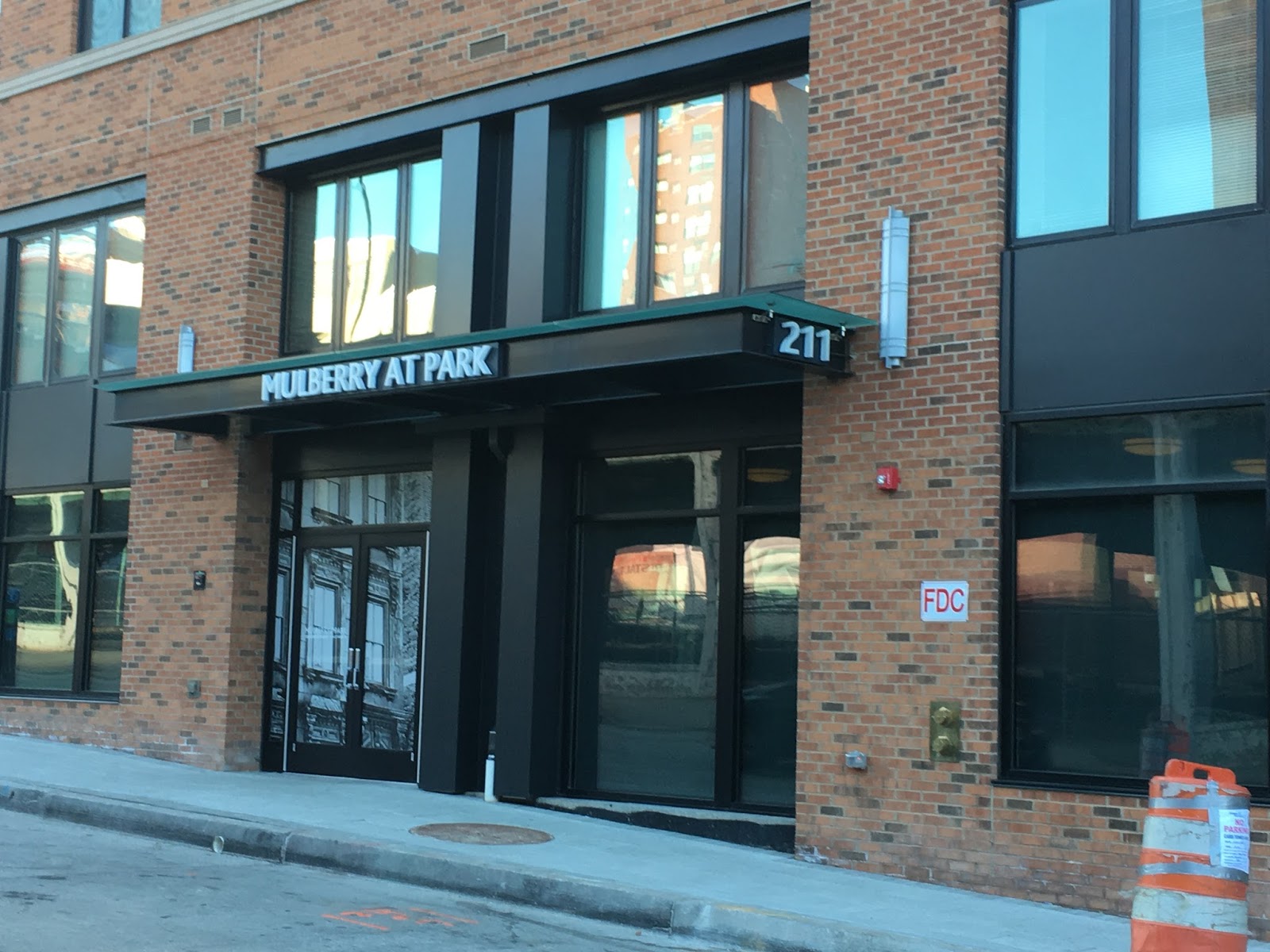
Mulberry at Park: Affordable Housing in the Westside

Mulberry Street from Greene Street to Cathedral Street is a difficult place to build, maybe even harder than West North Avenue (The Gateway Homes), Greenmount Avenue (The Lillian Jones Homes) or Howard Street (The M building at Howard and Madison) where other recent affordable housing projects were successfully completed. This section of the Westside is impacted by abandoned structures and vacancy on the entire block to the north of the project which has has not a single occupied building in it except for the Current Gallery which is open two days a week. Mulberry Street is also a narrow canyon of relentless traffic where curbs have been cut back close to the houses to make room for three lanes of traffic trying to get as fast as possible from the highway to nowhere ending at Greene Street to the Orleans Street Viaduct beginning after the St Paul Street signal. Another housing project planned a bit further west between Paca and Eutaw Street has been stalled for years over an impasse on cost and design.
Mulberry at Park: 68 affordable apartments now complete
(Photo: Philipsen)

It was therefore quite a surprise when Enterprise set out to knock out several vacant buildings on the south-side of Mulberry across the long since shuttered once famous Marticks restaurant and a condemned dilapidated one story parking garage. The project broke ground in July 2015, a few months after the unrest. It is now complete.

Marks Thomas architects selected a conventional brick facade design with paired vertical double hung windows that matching design elements found on still intact and active buildings on the south side of Mulberry east and west of the project. As a result the now finished building looks largely as if it had always been there.

The opening the building was marred by the relentless din of a bank of compressors pumping sewage from the various temporary surface pipes crisscrossing the area back into the pipes under Mulberry.
Barrels, sewage pipe and traffic: The public roam could use an upgrade
(Photo: Philipsen)

The 68 units, 34 one-bedroom, 27 two-bedroom and 7 three-bedroom apartments. which cost $22.3 million to build are limited to residents earning 60% of AMI (Average Median Income) or less. Per an earlier Enterprise press release Bank of America provided $15.8 million in construction financing, tax credit equity and permanent financing. Additional financing sources include the State of Maryland Department of Housing and Community Development with $1.5 million and Baltimore City with $870,000.
The rear is the southside
The units are arranged in a u-shape with the open side of the U in the back facing south with a deck sitting on the plinth of a service and parking garage. The rear of the building is clad in vinyl.
Habitat America provides on-site resident services.

Maybe the new apartment residents won't have to look very long across a scene of abandonment. BDC has undertaken several attempts of bringing the 400 block of Howard Street back to life. Negotiations with a few developers that would bring a bakery, a beer garden and more apartments and shops are still underway at the Development Corporation.

Meanwhile, 153 market rate apartments just north of the decrepit block are rapidly moving towards completion, another undertaking by the Time Group which also did 520 Park, apartments and the now popular Mount Vernon Market.  Time to look at the streets on the Westside as "complete streets" that support the investments in housing and provide a friendlier, more walkable environment.

Klaus Philipsen, FAIA

Today, Feb 16 is Housing Advocacy Day in Annapolis
Enterprise project sheet


Rendering of the project at groundbreaking
(Marks Thomas Architects)

Tuesday, February 14, 2017

What this President is doing to Me

My complaints pale in comparison to what millions of undocumented immigrants face. It is nothing compared to the plight of refugees stuck in camps around the world. It is minuscule in light of the increased potential for nuclear conflict. It is not worth mentioning in comparison to the threats from unchecked environmental degradation .
Greenpeace demonstrators in front of what is left of the Berlin wall

And yet, I want to share why it matters to me to wake up to a country that is no longer the place I deliberately chose over my own birthplace. Why I miss the country I came for. I did not flee persecution, oppression or poverty, just personal tragedy. Maybe to get away from the regular insult of political foes who would ask me to go "over there", meaning the so-called socialism in the other half of Germany, behind the wall. Maybe to get away from the occasional unreformed Nazis who would tell me that "under Hitler you would have long been gassed". This wasn't exactly typical in Germany some 30 years ago, but it just happened often enough to be gnawing. I wasn't a rabid flame-thrower who wanted to overturn the system, just a young and active member of the Social Democrats, the party of Willy Brandt, after all.
German youth with the Nazi salute

I wanted to get away from where optimism was seen as naivete and humor as something that happens at Carnival processions or in beer tents, both events I found profoundly not funny. Away from a country that worshiped work. But boy, I went from the frying pan into the fire on that one.

My American wife and her juggling six children and a law degree on top of the PhD she already had, her Apple 2e, and my own grappling with a different culture became symbols of the land that I had selected as my home. I learned that being dour wasn't a higher level of honesty and that embracing the future wasn't being unhistorical. That women as bosses were normal, that team meetings included black men and women, Asians and Indians, that it can be normal to have an excellent foreign born doctor; that it can be normal to move from place to place, to have several degrees, to work beyond 65 or get really bad pizza.
Trump supporters raising their right arm: A bit sloppy, but
recognizable

Speaking of pizza, not everything here was groovy. I discovered early  how disinvested and neglected Sandtown was. I saw people herded into vans, which I learned, were called paddy wagons, saw people bent over the hood of their own cars being frisked in plain view. I saw my fellow citizens sitting on the curb in handcuffs while police turned their cars upside down. Almost always those people were black. I hadn't seen those scenes in the Old World, Police there, learning from bad history, were usually held in the background. Except in the days of the Red Army Faction when I and my first wife reminded law enforcement of a couple on the wanted posters. One day at noon machine guns were stuck into our faces and we were briefly arrested. But I didn't have to fear for my life, Modern German police practically never shoot anybody.

I saw black anger in Baltimore in 2015 when storefronts were smashed right in front of my eyes while I tried to get out of Baltimore's Westside wondering whether my retreat against the flow of the looters was  treason on my own ideals or the right thing to do, as no doubt, my mother would have told me.
Paramilitary round ups of Jews called Razzia

But with Obama we had a President I didn't have to defend when visiting my relatives in the Old World, Germany just adored the young lanky President. America had turned the corner from being the bad cop of the world. Besides we lead in everything that matters these days, from computers to software development, from smart phones to app development, from social media to inventing the sharing economy and self driving cars. In spite of our trade deficits, the high income disparities and a crumbling infrastructure, I considered my country as having the right attitudes to overcome the problems: Openness, mobility, creativity and good doses of curiosity.

All this tossed around in my head amidst the two thousand or so demonstrators inside the international terminal of Thurgood Marshall Airport two Sundays ago when the crowd sang "this land is my land, this land is your land".
BWI protest at the International arrival 
Tears came to my eyes. Of joy that so many would spontaneously come out on a Sunday afternoon to show their discontent; of sadness that this was necessary. The travel ban was intensely personal: A citizen  with a passport for decades, I recall too well when I emerged from the international gates of many US airports after passing border control with just a visa and then a green card in my hands.
Round up of "criminal illegals" in New York 2017

Germans remain deeply traumatized by WWII even when they were born after WWII. As a freelancing high-schooler I had written reviews in the local paper about lectures which analyzed Hitler's speeches and his rise to power: The phase when hardly anybody seemed to take the rising right winger with his overblown theatrics seriously. When he then was democratically elected to an office and a democracy he had denigrated for years and swiftly dismantled. When he broke international treaties left and right. Martin Niemoeller's First they came for the Socialists, and I did not speak out—Because I was not a Socialist. Then they came for the Trade Unionists, and I did not speak out... ... is deeply ingrained in any German's mind. In school we had to watch the fanatic speeches and news reels showing the normalization of violence against fellow citizens. I remember from my first conscious years seeing a big city then still reduced to rubble in many sections. What would you have done? was a question that never went away along with how could it have been prevented?
Anti-fascist demonstration in Berlin  1930
"Nazi Victory will lead to Civil War in Germany" (banner)

I don't like unnecessary drama or apocalyptic sensationalism. I like very much to think that America is immune against insurgence and can't be taken down with a few executive orders. But then I read the Guardian, the SPIEGEL or the New York Times, and I see alarm around the world. I am once again told to go home to Germany or, inexplicably, Mexico, even though only on Facebook. I hear about a DC area transit bus being searched by immigration and customs officers. I fear to witness a raid just by driving to a movie; the ghosts of the past are vivid again.
No drama Obama handing over the power of the presidency
with his wife looking on

I feel as if somebody has robbed my home, my future, my piece of mind and the optimism I had worked so long and hard to acquire. But I won't give up believing and fighting for that America is better than this.

Klaus Philipsen, FAIA

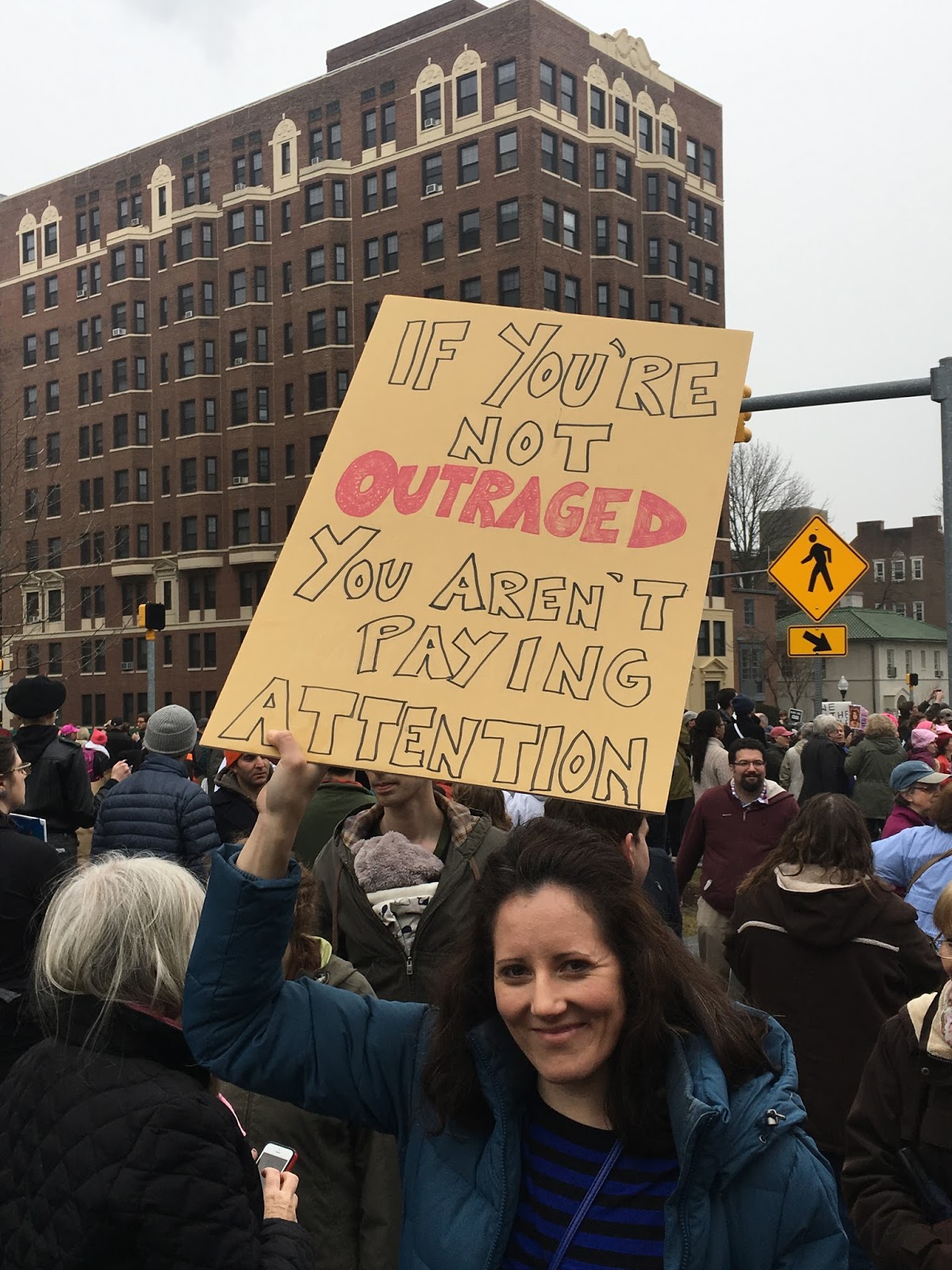
Women's march January 2017


"Our opponents, the media, and the whole world will soon see … the powers of the president to protect our country are very substantial and will not be questioned,"
(Stephen Miller, Trump Senior Policy Adviser)

"There are massive numbers of non-citizens in this country who are registered to vote," Miller told ABC News. "That is a scandal; we should stop the presses. That's the story we should be talking about, and I'm prepared to go on any show, anywhere, anytime and repeat it and say the president of the United States is correct, 100 percent." (Stephen Miller, Trump Senior Policy Adviser)
The daily turmoil starts at breakfast
   
Still true: Baltimore protest
This country is in a crisis. And if you're fighting to save this country, if you're fighting to take this country back, it's not going to be sunshine and patriots. It's going to be people who want to fight. Stephen Bannon, Trump Adviser and Member of the Security Council

How this reputable German weekly sees it

Its not all black or white in Baltimore's neighborhoods

The incredible discrepancies and inequalities between Baltimore's poorest and its richest neighborhoods has furthered an idea of Baltimore as rich white areas and poor black areas, a striking narrative that has some truth but isn't the full story.

For example Pigtown, a neighborhood that made it on the front page of the SUN on Monday, because it has again two competing community associations. That is a replay of a period when one faction wanted to name the historic southwest community Washington Village after the community's spine, Washington Boulevard. The other wanted to keep the more proletarian name Pigtown. It won out except in the brochures of real estate agents. Pigtown will soon proudly display a large pig as part of a 36 foot steel weather vane placed on the gateway into the community at Martin Luther King Boulevard.  The artist: Rodney Carroll who has made sculptures for cities across the country. He is a local pioneer who established his residence, studio and workshops in a couple of old warehouses in Pigtown where he also maintains a sculpture garden.(Here about the history of the name).
Gateway sculpture made by Rodney Carroll. A pig at 36' (SUN photo)

Fears of gentrification and the desire for revitalization were behind that battle and have been close cousins in Pigtown for decades. Successful small redevelopment projects at the fringes have stirred hopes of revitalization when Barre Circle, Roundhouse Square on Pratt Street, and Mount Clare Square  have gone on the market in the 1980s and 90s. The largest game changer came in shape of the Koppers site, an industrial
the pig as a weathervane (model)
brownfield that stood vacant after a fire had gutted the old foundry's warehouse in November of 1987. The site sits right next to the B&O museum and its redevelopment was a story of starts and stops, just as the story of the entire community.  In 1994 local developer Lisa Worthington first won the vote of the community for her development proposal (with my firm ArchPlan as the architect in collaboration with Peter Doo architects) and then pulled the plug on her development proposal. She was followed by a team with Otis Warren. But he, too withdrew when the site cleanup cost ruined his pro-forma after large concrete foundations were discovered. Finally, five years later, Camden Crossing, a 144 unit townhouse development really began to happen. Critics complained that the townhomes were out of scale, out of style and out of the price range of Pigtown.
Camden Crossing: Oversized townhomes

Each time Pigtown boosters thought  the neighborhood had turned the corner and each time others thought the community gentrified too much and would lose its quirky character and poorer residents. In spite of the new residents the commercial strip on Washington Boulevard long remained a pretty sorry affair with many vacant storefronts until the shops were managed by a Main Street organization. A coffee shop was a trail blazer, then Senator, now Mayor Catherine Pugh added a popular consignment store, and lately a whole wave of new stores opened up. Now two associations are at the old debate again. But the story of Pigtown is not one of white versus black.

What is usually lost in the debate is that Pigtown is one of only six communities in Baltimore where neither white nor black residents are the majority population. No ethnicity has a clear majority. The other five are: Brooklyn, Curtis Bay, Downtown/Seton Hill, Greater Charles Village/Barclay, Highlandtown and Patterson Park.

Another indicator for diversity is the "diversity index", defined by the Baltimore Neighborhoods Indicator Alliance (BNIA) at the University of Baltimore as:
the percent chance that two people picked at random within an area will be of a different race/ethnicity, whereby the number does not reflect which race/ethnicity is predominant within an area. The higher the value, the more racially and ethnically diverse an area 
Pigtown scores a proud 61.2 with only a few communities having a higher diversity ratio. Those include the Southeast (73.4), Patterson Park and Highlandtown each score the highest with 77, Charles Village/Barclay (67.8) Westport with 62 and Midway with 61.8, which is also the value for Little Italy. Not surprisingly, Sandtown Winchester has the lowest diversity factor with 7.3. (BNIA 2014 data).
Baltimore's ethnic composition

There is no law that says that diversity is necessary for economic recovery but the statistics strongly suggest that those communities that have a healthy diversity factor have a much higher chance to recover. Even the very wealthy communities of Roland Park, Guilford and Homeland don't have the extreme segregation characteristic of the poorest communities. (Their index is around 40). From the list of high diversity communities Patterson Park, Highlandtown, Charles Village/Barklay, Southeast and Little Italy are all stable or come-back communities. The newest neighborhood is downtown and its diversity ratio is encouraging as well: 68.8.
Poverty distribution in Baltimore (source: VCU report 2012)

The narrative of the "white L" and the "black butterfly" describing the shape of the map showing the ratio of black population is too simple. It is more accurate for the black butterfly wings (largely African-American communities on the east and west of downtown) than it is for the White L in the center. Attracting a diverse ethnicity is good for economic development, retail and services. Preserving the status quo or fear of newcomers isn't helpful if added opportunity is the goal. Pigtown is also proof that economic development doesn't have to mean displacement of blacks: The share of African Americans in the community grew from 49% in 2010 to 53% in 2015.


Klaus Philipsen, FAIA


Baltimore SUN 2005, Pigtown history and development
Baltimore SUN 1994, Koppers Site Redevelopment
Baltimore SUN 1999, Camden Crossing,

Friday, February 10, 2017

Roadkill and Transportation Scoring

All the talk about crumbling roads and bridges notwithstanding, Maryland residents find smooth highways and byways with wide shoulders pretty much all across the State, especially outside urban areas. How much that is still true becomes quickly evident when one crosses into Pennsylvania where many back-roads are curvy, have blind-spots, humps and frequently no shoulders. How smooth rural roads are becomes also obvious if one enters Baltimore City where many roads and bridges are truly falling apart.
10% of the budget go to transportation

Not without reason. Maryland spends a larger portion of its overall budget on transportation than Pennsylvania, Virginia, Delaware or New Jersey; more than 10% or more than $2 billion in capital funds. Failing pipe infrastructure that is 100 years old forces Baltimore to dig streets up so often that they resemble moonscapes.

After the Governor redirected funds originally set aside for the Baltimore Red Line to road construction on the eastern shore and Garrett County many Baltimore are residents asked themselves, what exactly are the criteria under which transportation dollars are spent? The answer is not as rational as one would expect in a time of scarce dollars. Expenditure is far less based on needs than on politics and a desire to spread the goods around. For many local politicians, bringing home the bacon means bringing road money into his district.

Baltimore-based Delegate Brooke Lierman co-sponsored bill 1013 introduced by Delegate Pamela Beidle in 2016. It included scoring measures intended to make transportation spending more rational. (the Maryland Open Transportation Investment Decision Act of 2016). The bill introduces metrics such as

  • Increased facility life span
  • Change in travel time reliability
  • Mode connections and choices
  • Economic development
  • Travel time savings
  • Leverage of additional investment
  • "Complete Street"

The Hogan administration explaining how the scoring bill kills road projects
Even though the bill stands in a long tradition of similar attempts created by Republicans and Democrats alike, with the closest example right in neighboring Virginia, Maryland's Governor sank his teeth into this bill with fervor. He began dubbing it "the road kill bill" and vetoed it after it initially passed. The veto was quickly overridden by the Democrats.
Now in the 2017 session the Hogan Administration has introduced an "emergency bill", HB402 to repeal the scoring requirements:
Repealing specified State transportation goals; repealing a requirement that the Department of Transportation score the extent to which specified transportation projects satisfy the goals; repealing a requirement that the Department develop a specified scoring system and promulgate specified regulations; repealing a requirement that the Department, in accordance with the specified scoring system, rank major transportation projects for inclusion in the draft and final Consolidated Transportation Program; etc.(HB 402)
The fight seems even more irrational than the transportation expenditures themselves, since the bill wouldn't have the teeth to stop a single project. The Governor is using the bill to cement a populist narrative in which urban liberals are trying to take rural roads away, especially for transit. The reality was exactly the opposite: when Hogan took nearly $3 billion off the table that had been set aside for Baltimore City and County to build the Red Line. (About $700 of which would have been State funds that were re-assigned). The state’s highest-ranking legal officer, the attorney general, says Hogan’s “Rogue One” interpretation of the law is pure science fiction.
A map created by the Baltimore Transportation Equity Coalition
showing the spread of yellow expenditures for roads 

The narrative of urban versus rural mirrors the election results for Hogan and the recent presidential election. It feeds the false notion that large dysfunctional metro conglomerations like Baltimore City and County are feeding off the rural hinterlands that have to fight for the crumbs that are left.

That narrative has nothing to do with reality. The Baltimore metro area alone makes up about 50% of the State's population, add in the urban areas of Maryland around DC (Montgomery and PG with about a million residents each), and one can get easily to about 75% of the State's population living in urban areas even if one discounts the rural portions of the counties located in the metro areas). No matter how one calculates the revenues (via income taxes, gas taxes or Vehicle Miles Traveled - VMT) the urbanized areas put more into the budget than they take out while they bear the brunt of the dysfunction of the current spending priorities: Congestion, air pollution, long commute times, decrepit roads and insufficient transit.
Activist's flysheet about the scoring process (source: 1000 Friends of MD, CMTA)

Maryland's transportation scoring bill has its weaknesses, some of the metrics are poorly defined or hard to measure, and the sponsor herself says "its just a score", meaning it doesn't bind the administration's hands. It was Republican President George Bush, senior, who inaugurated the Intermodal Transportation Efficiency Act (ISTEA) in 1991, a landmark national transportation bill that stressed intermodal connection, allowed transportation enhancement funds to go to trails and bike-ways to promote alternative transportation. ISTEA also required to look at the effects that transportation has on air quality and included Major Investment Studies as a way to ensure that alternatives are compared and evaluated and criteria for projects are met before they get build.   The bill did not prevent Sarah Palin's Alaskan "bridge to nowhere" but has brought at least some reasonable deliberation to federal transportation spending in America.

The time when transportation projects are simply funded because they are wanted by a political buddy should be over. Too many competing needs for money make it almost immoral to widen perfectly fine roads in rural Garret County devoid of traffic for political reasons while urgent needs in dense areas remain unmet.  The new Administration in Washington has threatened to remove some of that progress from their own brand of transportation policy. Governor Hogan should not fan the flames of populist divisiveness. The scoring bill is not a "road kill bill" and he knows it.

Klaus Philipsen, FAIA
updated

Transportation for America's article about the Maryland road bill fight
Detailed Republican critique on the scoring bill by Robert Flanigan
Hogan vows to repeal the Road Kill Bill (Baltimore SUN) Dec 2016
Rascovar: Hogan's Hoax
Recommendations for Better Project Scoring (Suggestions for each of the scoring metrics)


A fake news release making fun of the Road Kill bill discussion that was circulated yesterday:

For Immediate ReleaseFebruary 9, 2017Contact: Sean Emerson(301) 858-3649Marc.Korman@house.state.md.us
LEGISLATORS INTRODUCE ROADKILL BILL OF 2017
Bill Would Ensure Roadkill Is Peeled Off Of State Highways
Delegate Marc Korman and 32 other Delegates today introduced The Roadkill Bill of 2017.  Following Governor Hogan’s 2017 State of the State Address,[1] in which he asked legislators to address the roadkill issue, legislators have introduced this timely proposal.  Because it does not include mandated spending, cannot be mischaracterized as a tax, has a catchy name, polls well, is unopposed by big business, and is unrelated to Donald Trump, it is expected that the Administration will not show up to testify and allow the bill to become law.
“I agree with Governor Hogan that road kill wreaks havoc on our entire transportation system.[2]  Like him, I believe it is important we peel the roadkill off our state highways (I may have misheard him),” said Delegate Korman.
Existing state law[3] requires the State Highway Administration to remove “any animal carcass that will impede traffic or substantially endanger the safety of the traveling public.”  The Roadkill Bill of 2017 would require the Administration to consult with interested parties and adopt timely and comprehensive regulations to establish an accessible process for citizens to report roadkill on state highways.
“I agree with Governor Hogan that roadkill is a scourge in our state,” stated Delegate Andrew Platt, the top co-sponsor on the bill.  “Indeed, this bipartisan issue unites rural Maryland, urban Maryland, and suburban Maryland.  When it comes to roadkill, we are one Maryland.”
The bill will be referred to the Environment and Transportation Committee where it will be the subject of a hearing.

Wednesday, February 8, 2017

Caves Valley pulls out of Cross Street Market deal with City

The South Baltimore Cross Street Market has seen a fair share of victims and terminated deals, lately. First development partner War Horse LLC pulled out as a development partner and split from Caves Valley. Then Caves Valley terminated long time market tenant Nick's Seafood. Then the developer told all merchants that they would have to vacate the market for the duration of the renovation. Now, abruptly and only a few weeks after signing a deal and having been assigned the development rights by the City, the developer Caves Valley is pulling out of the deal altogether. The Market Corporation issued a statement:
"There is a divergence of opinions on the future vision of the market. In light of today’s announcement, BPMC will need time to regroup and consider next steps for developing an action plan that will have the best interests of both the community and merchants in mind."
Just a week ago Market Director Robert Thomas had described the Cross Street Market experiences for Community Architect Daily with these somewhat cryptic words:
I consider the Cross Street disposition an important and informative episode in the history of Baltimore’s public markets. Lessons learned, and being learned, from this experience will inform outcomes of the next two RFPs, along with other factors not totally under control of the Markets corporation. (Robert Thomas)
The episode now gets a complete re-boot. Reactions to the fact that Caves Valley's departure puts everybody back to square one are mixed as the BBJ reports this afternoon. Given that the market has fallen on hard times for quite a while, to have no plan in place now isn't necessarily good news. However, the turmoil that Caves Valley had created in spite of a very long time of negotiating the deal with the City in the first place, wasn't good for the market either.
Back to square one: Caves Valley is out

One can't help but suspect that the developer wasn't quite ready to engage in a complicated situation like this. Caves Valley is a developer used to success but also to getting their way. They have shown in Towson that they don't shy away from bloody battle with communities, a strategy that  doesn't work as well in Baltimore City where developers like Seawall (R-House) or Sagamore Development have set a recent standard that puts a premium on public benefit, long-term strategies and accommodation of community demands instead of taking a hard and combative stand. Whatever was made public about the future of the market did not seem to be in line with how public markets are defined, for example having local merchants instead of national chains.

Public markets have a public purpose. This means they are probably not profit centers for a developer. Caves Valley had engaged in the Cross Street Market knowing that engagement here was complementary to their investments on Light Street, in Sharp Leadenhall and the Casino. As such the developer wasn't dependent on a reasonable return on investment just from the market alone. It will be difficult to find another investor who can take this broader approach across various projects.

Inevitably the question will have to be asked, whether public markets can really be operated more successfully by private entities than by the City itself. To make "the numbers work" that could mean asking whether the Casino benefits set aside for the South Baltimore community could come into play to ensure a market that maintains public interest in healthy affordable food, a diverse community space and remains a business opportunity for truly local merchants.

Without inside knowledge in the Cross Street Market situation, it is hard to tell what exactly went down here, except that one can easily say that what happened isn't the way a development deal that involves City property should unfold as part of a public-private partnership, even though those frustrating terminations aren't unheard of. One simply has to remember the Superblock.  The Baltimore Fishbowl reports that Mayor Catherine Pugh said in a statement that the Baltimore Public Markets Corporation “is reviewing its options” and will again engage community residents “to fulfill the vision” for the Federal Hill location.

“Public-private collaborations will be key, and I want to see Cross Street Market become what the community wants and certainly deserves,” she said.

One can hope that the City takes the experience to heart when it considers the proposals for the Hollins and the Broadway Markets which will be due next week. Likely, the City issued those requests for proposals (RFPs) without enough conditions in place to prevent a similar debacle for those two markets. It isn't too late yet to put those safeguards in place.

Klaus Philipsen, FAIA

BBJ: Caves Valley Partners pull out of Cross Street Market Deal.

City lights and politics

On the occasion of Baltimore's 200th anniversary of the first gas street light the good old city street light was attributed yet another role, one rarely mentioned: The role of being a beacon of public-private partnerships. That is what James Smith, Chief of Strategic Alliances for Baltimore Mayor Catherine Pugh, said at Tuesday's bicentennial ceremony near City hall where Baltimore's first gas street lamp still stands.
200th birthday: The streetlight (SUN photo)
Smith was alluding to the complicated relation that Baltimore Gas and Electric (BGE) and the City have when it comes to street-lights.  BGE as a company actually goes back to the first streetlight as well as the company charged to provide a network of gas lines to feed the new technology of gas lamps and was called the Baltimore Gas and Light Company. So it is BGE's 200th anniversary as well this year, even though the good old municipal utility is long part of a national conglomerate called Exelon and has advanced from serving a few downtown streetlamps to serving over 650,000 gas customers and a million electric customers in the region.

But back to the streetlight: If a streetlight is out, and many seem to be out especially in Baltimore's poor neighborhoods, it isn't easy to decide whom to call and who is responsible for fixing it. In Baltimore only 10,000 of the 70,000 street lights are owned by the City and the rest is owned by BGE which has occasionally led to bickering instead of partnership, for example when it came to conversion of the lamps from metal halid or high pressure sodium to LED.
Light levels are said to be related to crime levels SUN photo)

To say that the relations are complicated may be an understatement when it comes to parsing out who owns what before a street light emits light: Its not only who owns the post and lamp but also who owns the power supply. In the City the answer is usually, the city owns a duct bank or conduit under the street and BGE owns the cable in it and all the switches, shut-offs and power stations from the power generation to the point of consumption. The electric juice inside could be sold by BGE but also by a number of others electric power suppliers that are competing in an open marketplace. But yes, it is a public-private partnership as the Mayor's strategist says.

That is an important point for the Mayor who has identified additional street lights as a crime fighting tool. This is in alignment with the guidelines provided by "Crime Prevention Through Environmental Design" (CPTED) and international organization devoted to what its name says. Baltimore police has long subscribed to the notion as well by placing mobile generator powered lights in high crime areas, a rather inelegant solution that blasts bright light into windows of the houses along those streets and stigmatizes a crime area in the same way as the blue flashing lights mounted to the tops of streetlights. Catherine Pugh imagines her safety initiative  less conspicuously as additional regular streetlights,
"I know there's been a promise of 6,000 new lights on the streets of Baltimore and I want to strategically decide where they will go on." (Pugh in a press conference on December 14, 2016)
One way to bring more light is the already noted conversion of the lamps to LED which turns in many cases the yellowish old sodium lamps in a much brighter white light that allows better identification of faces, colors and other details on the streets or sidewalks aside from saving electric energy.

The "cobra head" street light with high pressure
sodium lamp and monochrome light (photo: Philipsen)
But light, crime and public private partnerships isn't all there is to streetlights. Increasingly, they are also noted as important elements of the "smart city". As items of innovation just as Baltimore's first street light was in 1817 when it was the first gas light in America's urban streets. A smart light now is a place where data and information are collected, not only with cameras mounted to the poles, but also with sensors that can hear gun-shots (Baltimore police tested this already in some places) or sensors that can feel if someone is around and turn itself off or into a lower state of brightness if not. (The lights already have sensors that turn the lights on and off, depending on ambient daylight levels). Streetlights are also suitable as small cellphone towers or as places to distribute free WiFi. As such they can create more equity in access to information in neighborhoods where some students have to do their homework hanging out near their school walls to catch a WiFi signal since their parents don't have the money to buy Internet service for their home.

But more light isn't always good. At least that is what the Dark Sky advocates say who set out to reduce light pollution resulting in the increasing inability of seeing stars in the night sky, even on a clear night because city land suburban lights cast a bright glow over it. The modern street light is a "cut-off" fixture that casts its light more or less straight down and not into the sky or sideways like Baltimore's first gas light did it; but since the modern light has so much more oomph (lumens and footcandles) the light bounces back from the pavement and up it goes. Anyone who has looked down from an airplane window on a clear night can see how especially gas stations, shopping centers and ball-fields are so brightly lit that one can easily identify them even from 30,000 feet. In fact, night satellite photos from space reveal better than anything how much space sprawl and its twin, the streetlight. have devoured.
The retrofitted LED street light
with with a white light (photo: Philipsen)

Meanwhile, the streetlight as part of the electric grid  is as vulnerable as the entire grid. If the grid goes down, so do the lights and traffic signals. Only Baltimore's first streetlight on Holliday and Baltimore Street will still glow. It is still gas powered, and as such also a symbol of resilience.

Klaus Philipsen, FAIA


Tuesday, February 7, 2017

Buy American: Example MTA buses

Few people would guess that a standard 40' MTA bus costs over half a million dollars. $556,774.00 to be precise.  The previous generation of MTA's hybrid buses cost even more, about $750,000.

New MTA New Flyer diesel bus 
Even fewer people know that transit agencies using federal funds (nearly all of them) have to buy American made buses by law and that transit agencies can choose only between three North American bus companies: New Flyer (MTA's buses, headquartered in Winnipeg, Canada), Nova (St Francois du Lac, Canada) and Gillig (Hayward, California. (another bus maker, North American Bus Industry, NABI was purchased by New Flyer in 2013).

New Flyer and Nova assemble their buses in the US to qualify. 49 CFR661 mandates that 60% of a bus' components by cost must be of US origin. One can easily imagine what such a % figure does for rational manufacturing. Such as skimping on the chassis so it stays under 40% if it is foreign made.

To make matters worse, both bus companies use the same Cummins engines to propel their buses.
The New Flyer bus hybrid diesel electric model

When the MTA bought recently 172 new buses for 97.8 million (162 of them replacing old buses, 10 are added to the fleet for the Baltimore Link roll-out), only New Flyer provided a bid, the other company was too busy to even bother. All buses are 40' buses, the 60' "articulated" buses cost even more.

By now readers will guess that the Buy American requirement has a price.  The provision is in effect since 1991 but it is also a suitable illustration in the discussion about "America First". Trying to buy and make only at home can back-fire, not only in real hard $ but also in choice and in product quality.

The MTA has a fleet of 750 40' buses plus about 40 articulated buses and moves about a quarter million people a day. (By comparison: MTA New York runs 5,750 buses).
The Gillig bus, America's largest bus manufacturer

That's a lot of people who care about how quiet, smooth, clean and reliably their bus runs. The MTA has the 26th largest bus fleet in North America according to 2015 data, but the 7th largest New Flyer fleet. Could MTA bus patrons have a better ride, quieter buses, higher fuel economy and a more modern design if  bus companies could buy from an unrestricted market? Would transit agencies have to pay less? New York's MTA which doesn't use federal funds for their buses occasionally thinks so. In 2008 a sleek articulated Mercedes Benz bus could be seen plying Manhattans streets for test purposes only.  No purchase came of it.

Hard to say how foreign buses would compare. Even though the geographic spread of the market is huge, North American bus manufacturers don't have an easy time to survive. The number of just two companies is testimony to many bankruptcies and buy-outs in a market where demand is based less on need and more on what funds bus operators have access to to buy replacement buses. (FTA can provide up to 80% of the cost with a 20% local match). If no federal money is available transit agencies run their buses beyond their 12 year expected life span to the detriment of rider service and the detriment of the manufacturers. (MTA's oldest buses are 14-15 years old, according to Administrator Paul Comfort).
The Mercedes Citaro city transit bus

The corpses of bus makers line transit routes, so to speak. They include foreign makers that tried their hand with plants in the US: Among them the  German bus company Neoplan (bankrupt in 2006), Orion a subsidiary of the German Mercedes Benz company. The US bus maker Flexible went bankrupt in 1996. The scarceness of available US buses poses transit agencies in a precarious condition. At times they have to wait for their buses. Certainly not a condition that generates price competition. This situation may be temporary.

New technologies will certainly shake up the bus market, just as Tesla demonstrated it in the car market. Already there are two small bus companies (one with Chinese roots) that make all electric buses. Federal agencies also tested fuel cell buses.

In the meantime, anyone who ever rides  Dutch, German or French buses will realize that US transit buses seem to lag behind their European counterparts in design and innovation. Low-floor buses, now  also common here, were first introduced in European cities; so where buses with three doors, wider front boarding doors, longer rigid body buses with double rear axles, double-articulated buses for BRT on separate right of ways, and buses with frame-less glazing for the side windows.
CityPilot self driving bus

A new Mercedes Benz Citaro Euro 6 bus could be bought for $300,000 in 2014. It can be bought with EPS (electronic stability system) and as "CityPilot" it can also bought as a self driving version for test purposes.

"America First" is tricky business.

Klaus Philipsen, FAIA

updated for inclusion of Nova Bus

Baltimore Business Journal article about MTA bus procurement
Mineta Transportation Insitute report: The US Transit Bus Manufacturing Industry
Fuel Cell bus report
New York is testing a Mercedes Benz Bus
Citaro Bus brochure

Monday, February 6, 2017

White Supremacy in Port Covington?

When Baltimore elected the new slate of City council members it was clear that things wouldn't be any longer as they were before, when critics described the Council as a "rubber stamp" for the Mayor.

The new more combative Council could be seen in action several times already, for example when Councilman Zeke Cohen questioned the MTA about charging extra for for bus rides on the student passes for after school activities. Ryan Dorsey was right on his side. Next up: Minimum wage.
Council candidate Dorsey making his case before the
election (Photo: Klaus Philipsen)

Dorsey who represents the third District upped the anti last week with a Facebook comment on the Baltimore City Voters Facebook page. His comment appeared under the link of an article that stated that Kevin Plan was one of the members on the President's "council" on economic advisers which had sprung from an initial breakfast meeting to which the President had invited industrial leaders.
Ryan Dorsey White supremacy cozying up to white supremacy? Shocker.

"Quisling" probably isn't even an appropriate term to use. It specifically refers to a local traitor getting in bed with an occupying force. Plank is not a local. He is not from Baltimore. He doe
s not live in Baltimore. He is not about Baltimore. He is, himself, an occupying, colonizing, culturally appropriating force.
 
The comment didn't go unnoticed and soon commentary came form all sides, including the Mayor, the City Council President, fellow council members and Joshua Harris, the Green Party's candidate for Mayor who had lost against Catherine Pugh. Harris wrote this in response to Dorsey's comment:
Joshua Harris
February 4 at 6:18pmBaltimore
I would like to take a moment to say thank you to councilman Ryan Dorsey. I applaud his willingness to use his personal (white) privilege to shed light on an issue often swept under the rug and ignored in our city. In the face of political correctness and political theater he spoke truth to power, and stood by it. As a black man, I am often afraid to speak to issues of race, not wanting to be viewed as the "angry black guy". I truly applaud Dorsey and other white allies that I have seen in action: Nina Therese KasniunasDavid Troy Roshelle Kades Andy Ellis Andreas Spilly Hon Spiliadis Jen Fischetti Molly Amster Madeline Suggs Megan Kenny and many others. I hope that this has been an opportunity to further the dialogue about "Whiteness", what it means to not merely be a philanthropist from a distance, but risk and set that "Whiteness" aside to truly become an ally in the fight against structural, economic, and environmental racism and white supremacy. In the age of a Trump presidency this is a glimmer of hope. We need more folks willing to take a real stand even if it means risking it all. THANK YOU!
Councilmember Costello was less enthusiastic:
Eric Costello February 3 at 5:04pm 
The comments about Kevin Plank are simply untrue, disgusting, and are unbecoming of a member of the Baltimore City Council. This type of baseless and reckless rhetoric adds no value to moving our City forward. A public apology is warranted.
The SUN ran an article about the controversy which included a statement from Mayor Catherine Pugh:
"I am shocked. I have known Kevin Plank for almost two decades. He is a great Marylander, a great person and someone who is doing everything he can to lift Baltimore. Everywhere I go, in every corner of this city and this country, people talk about what Kevin Plank is doing for Baltimore."
The Dorsey comments opened the discussion about the wisdom of the tax breaks for Port Covington all over again, even though the matter is a done deal with legally binding papers that the previous Mayor, Council and Board of Estimates had approved.
Council hearing about Port Covington TIF in 2016 (Photo: Philipsen)

I sent Dorsey a number of questions asking for a written interview for this article. He sent me instead an article that apparently is intended as an op-ed in the SUN in which he digs his heels deeper in explaining his statements in the broader context of systemic racism and in the context of the Memorandum of Agreement between the City and Sagamore. In explaining his stand Dorsey says on Facebook this morning:
"I also believe that Plank's Port Covington development benefits White Baltimoreans at the expense of Black Baltimoreans. It relies on financial assistance from a Black-majority City to build a community that a majority of Black Baltimoreans may not be able to afford. Each of these actions treats issues of racial disparity and discrimination as secondary to business opportunity. This trivialization of race reinforces systemic racism, and by reinforcing social, political, and economic systems that disproportionately benefit White residents, falls under the umbrella of 'white supremacy'. I stand by my statements..."
Unfortunately, the references to the MOU that Dorsey makes in his op-ed don't seem to reflect the amendments that his predecessor Council members and the African American ministers of the BUILD coalition had negotiated and quote an older version of the MOU. The amendment improved numerous conditions including the referenced Affordable Housing requirements which Dorsey quotes in his editorial in their old version. The amendments read as follows:
1. Doubling of Commitment. The Amended MOU doubles SDC's inclusionary housing commitment to require that SDC provide income-restricted residential units equal to 20% of all residential units at Port Covington. At least 60% of these units must be provided on-site, while the balance may be developed offsite to address affordable housing needs in other City neighborhoods.
2. Affordability. At least ten percent (10%) of the affordable units, whether on-site or off-site, will be affordable to households at or below 30% of Area Median Income ("AMI"), so long as housing vouchers or similar assistance is available to SDC. SDC will also seek low-income housing tax credits ("LIHTC") to develop
units affordable to households at or below 60% of AMI, with at least five percent of the units affordable at or below 50% of AMI. If LIHTCs are not awarded, the required units must be affordable at or below 80% of AMI.
3. Required Fund Payments. If on-site affordable units cannot be constructed on a financially reasonable basis, SDC must make payments to the City’s inclusionary Housing Offset Fund, in amounts from $40,000 up to $60,000 per unit. For off-site units, the range would be $30,000 to $50,000 per unit until the City and SDC share in profits, when payments related to off-site units would increase to $40,000 to $60,000 per unit. 
I know Ryan personally and supported His run for the Council seat. I also responded recently to his invitation to speak about the student bus fares. His courage to step out of the generally approved line of consent and voice a different opinion is laudable, so is his intent of shedding light on institutional racism and the deplorable inequalities of Baltimore. I certainly share his severe concerns about the President's actions. But  all of that should be no reason to resort to the same simplified fire-bombing rhetoric that isn't based on fact.
A more activist Council: Zeke Cohen at the podium, Dorsey on the right. 

The participation of the various company leaders at the President's breakfast to which they were invited certainly doesn't constitute an endorsement of the policies of the one who invited. It represents nothing more than a willingness to learn and listen in dialogue, the same willingness that the Mayor and Congressman Cummings had also voiced. There may have never been a time when dialogue was more important right now. At least for the time being it is still true that it is better to be "at the table" than "on the table".

Only one industrial leader has since resigned from what the President has since morphed into an "advisory economic council", the CEO of Uber. His resignation was more a response to his own company's flap at the small New York taxi strike against the President's travel ban than a full throated political gesture.

There is no question that Baltimore has all the problems Dorsey references. But there is also no question that no city in America can prosper without a sound economic base. New anti-government and anti-trade policies coming from Washington represent a clear and imminent danger to Baltimore's economy. To have a successful entrepreneur who has built a large company in Baltimore being included among the CEOs of Uber, Dell, Dow, Intel, Boeing, Ford and others is not a small thing for Baltimore, nor is Plank's commitment to local manufacturing. To make it an issue that Plank lives in Baltimore County and not in the City seems rather myopic, in that context. In the bigger picture Baltimore needs to be seen as part of the region anyway, a metro region that includes the Washington region and competes globally.

I am sure the current mayor and Council would have been a stronger force in the negotiations of the Port Covington TIF, where unions, churches and some Council members had to basically force the previous administration into a better deal.

There will be plenty of opportunities for being vigilant in the 30 plus years in which Port Covington will have to be realized according to the plans, commitments and intentions. But using a superceded MOU and warfare rhetoric is just not the way of doing it. I suppose BUILD and the African American leaders of the communities around Port Covington who all approved the MOU will tell Dorsey in due time.

 Klaus Philipsen, FAIA


Ryan Dorsey's complete statement explaining his positions and the original Facebook post:


On Friday evening, the Baltimore Sun devoted an article to comments I made in the Baltimore City Voters Facebook group, criticizing Under Armour CEO Kevin Plank’s decision to become an advisor in President Trump’s administration. I compared that decision to his company’s Port Covington deal.

I stand by the substance of these remarks, although they may have been framed in too shorthand a fashion for readers not involved with the forum. I spoke knowing that most readers of the forum understand the historical context, and that my remarks about Plank refer to systemic forces, not personal attributes.

There is a persistent notion that those who elected Trump can be viewed as cartoon racists: poor, uneducated rednecks who use racial slurs and spout hatred. The reality, however, is that Trump’s win was carried by far more polished, professional types. Pew Research shows that Trump won college educated Whites by a 4-point margin, and as CNN’s exit polling shows, Trump won a majority of Americans making $50,000 or more, whereas Clinton won voters making less than $50,000 per year by a 12-point margin.

You will never hear most of these Trump voters use the n-word, foment Islamophobia , or promote sexual assault.  I am comfortable assuming that Trump voters shy away from such language not just because it is impolitic, but because they truly believe Trump is wrong in those areas. The problem is that these voters allow other issues, including economic issues, to become more important than misogyny, racism, xenophobia, or prejudice of any other sort. It is not a coincidence that those most likely to view matters of systemic inequality as secondary to other issues are also those who benefit from existing systems. By being willing to accept or ignore these systemic forces, including systemic racism, these men and women only help to perpetuate it.

No self-respecting Democrat can defend Donald Trump’s track record of prejudice. For months now, we have heard a chorus of public figures talk about their commitment to not normalizing Trump’s behavior, and not engaging with his administration as though it represents a legitimate approach to governance or the views of a majority of American voters. Yet, it seems for some, I crossed a line by criticizing Kevin Plank for doing exactly that.

When Kevin Plank aligns himself with Donald Trump’s administration by serving as an advisor to it, he is normalizing Trump’s behavior and treating his administration as legitimate. He is also earning a significant amount of potential political capital with these actions. In the process, Plank has become a representative of sorts for our City within the Trump administration. We should look at Plank’s track record to better understand what that might mean for Baltimore.

I do not pretend to know what is in Kevin Plank’s heart, but I do know what is in his memorandum of understanding for Port Covington. In issues of public policy, it is the actual impact on people, not the intended impact, that ultimately matters.

Take Port Covington’s inclusionary housing agreement. It makes 10% on-site affordable housing a goal, not a requirement, and defines affordability as 60% of Area Median Income (AMI). It does not require that these units be built unless Low Income Housing Tax Credits can be secured for them. If the tax credits are not secured, the memorandum raises the affordability ceiling to 80% AMI. Again, 80% is a goal, not a requirement. Ultimately, the developer can pay a fee that is significantly less than the cost of providing the units to avoid building any on-site affordable housing at all.

Because AMI is calculated for the Baltimore-Towson-Columbia metropolitan area, a rent payment based on an income of up to $46,000 per year, or $22.12 per hour, would be counted as affordable. Keep in mind, the median household income for Black households in Baltimore is $33,610, and the minimum wage is currently $8.75 per hour. The workers responsible for building Port Covington may also be unable to afford its affordable housing. The negotiated minimum wage for Port Covington's skilled trades is lower than Baltimore City's prevailing wage for all but 1 of the 98 listed skilled trades, and also less than the hourly rate needed to afford an 80% AMI housing unit.

That means our majority-Black City gave over a half-billion taxpayer dollars to a development that a majority of Baltimore’s Black residents may not be able to afford. Even Port Covington’s off-site affordable housing only requires “a preference for, but not a limitation to, locations that do not further concentrate poverty, as determined by the developer.” Those are tough facts to spin.  

That is just the beginning. Even as the vision of Port Covington remains mostly on the drawing board, its priority for City resources and attention has surpassed that of most Baltimore neighborhoods. Consider how our political capital to bargain for federal or state transportation funding is now occupied by the I-95 off ramps or Port Covington’s anticipated light rail spur, while infrastructure across most of the City’s majority Black neighborhoods continues to languish as it has for decades, having been cut in line yet again by waterfront development.

More broadly, consider the school funding issue. The state’s formula cuts funds when Baltimore’s tax base grows, in anticipation of more local taxes. Tax deals of the kind Port Covington is receiving mean those new funds won’t be available to cover the shortfall.  We are told that a short-term fix has been fashioned, and that a long-term formula fix is coming.  However, advocates have been warning all along of these consequences, and the time for fashioning a solution was before those consequences manifested themselves. City Schools ran a $50 million deficit in the two years preceding the deal, and suffered a $130 million shortfall this year. Who is harmed? A public school population that is 90% Black and Brown, in spite of White residents representing over 30% of the City’s population.

This is exactly how systemic forces take the actions of well-intentioned people, and use them to perpetuate a fundamentally racist allocation of benefits and costs. The system that organizes benefits and costs this way is called White Supremacy. If I choose not to speak out against it just because it does not harm me directly, I am enabling it. Port Covington—at least this round—is a done deal, but we must learn from it going forward if we are to truly undo the structural racism holding our City back.

I am glad that Kevin Plank has a philanthropic record, but Baltimore needs parity more than it needs charity. Charity, after all, is often aimed at the effects of structural ills (funding shortfalls) not the causes (unjust development). Addressing the latter requires a willingness to speak about it in clear terms. It also should not take a White city councilman to generate this degree of attention to the issue, when Black residents have made these same points for decades.