Monday, May 22, 2017

Denver and Baltimore

Except for Interstate 70 there is little that connects Baltimore with Denver even if both cities have an Italian imitation tower (Denver's Campanile versus B'more Palazzo Vecchio), downtown baseball stadiums and iconic mayors who later took care of their city as governors.
Denver's Campanile

Baltimore's Bromo
Tower
In 1830 Baltimore was the second largest city in the US, while Denver wasn't even conceived. (It was founded in 1858 and incorporated in 1861).  Even in the early 1950's Denver was only have the size of Charm City and as late as 2010 it was still smaller. But some time in the last years Denver surpassed Baltimore in population. It had to happen since Baltimore is shrinking and Denver became the fastest growing city in America. Next year the Mile High City is expected to heave 680,000 residents. Its location in the middle of nowhere has become its asset: There is no rival of similar size within 500 miles.

Denver hasn't been on an unstoppable upwards spiral forever. Far from it: its current boom is not the first the city has ever seen nor are the busts that usually follow.  The first knock came when the transcontinental railroad was designed to pass through Cayenne and not Denver. The city quickly recovered once it financed with great resolveand lots of private initiative the necessary connecting spur, setting a precedent that works to this day there.
Then there was the silver bust of 1893 and more recently the oil bust of the 1970s and later the dot-com and financial busts, each putting a temporary damper on the ambitions of the queen city of the plains located at the foothills of the Rockies. The ambitions were probably most visibly expressed by the plans for the nation's largest airport (in area): Denver International (DIA). But Colorado's geography, well suited for the increasingly popular active lifestyle and its distribution industries ideally positioned halfway between Chicago and LA, reinstated growth every time. 
Downtown Denver around 1925  (Denverite)
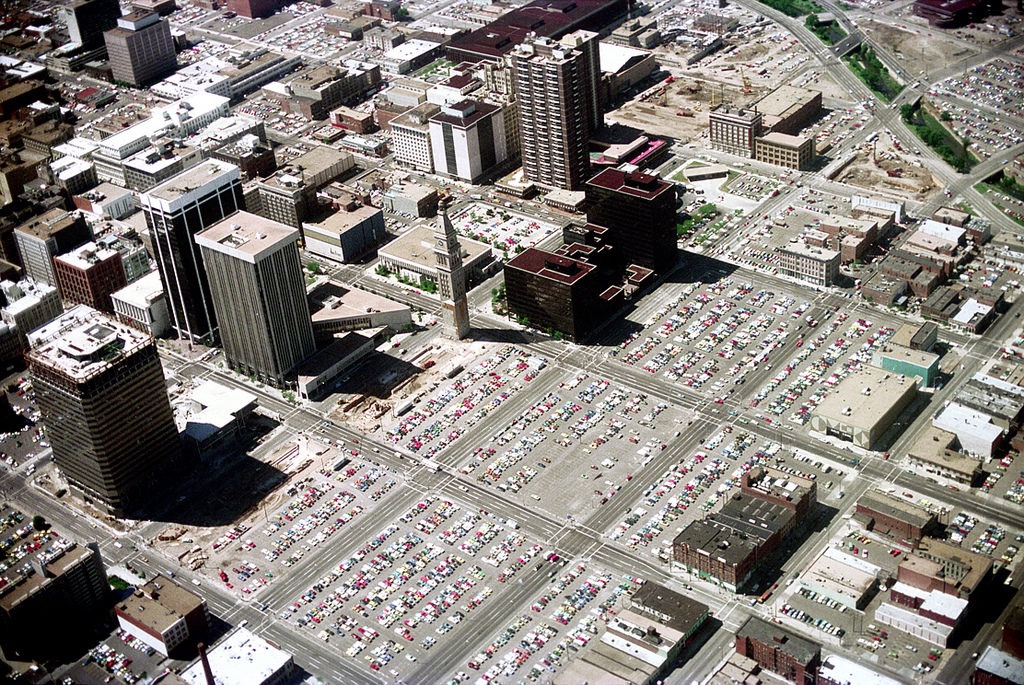
The result of Denver's urban renewal: Downtown 1976 (Denverite)

One could argue that all the buildings going up now are just beginning to make Denver a real place. Even with the infill, Denver is still far below Baltimore's population density as all western cities are. Because, or in spite of its comparably short history, the city of Denver treated its historic buildings with extraordinary disrespect. The City fell for the 1970's urban renewal and urban freeway mania with much more zealously than Baltimore. The result was that downtown looked for decades similar to that of Houston: A cluster of office high rises surrounded by block after block of surface parking lots. A cross-town interstate was successfully defeated but I-25 and I-70 still cut through the city proper.

Baltimore and Denver both built a pedestrian mall downtown to support whatever shopping remained. Baltimore's Lexington Street mall disappeared like most American ped malls but Denver's 16th Street, designed by Henry Cobb remains an attraction. Cobb worked in partnership with Ian Pei, the designer of Baltimore's World Trade Center. The mall is also the alignment for the free electric mall shuttle connecting two underground bus transit centers.

With so many new buildings, today's architecture in Denver is bolder, mostly modern, and less fixated on brick than in Baltimore. Philip Johnson, Daniel Libeskind, David Adjaye and Michael Graves designed architectural landmarks here. But even creative bold moves can become trite when repeated too often; some of what is currently en vogue will probably soon carry a time stamp just like previous decades which we now consider models of hideous architecture. 

Nostalgia is proportional to the speed of change and the one historic downtown block that survived the bulldozers, Larimer Square, is one of the city's major attractions today .
With their inverse trajectories Denver, a blue city in a red state turned the state blue and Baltimore, a blue city in a blue state couldn't prevent a red governor.
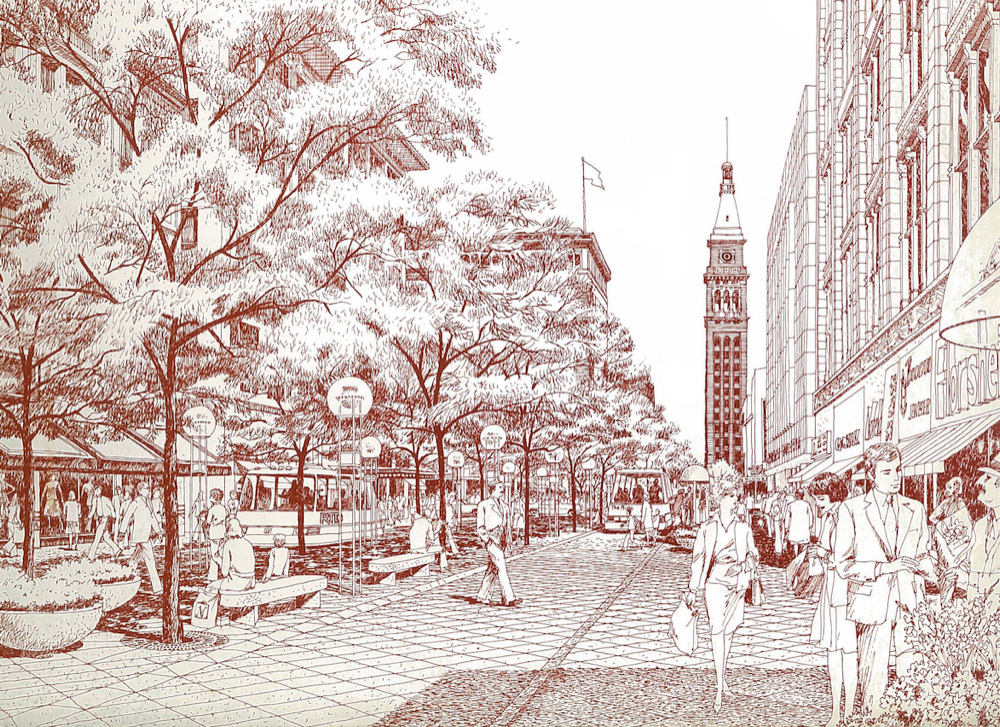
Cobb's 16th Street pedestrian Mall: Carefully designed (Denverite)
Both cities had a a good share of German immigrants and with it a history of brewing beer. Denver held on to the national beer brand Coors and also bred an exploding number of craft breweries that continue to colonize former industrial areas as spearheads of gentrification, for example in the RiNo district.

While one still ponders how much beer even the hippest town could possibly consume, a new economic power house built on "consumption" arises through the industrial scale production of pot. Whenever it smells sour and like old socks, natives explain, you are near one of those old factory buildings in which marijuana is legally grown. 

One cannot compare the two cities without talking about the huge difference in race. Denver is majority white with a population that is only 10% African American, in Baltimore over six times as many residents are black. A 1987 New York Times article wrote about the opportunities Denver presents to blacks:
Denver's black neighborhoods, east of downtown, look nothing like the poor inner-city neighborhoods of the East. There are few crumbling tenements or row houses. Instead, lawns are well-kept, trees trimmed, homes freshly painted. ''What you see,'' said one resident, ''is not a ghetto, but a struggling middle class.'
Five Points jazz festival: Gentrification
(photo: Philipsen)
Indeed, Five Points, a designated historic and cultural district, in which 90% of the African American population used to to live early in the last century, simply because they weren't allowed elsewhere, is a far less disinvested than Baltimore's Pennsylvania Avenue. It is the terminus of one of the city's light rail lines, home of the annual jazz festival and rapidly gentrifying. Unlike in Baltimore, gentrification is a real concern in Denver. It's not that the Mile High city would be overly wealthy, it's poverty rate of just below 20% puts it in a better place than  Baltimore's 23%, but the difference isn't as significant as one would imagine. The city has homesteading tax caps but began only recently with systematically addressing housing affordability. There is no inclusionary zoning law yet, but lately developers have to pay a fee that goes towards an affordable housing fund.

When it comes to crane counting, Baltimore would lose hands down and the development isn't all like a  "the wild west" gold rush. Denver's two largest development centers are well thought-out and the result of a orchestrated and inclusive planning process supported by visionary strong mayors such as Frederico Pena and John Hickenlooper and by a form-based new zoning code that puts much emphasis on TOD.

Pena's move towards the city-owned new airport DIA (by contrast, Baltimore sold its Friendship municipal airport to the State) allowed the redevelopment of the old Stapleton airport, with 4,700 acres the nations largest redevelopment (far out-sizing Port Covington), designed with a new-urbanist masterplan that includes a central park, various town centers and transit. Hickenlooper then set in motion the redevelopment of the Denver Union Station area, first by opening a brew pub there (before he became mayor), then by placing the baseball stadium there setting the stage for a massive transit oriented development.
Cranes over Denver, view from LoHi  (photo: Philipsen)

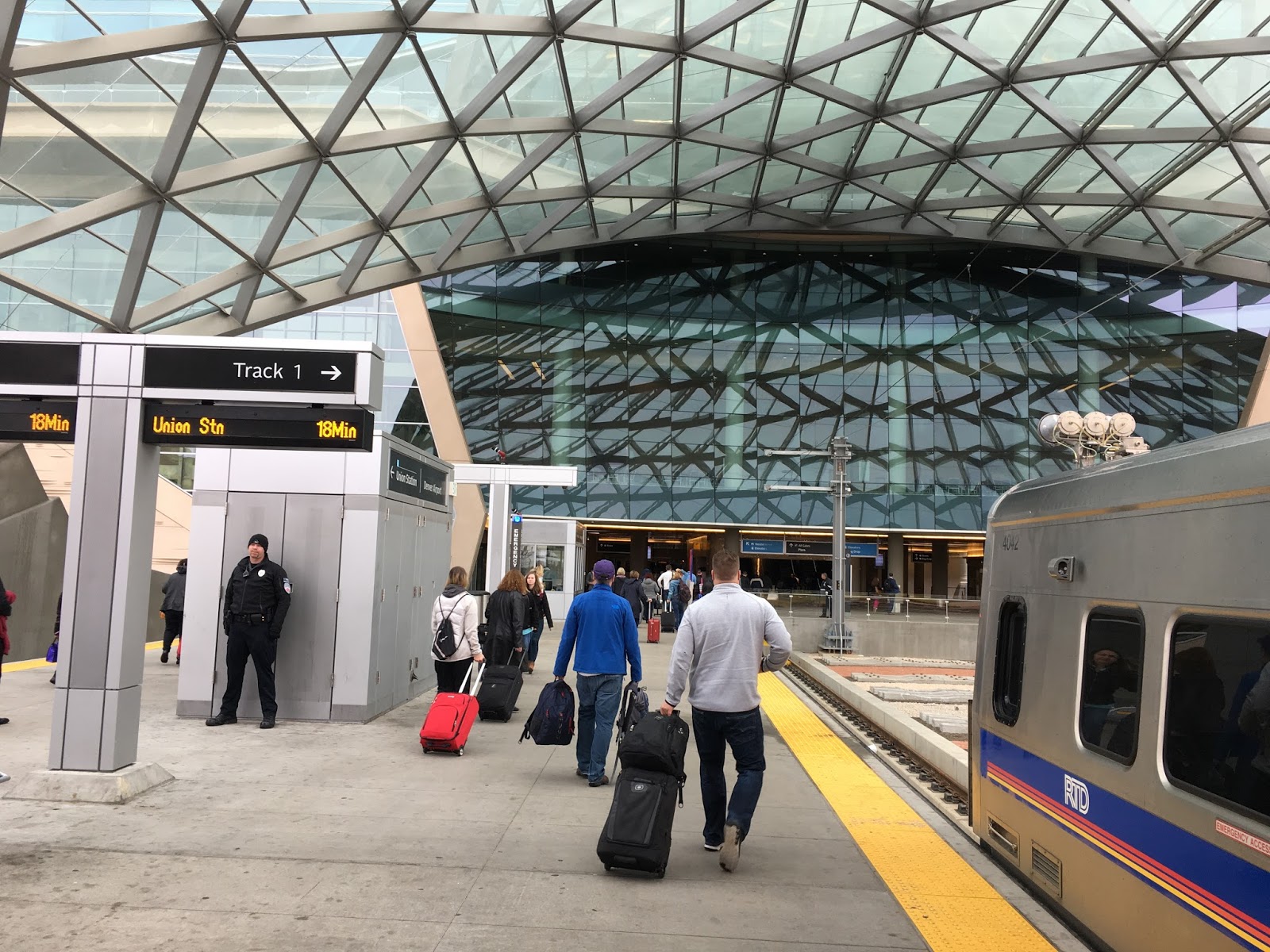
In spite of Denver's early railroad calamity at a time when Baltimore shone in the glory of the B&O, Denver soon surpassed Baltimore in the number of daily long-distance trains calling at its grand Union Station that easily beat Baltimore's Penn Station in splendor and size. But Baltimore kept its trains at Penn Station and Denver lost its importance as a passenger train hub. Today only the Amtrak Zephyr train comes to Denver while Baltimore. has dozens of trains to chose from, going either south or north. Yet, it was Denver that came up with a really ambitious plan for transit development in which it reinvented the transit that would stop here. It relocated an underground bus transit center, a light rail station, built a new Amtrak and a commuter train station and created in the process an entire new growth area of the city adjacent to its old heart. Designed for a 15 year build-out, the massive TOD has taken off so well that most projects are under construction or complete after only about five years.
TOD at Union Station in Denver (Photo: Philipsen)

It is this resolve to plan its future and stick with the plans that set Denver apart from Baltimore. After the Denver region and Baltimore completed their first light rail line, their transit pathways parted: Denver voted in 2004 for FasTrack, a ten year plan for ten additional rail lines and the associated TODs.

Many of the new lines are now in service. Airport trains are serving DIA, Stapleton and Union Station. The project was completed as a design-bid-build and operate P3 project, similar to what is planned for the Purple Line, although with a much higher local funding component and only 25% private money.

It isn't all glory in Denver's transit: The commuter train Gold line to Arvada is complete but can't open since FRA is withholding operations due to festering issues with positive train control and crossing gates.  But that is a small problem compared to Baltimore's Red Line transit project and the State Center TOD project having been taken off the table altogether.

Klaus Philipsen, FAIA

See also on Community Architect:

Four things to learn from Denver (2013)
Denver thriving (2011)


Train to the plane: A line station at DIA (Photo: Philipsen)
Train to the plane: Transit center and hotel at DIA  (Photo: Philipsen)

 
Denver Union Station: Amtrak Zephyr (left), commuter trains (right)
(Photo: Philipsen)

A new mixed use center designed by Gensler Architects is going up between Union Station and the light rail train station
Background: The suspension bridge that marked the beginning of the TOD (Photo: Philipsen)

FasTracks rail system map, current and planned


Friday, May 19, 2017

New construction: Hidden in plain view

Generally, even the most ardent architects, urban planners and construction geeks realize that the well-being of a city can't be soley measured by the number of cranes in the sky or by how much brick and mortar is laid down. Yet, biking around the central core of the city an architect can't avoid noticing construction in many places where a drive-by may not even reveal much. Hidden construction going on in plain view.


222. N Calvert Street. A canyon behind Mercy Hospital,
346 units, 430 parking spaces
Architect HCM, Baltimore

Hard to know which of these projects will make the City better. The more residents, the merrier, at least in a city that has shrunk so much. Of course, while the folks moving into these buildings may be genuinely new to Baltimore, they are balanced or even outnumbered by those moving out of neighborhoods that haven't seen enough TLC for some time, which points to the core of Baltimore's problem. While some investment and construction is reaching far beyond downtown and the waterfront, many neighborhoods are still losing residents because quality of life there is deteriorating.


How much construction is underway or planned with general info about a type project can be checked on the City's EconView map where projects can be filtered by type. The map clearly shows a strong concentration of activity in the center, but that would probably be true for any city these days. The conversion of obsolete vacant office spaces and temporary surface parking lots into apartments, hotels and condos slowly turns the mono-cultures of  the typical downtown of the 70's into what the real estate people never tire to call 24/7 neighborhoods, not a bad thing for a city.


The investment boom in downtown happens in many cities in the US and abroad. Change in assessed real estate values is highest in downtown, a reversal of fate from times when downtowns were the hole in the doughnut. Baltimore's fastest growing "neighborhood" is also downtown.


The fairly large number of apartment projects even in still shrinking Baltimore ensures competition and, to some degree, that those new unit rents won't go through the roof and be too expensive for regular folks. In that Baltimore isn't like San Francisco or neighboring DC and probably won't be for a while.


Still, a recent article in CityLab about Cleveland shows that even shrinking legacy cities should be taking all steps to ensure that new development does not result in economic displacement.

[preventive safeguards can be put in place] before the markets get hot [and transform] economically successful cities into wealth-sorting, bifurcating enclaves as capital reenters.
How to fix this bifurcation is up for debate. But lessening a crisis is different than preparing for the absence of one. It’s akin to preventive medicine versus the treatment of disease. Cities need to start getting much better at preventing a crisis in the first place.
There’s arguably no better place to test this notion than in the cities of the Rust Belt. The issues of the new urban crisis are still nascent in places like Cleveland, where the problems associated with the old one—poverty, disinvestment, and crime—are not exactly in the rearview. But this also means the market hasn’t yet dictated the terms of these cities’ reemergence. Those cities with the best foresight will have the greatest ability to put equity-based policies in place. (CityLab)
The article is short on specific measures that would maintain affordability. CityLab is influenced by Richard Florida  and his late awakening to the fact that cities are bifurcated and divided. The Cleveland article isn't written by him but one can see how CityLab has recently pivoted from singing the praise of  the "creative class" to illuminating  "the new urban crisis", Florida's latest book.


A more detailed critique of Florida and his way of looking at cities will be published on my bi-weekly blog shortly.


Below a glance of Baltimore's construction project distribution and a few pictures that show where some of Baltimore's more hidden downtown projects are. (all photos by me except for the renderings).


Klaus Philipsen, FAIA

Interactive map on Econview (stillshot showing all projects under construction or planned)
 
the 225 N Calvert St project as seen from Mercy

A rendering of the $75 million completed project

Franklin Lofts and Flats, $15 million, 20 apartments, Osprey Development, Cho Benn Holback Architects

the Osprey development   in a rendering by CBH

New $14 million Rutland Homes at EBDI (13 homes)

$30 million, New apartments on West Franklin Street developed by the Time Group
Architect: Alexander Design Studio

View of the courtyard of the Franklin Street apartments on a former surface parking lot

Mulberry at Park: $22.3 million, 68 new affordable units, Enterprise, Architect: Marks Thomas  


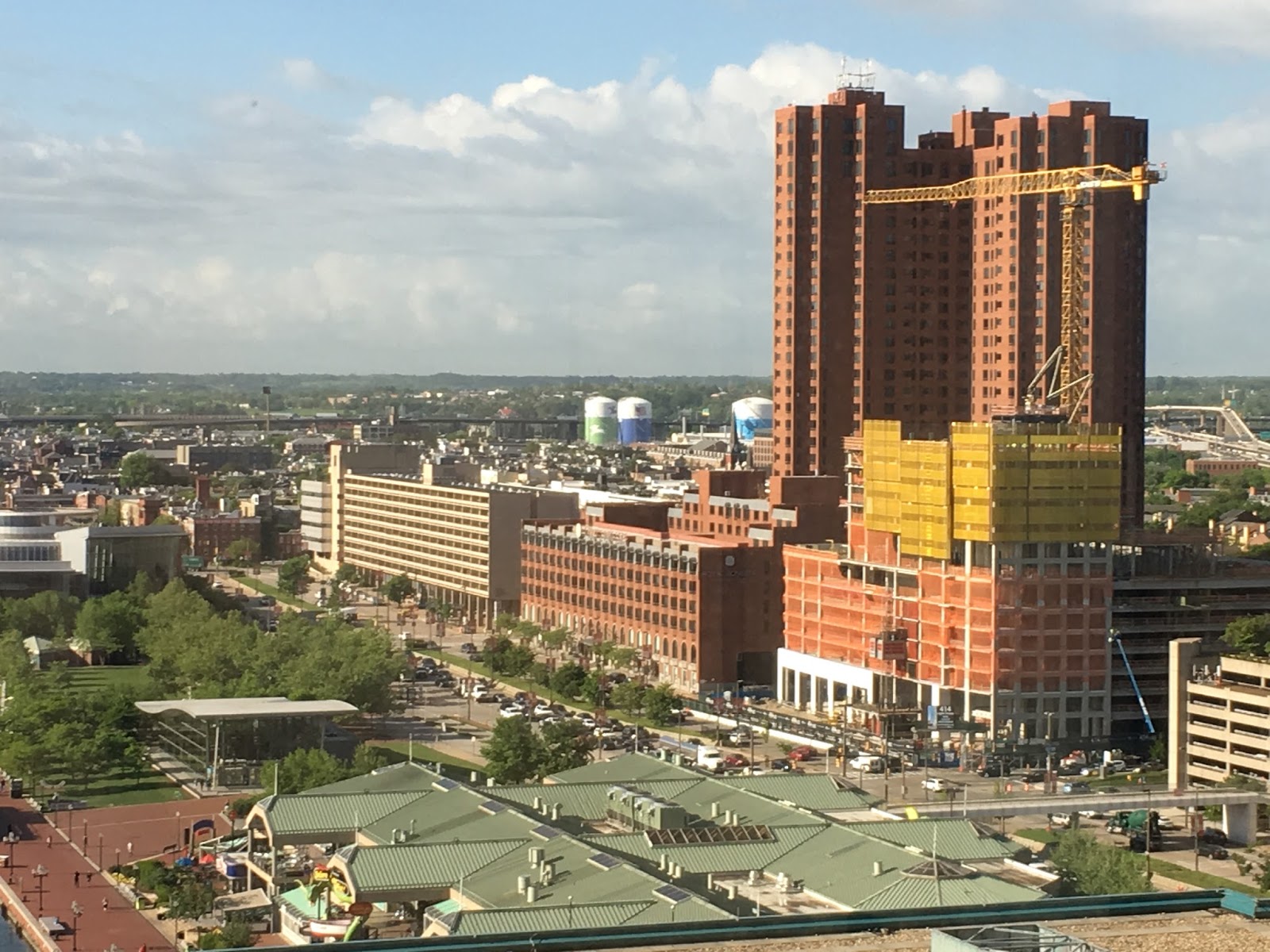
The most visible and the most luxury condo tower rises at the former McCormick lot at the Inner Harbor
404 S Light Street


Thursday, May 18, 2017

Suburban City: Orchard Ridge

Baltimore is full of surprises and allows new discoveries all the time. Some of my own recent discoveries will be featured on this blog

Making a turn and being transferred into what looks entirely like a new suburban subdivision in the county is one of the surprises one can have bicycling or driving in Baltimore and turning off the beaten path. 
Orchard Ridge 2017 (photo Philipsen)

Baltimore officials have long believed that suburban housing will attract people to the City.  An example for this concept is Heritage Crossing, the suburban style replacement of what used to be the Murphy Home highrises immediately next to downtown.

Two contemporary examples of giving suburban tract housing developers a piece of the city are on display in the Uplands on the westside of the City and the development of Orchard Ridge on the northeast side, both "subdivisions" by Pennrose. In both cases Pennrose promotes"suburban charm with urban amenities", a slogan that I consider somehow backwards.
Whether you choose a one or two-bedroom apartment or a two or three-bedroom townhome, you’ll find a modern design and large windows that make coming home something special. Adding to these wonderful comforts, you’ll also enjoy all of the extras at Orchard Ridge such as our community room, resident fitness center and a variety of resident events and services.
Orchard Ridge provides residents a quick commute to downtown Baltimore with easy access to I-895, Pulaski Highway, and Belair Road. Located minutes away from Herring Run Park, Orchard Ridge offers residents suburban charm with a close proximity to urban amenities such as shopping, dining and entertainment. (Pennrose brochure)
Suburbia in the City (Photo: Klaus Philipsen)
But the similarities to the suburbs in the counties are superficial, once one understands the genesis of both projects. Both originated with public or low income housing garden apartments deemed obsolete by Baltimore Housing and subsequently demolished in favor of a vaguely new urbanist development mix of homeownership and rental units and also include low income housing and a community center, a mix rarely found in the "real" suburbs.

Orchard Ridge is with just over 54 acres smaller than the Uplands where 1000 garden apartments had been leveled and are planned to be replaced with a total of 691 units, but only a fraction has been built to date. Orchard Ridge's history goes back to 292 units which were completed by the Housing Authority of Baltimore City (HABC) in 1954 as the Claremont Homes. Together with Freedom Village, a former blighted Federal housing property that the HABC acquired in 2002, and Claremont Extension, an apartment tower, a total of 752 units were demolished.

The new comprehensive redevelopment is a 461-unit, mixed-income community of townhouses and semi-detached homes, including a new apartment building, as well as a centrally located community center. 142 of those units are designated as "affordable". The builder is Harkins and the site plan design is STV. The project reminds of the HOPE VI redevelopments but has a different funding stream with $3.2 million from a HUD grant of up to $40,000 per unit for purchasers of bankrupt HUD properties (such as Freedom Village) if they keep units affordable.Other money comes from tax credit equity and debt.
Orchard Ridge development plan (STV)

The suburban feel comes from the fact that a fairly large areas gets developed in one time period (even though development was phased) and from the well known current day vernacular architecture mix of traditional form and new materials. Most buildings are three story townhouses with pitched roofs, front porches, and bay windows. The buildings are wood-frame construction with a combination of brick cladding and fiber-cement siding. The bay windows are clad in PVC panels with PVC trim. Porches have fiberglass columns on brick piers and vinyl porch railings.

Orchard Ridge and Uplands are part of the massive efforts of HABC to upgrade housing stock in Baltimore with the side effect of massively reducing the amount of affordable housing and reducing density overall. In all, Orchard Ridge and the Uplands seem better suited to be models for the counties that urgently need to include affordable housing. As long as they don't, the over 40% overall reduction of HABC housing inside the City remains worrisome since poverty rates remain high.

Klaus Philipsen, FAIA

Wednesday, May 17, 2017

Who cares about Pimlico?

Annually the debate about the future of Pimlico shifts into high gear when the first race horses arrive in Baltimore. Every year the prospects seem to become more dire. This has been going on since at least 1958 when interest in moving the event to Laurel was first recorded. There is even a State law to prohibit such a move. Everybody has an opinion about Pimlico and most provide lip service to history and tradition by saying they don't want the race of the Triple Crown to leave Baltimore.

But few want to back this desire up with the dollars it would take to do so. Governor Hogan hinted Tuesday that there may be State money, in what seemed destined as a move to keep the matter on the table. Ultimately State funds require enough votes and they are hard to come by when it comes to Pimlico.
Pimlico on the northeastern edge of Park Heights. Areas of strength are labeled. (2011, Park Heights Renaissance)

First, because Maryland would still keep the coveted race even if race course owner Stronach would be permitted to move it to suburban Laurel where just about everything seems to be easier. Legislators from outside Baltimore could easily see that as a no-brainer option. Second, and more importantly, Baltimore has failed to make a compelling case why the race should stay in the City and how that could be done. In other words: There is no City plan, no common platform and no consensus strategy.
Pimlico from the air (SUN photo)

Stronach doesn't mince their words: They don't like that the race course is surrounded by disinvested communities characterized by abandonment, liquor stores and a high crime rate. "When it gets too dark, we are getting everybody out of there" they are quoted in the SUN. On the other side many community activists shrug their shoulders about the race-course. It hasn't helped Park Heights before, why would it now?
Photo of a suggested tree lined linear park and trail around
the whole facility (MSA Report)

Activists and the City have attempted to improve Park Heights for years. Otis Rolley as planning director made it his top priority. But to date there is only a smattering of investments, in part fueled by casino revenue money devoted to the community, an overall concept and implementation strategy isn't obvious. So far improvements seem to be opportunity-driven and not following a strategy of consistently building from existing assets such as the race course, the metro stations or Druid Park,  even though Park Heights Renaissance under the leadership of Cheo Hurley is trying to change that.

In perfect timing Stronach upped the ante the other day right before the races: They added a cool $200 million to an estimate by the Maryland Stadium Authority released in February of up to $321 million needed to bring the facility up to standard. The City did not take a position on the menu of choices provided by MSA in their fairly comprehensive study that also includes considerations of community improvements. The City also take a clear stand relative to the race course owners.

A 2008 City masterplanfor Park Heights avoided a clear position as well and shows an option with and without a racecourse. Baltimore's new Mayor has  even toyed with relocation herself as the SUN reported in April, although she meant inside Baltimore without saying where to.
Berlin's abandoned Tempelhof airport became a giant
community playground. Would it work in Park Heights?

With so much uncertainty and ambiguity, the prescribed default would be that the race will eventually wind up in Laurel. That wouldn't be a problem per-se, if the City had a clear concept how the 140 acres in Park Heights could be used better, but no such plan is in sight and it isn't likely to emerge. Space is the last thing that is lacking in Park Heights. Even now Housing is desperately looking for someone to develop 49 acres of land they helped clear for redevelopment for which there is no demand.
65 acres in the heart of Park Heights in search of redevelopment

Clearly, a different, innovative and a decisive new approach is needed that addresses community needs and race needs at the same time in a win-win manner with community, City, State and race owners at the same table.

The same size Churchill Downs in Louisville may provide some hints what can be done: Although their facility dates back to 1875 and Kentucky is a much poorer State than Maryland, Churchill Downs was upgraded starting as far back as 1984 culminating in a 2001-2005 program that cost $121 million. In 2016 Churchill Downs introduced a new technology platform and mobile app. Most of the improvements over the years seem to have been funded by the corporate owners themselves. There are attractions such as a museum and an IMAX theater which are open year-round and help brand the city and the State around horses as a theme.

With Maryland's strong history on horse breeding, horse farms and races, there is no reason why Pimlico with added uses couldn't be a year-round attraction that can draw visitors to stray beyond the Inner Harbor even on non-race days as a destination for concerts, festivals, dining, shopping, public events and other activities. (A facility of that sort is envisioned for Atlanta). There is no reason why Pimlico couldn't be an urban horse park that isn't fenced off but provides a soft and open edge, similar to what the MSA report suggests with its hiking, biking walking greenway all around the property.
Atlanta vision (Georgia Horse Racing, Populous)
The Greenspring Valley horse farms are not far away after all and could be part of a program. There is no reason why the excessive empty surface parking deserts couldn't be converted into active and greener spaces with shuttle services provided for the one day a year when 135,000 visitors arrive. There isn't a reason why the State and the City couldn't demand that Stronach plans more events throughout the year in return for the money that the private corporation gets from casino revenues. There is no reason why much needed services and sit-down restaurants couldn't be located around the race-course, serve the community and provide venues for visitors to plan a day of activities there and spend more money in a way that benefits the community.

No one entity can afford the full cost of fixing Pimlico or Park Heights. But considering how much the interests of community, stakeholders, race owners, City and State actually overlap, it is time to come together around a bold, integrated and innovative 10 year plan that makes Pimlico part of Park Heights and Park Heights part of Pimlico.

Klaus Philipsen, FAIA

Previous articles about Pimlico and Park Heights on this blog:

Is Pimlico worth saving?
Park Heights: 64 vacant acres still waiting


The book, Baltimore: Reinventing an Industrial Legacy City is my take on the post industrial American city and Baltimore after the unrest. 
The book is now for sale and can currently be ordered online directly from the publisher with free shipping. 


Tuesday, May 16, 2017

Who can save State Center?


Baltimore City, particularly West Baltimore, has waited long enough to see progress on development projects like State Center. State Center will transform neighborhoods, create jobs, promote new business growth, spur transit oriented development, offer safe and affordable housing for
residents, and add to the City’s tax base.
Be among the voices the City and State need to hear!
Join community leaders as they gather to urge the Governor
to Build a Better Baltimore and redevelop State Center. (Flyer inviting to a rally in front of City Hall)
Dignitaries asking the Governor to build State Center (Photo: Philipsen)
A developer organized rally in front of City Hall took place on a gorgeous spring afternoon and attracted a small crowd holding sign "build a better Baltimore- build State Center".  A similar rally shortly before Governor Hogan cancelled the Red Line had little effect, and it is likely that this one will hardly be more effective. The parallel to the Red Line wasn't lost on anybody and invoked by every speaker.
"The governor truly has an opportunity here to demonstrate that he's serious about economic development in Baltimore City" City Councilman Eric Costello
What could possibly make the Governor reconsider and sit down at a table to negotiate specific objections? Just like when the Red Line was cancelled, communication, coordination, an analysis or a plan B are entirely absent. Instead there are strong words ("greedy politically connected crony capitalist developers" says Red Maryland, a variation of words the Governor himself has used) as if insulting a strong development team that includes out of state partners is a signal of Maryland being "open for business". Nor do these statements show any respect for a long broad based process with significant community participation and a complex use plan that addresses much more than the future of the State offices.
"We are tired of being robbed. Delegate Robbyn Lewis" 
Councilman Eric Costello introducing the speakers
(Photo: Philipsen)
And then there is the silly exploration by the Maryland Stadium Authority whether State Center could be a great spot to put an new arena. That study hasn't even begun yet and is not listed on the MSA website. The arena idea is testament to the fact that the Governor and his people haven't spent any serious thought on the State Center Plan or on how to make it better. In fact, Hogan (and to be honest, also Nancy Kopp and Comptroller Peter Franchot who as the Board of Public Works jointly cut the project off ) entirely misunderstand what the plan was all about, a plan that was the result of ten years of consensus building and collaboration for comprehensive urban repair to the damage the original State office complex did to the City fabric and the surrounding communities.
"Why can it be right in Southeast Baltimore but not in Northwest Baltimore?" Delegate Nick Mosby
The State Center Plan was never about finding the cheapest deal for the State to rent office space. Instead, the project was about leveraging two local State assets (State-employees working on State-owned land and two rail transit lines coming together here) for economic development and a better city. Everybody understood from the onset that the State's lease- back rates would amount to an investment in Baltimore. Except the Governor who keeps professing how much he likes Baltimore and then takes billion dollar investments off the table.
"Invest in Baltimore communities. The Governor should return to the negotiating table. This is a model for economic inclusion. We don't need another plan, we need to begin building now." Senator Barbara Robinson.
This is like MDOT Secretary Rahn who keeps using the argument that he "is in the business of transportation" to object to real estate deals and transit oriented development (TOD). But for transportation itself he has no long-term or even mid-range plans, no vision, especially not for transit beyond the imminent short-term bus overhaul.
"State Center is the difference between lip service and public service". Delegate Bilal Ali
I know there are folks who think transit agencies should not be in real estate and should focus on their core competency on running and expanding transit. Conversely there are folks who really think that better land use is key to transit's success. Each position has some merit, But to resist better land use and system expansion makes absolutely no sense. Whoever complains that the existing lines operate inefficiently should definitely be interested in making best use of what's already on the ground. What better way than to put more stuff where the stations already are, i.e. TOD?
Whoever doesn't want to deal with real estate, what better way than to expand transit until disparate pieces turn into a real system around which people scramble to be? Taking one or both of these two paths is globally how every successful metro region operates.
 "this is the heart of Maryland. Maryland only succeeds when Baltimore succeeds. the Governor pulled the plug on the Red line, he pulled plug on State Center, we can pull the plug on him". Senator Rich Madaleno, Montgomery County, wants to run for governor.
Alas, Secretary Rahn doesn't want to expand the system and he doesn't want to increase the land use at existing stations either. He only wants to build roads, especially in rural hinterlands, certainly not an expression of love to Baltimore and not a prudent transportation expenditure either. Of course, Rahn also objects to any metrics that would attempt to measure where dollars may be spent most effectively.
Community leaders and dignitaries stand united
(Photo: Philipsen)
When we build places they shape how we get around. Brian O'Malley, CMTA 
If reasoning and rationales don't go anywhere, political pressure is what is left. It was impressive to see Delegates, Senators and council people unite behind a project that had obtained so much consensus and praise for its design, its concept and its ability to create a win-win for the State and surrounding communities. Around America cities thrive because private-public partnerships rally around complicated and complex deals such as the Denver Union Station TOD. It is a case where State, City, the region and the core city stuck it out for the long haul. Now, after some dozen years in the making, all are reaping the benefits and the formerly desolate Denver station area is thriving.

In Baltimore, after a dozen years of transit and TOD planning, we stand still with our hands empty thanks to a Governor who loves Baltimore to death.

Klaus Philipsen, FAIA

SUN report about the rally

Related articles on this blog:

State Offices at Metro West? (January 2017)
Governor kills second Baltimore Megaproject (December 2016)
State Center showdown (July 2016)
Why State Center is a good idea (March 16)

My book, Baltimore: Reinventing an Industrial Legacy City is my take on the post industrial American city and Baltimore after the unrest. 
The book is now for sale and can currently be ordered online directly from the publisher with free shipping. 


Monday, May 15, 2017

Will the Purple Line die, too?

You are confused about Maryland's transit policies? You saw Governor Hogan and Secretary Rahn describe the Baltimore Red Line as a boondoggle and took the project off the table in spite of promised federal funding and over a quarter billion in engineering cost that had gone into it in an over 10 year planning period? You who saw the State chop its contributions to the DC area Purple Line to a fraction of its original size? You saw the Governor bash federal judges for not accelerating his finding about the Purple Line? This article will try to explain.
Proposed Purple Line Bethesda Station rendering
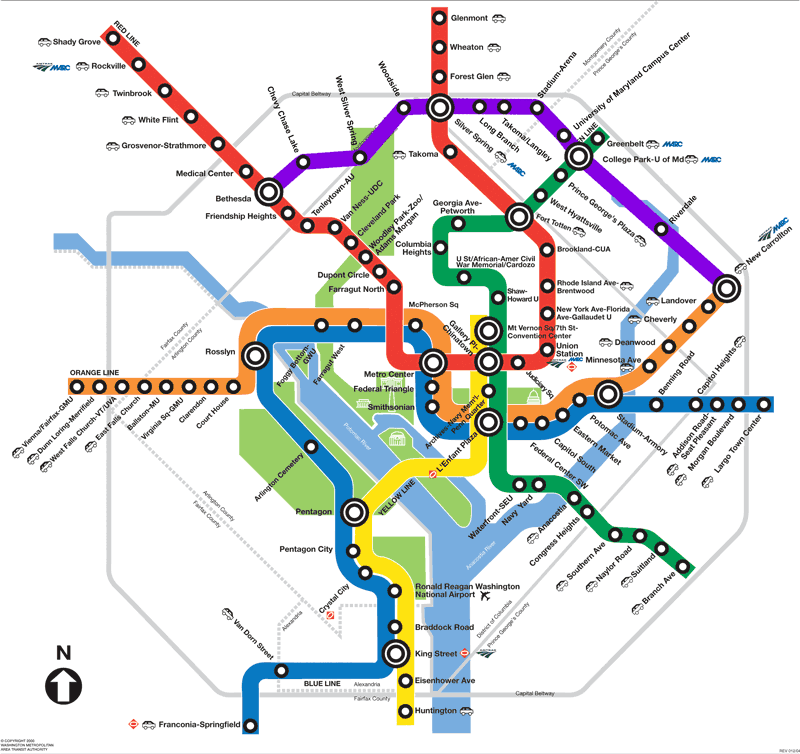
The Purple Line is a light-rail line which will circle and connect the region’s core communities inside the Capital Beltway, linking the spokes of the Metrorail system and connecting to Amtrak and MARC.The 16-mile light rail line will connect Bethesda in Montgomery County to New Carrollton in Prince George’s County, with intermediate stops in Chevy Chase, Silver Spring, Takoma Park, Langley Park, Riverdale, and the University of Maryland. Nearly half of the cost will be provided by a $874.6 million TIFIA loan from USDOT. It is one of the largest public-private partnerships in American history at $1.99 billion.(Coalition for Smarter Growth)
Amazingly the same two officials now speak up forcefully for the Washington area Purple Line. In a letter to Maryland's Attorney Brian Frosh: [We]“have both concluded that it is necessary, on behalf of the citizens of Maryland, to take action to force U.S. District Court Judge Richard Leon to make a decision in the Purple Line litigation pending before him.”  The Governor then stepped up his pro-transit rhetoric by accusing a federal judge of being partial because of his residence and his wife. The Washington Post quoted Hogan:
“We made the decision to move forward. . . . we committed the funding. Now there’s a judge who happens to live at the country club that the thing runs through that’s making the decision to hold it up. ...Right now, even with federal funding, we can’t move forward because of a judge who lives at Chevy Chase Country Club.”
Washington Rail Plan with circumferential Purple Line
Mr. Frosh has since filed a petition for a “writ of mandamus” asking the U.S. Court of Appeals for the District of Columbia Circuit to mandate that U.S. District Judge Richard J. Leon rule on a government motion to dismiss the 2014 lawsuit filed by Purple Line opponents. Frosh's petition says that the delays have “brought this project to the brink of cancellation.” The petition further states that if there is no ruling by June 1, the state won’t have enough money to continue pre-construction work, and the state “likely” would direct contractors to stop design and engineering work on the light-rail project. Suspending that work, the filing says, would add significant costs and could result in the 16-mile project being canceled. “The fate of the Purple Line hangs in the balance,” the attorney general  says.

[The fate of the Purple line project] "should be determined by policy makers responsible for the project and accountable to the public — or, if by a court, on the merits of the claim — rather than as a side-effect of inaction by the district court.”
What's behind all those strong words? The exchange about the law suit goes back to August 4 of last year a federal judge ruled that the environmental impact assessment should be redone because it didn't properly account for declining Metro ridership. The ruling came only four days before Maryland was set to sign the  P3 (public-private-partnership) agreement to build the Purple Line. Stewart Schwartz Executive Director of the Coalition for Smarter Growth commented last year:
“Yes, Metrorail is facing challenges over the next few years, but the Purple Line is a long-term investment and ridership forecasts are for 2040, by which time the Metro system will have completed major rehabilitation. Therefore, there is not a ‘substantial change’ in information related to the decision to advance the Purple Line,” 
Federal transit officials confirmed that view last December when they stated that further analysis had shown that Metro would have no significant impact on the Purple Line. After which the plaintiffs pivoted to other motives by saying that  Metro’s potential impacts are just one reason the light-rail line should be stopped and cited cost and environmental impacts as others.
Even though the Purple Line had its detractors from the beginning, it was widely attributed with having better organized support than Baltimore's Red Line.
Silver Spring library with Purple Line passageway (montage)

Supporters once worried about what the newly elected Governor would do about the Purple Line are now fighting side by side with him, if not physically, then at least with similar arguments. A coalition of 45 business leaders wrote to Secretary of Transportation Elaine Chao last week, urging her to finalize the Purple Line’s $900 million New Starts grant as soon as the project’s Record of Decision is reinstated by U.S. District Judge Richard Leon.The letter was signed by developers with projects in the Purple Line corridor, including the Bozzuto Group, Marriott International, which plans new headquarters in an “urban campus” in downtown Bethesda and by business organizations like the Greater Washington Board of Trade and the Montgomery and Prince George’s Chambers of Commerce. Regardless of the federal judge's decision, the federal commitments are by no means certain in President Trump's proposed federal budget.

In face of the challenge proponents of the transit line held a press conference on May 2 in a building passageway in Silver Spring that was built specifically for the Purple Line. Invited participants were Congressman Jamie Raskin, Montgomery County Executive Isiah Leggett, Prince George's County Executive Rushern Baker, Montgomery County Council President Roger Berliner, Prince George's County Council Chairman Derrick Davis, state and congressional representatives, Union members and others in which also Baltimore's Transit Equity Coalition's Samuel Jordan participated. The coalition demands the reinstatement of the Baltimore Red Line. 
Transit proponents support the Purple Line on May 2
(Samuel Jordan with hat)

Purple Line Now President Ralph Bennett, an architect and emeritus professor at the University of Maryland concluded: 
“The people of Maryland have waited far too long for the Purple Line to be built, and construction would have finally begun months ago were it not for a frivolous lawsuit filed by a group of Chevy Chase opponents who misuse the legal system to advance their own narrow self interest. Businesses know that the Purple Line is an investment in our region’s future that will pay off many times over in increased incomes, property values, and quality of life.” 
No matter how confusing the reversed roles of State officials may be when comparing the Red and Purple Lines, Baltimore area residents shouldn't rejoice that the Purple Line may be on the chopping block as well. Maryland as a State and the entire Baltimore Washington region will only remain strong and competitive if the entire region has fast and equitable transit and not the type of transit Jayne Miller  aired in a WBAL report last week. 

Klaus Philipsen, FAIA

Maryland Gov. Hogan seeks court order to compel federal judge to rule in Purple Line lawsuit
Md. attorney general seeks court order to force judge to decide Purple Line case
WBAL transit report on their local news last week

The book, Baltimore: Reinventing an Industrial Legacy City is my take on the post industrial American city and Baltimore after the unrest. 
The book is now for sale and can be ordered online directly from the publisher or from any of the bookstores. (Amazon)