Thursday, July 13, 2017

Driverless Future Challenge: Reclaiming the Street

In these columns I have suggested many times that cities need to prepare for a future with driverless cars and ensure that not a nightmare of even more privately owned cars, possibly driving even empty, becomes our future but one in which, thanks to shared car arrangements (think self-driving Uber or Lyft), the streets and spaces can be reclaimed and used better than for parking cars.


Luckily there are cities that pay attention to this not so distant future, one of them is New York.
In February, the alternative architecture firm Blank Space partnered with the City of New York and issued the Driverless Future Challenge to solicit solutions for a driverless future in this complex city.

In June four finalists were announced and this week, "Public Square" was chosen as the winner. The award-winning entry is by FXFOWLE with Sam Schwartz Engineering and allows New York City to rethink its streets and reclaim space for pedestrians in a modular and incremental manner which is much like "Parking Day". The entry was chosen as the winner of by a panel of New York City Commissioners, in front of a live audience at the NYU Skirball Center. "Public Square" is described on the website as "a plug-and-play system of interlocking unitized squares, roughly 8'x8' in size, with built-in infrastructure and a wide variety of arrangements, from seating, to retail pop-ups, play equipment, gardens and green space."
"It's important for cities to future-proof their infrastructure and policies, rather than wait for these technologies to reshape the city in ways we may not desire" Public Square offered a versatile tool kit for the city to reuse space for a variety of public needs." Michael Replogle, Deputy Commissioner for Policy at the DOT and one of the contest judges. Before Replogle had been the founder of the Institute for Transportation and Development Policy in the DC metro area 
The co-founders of Blank Space Matthew Hoffman and Francesca Giuliani emphasized that
"Autonomous transportation will impact every facet of New York City. The four finalists have crafted wildly unique solutions to a variety of topics: from creating autonomous micro-busses for the MTA that solve the 'last-mile' dilemma, and managing curbside use, to creating a platform for regional businesses to sell their goods in NYC without actually driving here"
This Video describes the winning entry. For a review of the proposals by the other finalists see here.
Square, the winning entry envisioning a modular street transformation

Another finalist proposed driverless car hubs described this way:
QueueY is a system for managing high-volume AV pickup & dropoff locations. It consists of curbside hardware and a multi-sided platform for managing last-mile transit. Without infrastructural coordination, the introduction of Automated Vehicles will create congestion with regards to pick up and drop off locations. QueueY establishes a coordinated zone around transit hubs, and converts curbside parking space to a dedicated loading and unloading area. As AVs approach the terminal, they’re directed to the next available station and allowed to park, and charge if necessary. The added technology within each hub further improves the commuter experience., including a weatherproof space to wait for rides, improved signage and communication between riders and their car, and ride accessibility for commuters without access to the internet on their own device. (video
sAVe, the autonomous shuttle for the last mile
Also a finalist was the group proposing sAVe, solving the last mile access problem in transit.
sAVe is a Service platform that offers multi-modal ridesharing services that will include automated vehicles as they become available. sAVe provides trip service in underserved neighborhoods and connects those residents to public transit hubs that they cannot otherwise access conveniently. In order to meet the needs of all users, sAVe rides can be found and booked via smartphone app, community kiosk, or by speaking with a customer service representative. The service offers the benefits of leveraging existing public infrastructure without increasing the number of private vehicles in already-congested areas, providing a social opportunity with associated rewards incentives to residents who choose to affordably ride-share with other community members, and gradually introducing AVs to new populations who may not otherwise get to experience or benefit from this technology. (Video)
Queue, the hubs for pick up and drop off of AVs.
While those technical design solutions are fun to watch, the key to entering a livable urban future will be the right policies. One can hope that the Driverless Future Challenge in New York provided enough food for thought for those who have to initiate the right policies.

Klaus Philipsen, FAIA

Wednesday, July 12, 2017

Project CORE, high hopes in the City

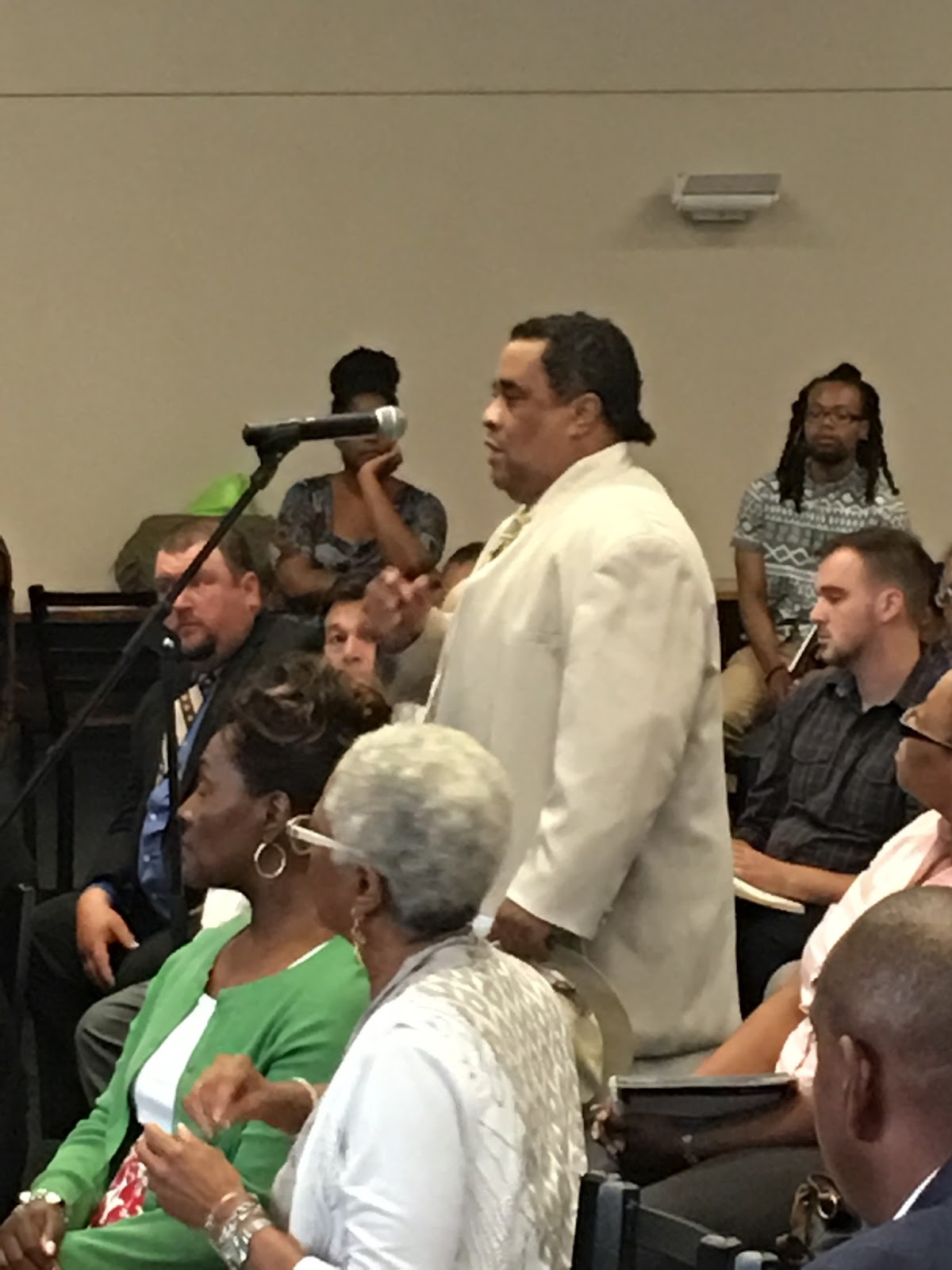
The telling moment came when Lieutenant Governor Boyd Rutherford lifted one of the last cards from the stack of audience questions in his hands and read out this question:  "What is the masterplan for Sandtown?" somebody had written on the card. "This is off topic" Rutherford noted, adding "that is not what we are here to talk about. That is a question for the City Planning Department". Then he picked up the next card. The Planning Director remained silent.
Lt. Gov. Boyd Rutherford is the MC
(Photo: Philipsen)

The West Baltimore Community Forum took place in the Talon Center of Coppin University where a high powered panel consisting of HCD Secretary Kenneth Holt, the Lieutenant Governor as MC, a representative of the Stadium Authority and Mayor Catherine Pugh provided a progress report on Project CORE (Creating Opportunities for Renewal and Enterprise), the much touted collaboration between City and State on which many neighborhoods have pinned their recent hopes. State and City had a number of staff leaders sitting in the audience, among them Assistant HCD Secretary Carol Gilbert, City HCD commissioner Braverman and Planning Director Stosur.

Rutherford praised the Stadium Authority's management of demolitions funded by project CORE and the collaboration with the City. (The best practice management of the CORE demolition avoiding dust and pollution will soon become the standard for City demolitions as well said Michael Braverman). Rutherford stressed that the State will not determine in any form what will happen with the properties. This is subject to what communities want or what the City plans. "We believe a better Baltimore will be a better Maryland" Rutherford said. He explained the three phases of CORE
The president of the Sandtown Improvement
Association asks a question
(Photo: Philipsen)

  1. Demolition and stabilization
  2. Residential redevelopment
  3. Commercial redevelopment
The project is a partnership between City and State in which the City provides 25% matching funds. Projects are funded based on applications. 2017 awards totaled $15.86 million for 30 projects.


Mayor Pugh stressed the importance of Community Development Corporations (CDCs) and vowed that the City wants to strengthen them. 968 blight units have been removed since 2016, another 160 units are given to proceed for demolition. The combined programs amount to a total funding of about $700 million, almost 90% of that money is not "new" money, though but includes previously existing statewide programs. Pugh stressed that development opportunities should not be given only to those who come from the outside but also to those who are already part of the community.

And why was the response to the masterplan question so telling? The person who asked about a masterplan probably assumed that spending over $700 million over four years would require some kind of strategic masterplan. A plan that would create positive feedback loops in which the initially funded steps provide ladders of opportunity from which additional steps can be leveraged. But aside from the City Planning Department's Green Network Plan which is currently up for online comments, there is no such strategy or masterplan. Instead projects are awarded based on individual merits, much in the same way as the Casino benefits are distributed or in the same way how the Empowerment Villages had been funded two decades ago and how investment has occurred in disinvested areas for a long time.
CORE display panel (Photo: Philipsen)

The event was well attended, CORE promises business
(Photo: Philipsen)
The Green Network Plan harbors assumes that CORE demolition can assist in making stronger connections between disinvested communities and the existing park system by creating additional open spaces and green corridors. There is a "heat"map showing where the best opportunities for building such a network exist. From it a network plan of green corridors and a node plan with community and nature nodes was developed.

Plans like the Green Network Plan would, indeed, ensure that demolition and stabilization doesn't just occur where it is opportune or where the loudest voices are, but where it can leverage the biggest benefits. The beginnings of housing, retail, transportation and preservation network plans are visible in various departments but they are not obviously tied to CORE (yet). For project CORE to operate in the manner of the Green Network plan, the City would need to finalize its commercial corridor assessments (LINCS), make its Healthy Baltimore 2020 plan geographically specific, strategize Vacants to Value, develop a comprehensive preservation strategy (large parts of West Baltimore are part of a local historic CHAP district) and overlay it with neighborhood strategic plans.  While City officials would certainly maintain that this is precisely what they intend to do, the awards given out in 2016 and 2017 do not show that any of these metrics were systematically applied.
Green Network Plan
Vacant rowhouse that should be demolished but
rehabbed in its end of row corner position
(Photo: Philipsen)
Yesterday at the CORE progress presentation halfway into the four year process, Planning Director Stosur did not speak and strategy was not only not the topic, it was called "off topic". There is still hope, though, that a strategic focus emerges for the last two years of CORE.

Klaus Philipsen, FAIA

Tuesday, July 11, 2017

Is it better for the FBI to stay in DC?

We now know that Trump's infrastructure may include a wall at the Mexican border with solar panels but doesn't include a new FBI headquarters building. Not in Greenbelt, Land­over, or Springfield, Va. This according to advance reports about a decision of the federal government to be formally announced by the GSA today.
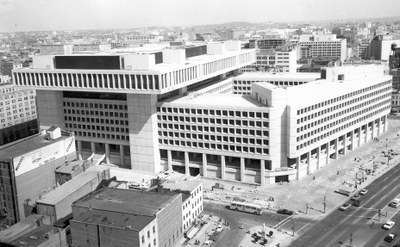
The J. Edgar Hoover FBI Building in 1975
A swap deal that has been on the table for years now seems to be aborted. It had envisioned that a development team would build a new FBI headquarters for free or for a much reduced cost in turn for obtaining the current site on Pennsylavnia Avenue in downtown DC for commercial redevelopment.

The theory of a cost effective bartering deal seemed plausible, except that it wasn't free at all. The Obama adminsitration had asked Congress to set aside $1.4 billion for it, the State of Maryland had promised hundreds of millions of infrastructure investment for its two potential replacement sites. Congress never put that kind of money into the budget.

The birth of the currently existing headquarters was similarly expensive ($126m – then a record for a government building and twice the original estimate) and time consuming and subject of a lot of back and forth. After several re-designs and careful review the design was approved in 1964 by the National Capital Planning Commission. It was several times modified before and after that approval for security and cost purposes. The approved plan consisted of 2,800,876 square feet of space for 7,090 employees. Height limits of 107 feet along Pennsylvania Avenue and 160 feet along E Street complying with what the Pennsylvania Avenue Advisory Council had suggested and and District of Columbia regulations required. The building wasn't ready for move in before 1974, a full ten years after the design approval.

There are elements in the President's decision to pull the plug on the relocation plan one could sympathize with or even rejoice about:
  • Smart growth: The big government functions should be in the capital of the nation and not in the suburbs, that is what a capital is for
  • Waste reduction: The current FBI building is only 43 years old and should not be demolished if one considers embedded energy and cultural heritage. Rehabilitation should trump demolition whenever possible
  • Simplification: The complicated swap deal the FBI had in mind is much more complicated than a regular real estate deal and requires a forced marriage between two very different skill sets needed for the construction of a suburban government campus and the commercial redevelopment of a prominent inner urban site
On the other hand the decision to simply abort a procurement process that has been in the works for many years and has absorbed considerable resources sets an extremely bad precedent:
  • Millions of public and private dollars have been wasted by the government agencies preparing bid documents and private developers trying to put viable bid packages together. 
  • The cancellation violates the trust that the private sector must have in the government bid and procurement process
  • the current building isn't big enough and already the FBI rents additional space for its 11,000 member workforce. Should any rehabilitation be considered, additional space is still needed
The Hoover Building (Photo: Washington Post)
The yanking of the deal is reminiscent of Governor Hogan pulling the plug on two large State procurement processes: The Baltimore Red Line and even more similar, the termination of the State Center project in which the State was supposed to get new office buildings from a private development entity as well.

Just as in the case of the FBI building, no practical alternative was offered at the time of the termination of the deal leaving the situation of obsolete government offices in the mode of a festering wound.

In the case of Baltimore's branch of the Social Security Administration, the feds pulled their deal off by simply abandoning their old urban complex for a more remote location. The idea there, too, was that a developer would swoop in and build a new government building in return for getting the old facility for redevelopment. That didn't pan out either. The old complex sat vacant for years until it was auctioned off to Caves Valley developers who won't build a new federal facility and who have not yet indicated what they will do with the complex. Some suspect that they wait to relocate the State Office workers there which then would leave the State complex fallow.
Baltimore Federal Building

There are a number of interesting architecture and urban design aspects in all of this:

Today the large monumental concrete structures designed in the late sixties and early seventies are the most hated buildings in America, a fate that the Hoover building shares with many brethren from the same period, such as Boston's City Hall, the Baltimore Federal Building and the State Office complex at State Center. Low esteem is typical for buildings when their design is about 50 years old. Old enough to not reflect current design sensibilities but not quite old enough to be considered a historic rarity. It is often forgotten that many of the today popular historic styles from Classical to Victorian or Modernism were fervently despised when buildings were about 50 years old.
Almost from the start it drew criticism. In 2006, the American Institute of Architects (AIA) described it as the “swaggering bully of the neighbourhood … Ungainly and ill-mannered.” Its glowering bulk and windowless lower storeys evoke dark and sinister power, recalling the state within the state that Hoover created, now metastasised into the surveillance state of the terrorist age. All this in the heart of the capital of the country that regards itself as a global beacon of openness and democracy.
It wasn’t meant to be that way. The building was designed to be open, with a courtyard where office workers could drop by and eat lunch. You could watch agents taking shooting practice. There was a museum displaying the triumphs of the FBI and its direct forebear the Bureau of Investigation, of which J Edgar became boss in 1924.(The Independent
Boston City Hall
From and urban design perspective it is interesting if not ironic that just in a time of a  urban renaissance the government still aims for the suburbs. The idea that the FBI needs vastly more space than 1964 is also interesting since IT has brought generally smaller work stations to the office world shrinking the demand for space. The idea that all 11,000 FBI employees need to be in one space may have to be re-thought as well.

Finally, from a procurement perspective: The GSA's creative idea of acting more like a private real estate holding by recognizing the value of its assets and leveraging it for new construction in a private public partnership (P3) appears to be frequently failing. Putting the old structures into the deal made it very complicated for private bidders. Additional complexity came from the fact that the government envisioned to run three locations competitively against each other leading to a bidding war between Maryland and Virginia, a bad idea in itself.

Now its all over. Especially Governor Hogan must be rubbing his eyes. Having considered a Maryland location for the new FBI to be almost certain he now has to see this dream vanish by Trump taking a page from Hogan's own playbook.

Klaus Philipsen, FAIA
Baltimore State Center Complex

BBJ article 7/11/17
BBJ article 7/12/17

Monday, July 10, 2017

Baltimore lessons for Haiti?

Over the last eight years I have written and spoken at various national venues about technology and cities in one way or another. Many aspects are open ended questions such as : "What Makes Cities Smart? (2016)", what are the  Future Industries, whether the "digital cities" is a Dream or Horror?, wondered  "If There Can Be Science in City Planning? , investigated if "Information Modelling Can Make Cities Smarter?"(2013)  and how Governance in the Digital City (2013) would work.  At one point I even wondered "What Architecture Has to do with Quantum Physics? and how the Emergence (2009) can be applied to cities.
Equity through technology?

In the end I concluded that the technological focus on efficiency isn't as important as good governance and equity. Cities can't thrive as long as they exclude large parts of their populations from thriving and that equity is the biggest issue cities face around the globe I began probing if  and "How Technology Can Provide Access for Distressed Communities".

Either through these articles and talks or the recent book about Baltimore I got the attention of Henry Beaucejour, founder and editor of Haiti Tech News.
Henry Beaucejour noticed through his work reporting for a Haitian newspaper that technology news was lacking for his country. With the importance of technology to the modern world, he knew that Haiti was in desperate need of a news source to cover the field. At the time of its founding in 2011, Haititechnews.com became the country’s first technology-only news source: a title they retain today.
Haititechnews.com seeks to help educate and advise the people of Haiti through top-quality reporting, available in four languages. Beaucejour hopes that through Haititechnew’s help, the people of Haiti will acquire the knowledge needed to start their own businesses in the private and public sector. (website).
He invited to speak at the Haïti Numérique 2030 Tech Awards event later this month, I began to wonder how much my Baltimore insights hold in Haiti, or specifically in Port au Prince where the event will take place. Port au Prince is so much bigger (depending how one counts and who does the counting anywhere between 1 and 1.2 million residents) than Baltimore and so much poorer. Its murder rate is has been reported as high as 2,000 per year, a number that is about four times higher than Baltimore's current horror rate (based on population).
West Baltimore, life expectancy of North Korea

Port au Prince doesn't have a sewer system at all while Baltimore's was once the pride of the city even though it now it routinely breaks and overflows with thousands of gallons of raw sewage going straight into the Bay via the Jones Falls. Baltimore just embarked on a multi-billion redo of its main sewage treatment plant (an amount higher than GDP of all of Haiti), Port au Prince's first sewage treatment plant is still a distant dream with crowdfunding on Indiegogo. The fact that UN troupes introduced cholera and the UN Secretary having set up a remediation fund means little since few nations paid anything into it so far. ($2.27 billion has been requested by the UN for Cholera eradication).

Equity, for sure, would be a common denominator between Baltimore and Haitian cities, notably its absence.  Port au Prince has a hotel (paid by the Clinton- Bush post earthquake Haiti fund) where the night costs $250. It has heavily guarded grocery stores with import foods  that cost more than at Whole Foods in Baltimore and posh hillside quarters overlooking the sea. And close by it has places such as the Cite de Dieu, a slum of 40,000 people. It is likely that the life expectancy discrepancy between Cite de Dieu and Petion-Ville is even higher than the 21 years between Sandtown and Roland Park.
Haiti Numerique 2030

One could go on and on with those mostly inaccurate comparisons, but the question in face of my talk in Port au Prince is this: Can innovation and technology provide opportunity  in one of the world's poorest nations or in Baltimore? Can the high penetration of cell phones even in the poorest quarters leverage the voice of people even though most can't read and write?
Social determinants of health

The West Baltimore Innovation Village has been founded with just this goal in mind. Innovation Village already collaborates with Kampala in Uganda and has according to Richard May been recognized by the UN as a model that  "presents a new approach to a better Smart Cities strategy through creating holistic, integrated solutions designed to increase access to jobs, quality of life, and sustainability."

Your comments or responses to these questions are welcome! Please write below whether you think that there are parallels between Baltimore and Port au Prince and what technology can do to leverage opportunity. I would love to deliver your messages from Baltimore.

Klaus Philipsen, FAIA

Friday, July 7, 2017

"Welcome to Hell": Anger is international

Pictures from Hamburg, Germany this morning prove that American cities are not the only ones where anger erupts in burning cars and trash on fire, broken windows, bullying police and swarms of helicopters overhead. Nor are they the only ones with problems of police violence (Hamburg), racial discrimination (Cologne), drug problems (Frankfurt) or concentrations of poverty (Berlin) even though all these pathologies are much more accentuated here in Baltimore.
Hamburg protest against the G-20 summit

Where Trump, Erdogan and Putin assemble in one place, the anger of people who see the growing divide between rich and poor, the heated globe and the arrogance from those who could do something about it, has an international dimension. But many of the root causes are local and rooted in a system a system that seems to double down on all the bad policies that caused the global crisis in the first place, an attitude for which the American President has become the symbol.

This crisis is not one of east against west as Trump proclaimed yesterday in Poland in front of a jubilant crowd of ultra conservative Poles, but one of a global war of those who have everything against those who don't. The global allotment of wealth has become extreme and so have the disparities in the standard of living and those rifts are mirrored inside countries and inside their major cities.
Cars and dumpsters in flames in Hamburg

The two port cities of Hamburg and Baltimore both have neighborhoods which are incredibly wealthy and open to the world, and, newer for Hamburg, also sections of town with entrenched poverty where people barely get out, don't have a job and little access to opportunity.

Of course, similarities between the Hamburg and Baltimore go only so far, especially in the context of the G20 summit. Hamburg had 48 murders last year and even that low number brought about hand-wringing in the city because this rate exceeded that of the entire country of Denmark (45). A April 2017 study shows that 20% of all Hamburg children grow up in poverty, in Berlin the rate is 30%, the German national average is 15.7% whereby poverty is defined as less than 60% of mean income. Hamburg is a much larger and growing city, Baltimore is still shrinking.
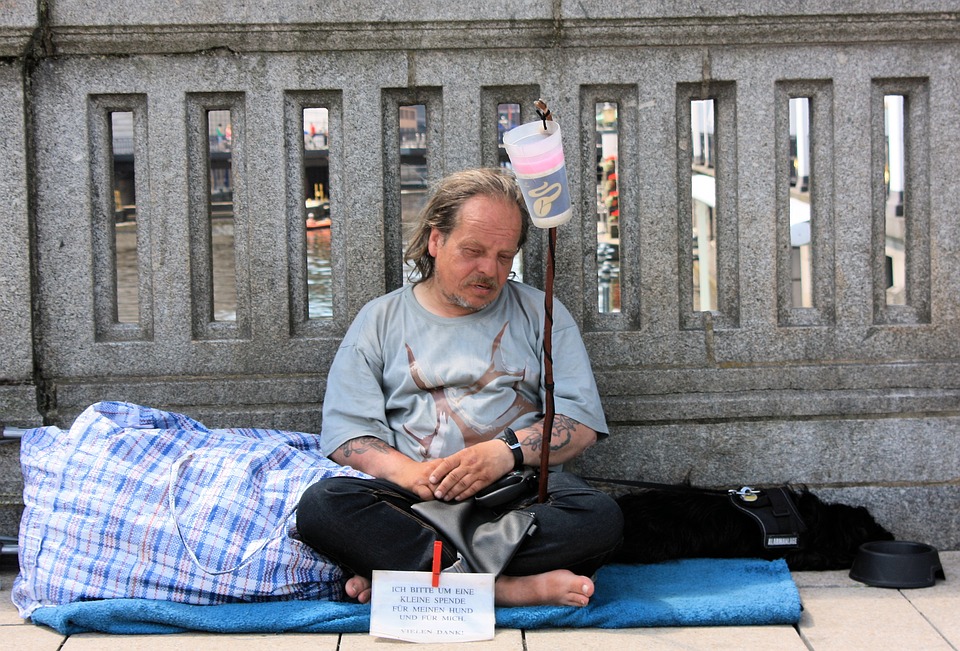
Poverty in Hamburg

Yet, looking at the pictures of Hamburg reminds of the images of April 2015 here at home.

In all of the frustration of how the 21st century seems to be shaping up, a few positive facts shouldn't be forgotten: Worldwide the rate of those living in absolute poverty has fallen, so has the rate of those starving. Birthrates have fallen as well even while the discrepancy between rich nations and poor nations continues to grow.
The share of the global population defined as “poor” — those making less than $2/day — has fallen since 2001 by nearly half, to 15 percent. Overall, the world has become “wealthier” compared to the turn of the millennium. Notably, those in the middle-income bracket making between $10 and $20/day have nearly doubled their global presence, from 7 to 13 percent. (Inequality.org
"Welcome to Hell" demonstration in Hamburg
The issue is not necessarily that the world goes to hell in a handbasket (Slogan of the Hamburg anti G-20 summit demonstration: "Welcome to hell"), a sentiment that has been around for millennia but that cities have become the centers of the extreme disparities between rich and poor and that those disparities are still growing.

US cities like Chicago and Baltimore which have by far larger disparity gaps than any European city need to show a way forward how to spread the wealth, especially in a time when national policy is pushing in the opposite direction.

Klaus Philipsen, FAIA

A moment of pause

Images we have seen in Baltimore


Thursday, July 6, 2017

Parking cost - a tool of transportation policy

DYNAMIC PRICING. IT’S A HOT AND POLARIZING TOPIC IN THE WORLD OF TECHNOLOGY… AND NOW PARKING. (Parkifi)

Baltimore is often a late adapter but not when it comes to dynamic pricing for parking. In this case the Baltimore Parking Authority is ahead of the pack with only a handful of other US cities having introduced the concept to date. The Board of Estimates gave the green light last week.

Parking kiosks:
Rising rates?
Before anybody jumps out of their skin over the City finding creative ways of milking its residents even more, consider this: The cost of parking is an important element of a comprehensive transportation strategy.

Excessive amounts of parking and low cost for it have lured cars into the central business district for decades and have enabled turning many downtowns into some type of ghost-town devoted to predominantly one thing: The resting automobile.
Parking still dominates most American Cities
(Photo: South Baltimore)

It is time that this practice comes to an end, especially on the eve of the next big disruption, the autonomous vehicle.

The leader in dynamic parking was San Francisco with its sensing equipment providing real time information about parking space usage and available open spaces a high tech version of a parking management practice that has been around in Europe for decades.

But such big up-front cost and high tech sensing technology may not be necessary with the less dynamic model that Baltimore has in mind. The Xerox company is advertising its own services and explains softer methods of demand measurement that aren't "real-time" and instead use what Xerox calls a monthly parking "thermometer".  Baltimore is not using Xerox but will apply a similar method:
When we say that prices change dynamically, we mean that a timetable of prices is fixed in advance and is changed every few weeks. We are not talking about the sort of hard-topredict minute-by-minute price changes that are common for air fares, which would make drivers’ lives even more complex. For instance, imagine you were happily parking on a street that usually costs $5 per hour and as you stepped out of the car, the price shot up to $15 per hour!  (Xerox brochure)
Demand based pricing: Parking Authority graphic
The Parking Authority describes its own new approach as an even more sluggish response to demand: Six months. On its website the agency describes its new program this way:
Beginning in the Summer of 2017, the Parking Authority of Baltimore City will use actual demand for parking spaces to determine the hourly parking meter rate on blocks in the Central Business District. Using data collected every six months, the Parking Authority will adjust rates to help create one or two available parking spaces on each block, making it easier for parkers to find parking downtown and spend more time enjoying Baltimore.
To reach our goal of one or two available parking spaces per block (15-25% availability; or 75-85% occupancy), we must use the right rate - the lowest rate that will regularly produce one or two available parking spaces on each block face.
Data will be collected and analyzed every six months to determine the average occupancy rate on each block. Meter rates will be adjusted incrementally and slowly. Rates will be adjusted up or down in $0.25 increments no more than once every six months.
If occupancy is higher than 85% in a particular block, the rate will go up.
If occupancy is lower than 75% in a particular block, the rate will go down.
If occupancy is between 75% and 85%, the rate will not change
In a way the suggested approach isn't all that new. Parking has always been more expensive where it was scarce and in high demand. But in the past the rates were more a guess and once established they were hard to adjust. The new approach is more flexible and based on actual data. The result of such a soft application of demand based pricing should not be a general increase of cost but a mix depending on how well parking in certain blocks has been utilized:
Prediction of rate change (Parking Authority)
Los Angeles, prices for parking are lower with dynamic pricing in 60% of parking spaces and higher in only 27% of spaces.
“By using pricing as a level, we are trying to balance the supply and demand for parking,” said Soumya Dey, director of the DDOT’s research and technology transfer division. “From a customer perspective, I think this is about making the parking experience improve. So they know where the available spaces are, they know how much they need to pay and the parking search time, the amount of time you spend to find an open parking space, improves.” (Parkifi)
The Parking Authority found these utilization rates in downtown Baltimore:
On 23% of blocks, the rate should go down $0.25
Average occupancy rates on these blocks were below 75% (too low)
On 41% of blocks, the rate should go up $0.25
Average occupancy rates on these blocks were above 85% (too high)
On 36% of blocks, the rate should not change
Average occupancy rates on these blocks were between 75% and 85% (just right)
The City, through its semi-governmental agency, manages 918 multispace meter kiosks and creates an annual revenue of $15.5 from meters alone. Parking is one of the hot topics in any city that is as car-centric as Baltimore. However, urban planners and transportation planners have mostly agreed lately that one cannot build oneself out of the problem of parking just as one cannot build oneself out of congestion with new roads or more lanes. The traditional approach is more like pouring gasoline into the fire.
Instead of covering the city with parking facilities which makes it ultimately a very unattractive place, the new approach manages demand both for road surface and for parking with the goal to optimize demand and supply.
Prime real estate handed over to the "resting car"

The management approach looks at the matter in a multimodal fashion as part of a transportation problem. The Baltimore Parking Authority is coordinating mobility in a comprehensive way including
  • on street and off-street parking, 
  • bike parking in City garages, 
  • Zip-Car (200 vehicles and 10,000 members in Baltimore) and also 
  • the new point to point car sharing of Car to Go. 
  • The Circulator 
The Circulator is not run by the authority but is its most progressive element since the Parking Authority is contributing funds from surcharges on garage parking. One of the Circulator's stated goal was to decrease parking demand in the center city garages by making underutilized peripheral garages more accessible for downtown workers and by reducing quick trips inside downtown by offering the free shuttle instead.
New pilot kiosk:
Based on license
plates

The agency is considering more customer convenience through the broader introduction of new meter kiosks in which the license plate number is entered and it wouldn't be necessary to return to the car to place the paper ticket on the dash board. Three of those new meters are in testing on City owned surface lots in Waverly, Barclay and Saratoga Street.

The authority manages 17 municipal parking garages and 23 surface lots. The question whether four of the garages should be sold to fund recreational facilities for youth began under Mayor Rawlings Blake. The four garages generate $9.5 million annually but costs 7$ million to operate according to Executive Director Peter Little. The decision whether to sell the garages rests now with Mayor Pugh.

Demand based pricing is the next step in giving Baltimore a better balance between the various ways of getting around. The next round will involve the autonomous vehicle. If those self driving cars would not be privately owned like today's cars, they wouldn't have to be parked 95% of the time and instead, as part of a fleet, could be transporting passengers most of the time potentially freeing up millions of square feet of urban space currently devoted to parking. The only way to ensure that fleet-based AVs become the future of cities and not privately owned autonomous vehicles that will be sent out to get pizza, cities have to practice fleet management and vehicle parking management strategies today so they can eventually assist in managing space in the most productive way for an optimal quality of life.

Klaus Philipsen, FAIA

Baltimore Parking Authority presentation on meter rates

BBJ about dynamic pricing plans
Nelson Nygaard 2016 Austin Parking Strategy


From Nelson Nygaard Austin Parking Masterplan 2016


Wednesday, July 5, 2017

Anything wrong with 4th of July parades?

 “We hold these truths to be self-evident, that all men are created equal, that they are endowed by their Creator with certain unalienable Rights that among these are Life, Liberty and the pursuit of Happiness.”

No matter how hot: The local parade is a must
Writing anything critical about  the much loved 4th of July is paramount to touching the third rail of the subway: Instant electrocution.  Too much Americans love this holiday that unites the country around history, celebration and the annually repeated experience. Some have attended the parades for decades, assembling their extended family on the same spot on the parade route year after year. There is a strong sense of local community when one sees local politicians, local businesses, churches, non profits and the volunteer fire department march in the parade. It also builds community to see friends and neighbors, all in festive mood and enveloped by the sound of the marching bands. Old village centers come to life. What could there possibly be not to like?
cars, cars, cars

The risk of critical observation is heightened when it comes from someone who is foreign born, no matter how naturalized, especially when descending from a country where nationalistic parades are have become impossible for the simple reason, that the country's history is so terribly marred. In fact, much of the US pride on display on the 4th comes from having defeated the evil of that nation. But the observer's disadvantage may also heighten the sensibilities when it comes to display of national pride in general.

As Senator Bill Ferguson wrote in his letter to constituents on occasion of the holiday this year:
While America formally declared her independence from a tyrannical monarch 241 years ago, it’s easy to forget that that freedom wasn’t for everyone in the beginning.
It would be another eighty-seven years before black enslaved persons would be granted some form of agency in America - another seven years passed before black Americans could even attempt to vote, and another fifty years before women were granted this right.
The United States of America is not without its flaws. We still see systemic oppression, even right here in the place where the National Anthem was written, it takes a degree of willful ignorance to overlook the injustices we see daily (some of which are encouraged in the stanzas of that famous poem). Even today, 241 years later, women, people of color, and LGBTQ folks struggle with challenges that many of us have the luxury of ignoring.
Military might as an expression of independence

Today, it is important we remember that America is a country made up of people from all walks of life. Americans wear many hats. And while we may toil through a difficult, polarizing time in our political history, it is paramount that we recognize the value of one another, and make an effort to improve the common ground beneath our feet.
An observation of one of the suburban parades in Catonsville made it pretty obvious that the ideal of the America on display was still pretty white, pretty male and pretty macho. Even though Baltimore County has nearly 30% African American population overall with majority black populations right north of Catonsville it was initially difficult to spot even individual African Americans in the parade or among the spectators. For a while Delegate Sydnor's pick-up truck with a small group sitting on the truck-bed was the only group integrating the parade until eventually a smattering of blacks appeared mostly in marching bands. Old white males on motorcycles, on old army trucks, in honor guards, in vintage sportscars, in Jeeps and on firetrucks dominated by far. Showing muscle is a genuine part of those parades, from the display of huge tow trucks, military equipment, fire equipment to all-wheelers, a reminder of how long women had to wait before "all men are created equal" was taken less literal.
White, male and macho

A visitor from Mars or, less far, a refugee from Somalia or Yemen, could think that the parade is about the combustion engine and cars and trucks in general. The wheeled portion of the parade far outnumbers those on foot. Entire marching bands are wheeled on flatbed trailers. Vintage cars without catalytic converters and lawn-mover type all-terrain carts with stinking two-stroke engines foul up the air right into the faces of the very old and the very young sitting on lawn chairs along the parade route. Muscle cars burn rubber and fire engines blare their sirens until the babies scream and one wonders if these sounds and smells should really represent our civilization.

Yes, there were tiny signs of diversity such as a Asian group promoting truth, tolerance and peace, there were marching bands consisting to a large part of women and there was even a woman steering a vintage army truck. And, maybe more a throwback to other times, there was also "Miss Virginia" with a crown, a beauty queen who looked like she had just hopped a 1950s poster.

Ms Virginia: Back to the fifties

The nostalgia for the 50's was everywhere, the "good old times" which were mostly good for those who dominated this parade, whites and males, the very ones who have once more captured the strings of power.

Overt politics are kept away from the Independence Day parades by the Grand Marshalls who screen who will participate. Rightly so, with all the rancor and strive already, who would want more of it in a holiday parade?

But there is no way of denying that the politics of small town Main Street are a not so subtle veiled reminder, that this world has been embraced as the way it has to be for too long already.

Klaus Philipsen, FAIA

“What, to the American slave, is your 4th of July?  I answer; a day that reveals to him, more than all other days in the year, the gross injustice and cruelty to which he is the constant victim. To him, your celebration is a sham; your boasted liberty, an unholy license; your national greatness, swelling vanity; your sounds of rejoicing are empty and heartless; your denunciations of tyrants, brass fronted impudence; your shouts of liberty and equality, hollow mockery; your prayers and hymns, your sermons and thanksgivings, with all your religious parade, and solemnity, are, to him, mere bombast, fraud, deception, impiety, and hypocrisy" Frederick Douglass in Rochester, New York, in an Independence Day address to the Ladies of the Rochester Anti-Slavery Sewing Society. The New Yorker.July 2017.

Huffington Post: Independence Day
Young and female: Marching band

Integrating the parade: Delegate Sydnor's truck


Black and female: Thrusting wooden guns

Right-wing backlash against a critical review of the Independence Holiday:

Fourth Becomes Triggering Event for U.S. Leftists

Liberal columnists, activists, and others on social media claim America's birthday steeped in racism

Monday, July 3, 2017

Hands full at Baltimore Housing

Mayor Pugh's move to split Baltimore Housing once again into two agencies, Housing and Community Development (HCD) and the Housing Authority (HABC) in charge of public housing has met with widespread approval, mostly because of the equally widespread discontent with the previously combined agency.

Michael Braverman is now the Commissioner of HCD which according to Pugh will be strengthened to take charge of some aspects of community development which had been oscillating between HCD and Baltimore Development (BDC). Braverman's rise to the top from his longtime deputy position under Commissioner Graziano has been welcomed by many who see him as a likable and diligent person who navigated the treacherous waters of the agency with integrity and knowledge.

Two Agencies, One Mission: 
The Housing Authority of Baltimore City (HABC) was established in 1937 to provide federally-funded public housing programs and related services for Baltimore's low-income residents. HABC is the fifth largest public housing authority in the country, with more than 1,000 employees and an annual budget of approximately $300 million. The Agency currently serves over 20,000 residents in more than 10,000 housing units. HABC's portfolio includes 28 family developments, 17 mixed population buildings, 2 senior buildings and scattered sites throughout the City. Baltimore's Housing Choice Voucher program provides an additional 12,000 families with rental housing subsidies each year. 
The Baltimore City Department of Housing and Community Development (HCD) was created in 1968 to consolidate local community development efforts with housing and building code enforcement. With just over 500 employees, HCD strengthens City neighborhoods by attracting investors, developers and home buyers. Through the administration of CDBG, HOME, City bond funds, and other creative financing mechanisms, the Department finances and guides strategic development projects to meet housing and neighborhood needs. To hold property owners accountable and keep neighborhoods safe, HCD monitors construction and building activity and enforces the City's housing and building codes. The Department also provides a host of valuable community services, administers the Head Start program, operates three day care centers, and administers a host of energy assistance programs to residents in need.
Braverman, left, HUD Secretary Carson and Mayor Pugh (HABC photo)
How the two new departments will be organized in the future is still largely unknown, the new HABC chef has yet to take her position. When HUD Secretary Carson came to Baltimore, it was still Michael Braverman who met with him to discuss the future of public housing as Acting Commissioner (Carson wants to privatize it).

Demolition 

Already, the Baltimore Brew comes out swinging by giving prominence to a letter from a Sandtown resident to Braverman complaining about the sloppy demolition work on the house next door tho his.

One would assume that "Vacants to Value" will remain part of community development and that demolition as well as code enforcement would stay under Braverman's purview.  He will have his hands full, because, indeed, city organized demolitions have had their problems (most recently a Fort Avenue building demolished on behalf of code enforcement fell onto a neighboring building requiring its demolition as well). In Remington a house being demolished also demolished an adjacent community garden. Demolition of vacant Baltimore rowhouses is a hot topic with many facets and stories from communities who want to see more demolitions to preservation advocates who want to see less.
Sandtown resident Henry Anderson (Brew photo)

In general, there is no question that there are too many vacant houses while the benefits of demolition are largely unproven,

Demolitions cost much and the gains beyond eliminating an immediate hazard from an unstable structure are debatable. The Planning Department is currently trying to link demolition lots to a green infrastructure network of open spaces, but the chances that a useful demolition creates also a useful green space are extremely slim, except when entire blocks of houses are eliminated. The bulk of demolitions leads to open block corners or unsightly gaps in a block of rowhouses creating a new nuisance through exposed sidewalls (rain, heat, cold), and weedy lots that invite dumping and require upkeep.

For the money it costs to demolish a house, shore up the party walls with new concrete block walls, fill the basement with new soil, and landscape the lot it would be sometimes better and easier to stabilize and secure the vacant building until a new use can be found, especially in cases where a vacant structure has not yet deteriorated to the point of being half collapsed. The options of making (especially City owned) vacants look less like eyesores have barely been tapped.

The Mayor speaks a lot about the goal of abolishing homelessness. Occupying stabilized vacant houses would be a good transitional use, even though, the cost of getting some buildings into a habitable condition varies widely This  is where some creativity is necessary. Some cities have established legal homeless camps with semi temporary structures that are more than tents and less than a permanent residence. It wouldn't be inconceivable to employ the homeless in reconstruction efforts as well, although such efforts of job creation have their own set of pitfalls.

Permits

Another field rife for reform is the process under which building permits are obtained in Baltimore, also an area under Braverman's control. The Mayor has spoken about this as well. The permit office has enacted a number of reforms including electronic submission not only of large commercial projects but now also of "over the counter projects". The reviewers can now review the drawings concurrently although they still go through the reviews in a certain order to ensure the basics like zoning and site design are covered before others even spend time on a review. But the electronic submission process itself can be painful and has done little in eliminating the favorite ploy of reviewers. The trick consists of reviewers asking early on some basic questions to put the ball back into the court of the applicant. The applicant now has to respond to the questions before the review clock starts ticking again.

The issues with the permitting process has its own section in the Pugh Transition Report.
Every year, more than 30,000 building permits are issued in Baltimore, representing more than a billion dollars of investment in the City.1 Unfortunately, the current permit issuance process includes a number of barriers to transparency, efficiency, and predictability. These barriers contribute to a suboptimal customer experience and diminish developer and investor confidence. Fortunately, there are a number of opportunities upon which the Pugh Administration is prepared to act. (Transition Report)
 The Transition Report makes a number of recommendations that heavily rely on technology and integration of the e-file permits with on site inspections and tiptoes around one of the key issues, the lack of qualified personnel among reviewers and inspectors due to a high stress work environment and low pay. Anybody who has dealt with permits knows that the settings is fraught with tension because applicants generally assume that the reviewers are giving them the run-around and the reviewers think that the applicants are too lazy to study the codes correctly. Baltimore has tried for years to instill a culture in which plan review is a service that the City provides and not a test in which applicants are proven to be fallible. Reviewers like to say "I am not your code consultant"  meaning that they shouldn't have to explain the code if they reject a particular design option.
Mayor Pugh announces e-file for small permits (SUN photo)

A preliminary early review option in the form of a paid meeting with a reviewer and the fire inspector is supposed to provide plan preparers with the option of discussing issues before lots of time and money has been invested in drawing up a solution that reviewers would later reject causing costly delays and re-submissions. Ideally such an early review should be outcome-oriented as in "how life, safety and welfare of the prospective building occupants can be ensured", providing flexibility in how it can be done that is urgently needed in a city that has so much adaptive re-use and rehabilitation of buildings that were built long before modern codes were as refined as they are now. Alas, the departure of a very qualified fire inspector who was able to discuss fire safety on a very high level of experience and knowledge of the code and applicable research has left the review of code and fire issues as a high risk game in which decisions as to what would be accepted and what not appear rather random.
"This is a guiding principle of Mayor Pugh's administration, and that is to improve the customer experience so that the customer can be doing what we want them to be doing: investing their time and energy into Baltimore city properties." Braverman
Given how much development can contribute to economic development, the City must see that saving money by letting reviewers work on low salary and in a crowded unpleasant work environment is a poor way of saving. It furthers the notion that Baltimore is a place where it is hard to do business, especially for the smaller developers, owner and architects who cannot afford their own army of code consultants, expeditors and development consultants that larger companies employ to navigate the treacherous waters of Baltimore reviews and permits.

Public housing, the sale through the Rental Assistance Demonstration program (RAD) and the shortage of  affordable housing and the failure to employ Baltimore's inclusionary zoning are issues for the new HABC Commissioner Janet Abrahams. Worth a separate article.


Klaus Philipsen, FAIA