Tuesday, September 19, 2017

Can design make police a part of the community?

On the same summer day when a fight was brewing between a City councilman and the Police Commissioner about remarks in which the councilman commented on out of town police who "beat, abuse, and kill the people who actually live here" a different approach was celebrated in Sandtown with the renovation of the Western District Station which is based on collaboration between citizens, the police, the City of Baltimore and, in a leading role, private entities who want to make a difference.
Symbol of a new beginning? (Photo: Philipsen)

The generalized problem statement of a police force hostile to residents and the celebrated design of a citizen-friendly police precinct station both since faded from public awareness due to the steady maelstrom of violence in Baltimore continuing unabated day after day.

Another look at how design can manifest a new and different relationship between police and community is warranted. Some ideas can be taken from the "mobile police precincts" of the Seven Eleven stores where the cops hang out, and both, the merchant and customers feel safer as a result and carry them on to the precinct station.

The $4.5 million Western Precinct model is privately funded. The renovations include modern interiors and policing upgrades, a new wellness gym for officers, community meeting space and a landscaped front yard with a fountain and sidewalks engraved with inspirational vocabulary. Free internet and mobile device charging stations for community residents, public restrooms, and a welcoming facade round out the conversion of the Western precinct station on Mount Street, no longer a bulwark surrounded by concrete barriers but a place striving to be in and of the community.
In and of the community (JRS rendering)

"It's a public building and everyone should feel welcome," Ana Castro, of JRS Architects was quoted in news reports. She led the design team of the new station house and spent countless hours there studying how to best relate the redevelopment project to the community.  It became her most important project she told me. Inserting community into redevelopment is also JRS Architects approach for the Weinberg funded Baltimore Library Project for which the firm is the architect and which is part of getting Baltimore's public schools into better shape.

Maybe more than the resulting design it is the collaborative process in which the police station design was developed that is most remarkable. Especially if one considers that this station was an infamous symbol of the unrest after the death of Freddie Gray who lived within the western district. The City, Baltimore Police, the community and private companies such as War Horse Cities CDC, a nonprofit development company owned by Scott Plank, his family's JS Plank & DM DiCarlo Family Foundation, the Baltimore Ravens, Comcast and Under Armour came together to make a difference in this symbolic place. As a result of extensive collaboration Inez Robb, president of the Western District Community Relations Council, hopes for new transparency between the neighborhood and police.
Will the community really hang out here?  (Photo: Philipsen)

There will even be a phase II of the project, that is supposed to redevelop vacant and dilapidated rowhouses across the street into new housing in the community, expected to launch later this year.
Given that the 1958 somewhat modernist concrete and brick structure is similar to most of the other police stations of the Baltimore Police Department, Plank suggested that the renovation and amenities could likely spark renovations at other districts, too.

Given how the year has continued after the opening of the station, the words imprinted into the concrete, "love," "empowerment," "respect" and "possibilities" feel more like an aspiration than an expression of a new post unrest reality. Inside, in true Under Armour fashion, they will find additional inspirational slogans.
"It'll bring more people in, but it also shows people pride. Because the building is rehabbed, it's a liveable building now — and it shows people a different view of police." (Arlene Fisher, long-term Harlem Park activist)
Unfortunately, realities in Baltimore are so stark that small steps like a more user friendly police stations easily get lost. In the long run, though, it is precisely this shift from a police that fortifies itself like an occupying army in the community to a force that is a resource for the community, that is needed to build lasting security and safety in Baltimore. The journey there is still long. One can't know how many police commissioners Baltimore it will take before this goal is reached. But for inspiration, police leaders should continue to look at the words in the steps. Following Thurgood Marshall's motto "In recognizing the humanity in our fellow beings, we pay ourselves the highest tribute." they can't go wrong.
Upgraded front on Mount Street (Photo: Philipsen)

Klaus Philipsen, FAIA

Baltimore City Paper photo tour
Baltimore SUN report


Inscription on the step risers (Photo: Baltimore SUN)


Slogans in the locker room

The new gym, freedom next to lock-up cells

Monday, September 18, 2017

How "Step" and "Rat Film" gauge Baltimore

Artists, moviemakers and storytellers whiff out new risks, opportunities and trends earlier than sociologists, planners and architects. It is no surprise, then, to see how artists are mining Baltimore as fertile ground to hold the mirror up to American society and its ills and promises: No better city to demonstrate de-industrialization, disenfranchised populations, racial discrimination, lack of resources and the resulting crime and dysfunction, but also self organizing, insights and lots of hope.
Baltimore rat exterminator Harold Edmond in Rat Film

Two recent indie movies illustrate this very well and in very different ways: Step (A Sundance award winner) and Rat Film. Both are documentaries made by Baltimore native directors, and both are placed in the "other" Baltimore which tourists normally don't get to see. Aside from the common location, the films are as different as possible. The one follows a straight story path into well known movie making-patterns which usually end happily. The other is a sequence of often dark, sometimes vaguely funny dioramas that are only loosely connected often by not much else than their Baltimore locus. "Like its star critters, the movie scurries through the underbelly of its city on an unpredictable path, zigging where one might expect it to zag", the New York Times syas about the film. The one film is an uplifting reminder that persistence can prevail against all odds, the other juxtaposes dystopia and dysfunction with a spirit of pragmatic survival highlighting uncanny and somewhat frightening similarities between humans and rats.
Equal parts disturbing and humorous, informative and bizarre, “Rat Film” is a brilliantly imaginative and formally experimental essay on how Baltimore has dealt with its rat problem and manipulated its black population.(NYT Movie Review)
Either way, it is an elating experience to see these movies on the big screen and how the gauge Baltimore not just as a backdrop (such as in Sleepless in Seattle) or tell the epic Baltimore history from the white immigrant perspective such as Barry Levinson's Baltimore trilogy or from John Water's own panopticon of characters. Nor do the new films serve up the crime based narratives of Homicide and the Wire. Step and Rat Film move on to the nagging questions of opportunity, equity and the history of oppression.  As its famous predecessors the films pays homage to the life of everyday residents and their survival and philosophies, teaching at the same time a lot about education, urban planning, research and the subtle and not so subtle means of infusing these fields with white supremacy. The Baltimore SUN was so excited by Step that the paper believes the film will change how the world sees Baltimore.
Step Baltimore Leadership School for Young Women
“Every American city has problems. But it's important that — yes, acknowledge the problems, we are honest about the problems. But also tell the other side of it, the other stories, the stories of hope and joy.” (”Sandra Lipitz)
This documentary has a classic twinned narrative: The girls must get into college (that’s the school’s main goal), and there’s a big step competition coming up. “Step” manages to tell both stories in under 90 minutes, with a city rived by the death of Freddie Gray while in police custody as its fraught backdrop. (NYT)
Step: How  Tayla Solomon succeeds
As we get to known the girls and their families, Ms. Lipitz upends stereotypes — about Baltimore, single mothers and young black girls in urban communities. Little is sentimental or sugarcoated; Ms. Lipitz is interested in nuance. (NYT Movie Review)
When, due to water problems, school had to let out early twice in the first week after the summer break, it wasn't just any school, but the Baltimore Leadership School for Young Women now famous from the movie which it carries prominently on its website. Wherever the girls from the Leadership School go after stepping out into the street in their pleated plead skirts, they are no longer just another group of middle-schoolers, but they are the determined young women from Baltimore who won the multi-state step competition.
Praise for the Rat Film

Movies and novels are just a few of the methods on how new frontiers are explored and new territory is settled. Giving Baltimore City rat exterminator Harold Edmond the role of main protagonist in Rat Film, director Theo Anthony gives a powerful voice to one of the many who usually don't have one. What the audience gets to hear is a panorama of thoughtful, even philosophical observations processed by someone who has served Baltimore's under-served communities for 17 years. The media all quote his most memorable sentence: "Ain't never been a rat problem in Baltimore; it's always been a people problem," but Edmond is sympathetic to his customers and, curiously, also to the rats he sets out to eradicate. He locates the rats "where people have no education, no aspirations and no hope and just live day to day" as he muses behind the wheel of his beat up city truck.
Harold Edmond and film director Theo
Anthony discuss the Rat Film at
the Parkway Saturday

Theo Anthony"s audience will also see Baltimore differently. The film shows Charm City from the street, as a crude model in a video game, from the air and from the view of those living inside its walls. In a drastic move the film director has his Baltimore blown up as part of the 4th of July celebrations. "The people agreed surprisingly easily" the entirely unemotional off screen narrator dryly states at the end of his film. The voice states that a a new city was created and that the residents named it New Baltimore. The film suggests without explicitly saying so that the new city wouldn't come out all that different from the old one, not because of Baltimore per-se but presumably because of the laws of the bigger universe in which the rats and humans exist; yet the end leaves hope that there may be some improvement. That hope is established right in the beginning when we learn "A rat can jump 32". A Baltimore trashcan is 34". That is when the viewer begins to root for the rat and hopes that in the end it manages the leap, although this final extra high leap into freedom in which Americans intrinsically believe, remains only suggested in the film, reinforced by the repetition of the scene near the end but less certain than the fate of the baby rat, which is devoured alive by a snake recorded by a merciless camera.

The two new Baltimore movies make the unlikely leap their underlying theme. To leap high enough for a a quantum change in opportunity. An inspiration for the city in which the movies play to leap to the occasion and finally doing right by their residents by creating equity and opening up access.

Klaus Philipsen, FAIA
Baltimore as a video game model in Rat Film

City Paper: Rat Film
Baltimore Magazine: Rat Film
New York Times Movie Review: Rat Film
NPR review: Rat Film
New York Times Movie Review: STEP

STEP currently plays at the Charles Theatre, RAT FILM at the Parkway Theatre.

Friday, September 15, 2017

Perkins Homes: Opportunity or Displacement?

Perkins homes, a public housing project at the periphery of Fells Point represents pretty much all current urban housing issues:
  • the sad shape of public housing
  • the privatization of public housing
  • the ongoing reduction of protected affordable housing units in urban areas
  • gentrification and urban renewal
Complaints about Perkins Homes, a large public housing complex of two story walk-ups wedged between what is now Albermarle Square, the Central Avenue corridor and Broadway in upper Fells Point, have been numerous over the years. Residents suffered from bad quality of life in the 688 unit complex consisting of 48 buildings on 17 acres of land which was created in response to the housing needs of post WW II America and is the oldest remaining public housing project in Baltimore.
Former Housing Commissioner Graziano in discussion with
protesting Perkins Homes  residents in 2016 

In 2002 the City's HABC finally set aside $9.3 million for upgrades and orchestrated a Saturday session with residents, architects and housing officials to determine rehabilitation goals. At the time HABC was fixated on giving the homes gabled roofs as they had done on Orleans Street public housing but the real problems were poor public areas between the buildings, small units and lack of amenities. The whole complex was essentially substandard. But what little money there was ($13,500 per unit) was eventually channeled towards ADA upgrades elsewherein HABC's dwindling housing stock and Perkins Homes public housing stuck out more and more like a soar thumb in the rapidly gentrifying outer regions between Fells Point and the brandnew Harbor East.

Since then HABC had announced full demolition twice. A redevelopment reviewed in 2016 anticipated 1,100 units, of which 629 would have been heavily subsidized affordable units, alongside market-rate and moderate income homes. But that $170 million to $200 million  plan fell through.
Lacking the charm of historic Fells Point: Open dumpsters

Recently Beatty Development with Mission was selected as as the new master developer.
Giving the developer of Harbor East and now Harbor Point this project certainly created bad optics. Too much it looks like it follows the usual pattern in which public housing gets diminished and the poor get displaced so thriving areas can spread and the land can be used for a "higher and better use". Certainly housing advocates and some residents spin that narrative.
“Even though they promised us whoever lived here now, once the property goes down and comes back up, they have to give us a place,” she said, “I really don’t believe that.” Roxanne German, resident
The reality is a more complicated because, as noted, it includes almost all of the critical aspects of the current debates about the future of affordable housing. Beatty development has taken over a really hot potato and his project will have to address many of Baltimore's ills that have long festered around Baltimore's housing, its segregation history and the concentrations of poverty which resulted in the nationally known case of Thompson versus HUD under which Baltimore is obligated to de-concentrate pockets of poverty common in public housing. Barbara Samuels of the ACLU, the organization that brought the case says:
Perkins has really unique potential to either further segregation in the city, the two Baltimores, or to begin working toward one Baltimore and resolving that issue. Is it going to be used as an opportunity to really start creating a diverse and racially integrated community?” ” Barbara Samuels, managing attorney for ACLU of Maryland's Fair Housing Project.
Perkins Homes, 48 buildings on 17 acres
The Thompson case can easily become a smokescreen for displacement. Many critics of the HOPE VI redevelopments which replaced Baltimore's massive public housing projects La Fayette Couts, Lexington Terrace, Murphy Homes and Flag House Court have indeed resulted not only in a significant reduction of units held by Baltimore Housing but also in a massive reduction of affordable units available in the city. Turning public housing over to private entities that are under the obligation of maintaining affordability over a certain period of time is a national policy and practiced in many cities across the country. Privatization isn't the answer in some foreign cities with gentrification pressures, such as Berlin:
To stop landlords from hiking up rents, one Berlin borough is taking drastic action: blocking the sale of a building and buying it up for the government. Earlier this week, the inner-city borough of Friedrichshain-Kreuzberg announced that it wouldn’t allow a privately-owned tenement to be sold to an international investor. Instead, officials are directing the sale toward a state-owned independent housing association committed to affordable rents. (CityLab)
Converting "projects" into mixed use developments in which affordable units blend with "market rate" rentals and sometimes also homeownership units is also popular and certainly a medicine against the disciminating look of easily discernible public housing of the past.

Armed with evidence that the zip code determines health and well being more than genetics, it is easy to argue for dispersal of poverty and for "moving to opportunity" strategies in which poor families are placed in better neighborhoods, often outside the city limits. What is less understood is what all these measures do to "social capital", the personal networks of families, and the cultural identity of those who used to live in public and see it as their community.

To find a path towards an equitable future Baltimore Housing has launched a Perkins Transformation process which states these goals:
The Perkins Transformation Project supports a community-driven approach to neighborhood transformation. There are three main core goals:

Housing
Replace distressed public and assisted housing with high quality mixed-income housing that is well-managed and responsive to the needs of the surrounding neighborhood.

People
Improve educational and economic outcomes through services and supports delivered directly to youth and their families.
Neighborhood
Attract public and private reinvestment in distressed neighborhoods to improve the amenities and assets (ex. safety, good schools, commercial activity) available to the community.
The process has its own flow charts and a long list of partners. The developers have not released many details, evidently waiting for more community feedback. Delegate Brooke Lierman, the project is located in her district, participates in the process. She told me:
I look forward to working with HABC and all the developers who were chosen as partners for the redevelopment of Perkins Homes and the surrounding area to make sure that we do not lose a single affordable unit, and that we create modern, comfortable, and safe housing with first-class amenities, a great school, and businesses nearby.  I encourage all interested residents to attend the monthly meetings at Perkins with the development team and HABC to voice their opinions. (Delegate Brooke Lierman)
Prekins Homes resident Terry Watkins in a SUN video
At the intersection of poverty dispersal, gentrification and displacement, the Perkins Homes redevelopment plans are certain to generate vivid debate. If all current affordable units will be recreated on site allowing all public housing residents to stay in the area, the new development has to increase density significantly in order to be mixed use and economically diverse.

Density has always been eyed with suspicion in Baltimore, especially by people who are used to have their own front door. The affordable housing project M on Madison shows on a small scale how apartments and "townhouses" with a front door can be combined into a taller and denser building. The Printer's Square project (designed by my office) has used a similar approach for an existing industrial building when it was converted to a mix of affordable and market rate units. 1:1 on site replacement is not a given, not even if the Choice Neighborhood grant of $30 million comes through with its own set of restrictions. Off site replacement is possible and current residents who worry that they may not find a unit in the new development once it is complete are rightly concerned, unless the various working groups establish as a clear principle that the new development must have the same number of affordable units or more than the current public housing project.

A truly equitable redevelopment of Perkins Homes located in the thriving area between Fells Point, Little Italy and Harbor East could become a trailblazer for new ways in which affordable units are integrated into a larger development and displacement is not the recipe.

Klaus Philipsen, FAIA

Baltimore SUN 2016: Perkins Homes Redevelopment
Baltimore SUN 2017: Baltimore housing authority selects Harbor Point developer for Perkins Homes overhaul
Baltimore SUN 2017: Residents, advocates worry Perkins Homes' redevelopment will reduce affordable units
2015 City Paper story about Perkins Homes
HABC: Perkins Homes
Zoning approval 2016: Baltimore SUN


Thursday, September 14, 2017

City Link - Babylonian Confusion?

Talking about transit can sometimes feel like Babylon. Operators, agencies, riders, the union and activists all taking a different perspective and speaking their own language. Link at to this the ongoing challenge of all new route names. To illustrate the point one can take public comments from former MTA Administrator Paul Comfort and an assessment from the current Administrator Kevin Quinn and compare those with what riders say on the Facebook page "Where is my bus, Baltimore?". Comfort, was the greatest promoter of the Baltimore bus "reboot" dubbed Baltimore Link and still touts his bus baby with full throttled enthusiasm, now as Vice President of Development for the transit software firm Trapeze and self described "Executive Leadership Consultant, Chief Transit Evangelist and Keynote Speaker." In a recent Linked-In post about how Philadelphia's SEPTA also considering a reform a la Houston,  he summarizes what Baltimore's bus overhaul was all about this way:
Talk of the town: Not seen as a success
Three primary principles are being picked up by many cities now: increasing high frequency transit, reducing redundant routes and removing some bus routes from the city central business district , where they get jammed up in traffic. A fourth one is to make sure service is going to where the jobs are today and eliminating bus stops where there are more than one on a city block. We followed these principles in Baltimore as we designed the reboot and rebranding called Baltimore Link .(Paul Comfort on LinkedIn)
Those goals sound totally reasonable. But is it possible that all those goals could be met without riders really giving what they need?  From his new perch Comfort's unbridled enthusiasm doesn't have to weather the almost equally vibrant dislike of his project by many bus users. What would he have said in Baltimore's War Memorial Hall where the transit Union ATU convened the loudest anti voices? Instead, Comfort travels around the country and sells transit software, peddles transit safety and links Link to Trapeze's services such as in this article posted on the Trapez Group's website. A few of Comfort's statements may illustrate the Babylonian confusion:
In transit, like in an orchestra, you need to know your audience. If their needs and tastes change and you keep offering the same product, they may stop coming, give you bad reviews or even walk out of a performance. All bad. (Paul Comfort).
Paul Comfort selfie in front of his new employer offices
This sounds like a fine insight except Baltimore's "audience" isn't impressed and that the assumption they can vote with their feet is a bit idealistic.
Whatever rider fluctuations Comfort describes, much is the results of external factors such as the financial crisis, high gas prices in their wake and the onset of the demographic wave of Millennials. So transit ridership went up all over America without any bus "reboots". Surprisingly now the nation sees a long period of record low gas prices.  With that transit usage is down across the board.  Even Houston saw eventually decline after some very modest increase immediately after its bus reform and added light rail. (Now with a million cars destroyed by hurricane Harvey, Houston may see an uptick again).

At any rate, MTA's reboot, will not bring transit users in droves even if one concedes that the ATU protest "town hall" meetings were not representative and that satisfied riders will never make as much noise as those who are unhappy. To see why Comfort's goals and rider's expectations don't align, let's look at another statement in Comfort's article:
You see, the bus routes had not been comprehensively updated in over fifty years. The routes followed the patterns of the old city trolley cars and two thirds of the routes went downtown, to the most congested part of the city. (Comfort)
True, many of the old bus lines followed the historic streetcar routes on the main arterial roads which define Baltimore. Baltimore saw its biggest expansion and population growth while streetcars were in operation and growth followed the transit lines. Today we call this transit oriented development. True, lots of sprawl occurred since and most car drivers today don't use the old arteries any longer but drive on the JFX, I-95 or the Beltway instead. But neither the old nor the new bus system relocated buses onto these freeways for the simple reason that, once on an expressway, a bus could move fast but not pick up any riders anymore and only perform A to B type operations. It was at times suggested that MTA have more service of that type either as "bus rapid transit" or as commuter or express service, but the MTA didn't introduce this as a significant systemic option.
While there were 145,000 jobs in the CBD, there were another 600,000 jobs in the surrounding region. Additionally, light rail, metro subway, and MARC commuter train services had been added since then but the bus routes never were tweaked to allow for real connections between these modes. (Comfort)
These numbers may be correct and there is certainly job sprawl but it remains a question to what extent MTA can chase all those outlying jobs, which are spread all over the place whereas they are nicely concentrated in downtown. Whatever suburban job concentrations there are, such as in Hunt Valley, BWI and Owings Mills, MTA serves them well, even with rail transit. Social Security and CMS in Woodlawn, of course, are the exception, they were supposed to have been served by the Red Line.
The statement that rail service and buses "never allowed real connections" is simply wrong. Each important metro and light rail station had built in transfer points between rail and bus, whether it was Cromwell Station, Odenton, Patapsco, Camden, Baltimore Street, North Avenue, or Timonium on the LRT line or Lexington Market, Penn North, Mondawmin, Reisterstown or Owings Mills on the Metro. Penn Station and West Baltimore also had already bus transfers for MARC riders before Link.

So when it comes to using terms and metrics that all side can agree on, there must be a better way of assessing how well or how badly the new bus system is performing than listening to the war stories of riders, however valid they may be, or taking MTA's reasoning on face value. It is surprising to see, though, how little agreement there is how to "prove" that Baltimore Link really works.

It isn't so because many data are not fully in yet or at least not fully analyzed, given that school just started and the initial fare free two weeks led to some distortions. It is more so, because there isn't a publicly vetted and agreed upon set of metrics and benchmarks against which both the old and the new system could be compared, a baseline that should have been established long before the new bus system went into effect. There was a lot of talk about it among activists and at one point the MTA presented over 40 metrics for that purpose. But there was never an agreed small set of indicators that everybody would find most meaningful and which could readily be measured, not only after Link was introduced, but which were also available for the period immediately before.
Job center access: Date from the transit model

This week the new MTA Administrator Kevin Quinn, who as MTA's planning director was charged with the Link implementation, came out with a message to transit users, in which he declares Link a success using metrics that compare before and after. Not surprisingly, he uses mostly the same rationale as Comfort in his article. Most riders won't be easily convinced by the indicators which are abstract in nature and the result of model comparisons not actual rider experience. Quinn writes:
We’ve met our first goal – to improve service quality and reliability – by establishing the CityLink frequent transit network (FTN). For the first time ever, Baltimore-area residents can count on high-frequency bus service that arrives about every 15 minutes between 7 a.m. and 7 p.m. weekdays, much like Light RailLink and Metro SubwayLink.
CityLink also has helped us reach our second goal – to maximize access to a frequent transit network (FTN). Over 130,000 more people now have access to high-frequency transit within a quarter-mile of where they live. That’s a 32 percent increase over the previous system’s access to an FTN.
...The average number of jobs accessible within 30 minutes on transit has increased by 11 percent. ... an estimated 37,500 jobs are now within a quarter-mile of a frequent transit network. That’s 14 percent more than with the previous system. Service to the Amazon Fulfillment Center is up by 14 percent; to Canton Crossing by 40 percent; to JHU/Bayview hospital by 18 percent; and to Woodlawn/Social Security by 11 percent.  
While no transit plan is perfect or could be, we work every day to make sure that BaltimoreLink works for as many riders as possible. Those are the facts.
Run time improvement on dedicated lanes (MTA)
Quinn made the same point with some additional details at a presentation to the advocacy group Transit Choices. Some of the presentation images are included here.

Riders meanwhile share their daily experiences on Facebook Groups such as Where is My Bus, Baltimore? with messages such as this:
160 EB to Fox Ridge should have left JHH at 4:21 was a no show today.
Waiting on the bunched up NVs still. Have been at the stop since 5:05pm.,10-15 Headways not working. #11084 arrived now at 5:26pm. I will be late for a 6pm meeting at the SE Anchor Branch Library.
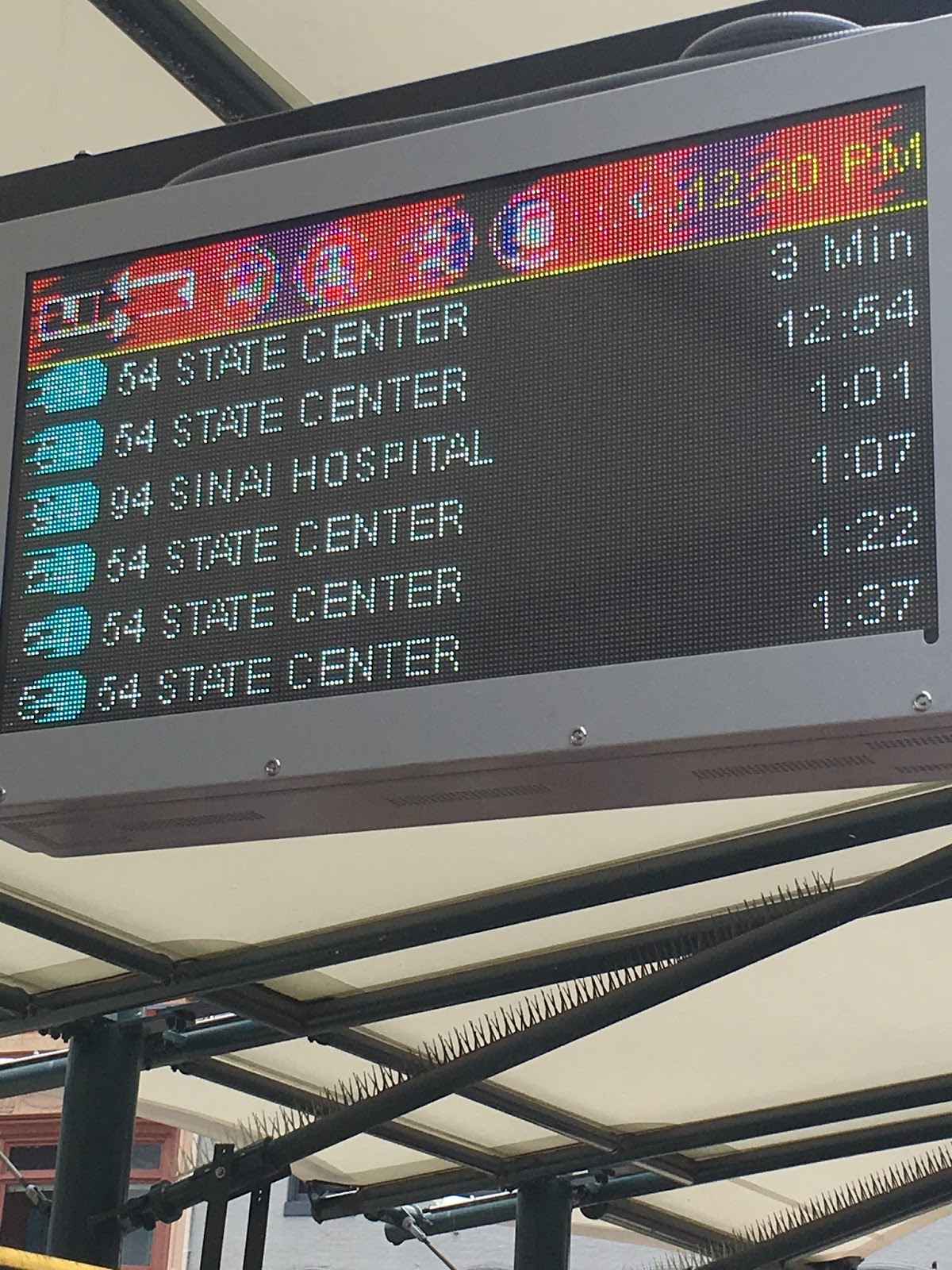
Ughhhh..... Got to bus stop 15 minutes early bus 54 Carney was suppose to come at 10:06am Well I'm still waiting and next bus come at 10:36am. I checked Google maps and it said on time but I'm still waiting. This is ridiculous 😠😠 I can't keep being late for work
Many riders feel left behind by MTA
Three PURPLEs back-to-back. One going to Catonsville. Two going to Paradise Loop. | Observed at Howard Street (Across from the McDonalds)
Another day of getting to the bus stop and waiting 20 minutes and deciding to take the UM shuttle instead because 2 NVs are still 4 minutes away. I remember the days when the buses followed a schedule in the morning....not happening anymore. These 10-15 minute Headways are a myth with the constant bunching. MTA management, please do what you promised.
It is obvious that the MTA and the riders talk about the same system but in a different language and that in this manner there will never be agreement whether the system works or not. In fact, the statements of the MTA Administrator and the ones stated on the Facebook group can easily coexist and both be true. Riders want the bus to be on time, reliable and get them where they want to go in a reasonable time. It is as simple and as complicated as that. The MTA knows that in this regard a lot of problems still exist. 
TSP installed: check (two corridors)

As a result, MTA is still making improvements as the adjustments in the current fall schedule prove. Depending on perspective, the long list of changes listed in full below, indicates that Link as initially implemented didn't work. Or it proves Kevin Quinn's last point, that the MTA works "every day to make sure that BaltimoreLink works for as many riders as possible".

In spite of its length the list can't be the answer to the Babylonian confusion that still prevails when it comes to perspective, goals and metrics. As long as buses don't reliably show up on time, riders won't be happy, no matter the system set-up.

Klaus Philipsen, FAIA

Washington Post about Baltimore buses 


Fall 2017 Service Adjustments

The following is the list of changes for the Fall 2017 service change, which will start on Sunday, September 3. A total of 25 adjustments are included in the service change, including shifting of trips, adding in trips/increasing frequencies, increasing service spans, and alignment changes. These adjustments are based on internal and external feedback, including comments from operators, the public, and other MTA departments. These adjustments are in addition to the supplemental service/school trippers added in the Fall pick to manage increased demands on the system as a result of students returning to school and using MTA service.

Service Modifications

CityLink Blue - Weekday
  • Three eastbound trips that originally started at North Bend Loop, now will be extended to start at CMS. Two westbound trips that terminate at North Bend will be extended to CMS.
  • Added early morning trips (eastbound 413 AM, 439 AM, 500 AM; westbound 417 AM)
  • Adjusted runtimes.
  • PDF Schedule  l Map
CityLink Gold - Weekday
  • Added westbound trip at 242 AM.
    Dedicated lanes implementation schedule (MTA)
  • PDF Schedule l Map
CityLink Navy – Weekday
  • Added a southbound trip leaving Mondawmin at 1010 PM.
  • PDF Schedule l Map
CityLink Orange - Weekday
  • Added three westbound and eastbound trips at approximately 330 AM, 432 AM, 530 AM. Frequency increased to every 30 minutes early morning, then every 15 starting at 600 AM.
  • Adjusted runtimes.
  • PDF Schedule l Map
CityLink Red – Weekday
  • Extended northbound 430 AM trip from Towson to Lutherville.
  • Added northbound trip leaving University of Maryland Transit Center at 506 PM.
  • PDF Schedule Map
CityLink Yellow – Weekday, Saturday, Sunday
  • Extended all trips currently originating and terminating at Riverview to Patapsco Light Rail Station, including late night trips short turning at Commerce Drive.
  • PDF Schedule l Map
CityLink Pink - Weekday
  • Added two morning trips (315AM, 415AM) both eastbound and westbound.
  • PDF Schedule l Map
CityLink Brown – Weekday, Saturday, Sunday
  • Modify alignment to bypass White Marsh Mall past 930 PM (directive from mall management on private property).
  • PDF Schedule l Map
CityLink Lime – Weekday, Saturday, Sunday
  • Change northwest segment from "Not in Service" to revenue service on Brenbrook Drive and Old Court Road and proposed two new bus stops (at Home Depot/layover and Northwest Hospital).
  • PDF Schedule Map
LocalLink 31 – Saturday, Sunday
LocalLink 34 – Weekday
  • Extended two trips in both the morning and evening peak to Greenspring Station.
  • PDF Schedule l Map
LocalLink 52 – Weekday, Saturday, Sunday
LocalLink 62 – Weekday
  • Swap northbound and southbound trip start times to restore previous service schedule.
  •  PDF Schedule l Map
LocalLink 65 – Saturday, Sunday
LocalLink 67 – Weekday, Saturday, Sunday
LocalLink 69 - Weekday 
  • Rebuilt service to provide a more evenly spaced frequency on the trunk (Patapsco LR to Cromwell LR) and branches to Jumpers Hole and Annapolis in both directions.
  • PDF Schedule l Map
LocalLink 70 - Weekday
  • Rebuilt service to provide a more evenly spaced frequency on the trunk (Patapsco LR to Cromwell LR) and branches to Jumpers Hole and Annapolis in both directions.
  • PDF Schedule Map
LocalLink 75 – Weekday, Saturday, Sunday
  • Added trips to fill in overnight service gaps when Light Rail is not in service.
  • PDF Schedule l Map
LocalLink 76 - Weekday, Saturday, Sunday
  • Modified northbound alignment of route due to difficult turning movements based on operator feedback. Former alignment was eastbound Pratt, left on Calvert, right on Lexington. New alignment is eastbound Pratt and left on Gay.
  • PDF Schedule l Map
LocalLink 80 - Weekday
New stop signs (Sweeney)

LocalLink 83 – Weekday
  • Restore service to 20 minute peak and 30 minute mid-day frequency, mirroring the previous schedule on the former 53 line.
  • PDF Schedule Map
LocalLink 87 – Weekday
  • Shifted trips to provide better transfer access; trip departing Owings Mills Metro Station at 359 AM now departing Glyndon 425 AM, arriving Owings Mills Metro Station at 450 AM to connect to first Metro trip.
  • PDF Schedule l Map
LocalLink 89 – Weekday
  • Shifted trip to deliver a 543 AM arrival at Redland Court.
  • PDF Schedule l Map
Express BusLink 104 – Weekday
Express BusLink 120 - Weekday

Bus Stop Adjustments

For the Fall service change, there are a total of 85 proposed bus stop adjustments, which include 14 proposed new stops, 32 reactivated stops, 24 stop relocations, and 15 stop removals.