Wednesday, May 29, 2019

How not to erase history, one building at a time

The two pre-Civil War stone mill-worker houses which were recently  leveled in Woodberry, in spite of promises to preserve them, seem to be an especially brazen case wiping out history through deceit, but they are far from being an exception.
Almost nothing can reverse this 2hr act act of vandalism (Photo: Philipsen)
In response to the startling demolitions of two historic stone homes from the 1840s in Baltimore’s Woodberry neighborhood on May 21, 2019, Preservation Maryland issued the following statement:
As the statewide historic preservation advocacy organization, Preservation Maryland feels compelled to denounce the recent demolition of 3511 and 3525 Clipper Road, two historic stone buildings in Baltimore’s Woodberry neighborhood, and voice our concern over the precedent this type of demolition presents. [....] 
Preservation Maryland recognizes not every building can be saved. This situation, however, sets a troubling precedent where public concern is disregarded, assurances are ignored, and demolition occurs without basic safety precautions. The loss of these buildings also underscores the need to take a hard look at the demolition review process in Baltimore City and to address the challenges citizens face to guide development in their own neighborhoods. Baltimore’s history deserves much better than the bulldozer’s blade. (Preservation Maryland)
In fact, Baltimore, a city with a rich and long history and one of the largest set of earmarked historic structures in the US, can look back on a whole series of legal or illegal demolitions that often lead to surface parking lots or even sites covered in rubble and no prospect of construction. At times courts intervened, injunctions were issued and yet, in the end the buildings were gone.
Royal Theater on Pennsylvania Avenue ca 1930 (Theater Talks)

Some of those demolitions go far back: the Calvert Building on St Paul and Fayettte (demolished 1971), the News American Building at South and Pratt Streets, the Royal Theater on Pennsylvania Avenue (1971), The McCormick Spice Company (1989) the Southern Hotel at Light Street (1993), the Sun Life building on Redwood Street (2001) and the Rochembeau on Charles Street (2006) are just a few examples.
Some demolitions are more recent and even involve modern buildings or structures such as the Mechanic Theater (demolished in 2014), the McKeldin Fountain (2016), the St. Vincent's Infant Asylum on Division Street (2015) and the Freedom House on Druid Hill Avenue (2015). Large scale demolition can be expected for the Baltimore Jail later this year.
Baltimore Jail (rendering)

Sometimes the demolition-happy parties were developers who overestimated their ability to build new, sometimes a company that saw a brighter future elsewhere, sometimes it was the City and its inspectors, or an agency set on urban renewal. In one case it was the Catholic Archdiocese of Baltimore that wanted a better view of its famous Basilica, in another Bethel AME demolishing instead of repairing. Sometimes developers even get the official blessing of CHAP to demolish historic assets through a very large loophole in preservation: Economic hardship. (Example: Eddie's in Mount Vernon).
A token marquis, the Royal today
(Photo: Philipsen)

Not that preservation in Baltimore didn't have a lot of successes as well. In fact the City is brimming with excellent examples of preservation and adaptive reuse, too numerous to list, from the Hebrew Orphan Asylum in West Baltimore (reconstructed now) to the American Brewery in East Baltimore and many more in between.

But if an owner or developer is intent on destruction, there is currently little leverage to really prevent it, no matter if a structure is in a local historic CHAP district (which has legal protections) or just in a National Register District (which has only carrots but no sticks). A developer who breaks the law may get stopped and fined, by which time the deed is usually done. At times the developer even walks away, leaving behind a pile of rubble without any prospect for anything. This seems to be the case in Clipper Mill and it certainly has been the case in Marble Hill. Outside of CHAP Districts one can rarely find hard reasons to deny a demolition permit. One exception may be the historic Gombrecht Building at 320 N. Eutaw Street which is outside the Market Center CHAP district. The applicable urban renewal plan there stipulates that demo can only occur with new funded development plans in place. A demo application is currently under review.
McCormick Spice Company demolition on Light Street
So what could be done to prevent those who, against better knowledge, are set on a slow continued destruction of Baltimore's history?

For example, what could really protect Martick's former restaurant, initially a thorn in the side of the developer doing the block at Park and Mulberry? The developer agreed on keeping the front part after a push by the preservation community. But with the demo permit for the rear portion of the property in his pocket, what would prevent the developer to push it all down in the span of maybe an hour?

The case of those Woodberry stone houses, where the deed of demolition was done in the span of a morning should be used as an instructive lesson.


  • The $3,000 fine the contractor has to pay is about lack of notice, missing fencing and lack of dust control. The fine is nothing in the context of the overall project cost. 
  • The the project had been presented to the design review panel (UDAAP) showing the historic houses preserved and integrated into the project. But it meant nothing. 
  • The preservation charade was the result of a massive public outcry, but as Pavlina Ilieva, UDAAP chair and partner of the the firm Pi.Kl which was the architect of the project stated: "You can't just rely on advocacy by the community".  
  • Woodberry is a historic district on the National Register of historic places, but tat distinction means nothing for enforcement, it just entitles developers to incentives.
  • The Department of Community Developmnt which handles permits issued a demolition permit but knew nothing about the UDAAP review and vice versa. ""There is no alignment of policy or process" (Iliaeva). 
As a result of the deceit, the project lost one of the development partners and also its architects. Most of all, though public trust was lost. It is entirely unclear at this point, what will happen with the two piles of rubble marring Woodberry, a well kept community for which those two houses were so architecturally representative.
Demolition of the Sun Life building on Redwood Street (Sun

Learning from this case, a revision of the tools available to prevent the all too frequent demolitions could include these steps:
  • change the zoning code so that contributing buildings in the National Register District have some level of protection even if they are not individually listed as individual landmarks. 
  • Do not allow demolition anywhere without approved long-term plans and financing in place
  • Increase the fines for violations significantly so they become a true deterrent
  • A much tighter definition of "economic hardship"
  • State and federal historic tax credit programs need to be better funded and be linked to reinvestment and social impact funds
  • If a project had been approved by UDAAP for a certain design, no significantly deviant construction permit should be issued, no matter what and when.
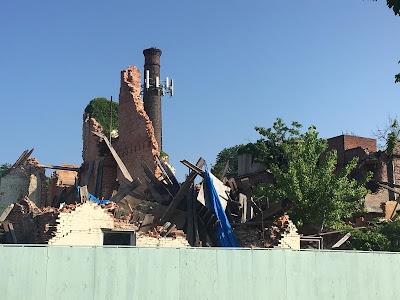
    What's left of the St Vincent Infant Asylum building in Marble Hill
    (Photo: Philipsen)
When asked what measures she would consider effective in preventing further debacles like the one in Woodberry, Ilieva aslo suggested clearly defined memoranda of understanding (MOU) between the developer and the community or even between UDAAP/Planning and te Owner.

For those who doubt that more preservation is worth any trouble or may even think that we have too much historic stuff already: There is a growing body of evidence that historic preservation returns more value than the extra cost it sometimes causes compared to new construction.

Baltimore offers the evidence: The areas with lots of preservation (Fells Point, Federal Hill, Bolton Hill, Mount Vernon) are faring far better than those with demolition and plenty of urban renewal. Areas of large scale demolition such as State Center, the Highway to Nowhere, Jonestown Mall or where the highrise projects used to stand did far worse, economically, socially and in terms of urban design. Their historic character is what sets cities apart, especially in a time when historic value isn't just counted as exceptional brick and mortar, but also in terms of social history. The Reid's Drugstore on Howard Street, for example., is not remarkable for its architecture but for the Morgan student sit-ins that happened there long before the Civil Rights movement really unfolded.
St Vincent Infant Asylum building in Marble Hill before demo
(Baltimore Heritage)
One of the great surprises of the digital age is that quality of place remains such a key factor in where people choose to live and businesses choose to open their doors. Only 10 or 20 years ago, futurists and technologists promised us that place would become irrelevant: We would all live and work and connect with the world via the internet, free to roam anywhere we chose. But millions of years of evolution are tough to shake; we remain social creatures and continue to seek connection, delight, and fulfillment in real, physical space. (CityLab 2-8-2019)
Especially in the current difficult situation in which Baltimore finds itself, the city's history and its rich architecture are very valuable assets which everyone should cherish.

Klaus Philipsen, FAIA
Mechanic Theater demolition  (Matthew Carbone)

Related articles on this blog:

Tearing down Eddies in Mt Vernon? (Eddies in Mount Vernon)
Demolition gone astray (Rowhouses in South Baltimore)
Old Baltimore on fire (The Gombrecht Building on 320 N. Eutaw Street)
Bombing downtown (The Mechanic Theatre)
Why "tearing it all down" is not an option (former Elementary School PS 103)
House that was demolished
(Preservation MD)
Chambers Building on Charles Street: Demolition and then what?


A similar house on the same side of Clipper Mill Road that has been restored
(Photo: Philipsen)

Demolition of theWoodberry stone houses (Photo: Fred Scharmen)

Thursday, May 16, 2019

Is Baltimore resilient enough?

Resilient, of course, means to be able to bounce back from adversity and bad impacts. One could easily imagine that Baltimore should be, by now, extra resilient, given all the adverse conditions which beat the city back, time and again.

This is particularly painful in a time when other cities build reserves and get fat and strong from years of economic boom. Their getting fat could mean they are getting complacent, not something we could afford here in many years. Even in the most affluent places such as San Francisco, strength isn't flowing evenly. People with service jobs can't afford to live there anymore, no matter how liberal and well meaning the local government. Baltimore largely has staid affordable.

This, then, becomes one of Baltimore's consolations: We have avoided some of the pitfalls of success. Still, when it comes to inequity, we are a frontline community, and know what we are talking about, what with having invented the racist restrictive covenants and zoning codes that laid the groundwork for systemic inequity?

But are we resilient? Is it is resilient if people in neighborhoods that are under fire every night get up in the morning, go to the bus stop for the long journey to a job that doesn't pay enough? To add insult to injury, those very same people learn just now that their bus ticket will soon cost 10 cents more. Yes, that is less than the single ride ticket in most other cities, but many of those places have ambitious transit plans like the $billion Red Line that was taken off Baltimore's docket. Meanwhile, our system, stuck in its current size, is slowly improving its performance. Resilience?
Baltimore IT Director Frank Jones at ransomware press conference

Is it resilient when dozens of non-profits have to address re-entry of formerly imprisoned citizens because our criminal justice system has "correction" only in its name and not in its practice?

Is it resilience when dozens of non-profits such as  Turnaround Tuesday or Barclay Corps have to do workforce development because our schools churn out students that cannot get any jobs for lack of skills? Is it resilience when citizens have to patrol their own streets because the trust to the Baltimore Police is so broken that collaboration looks like treason to some? Is it resilience for Cease Fire to stand tall while some Federal Hill restaurateur calls them "village idiots". (He has apologized, maybe another sign of resilience?).

Baltimore wasn't and isn't resilient against the Robin Hood Ransom Ware, even when the meter maids recovered first and retreated back to pen and paper pads to write parking tickets. But the Finance people didn't find such a work-around yet and so all home sales came to a screeching halt, the exact opposite of what this city needs. Even if we can bounce back from this sooner than later, I can already hear the words, "this happened when our servers were down", as an explanation for anything that is missing in the chain of necessary information.
Baltimore disaster preparedness and resilience
plans

Most people who are not IT experts can't say, how well other cities or organizations are armed against such an attack. Many places have been hacked, apparently it is not easy to say if a City like Baltimore can have a fully effective defense against such software attacks. We know, though, the Pugh was Mayor she wasn't very complimentary about the City's IT prowess. Resilience means, we can bounce back. If the agencies have all their data and files safely squirreled away somewhere else than on the main servers and the IT Department knows what to do, it may be possible to get everything back together rather quickly. We don't know, what our IT department can do, and once again we are relying on the FBI being involved. This seems to become our trademark, not a sign of autonomy. Doesn't resilience also mean autonomy to some extent?

Possibly transparency isn't what one should expect in a case of ransomware attack, but the amount of non-communication about the topic is not heart warming or comforting. It probably means things are even worse than we think. There isn't an easy to find place where means and methods are published about how citizens can interact with the various agencies when they have to on alternative channels. After a week door stickers that say "our servers are down" are getting old. Does the City maintain a paper trail on all those transactions and records? Wouldn't that be part of resilience?
The Greater Baltimore Board of Real estate on Wednesday afternoon:
“We’ve just been informed by Baltimore City officials that I.T. technicians have determined the root of the problem in the data system compromised by the ransomware attack. Each facet of the system is being evaluated to ensure there are no glitches and that it can be relaunched fully functional and integrate with parallel systems. This process is anticipated to take between four and five business days, which would mean that the citywide system should be online and operational by the end of next week. 
As a word of caution, there are no guarantees for this time frame because the application of this remediation is truly untested waters.
Ellicott City plans to spend $150 million on getting more resilient. What would be the equivalent amount for Baltimore City, just to arm ourselves against stormwater that wreaks havoc in our valleys as well, not to mention with our aged and rotten stormwater lines? And that isn't even mentioning resilience against seawater rise that makes itself felt in Fells Point and elsewhere.
Russell D'acampo, Wind-Up Sapce

Baltimore did a good thing against air pollution which hits disadvantaged communities so much harder than the affluent ones which usually sit upwind from polluters like the Baltimore Wheelabrator Incinerator. It legislated less pollution. But are we resilient enough to bounce back when the incinerator really closes and all our trash has to go into landfills or are we just moving the problem around? That trash energy can heat hundreds of downtown properties seems resilient, somehow, if just the exhaust could be filtered to be less polluting.
Marvin Hayes, Baltimore Compost Collective, Sept 2018
 Photo by Brandon Block.

Is it resilience when a successful arts and entertainment district far away from the waterfront can continue to thrive even though its early adapters and promoters fall like flies, from Liam Flynn to red Emma's and now Russell Dacampo's Wind-Up Space? The visitor numbers of the Film Festival ending this week will tell, among other things. The arts are needed in crisis, for comfort, as a guide and for meaning. Artists may be the most resilient folks around.

Most agree, Baltimore has grit, a term often bandied around to describe the rough edges and the authenticity that comes from unique circumstances.  If being battle-worn makes people resilient, Baltimore is the epitome of resiliency. But there is a breaking point when challenges become too numerous and too big and instead of making them stronger they break people. A point when bystanders  become cynical, disillusioned and give up.

Of course, in most parts of Baltimore life goes on, ransomware or not, and regardless who is mayor. As a place with low cost real estate, so close to Washington, there are enough investors who wonder if they couldn't get something going here. But our very own Cordish company rather invests near a $1 billion in Kansas City (Cordish COO Zed Smith) than here. One shouldn't discount the possibility, that cities can actually fail.

Klaus Phlipsen, FAIA

Friday, May 3, 2019

Should Baltimore's Next Mayor be weaker?

With the latest Baltimore quagmire the phrase "moving the city forward", a favorite cliche for decades, has received new currency. It conjures up shoulders to a wagon stuck in the mud on the way  towards freedom, exploration and riches. In that image forward is clearly defined. It had one direction: West.
Shoulder to the wheel: Baltimore moving forward

Unfortunately, neither the country as a whole nor the city of Baltimore have this type of consensus about where "forward" should take us.  The articles on this blog have tried for a long time to sort out what "forward" could mean, from , planning, urban design to transportation, governance and "smartness".

Example: Should the Baltimore mayor have less power? Be paired with a City Administrator? Be subjected to recalls by the City Council? All ideas floated by council members in various bills submitted for debate. Instead of offering my own assessment, I will reprint here with his permission a
little essay by Dan Sparaco which I found in my inbox yesterday.  Dan Sparaco was a Deputy Mayor under Stephanie Rawlings Blake, so he knows the Office of Mayor from the inside.

I put his arguments against curtailing mayoral power up here as a guest contribution and for discussion. It is one of a series of essays Dan wrote under the title B'more Now:

Bmore Now: Who's in charge here?

By Dan Sparaco
Dan Sparaco
Can you imagine Martin O’Malley or Sheila Dixon not wanting responsibility for “day-to-day operations of the City?”
I can’t.
Say what you will about either one of them, but when they were mayor, we knew who was in charge.
Yet days ago, a City Council bill was introduced that would: 
delete the language that says the mayor “shall have general supervision over all municipal officers and agencies,”take away the mayor’s power “to remove at pleasure all municipal officers,” andgive executive power to a City Administrator who would control the budget, get paid more money than the mayor, and who the mayor couldn’t remove without a majority vote from the City Council.
A less accountable mayor is not the answer to our problems.
In fact, this sounds like we’ve given up on having a good mayor ever again.
With a mayor on the verge of resignation it’s hard not to feel that way.
But adding another box to the org chart does not create a better government, or answer the question of leadership.
We have a Board of Estimates that approved the Healthy Holly contracts. We have a Comptroller who is supposed to be responsible for fiscal audits who forced out the city auditor. We have a part-time City Council. And we have an Office of the Council President designed mostly for someone to inherit the top job – as three of the last four mayors have done.
Sure, other counties have a Chief Administrative Officer, but there’s a big difference – they don’t have any filler:

In Montgomery and Prince George’s, there’s no doubt who’s in charge – the CAO works at the pleasure of the County Executive, who doesn’t need Council permission to replace them.
Meanwhile, Baltimore County shows the downside to a “non-political” administrative officer. Their new County Executive created a commission that just released a report, finding that their budget process is “highly centralized and has traditionally vested disproportionate power in the hands of the County’s administrative officer and a small staff in the budget office,” creating a system that “lacks transparency, stifles innovation, and discourages accountability.”
Baltimore City once had similar problems, when its own budget process was driven by finance directors like Charles Benton or Ed Gallagher, who drafted the city’s budget like the man behind the curtain in Oz.
The problem the city has today isn’t an all-powerful mayor, but a system that begins and ends with a Board of Estimates created in the 19th Century. All of our peers seem capable of running a government without one.
Real change starts with looking to places like PG and MoCo, and looking to the reforms already made by cities like Detroit and Seattle and New York.
Adding a “city administrator” to a broken system isn’t real change, and tinkering with the budget process within that broken system isn’t either.
There’s nothing wrong with giving our City Council more say in the budget process, as is the case in MoCo or Prince George’s.
But there’s no point in making the changes introduced this week to our City Council while leaving the rest of the dysfunction in place. Those changes give our City Council more power over the budget than other County Councils have, but then take away the mayor’s line item veto, for no good reason. 
There’s no need to get even deeper into the weeds. What we need to do is stop tinkering with something that needs a total overhaul.
Sure, “Baltimore is the only jurisdiction in the region that does not have a chief administrator.” But look around. Is that the real difference?
The real difference between the city and its peer jurisdictions is a pointless Office of the Comptroller, an unaccountable Office of the Council President, and a Board of Estimates that encourages corruption.
And there’s one more difference. Some of our peers have a full time Council that not only picks its own chairperson or speaker, but has at-large members:

What we need is a fresh start. A reset.
--Dan
The reprint here isn't an endorsement of the person (whatever his plans are) nor of his assessment of all aspects of Baltimore. For example,  "the fresh start" and "the reset" are cliches as much as "moving forward". Baltimore has been in "reset" mode for pretty much the entire time I have been here. On my iphone "reset" means that all customization, would be lost and the phone would be like fresh from the factory. We can't afford this for an entire city, whatever it means. 
Catherine Pugh talking about the removal of the Confederate monuments

Too many good things are happening, including

  • significant investments in the neighborhoods, including the disinvested communities of the Black Butterfly. 
  • The consent decree with the Justice Department regarding the police department  is in its third year, a promising Commissioner is in place, 
  • Baltimore's monumental school construction program is in its seventh year. (9 schools have been completed, six are under construction and another 13 are in various stages of design). 
  • We have a reinvestment fund, an affordable housing funds, a complete streets bill 
  •  the Vacants to Value program that other cities cite for its innovative approaches. 
  • The City Council came rejuvenated and re-energized out of the last election and has passed many progressive bills.  
This is only a partial list. Still, clearly the City hasn't accomplished its main goals:
Less crime and more residents. Crime remains sky-high and residents continue to flee. The reasons are less the absence of good initiatives but a lack of coordination and synergy. City agencies frequently trip themselves or each other. The actions on Baltimore's traffic signals or its bike-lanes are just two small examples. 

I will continue to use this space to promote ideas on how to pay attention to the details and still keep the big picture in mind. Weakening the next Baltimore mayor because of what happened is a response which doesn't take in account how much Baltimore's past successes depended on strong mayors in the past. Don't forget, Mayor Pugh's best moment was when she was strong and took the monuments down. 

Klaus Philipsen, FAIA

Tuesday, April 30, 2019

The Convention Center's biggest problem is Baltimore

Baltimore leaders continue to peddle the notion that Baltimore could land all those big conventions if only the Convention Center were bigger and newer.

Even though there may be the one or the other event that has trouble fitting into the 1.2 million square feet we can offer, the fixation on the size of the center is grossly misleading. Everyone who ever went to a convention knows that most convention organizers aim for a geographic mix while looking for the really cool cities where everyone wants to go. An attractive city with a stellar image boosts attendance and is the root of the business model.
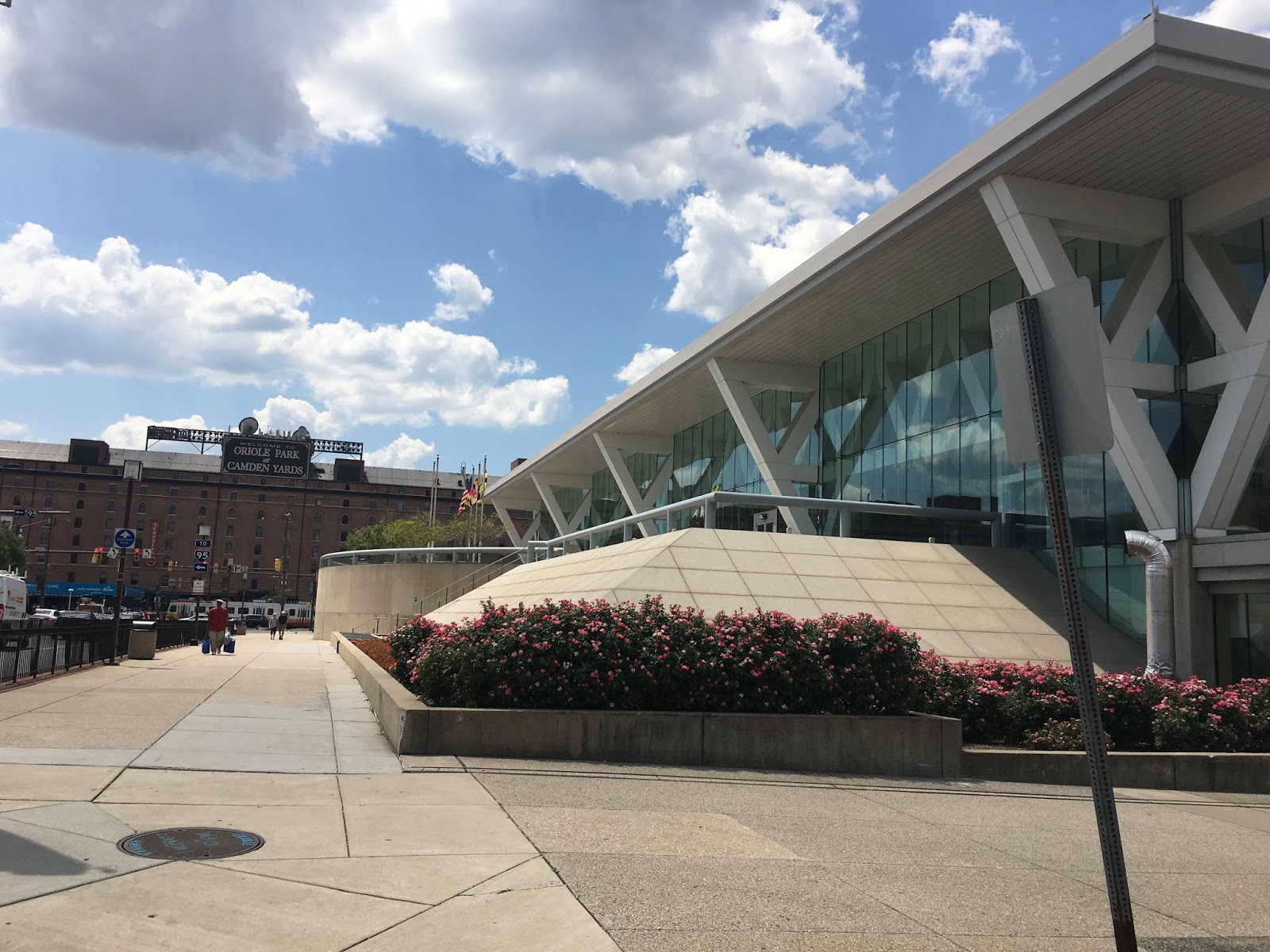
The Baltimore  Convention Center is bunker-like and
blocked off by too many lanes of traffic 

Is Baltimore the city everyone wants to go? It certainly could be, just as much as Pittsburgh, New Orleans or Detroit, but it isn't and hasn't been for a while.

Its not only the overall image of Baltimore that is an obstacle ("is it safe?", "are they competent there?") but also the setting of the center itself, the nearby hotels and what one sees when stepping out the Convention Center!

The times when conventioneers wanted to check into a hotel and walk from their bed straight into the nearest ballroom presentation, without ever stepping outside, are over. Today most people come for the urban experience. Many organizers complement their program with tours and programs in nearby facilities that allow participants to get a whiff of their host city. Baltimore's Convention Center opens up to Pratt, Conway, Charles and Sharp Streets. Each street is duller than the next, in part because of the bleak facades of the Center itself, but also because the other side of the street not only doesn't look much better but also is utterly unreachable because of all the traffic. As such, the Convention Center not only fails to attract enough visitors, it is also a drag on the city. Just consider, how wonderfully the westside of downtown could flow into Otterbein without it!

Baltimore cannot be expected to compete with nearby "class A" convention locations such as NYC, Philly or DC. Instead we need to corner a market that isn’t in direct competition with those neighbors. Maybe in the "B market" to which Baltimore should cater the 1.2 million area it has is just fine, considering that the larger the center, the larger the potential dead-zone in the city it creates. 1.2 million square feet, if spruced up, are a lot of space!
Walking along here provides little pleasure. But it would be easy to fix this
(photo: Philipsen)

Just take Nashville: Because its a hip city on every list noted as "up-and-coming", they also built a brand new convention center for nearly a a billion dollars.

But the center in Nashville is compact with its 1.2 million sf, the same size we currently have. It looks attractive from almost any perspective and it easily hooks up with other nearby attractions such as their arena and the Bridgestone Arena and the Country Music Hall of Fame. It doesn't have any imposing port vehicle delivery areas, not in the front or the back.

The surrounding Nashville streets are lively most of the time and one can easily walk to Broadway and the various bars and restaurants. There is a lot of traffic in Nashville (they hardly have transit) but aside nothing roars directly by in the manner Pratt and Conway Streets where traffic has highest priority.  No street next to Nashville's center is as dull as that block of Charles Street between Conway and Pratt which makes it impossible to imagine that the Inner Harbor is only a stone-throw away.
Face of the Nashville Convention Center: Outdoor terrace

Of course, the Inner Harbor itself is tired. On the way to HarborPlace the recent added street level activity at the corner of Pratt and Light is welcome, but the devastated McKedlin Plaza and the back of the now marginal Light Street pavilion present only more barriers,  far from exuding any coolness. (When was the last time that "Ripley's Believe or not?" was cool)?

Adventurous souls who want to explore downtown are certainly not enticed to do so. Venturing north from the Convention Center is no fun, no matter which route one tries: Eutaw or Howard Street, Hopkins Plaza, Charles, Light or Calvert Street. In each case at least the initial block is dreadful, often a lot more. Chief among deadening elements: Parking garages and surface parking lots. Equally awful for the much touted "pedestrian experience" are hotel loading zones, the brutalist facade of a fire-station with trucks blocking the sidewalk and the general lack of street trees, sidewalk cafes or retail. 

Eying their options,  conventioneers will inevitably amble towards the water's edge and stay there like caged animals. If they are persistent enough to not being deterred by parking lots and garages even in this most prestigious waterfront zone, or by interesting but impenetrable buildings like the Columbus Center and the condos of Scarlett Place, they will eventually find Harbor East and its smaller and livelier streets and restaurants, even though there is no way-finding to guide them there. Nothing tells them that even further out, along the promenade there would be also historic Fells Point, an area far more interesting than any section of Nashville. Yet there is no real promenade signage and walk access to Fells Point has been blocked  by the Central Avenue bridge construction and the construction of the Whole Foods tower there for years. The walk route around HarborPoint is now possible thanks to the awful car-centric new bridge, but once again, there is no guidance and only insiders who know "Sandlot" would venture there.
Parking garage on the horizon: Why would one want
to go here? And this is one of the better pathways
north!

Back at HarborPlace and the Convention Center, the entire freeway-ersatz network of Key Highway, Light, Pratt, and President Streets ringing the harbor is a deterrent for pedestrians ensuring visitors won't venture into the old downtown.

With just 63 annual events per the latest report, the Convention Center is far from fully booked. What should be done?

Sure, a few upgrades inside and on the facades of facilities would be good. A outdoor seating area along Convay Street on top of the awful plinth with the big exhibit halls below would be easy to do and potentially an attraction for ballpark visitors and conventioneers. The idea of combining a new arena with the convention center is creative and nobdy will cry about the loss of the Sheraton Hotel for this purpose.

Yet, nothing will work, as long as Baltimore continues to project incompetency, corruption and crime. Eeventually, Baltimore will become interesting again, in the same way New Orleans and Detroit worked their way out of the swamp. In the meantime a lot could be done to bring the areas surrounding the Convention Center up to snuff.
The Sheraton facing Conway Street: As pedestrian
unfriendly as possible (Photo: Philipsen)

To be perfectly clear for all those who say: Who cares? All those collateral improvements would foremost benefit Baltimore's residents. The benefit to visitors, conventioneers and the resulting economic impacts would be secondary.

In that, the convention center is, just like Pimlico, another example, that Baltimore's future isn't either for tourists or for residents (the typical binary approach), but the two are inextricably intertwined. In other words, the center can only recover when Baltimore recovers.

Klaus Philipsen

Related on this blog:
Convention Center: 
is bigger really better?
Nashville 2018 Financial report 
Too much traffic, too many lanes and the pavilion as a
barrier: Access to HarborPlace from the west.
(Photo: Philipsen)

Friday, April 26, 2019

The Baltimore Jail - Historic but to be demolished anyway

One would think that solid, 120 year old  buildings constructed from solid granite should stand a chance to be preserved, especially if they are recognizable Baltimore City landmarks, listed in the National Register of Historic Places and undisputed historically "contributing" structures. Historic preservation can fine even a mayor $500 a day for having the wrong shingles on a house. The Maryland General Assembly didn't give the State any funds to replace the demolished structures. But nope, the jail is on course to go the way of the News American, the Redwood Towers, the Mechanic Theater and the McKeldin Fountain. There isn't even a stipulation to save the granite.
Entry to the Tower  (Photo Philipsen)

The buildings in question are owned by the State of Maryland.  By necessity the State had to run through the Section 106 process that is known from national environmental law and designed to protect historic or environmental assets. The State adopted the same provisions even where no federal funds are used. The Maryland Historical Trust Act’s “Section 106” sets out procedures that require engaging community members and other interested parties in a process that allows the parties to understand a state agency’s proposal and to evaluate alternatives and mitigation where historic buildings could be impacted or demolished. At least that is the idea.

In question here is the Maryland Penitentiary complex in central Baltimore City. It is a 7.4-acre area of correctional buildings constructed between 1811 and 1995. Or as the Maryland Historic Trust "eligibility form" describes it:
The Maryland Penitentiary complex is significant as a largely intact collection of architecturally distinctive prison structures dating from the late nineteenth and early twentieth centuries and is eligible for listing under National Register
Rendering of the Jail in 1900
Warden John F. Weyler, appointed in 1888, undertook an ambitious construction program at the penitentiary, drawing on the latest ideas in prison design. Weyler commissioned architect Jackson C. Gott to design the Administration Building and O’Brien House, West Wing, and Boiler House. Completed in 1899, these buildings demonstrate a uniform Romanesque Revival aesthetic rendered in local Maryland granite. The new penitentiary buildings were state of the art facilities at the time of their construction. Soon after their completion, two additional buildings were constructed. Building A, designed by Baltimore architect Hugh S. Magruder, was constructed in 1902 to serve as a brush factory. C-Block, built in 1907 as a new women’s cell block, was designed by architect Charles M. Anderson of Baltimore. 

Prison complex overview.  All tan structures are contributing
Architect Jackson C. Gott designed the MTC West Wing, completed in 1899, as a cell-block wing connected to the Administration Building. Originally, the overall design of the Penitentiary included a south wing as well, but it was demolished for the construction of D-Block (Building 009), in 1995. The Romanesque Revival West Wing features characteristic elements such as rough-faced stone masonry, paired windows, and towers. The wing extends along E. Eager Street, and measures approximately 350 feet in length by fifty-five feet in width. The linear-plan wing exhibits a pitched standing-seam metal roof, and terminates in a square-plan, pyramidal-roofed “keep” with corner towers. Structurally, the wing consists of an outer shell of coursed Port Deposit granite block and an interior free-standing, five-tier, steel cell block on a concrete foundation and sub-basement. The ground story is composed of larger granite blocks, while the upper portion of the exterior is constructed of smaller blocks. The sides and top of the interior cell block do not touch the outer shell, effectively creating a prison within a prison, as the building was frequently described historically.

Warden House (The Castle, building 102 on map)
It is important to note, that although one could reasonably argue for separating the historic and architectural value of the buildings from correctional practices and the need for reform for more social justice and equity.

The State of Maryland and its Department of Public Safety and Correctional Services (DPSCS) in there argument fr demolition are playing these two aspects against each other when they try to substantiate why so many buildings in the complex need to be demolished. But historically, the buildings and justice reform have always been intertwined even if that may not be obvious today. Again quoting from the MHT documentation:
Prior to the American Revolution, Colonial prisons were largely associated with severe corporal punishment and public executions. By the late eighteenth century, reformers, such as John Howard of Great Britain, began to articulate a more progressive approach to incarceration. [...] 
Following grand jury investigations into conditions at the penitentiary, and Weyler’s persistence, the state appropriated $250,000 in 1890 for the construction of a new penitentiary. The appropriation was distributed in increments of $50,000 per year, and in 1894 the Jail Board had sufficient funds to acquire the property situated between Eager and Truxton Streets, to the north of the existing complex, and break ground on the new buildings.14
Weyler planned the layout of the complex. He studied the latest ideas in prison design, with an eye towards convenience, sanitation, security, and extensibility. In 1893, Weyler and architect Jackson C. Gott visited the state penitentiary at Allegheny City, Pennsylvania and the reformatory at Elmira, New York. Weyler was impressed with the prison at Allegheny City, particularly its ventilation and lighting systems and the arrangement of its workshops. In addition, Weyler took note of the emphasis placed on vocational and educational programs at Elmira, intended to reform the incarcerated and ease their transition back into society.
Building 109 on map with tower (Photo: Philipsen)
Now, there is no doubt that prisons in the United States today have little to do with "correction" and "rehabilitation" and that the historic City Jail does not comply with modern standards of justice. Anyone who has toured the D Block (with the steel cell block inside the building) will come away with the depressing feeling that these accommodations were less human than lion cages. In fact, the correctional system has been under a consent decree for a long time.

The question, therefore, is, how a modern jail can either coexist with historic preservation or be exercised in a new location. In violation of the spirit of Section 106 which seeks to minimize adverse impacts, the demolition plans by the Division of Corrections did NOT consider various options with a range of impact mitigation. In fact, the demolition is sought BEFORE any design for a new facility has been developed because no funds for design or construction of a new facility have been appropriated. The assumption that all buildings suggested for demolition need to go to allow a new facility to be constructed is based on nothing but a bubble diagram and a rough estimate of the needed program space. Not considered are options such as maintaining the front wall of the D block as a perimeter security wall that a new facility would still need. Not considered either is a hopefully shrinking prison population.

The 106 process which included three meetings with "consulting parties" representing the preservation interest brought  a small success in that a few building elements were removed from phase 1 demolition. This is documented in a Memorandum with MHT. It states:
DPSCS shall retain and preserve the Maryland Penitentiary’s Building 005/Administration Tower, and the Building 006/O’Brien House attached to the front of Building 005/Administration Tower, as well as seventy-two (72) feet length of the Maryland Penitentiary’s Building 109/West Wing to include the first set of turrets on the North and South side and two full arched windows, as shown in Exhibit D. [...]  
DPSCS has [also] removed the Building 102/Castle Building/Warden’s House at 300 East Madison Street from the State of Maryland’s demolition plan and the construction base bid package for the current Undertaking. Once the Therapeutic Treatment Center project is funded, DPSCS shall develop and consider alternatives for the treatment of the Building 102/Castle Building/Warden’s House. Such alternatives may include retention and rehabilitation, salvage, demolition, relocation, or other measures.
Demolition compromised (blue remains)
This "compromise" is better than the initially sought full demolition, but it ignores much of the findings of the State's own historic agency, namely the value of assembly as a whole. The  MHT eligibility document is quite clear about the value of the ensemble in its summary :
Considered as a whole, the Maryland Penitentiary complex maintains sufficient integrity of Location, Design, Setting, Materials, Workmanship, Feeling, and Association needed to convey significance within the context of late nineteenth and early twentieth-century incarceration and prison design. The six contributing structures all retain important character-defining exterior features. Integrity of Design, Materials, and Workmanship are retained through the presence of original stone masonry, arched window forms, towers and crenellation of rooflines, and elements, such as clustered columns, foliate capitals, and ornate moldings, that are specifically associated with the Romanesque Revival style and the architecture of the late Victorian period. Integrity of Design is further enhanced by the retention of much of the basic layout of the complex and the historic spatial relationships between the buildings.
The photo illustrates the massive scale of the construction
(Photo Philipsen)
Note that in the MOU DPSCS still maintains the option to demolish the landmarked Warden House ("Castle") in the future.

So, how is it possible that the Correctional folks can plow forward with demolition of history in spite of  all those findings? The answer is that local laws mean nothing to the State. Local historic district rules and local landmarks can safely be ignored by the State. National Register District eligibility has no teeth at all, it only allows for benefits such as historic tax credits. Thus, MHT had no choice but to agree "that the fulfillment of the terms of this MOA will satisfy the responsibilities of any Maryland state agency under the requirements of the Maryland Historical Trust Act of 1985".

The "consulting parties" included AIA Baltimore, Preservation Maryland, Baltimore Heritage and representatives from CHAP. All tell me that there is no legal recourse against what the State plans to do.

It is sad to see structures that stood for over a century disappear only because the current administration wants to see them go for the possible day when money for a new jail may be available. Those structures could stand another 100 years until Baltimore City has sorted itself out, the elevated JFX has been removed, the Jones Falls been day-lit again and the monumental jail structures could be part of a farmers market, a climbing gym or a maker space or something we just haven't imagined yet.

Klaus Philipsen, FAIA


Wednesday, April 24, 2019

Water Taxi: Ridership down by 68%, so is service

Per their website the Baltimore Water Taxi system has only 36% of its landings open and runs its taxis at 1/2 hour schedules on weekends only. On a beautiful Wednesday afternoon with plenty of people strolling around, no vessel was in sight at the Harborplace stop or anywhere else. This wasn't how the service was run before Plank Industries owned it.
Waiting for Godot at HarborPlace: No water taxi
during the week in April (Photo: Philipsen)

Michael McDaniel, President and CEO of the Baltimore Water Taxi now owned by Plank Industries explains the reduced service this way:
The number of riders has significantly declined since 2015 from a high of 300,000+ to last year’s total of 96,000.  As you can imagine if any business lost 68% of their clientele it would directly affect their bottom line.  We are no exception and the impact of this has required us to scale things down. 
One has to wonder what is cause and effect. No doubt, Baltimore has been hit by its declining reputation and tourist numbers are down across the board. Still, its a catch 22. Once service becomes unreliable and unpredictable or inconvenient, ridership will drop further. Obviously, a decrease in service was not how the new partnership with Plank Industries  was envisioned. To the contrary, expectations were high when Under Armour's Sagamore was associated with the system and replaced the light and fragile vessels with  all new made-in-Baltimore boats for a significant cost.
Fancy no boats but no service

McDaniel explains the dramatic ridership loss with a whole litany of reasons. He wrote to me:

The decline in ridership for the Baltimore Water Taxi can be contributed to a lot of things:
  • Low tourism rates.  Number one question we are asked, "is that area safe?"
  • Low foot-traffic around Harbor Place and Fell's Point.
  • Competition with Uber, Lyft, Lime, Bird, Spin, and Jump as the "fun" and affordable way of getting around the water
  • Availability of affordable parking
One silver lining is an uptick in riders on the free commuter water shuttle Harbor Connector which is paid by the City and has maintained its schedule. McDaniel states that the service reduction on the tourist boats is based on an analysis under the following aspects:
"This Landing is Closed": Science Center
- System design (i.e., Harbor Connector vs. Baltimore Water Taxi)
- Historical ridership patterns/habits
- Current operating conditions
- Future ridership demands
- Financial
Scooters taking the butter off the bread for the Water Taxi?
He agrees that the drop in ridership and service is disheartening and says he wished 
"we can run the service 365 days a year from every location with direct routing and ample parking for zero dollars and zero cents.  However, that's not reality.  As stated we lost 68% of our ridership which means 68% of our revenue is gone.  I have to believe you understand what a loss like that does to a small business like ours. 
McDaniel considers the 2019 changes temporary as the company continues to evaluate routes and landings.  The Water Taxi operates under a license with the City of Baltimore which was renewed after Michelle Pourciau came on board as DOT Director, however under terms that were spelled out in a RFP that had been developed before her arrival and which, for example, spells out that the free Connector commuter shuttle service has to be operated under its own brand. McDaniel assures that

 of course, we are in close consultation with the City and in compliance with local, state, and federal regulations up to and including our contract.    
Plenty  of folks want to ride those boats on a Wednesday afternoon
An inquiry with DOT regarding requirements of the license agreement did not provide an immediate answer. Director Porciau stated that the department is looking into the matter. Trouble with the Water Taxi mirrors the calamities with another recently re-licensed transportation service, the Charm City Circulator. Here, too, was the RFP written in such a manner that optimal operations were made difficult. The previous operator, Veolia Transportation (Transdev) was sued by the City about services not performed but paid.  The current operator, RMA, has no experience with a fixed route transit system as large as the Charm City Circulator. After the departure of Transdev, Circulator service was severely curtailed because RMA didn't have enough buses or operators. It isn't clear if all those issues have since been resolved. 

Klaus Philipsen, FAIA