all photos: Klaus Philipsen
An architectural, urban design, planning, transportation and urban policy blog with focus on the Baltimore region
Sunday, November 14, 2021
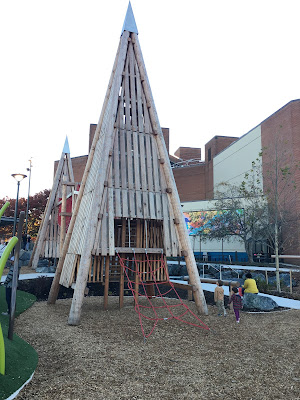
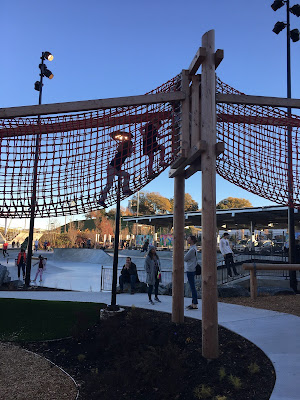
The new Rash Field - A story in pictures
all photos: Klaus Philipsen
Friday, October 29, 2021
The trouble with WMATA's new Kawasaki trains
Users of Baltimore's single subway line know about "gauge face angles". Tracks being out of compliance in 2018 forced the 15.5 mile line with its 100 subway cars out of service until the tracks were repaired. Ridership plunged. But in the big picture of the Baltimore Metro area the shut down of transit for 18,500 riders does not make a big splash.
| The interior of the 7000 series of WMATA's subway trains (Photo: Philipsen) |
DC Metro riders now had to learn about wheel gauges. Problems with Metro are quite different in Washington where WMATA operates 1,318 subway cars on 117 miles with 626,000 riders a day. When this system takes 60% of its railcars out of service, the effects have a huge impact on the entire region. There is no bus bridge, no Uber Service and no bikeshare that can pick up the lost capacity and the resulting gaps in schedule where now headways may have gone from 4-8 minutes to 30 minutes. Only the fact that COVID continues to take a toll on Metro's ridership has saved DC from a total collapse. Nevertheless, the impact on people relying on the trains is significant, especially since the disruption appears to drag on after the October 17 derailment followed by the order of the Metrorail Safety Commission to remove the cars from service.
IT IS HEREBY ORDERED that WMATA will:• (1) Remove from revenue service all 7000 Series railcars by 5:00 a.m. Monday October 18, 2021; and• (2) Develop a plan, under the oversight of the WMSC, to assess the cause, and to provide for the detection and prevention of wheel gauge anomalies in 7000 Series railcars; and • (3) Implement a plan that provides for the safe return to revenue service of each 7000 Series railcar.
What happened in DC has to do with wheel gauge (the distance between the inner wheel flanges on an axle) which obviously needs to be closely fitting the track gauge or the wheels can jump the rail, what is what happened on October 17.
Surprisingly, the culprit wasn't an old rail car but the new Kawasaki 7000 series which was gradually replacing the 1980's 5000 series coaches since 2015. Kawasaki Heavy Industries supplied 748 7000-series cars between 2010 and 2019, replacing the old 1000- and 4000-series trains. Until the recent mishap, WMATA considered those new coaches as the most reliable in Metro’s history.
However, they do not hold their gauge accurately, instead the wheels appear to move outward on the axle over time, a defect that WMATA had detected during routine inspections since 2017, two years after the new cars went into service. There is now discussion, why these findings did not result in broader preventive action. The exact causes for the wheel migration and the circumstances of earlier wheel gauge problems are now subject to federal investigations. Wheel gauges not following specifications were found on over 31 additional wheel sets once all 7000 series cars were inspected.
| Kawasaki wheel truck assembly Yonkers, NY (Photo: Ken Stabile) |
Aside from some Spanish trains that can adjust to different track gauges while running in service (I wrote about that here), train car axles and wheels (the entire assembly is also called the truck) are principally a fairly simple affair which looks a lot like it did a century ago. However, with higher speeds and modern safety requirements, the trucks and bogies under the trains have become a more complex arrangement which to maintain requires a lot of precision inspection and occasional adjustment to account for wear, for example through “wheel truing”. The wheel gauge, though, wouldn't normally be considered a wear item. The matter of the non-compliant gauge is under investigation by the National Transportation Safety Board (NTSB). Kawasaki, which manufactured the derailed cars in 2016 in Yonkers NY, is rather tight-lipped about the matter, other than stating that the Kawasaki Group “was offered party status by NTSB and has been participating in the investigation together with WMATA”. In a question and answer piece online, the company states that the WMATA trains have a specific assembly that is not being used on other systems, for example in New York City's metro which also uses Kawasaki cars.
The trucks for the WMATA 7000 series railcars are of unique design for the technical requirements of WMATA, and the identical trucks are not used by
other railway operators in US or Japan. The specifications of the trucks vary depending on the type of railcars. (Kawasaki)
Earlier this year WMATA had placed an initial contract for additional new rail cars made by Hitachi. The 8000 series vehicles could cost up to $2.2 bn, if all contract options are exercised and all old cars would be replaced by this model. It is promising to improve on the design and features of the new fleet of 7000-series cars and be lighter, safer and more energy-efficient than current cars. Like the Kawasaki cars they will have digital screens and real-time information, dynamic maps. They will also feature electrical outlets for charging personal devices, and additional hand-holds for standing passengers.
| On order since March 2021: New Hitachi train 8000. |
No time has been given so far, when the Kawasaki 7000 coaches can go back into service. In the meantime the old fleet based on a 1970's design by the Italian company Breda (now Hitachi) will have to do. These large and comfortable cars are still the general template for design, both, for the 7000 and the 8000 series. Neither feature the now popular accordion style fully connected coaches found in Europe. The Italian designed original cars were part of the DC subway project which was conceived as one of President Johnson's "New Society" projects that gave us the acclaimed DC subway and it’s stations and the Dulles airport.
The wheel gauge debacle sets WMATA back, just when the transit agency had gained back some lost trust from riders after full service outages in 2015, stemming from spectacular electrical failures leading to track and train fires. Maryland contributes heavily to WMATA’s funding.
Klaus Philipsen, FAIA
https://www.railwayage.com/passenger/rapid-transit/wmata-removes-all-7000-series-cars-following-derailment/https://www.washingtonpost.com/transportation/2021/10/19/metro-7000-cars-recovery-pandemic/
https://www.railwayage.com/passenger/rapid-transit/hitachi-rail-wins-wmata-8000-series-contract/
Monday, October 25, 2021
Can electronic billboards revive downtown?
Baltimore is only the latest battleground for the $8.2 billion billboard industry to expand its latest technology into the downtowns of bigger US cities.
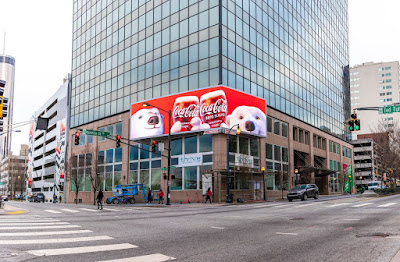
Digital displays are the future of outdoor advertising. The new technology draws attention providing a high profile approach to delivering your advertising message. Digital displays typically hold your message for 10 seconds and the number of advertisers per display can vary. Additionally, digital displays now offer options never before available to outdoor advertising; networking capabilities, daypart selection and static or fully animated creative. The advertising message can easily be changed with a simple electronic file download. (Atlanta Billboard Company)
| An Atlanta example of an electronic sign under their new sign ordinance (Atlanta Curbed). |
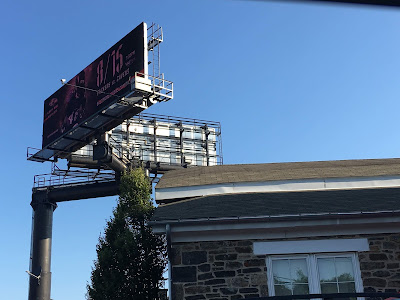
Twenty years ago Baltimore had an epic billboard fight which left the advertisers only with their legacy signs that had been in place back then. Not only are they still there, some of them have also been converted to giant television screens, or in the industry parlance "variable message signage". Now the national billboard giants feel it’s time to expand their reach: How about selling the latest technology as "game changers" that add "vibrancy, vitality and place-making" to downtowns?
Baltimore rolls out the carpet
In a time where downtowns suffer from a noticeable absence of people thanks to the pandemic, advertisers found a receptive audience in those whose business it is is to promote downtown. For example, Shelanda Stokes, of the Baltimore Downtown Partnership. Following Petula Clark’s lead, she says that downtown electronic billboards promoting Toyota, Coca Cola or dog food would bring everything that's missing, including walkability, synergy motion, art and light.
Downtown residents beg to differ. They should matter, since they are what fills the vacant and obsolete former office buildings and are downtown's best chnace for a prosperous future. Barbara Valeri describes her view in a letter to the editor in the SUN where she opines that the bill is not a bright but a dim idea. She told the Brew: “fix the roads, mend the sidewalks, get rid of trash and clutter and graffiti, make downtown safer and focus on other basic upgrades.”
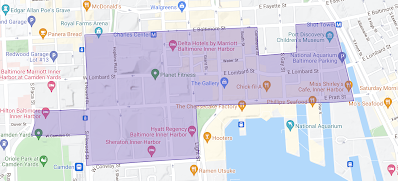
| Area of Special Sign Control (DPoB website) |
Let’s enliven downtown by welcoming more small and minority-owned businesses, erecting more affordable housing, and cleaning our streets and harborways (Barbara Valeri in SUN letter).
A City Council Committee, the full Council and the Planning Commission fell easily for the beckoning of the billboard industry. Unlike councils in other US cities they waved a new bill right through, before the general public had time to realize what is being discussed. This is surprising, since last year a bill to allow billboards along rail right of ways went up in flames. Apparently the lesson the lawmakers drew from that defeat was to run over their constituents this time. An appeal of William King, interim president of the City Center Residents’ Association (CCRA) and attorney by profession, to delay the final vote on the bill did not stop the Council to finalize the vote and approve the bill the same night. Councilman Costello, the bill sponsor, has yet to meet with the CCRA, according to King.
| Legacy billboard on the JFX in Baltimore |
Other cities
Other cities should be a warning or a lesson as well: When Indianapolis was under similar pressure to put variable message signage downtown, there was a public outcry, a city led survey and a clear stand of the city's mayor pushing back. As a result the ban on new digital billboards, a technology coveted by advertisers but reviled by neighborhood activists, still stands. In San Jose the fight was led by a strong opposition with arguments that are similar to those of opponents here. The billboard expansion bill was halted for the time being.
“The idea that San Jose can be the next Times Square (above) is an illusion and it's misguided. There’s a real categorical difference between signs that embody the history and culture of a place that advertise a local business or tell a story about entrepreneurship versus a TV screen that changes every seven seconds, and has no connection to the place that it’s located” Ben Leech, executive director of Preservation Action Council of San Jose.
“If the city is so convinced that this change in our signage will benefit the city, then it should be voted on by the people, not politicians who may or may not be supported by the sign lobbies.” San Jose resident Alex Taylor to Councilmember Raul Peralez.
The Ludlow, East Market Phillly, proposed sign. (BLK Architects)
“The billboard industry is a special interest group and they’re the sole beneficiaries of this sign ordinance change. There’s just no public benefit here." Les Levitt, San Jose downtown resident
The billboard industry likes to point to other cities such as Atlanta, Washington DC and Philadelphia which already adopted special sign districts and allow electronic billboards. As far as I can tell, DC allows only 32 individual "special signs". Atlanta's ordinance maybe the most far reaching, but it allows only static signs with scrolling letters and has many restrictions regarding size, location and glare. Philadelphia also doesn't simply open the door but puts strict criteria in place, including a requirement for large investments:
The public improvement requires a minimum investment of ten million dollars ($10,000,000), exclusive of any facade work directly associated with construction and operation of the sign.
(c) The public improvement has been completed prior to the application for a zoning permit, or will be completed pursuant to an approved investment schedule prepared in accordance with subsections (.1) through (.3), below.
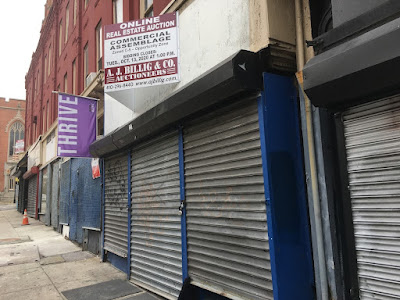
| Shuttered downtown stores Baltimore (Photo: Philipsen) |
True, Baltimore's downtown streets frequently lack vitalility, even during the daytime. Where are the people one wonders and at night when many businesses go dark behind steel shutters, the impression of dullness increases. The many restrictions on signage codified in Baltimore's reformed zoning code don't help, although the code allows for "Areas of Special Sign Control (ASSC) districts, exactly the provision this new bill uses.
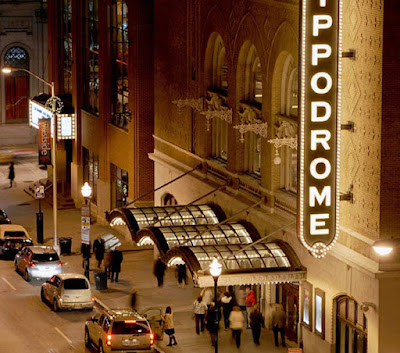
But the variable message board is far from the cherished neon signs which to this day signals economic vitality. Instead of enhancing a building it simply covers it up or, worse, sits on top of it. Where the neon sign can be a sculpture the e-board is as flat as a photo of sculpture.
| Historic projecting neon signs (High Mountain Signs) |
The City Council adopted new ordinance only sets a framework for the new types of signs, including where they could occur. Details are to be worked out by a yet to be created group of city agencies and stakeholders. A detailed plan would have to be approved by the Planning Commission.
DPOB is requiring all media companies participating in the District to live up to a far higher standard of community benefits and responsiveness than any other signs in the City.
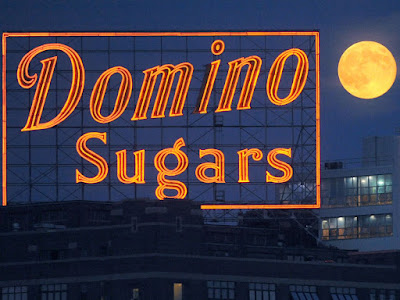
"15-20% of those billboards to be dedicated to small business, minority business and local artists,” and that DPOB is asking for 1% share of the signage revenues for its organization plus 1% for each of the city’s four arts and entertainment districts. According to calculations performed by DPoB there could be as many as 20,227 sf of those signs in the designated area. That would amount to 2.4 times the size of the giant landmark Domino Sugar sign.
As noted, digital signboards are much different than the beloved Domino Sugar sign. They are essentially giant TV screens and in that way they can display any image in any color, including animated displays. For an impression on how those signs work, go up Charles Street and look at the giant billboard across from Penn Station that once was once a static paper billboard depicting the Natty Boh man proposing to the Utz girl.
| Domino Sugar sign (Baltimore SUN) |
Visual stimulation through additional screens is most likely not at all what makes downtown attractive at night.
Anyone who has been at Times Square lately can attest that the screens all around the area are impressive but overpowering. After a short while their blue-white flicker becomes far more annoying than a wall of screens in a sports-bar can ever be. Comparing their effect to that of the old neon signs is like comparing gas station lighting with a romantic dinner candle.
| Model Times Square? Urbanity through by Giant TV screens? |
Baltimore Planning Commission chair Sean Davis promised in the hearing of the initial bill that “I’m going to be a real jerk when it comes to the actual signage plan.” On the way to fleshing out Baltimore's new enabling legislation, there will be many opportunities to channel the matter into a productive course. No doubt, good signs can enliven a downtown, and that would be a good thing.
As always, the devil is in the detail. The ordinances of other cities can be a good guide for how to control size, brightness, animation, change-over speed and the height to which those signs can reach. Giving away 22,000 sf of façade area to a multi billion industry in exchange for a few peanuts is not the way to do it.
Klaus Philipsen, FAIA
Friday, October 8, 2021
In Pigtown a Microcosm of Baltimore
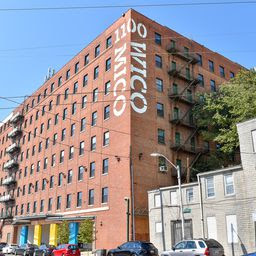
| The WICO front entrance area: dwarfing its neighbors (Photo: Brevitas) |
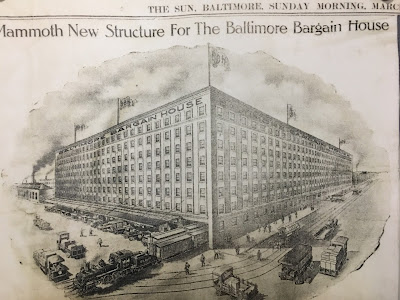
A co-working space where creatives, non-profits and start-up businesses work cheek to jowlIn 1915 distribution warehouses were called wholesale businesses. This one was an innovation for its size (416,000 sf), its large freight elevators, conveyor belts, and the logistics of how the wares were flowing through the building. This particular Amazon of the day was owned by the local immigrant Jacob Epstein, born in 1864 in Lithuania, who came as a 15 year old to Baltimore. Two years later, he already founded the Baltimore Bargain House, a business he incorporated in 1894. When even the Bargain House on Liberty Road (now the Nancy Grasmick Building) which Epstein had completed in 1911 wasn't large enough to hold all the goods he peddled, he commissioned on the eve of WW I in January 1914 an all new type of building that was bigger than any other in Maryland (it predates the Montgomery Ward building), a huge cavernous structure which current owner Chris Regan describes as "more of a hive". The Sun of January 11, 1914 notes that three steam engine run trains could be unloaded at the same time at a loading dock connected to the B&O tracks. Those tracks can still be seen leading into the building.
a place to conserve the heritage of sowing
a brewery and video arcade (in the works)
| Baltimore SUN 1914, trains, trucks and merchandise (MD Jewish Museum) |
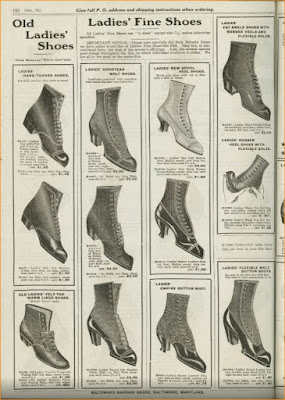
Epstein also built a local community of employees, which included over 1,600 people. The workforce was relatively diverse, comprising of immigrants from various countries as well as industry experts from across the nation. Many workers remained employed at the Baltimore Bargain House for decades.Mail order was already a thing back then, and Epstein issued annual catalogs featuring his goods that could be ordered and delivered, quite like today, except without a computer and, in his case, limited to wholesale. The Henry Ford Museum has some of his catalogs on display. It explains:
His catalogs featured a variety of clothing, personal accessories, fabrics and household goods available to shopkeepers and retailers.
| Page 192 of Epstein's mail order catalog in 1915 (Henry Ford Museum) |
The Jewish Museum of Maryland describes Epstein in a biographical sketch as a figure of note in Baltimore, in a long list of other outstanding Baltimoreans:
Epstein was the Baltimore Jewish community's most prominent philanthropist in the first half of the twentieth century. He established the Mount Pleasant Home for Consumptives (the Jewish TB sanitarium) and played a major role in the Federated Jewish Charities and the United Hebrew Charities, the two organizations which would later merge to become the Associated Jewish Charities. He was the Associated's most important contributor in the 1920s and 1930s. He helped establish the Baltimore Museum of Art and sat on the Board of Directors; his personal art collection was one of the founding collections of the museum. He also raised funds for the establishment of the Johns Hopkins Homewood campus. Epstein also helped finance a Baltimore baseball team in 1913 for the short-lived Federal League.The once modern building eventually became a giant albatross. After its heyday under Epstein who died in 1945, Pigtown's largest building was largely forgotten. It idled in the hands of Baltimore City from 1976 until 2003, when it took its first run as an innovation center, then under the name of "the Raleigh". under the helm of a Boston firm and with the intent of creating a business telecommunications incubator and a trade center that would focus on bringing U.S. headquarters of Chinese businesses to Baltimore. (BBJ). The building changed hands for $1.25 million. In 2007 the building changed hands again for now $8.8 million and was finally sold again in 2017 for $10.9 million, this time to the current owner Tower Hill LLC. The building is now assessed for 10.38 million.
Epstein was a major civic leader. He served on the Public Improvements Commission, the supervisory body charged with developing the land that Baltimore City annexed from the County in 1918, which tripled the size of the city. He also worked to make Baltimore the major supplier of goods to the South.
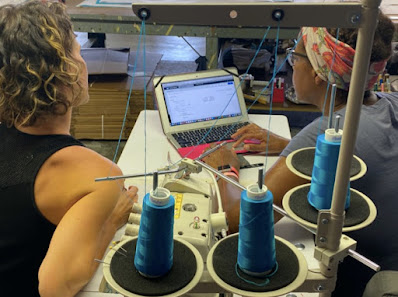
| Sew Bromo: Tradition and progress in the garment industry (Photo: Stacey Stube withNicole Samodurov and Susan Clayton Sew Bromo) |
The spirit of the current 1100 Wicomico is Chris Regan, a Brown University graduate who wanted to be an architect but wound up graduating as a behavioral science major working in financing and affordable housing. In 2001 he created his own real estate and consulting firm Tower Hill which now operates out of the Wicomico, which is the company's flagship revitalization project. Regan discovered that "the WICO" has deep historical roots and made sure the building was redesignated as contributing in the Pigtown historic CHAP district, although he didn't success to get funds from the forever underfunded State historic tax credit program. It irked him that the vacant and burnt out Ice House team received $3 million and had to return the money for non action while his employment hub went empty.
Some of today's occupants dream big just as Epstein once did. And not all is about new technology. For example, Stacey Stube: Born around the corner to an immigrant she moved her "Sew Bromo" enterprise into the building, a step that was featured in the Baltimore Business Journal. She operates under the brand name Elsa Fitzgerald.
[Stube] is plotting a pilot to bring entrepreneurs and industry experts together to help grow a new generation of fashion businesses.
The SEW BROMO - Fashion Innovation Hub will support startups by providing education and small-batch production support. Stube hopes the space can serve as a small factory operation, where local and global fashion entrepreneurs can learn about garment manufacturing from the digital space.
The hub will provide fashion entrepreneurs with ample space, tools and support as they navigate everything from learning traditional garment-making skills, to crowdfunding to support production, to online marketing and sales.
A year in, Stube didn't quite make her goal of raising $100,000 through a much recognized 8 day 200 mile super-marathon run, but her aspiration to save the history and art of sewing for Baltimore is no less ambitious and her enterprise appears to be flourishing thanks to her tenacity.
| Stacey Stube at 1100 Wicomico's garment factory Innovation at Fashions Unlimited (Photo:Jill Silverman) |
Another tenant with high aspirations is Early Charm Ventures. In their own words, they are "a venture studio, founded in 2012 in Baltimore, that converts science to business." The company specializes in taking scientific discoveries made at universities and turning them into start-up companies. They offer their experience in linking companies with researchers. Lifting Labels is "guided by [the] mission to reduce poverty [and] is "Changing Lives with Each Stitch" to ensure that formerly incarcerated men and women can find and retain quality, empowering jobs when they return home to Baltimore City by manufacturing ceremonial apparel." Cindy J. Cosmetic Labs is a woman owned minority business "with her own formulation laboratory for Cosmetic business owners who want to start their own line of products like Hair Care, Skin Care, Color Cosmetics, Men’s Care, Baby Care, and Bath & Body Care." Galen Robotics "is developing a single-platform solution to aid surgeons across several disciplines with minimal disturbance to existing workflows. Our cooperative control paradigm aims to eliminate hand tremor and enable surgeons to realize precise minimally invasive interventions in otolaryngology, spine surgery, and tissue reconstruction that were previously considered beyond human capacity".
The building has plenty of space left, even after a new brewery will open on the first floor, potentially with pop up spaces in the fall and a final opening next spring. Vagrant Coffee already operates a small coffee shop on the first floor. The eight floor, wide open and offering fantastic views across Baltimore on all sides remains up for grabs. Representative of the dynamic image the project emanates, things are in constant flux. The City of Baltimore operated a contact tracing operation here that came and went. Morgan University held events here and had an exhibit about redlining. Politicians hold fundraisers, a food truck sets up and then disappears. Hammering, boring and cutting are frequent noises, telegraphing well through the heavy concrete structure.
| Events on the 8th floor: MSU lecture in 2019. (Photo: Philipsen) |
I should mention that I rented a small co-working place in the building after my lease on 429 N. Eutaw Street ran out and I was looking at a much smaller space in a creative setting. My neighbors in the co-working suite are sevenwcllc, an interior designer and the marketing startup Goldiata Creative as well as developer Dean Harrison. The current directory lists 52 tenants. COVID has slowed activity in the hub, but certainly not squashed it.
The Wicomico is the spark for other entrepreneurial in the area of the adjacent Carroll Camden industrial park. Next door a 116,000sf industrial building will be converted by Mayorga,Organics LLC, an organic coffee company that also enables sustainable coffee farming in Latin America, relocating from Rockville to Baltimore. Several other long dormant buildings in Carroll Camden Industrial Park are also slated to become active again. Also in a perpetual state of renewal but with a clear upward trend: Pigtown’s “Main Street”, Washington Boulevard with its newly dedicated pig weathervane gateway symbol designed and fabricated by local resident and sculptor Rodney Carroll.
In the trajectory from innovative hub of economic vitality to decades of decay and dormancy to failed attempts of revival all the way to a renaissance that consist of part future, part past, part entertainment and part food seems to stick. In that the Bargain House/Raleigh/1100 Wicomico represents a mirror to what happened and continues to happen to the entire city.
Klaus Philipsen, FAIA
Monday, September 27, 2021
A Strategic Plan for Baltimore's Transit Bureau
| One of the new fleet of Charm City Nova buses (Photo Philipsen) |
The Transit Bureau is responsible for the Department of Transportation’s (DOT) transit programs including the Charm City Circulator, Harbor Connector, Bikeshare, Rideshare Programs and Transit & Marine Services (Dockmaster’s Office). BC-DOT website
| Short lived: Bewegen Bike share station (Photo: Philipsen) |
| SPIN Scooters licensed by the City are required to be also placed in the Black Butterfly (Photo: Philipsen) |
| Failed retail downtown: After COVID downtown will never be the same (Photo: Philipsen) |
- Downtown will never be the same again: demand for office work located there will remain weakened. Depending on forecasts, between 10-30% of office workers will never return.
- This puts downtown retail and restaurants into a tail spin, further depleting transit demand there.
- Overall, traffic and travel patterns become more dispersed geographically and by time of day essentially turning "rush hour" into an all day event. The dispersed demand is harder to meet with transit.
Considering all of this history and the attractive portfolio it would be quite interesting to see how a modern DOT transit office would position itself in the next 5-10 years and how they would differentiate themselves vis-Ã -vis the more traditional MTA transit.
•How should city transit be funded?To answer this it is useful to recall the Circulator he water taxi was a service licensed by the city. Since then the bus service was expanded to the point it requires each year general funds to sustain it. The Connector also bleeds money. Bikeshare and the scooter services as well as the water taxi are supposed to be revenue sources helping to keep the mobility fleet afloat. The good news is, scooters seem to recover quickly after COVID in spite of a still reeling downtown.
•What is the division of labor between MTA and DOT?
BC-DOT and MTA need to closely cooperate in this environment to not cannibalize each other , to create synergy and towards an end to end menu of mobility options in the spirit of Mobility as a Service. It should help that the MTA will shortly come out with its own Strategic Plan, a fisrt for the agency. Cannibalizing of the Collegetown and apartment shuttles crisscrossing the city needs to also end and those riderships need to be consolidated into one commonly funded system
How viable is the water taxi? How does it relate to the free Connector Service? What is the vision?
The first question is closely related to the future of Baltimore and how attractive it will be for visitors. The second answer is simpler: Operationally it makes much more sense to combine these services without distinguishing the boats and branding, a requirement that comes from the City.
Free tickets can easily be arranged for workers that use the service as commuters.
The extension to the Middle Branch would offer additional utility for residents and commuters. A fast commuter line should start at a park and ride terminal at Canton Crossing and intercept some of the east west traffic overburdening Boston, Fleet/Aliceanna Streets.
It makes no sense to exclude anybody from a boat that is running, anyway, no matter when or where. Conversely, it may make sense to operate the water taxi as a on-demand service instead of a semi-fixed schedule service.
BC-DOT manages the water of the Inner Harbor via their Dockmaster, and wharfage fees, revenue sources that can support the water transit services. Likely there are untapped synergies. Then there is the issue of the docks, ie. the landside stop facilities for the water transit. They are as important for the experience as the boat itself and they are currently very skimpy, not unified and as far as information goes, a puzzle for potential riders. The docks could act as pearls on the string that is "the promenade", have amenities such as shelters and benches, real time arrival info and at least some should be hubs connecting to the Circulator and MTA services and offer bikes and scooter right there.
•Is the circulator operating optimally? What is the 5 year perspective?
The Circulator has suffered from mission creep. But a downtown with fewer employees, a future of automated fleet vehicles without a need for parking require to put the service on a new footing. Maybe as a hyper local service that is free and frequent and equitably serves residents, commuters and visitors in downtown and the adjacent neighborhoods.
A service plan should either be based on extensive stakeholder participation or the City should give up being so prescriptive. If orescribed service and budget don't align, one option is to ask the operators how much service they can offer for a given budget and let them compete over service rather than price.
The current routes seem to make little sense: The Purple Route is too long and duplicates too many other bus services. The Banner Route duplicates MTA bus 95 and was originally based on a time limited grant. If the service remains it should connect to the water/Connector dock at Hull Street and serve Tide Point/Under Armour. The Green Route looks very "gerrymandered". It needs a clear purpose. For example, it could become a northern east-west route connecting Middle East with Pennsylvania Avenue via Mount Vernon/Seton Hill. The current north south route portion on Broadway could be a separate second north south route and connect up to North Avenue.
![]() |
| The Circulator map shows that the service dominates in the "white L" and that the green route has a chaotic routing (website) |
•How can bike and scooter share be supportive of the bus and water services?
What does it take for DOT to truly manage this portfolio?
DOT embarked on a Strategic Transportation Plan under Director Sharkey's predecessor Pourciau. It has been pretty quiet around the progress of that plan. A focused Strategic Plan for the Transit Bureau could be a jump-starter and model for the rest of the department. By the way, MTA also posted its own first ever strategic plan.
This article is based on a presentation I gave to the Advocacy group Transit Choices on 9//23/21. That presentation can be found here.