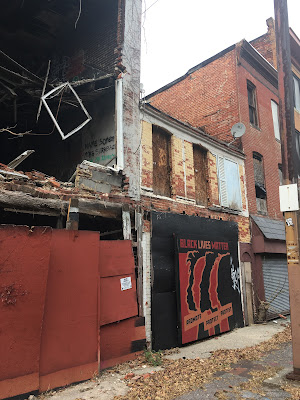
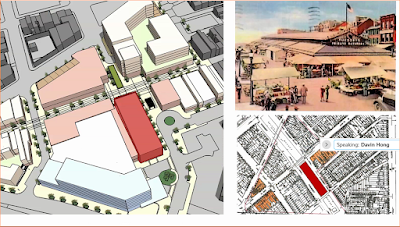
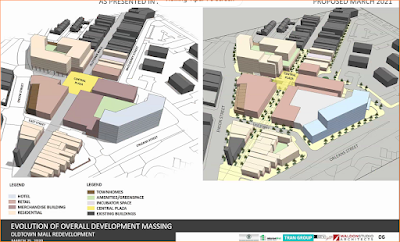
Friday, March 18, 2022

"Vacants to Value" becomes "Buy Into Bmore": More than just a name change?

 In her signature suite and bow-tie outfit Housing Commissioner Alice Kennedy laid out her many responsibilities in front of a room full of developers, investors, former and current administrators including her former boss, Paul Graziano who had placed himself modestly into the last row.  Only when it came to the few daycare centers which for some odd reason DHCD still runs but tries to get rid off, did she briefly refer to Graziano by saying "he would know something about that topic". This wasn't meant to imply he wouldn't know about the other topics, still this interpretation briefly lingered in my head, before her forward looking presentation recaptured my attention. Many good things seem to be in the offing, many having to do with efficiency of the nearly 400 employee department itself, whether it is for permits or the release of federal grant money to small local recipients who suffer because payments take forever.

Alice Kennedy explaining the puzzle pieces

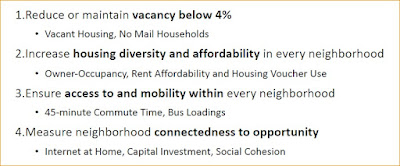
But one thing, especially caught my attention: The Buy Into B'more initiative that had just been announced together with a $100 million infusion into Baltimore affordable housing initiatives. $39 million are supposed to go into addressing vacant homes, in part motivated by the tragedy of three fire fighters dying in a vacant home that caught fire earlier this year. (See Mayor's press release)

From O'Malley's push for 5000 homes to be eliminated from the vacants list to "Vacants to Value" (Rawlings Blake), to Brandon Scott's "Buy into Bmore" the list of Baltimore Mayors trying to reduce Baltimore's 15,000 vacant homes in City possession  is long and complete. Yet, thanks to a steady flow of new abandonment the 15,000 vacant homes remained as a figure that didn't budge. Alice Kennedy said that the properties are now offered on a dynamic website that would function much lake MLS listings proliferated by the real estate portals of Zillow, Redfin and Trulia. Indeed, anyone used to Baltimore's clunky turn of the century style websites for payments, permits and rental licenses will be surprised about how smoothly and elegantly the site operates. The main features are a set of filters through which one can select what type property in which area one is looking for and a map that shows all available properties or those that match the filters. The map can be enlarged to the point that it shows individual parcels which can be clicked for parcel number and a photo and additional info from the SDAT records. 

Vacants can be an imminent danger 

It is questionable that a more fluid and modern access to the vacants database will make those go away or lead to a stampede of buyers. However, the added transparency should help avoid behind the scenes preferential treatment where certain entities seem to have had early access to data, an item that was rumored to have caused the sudden and then surprising demise of the previous Commissioner in 2016. For better or worse, the large amount of investor money which had been sloshing around the globe and that had contributed to overheated real estate markets in many larger US cities left Baltimore if not untouched, but relatively cool. While real estate values improved here also, the 18% gain is small  compared to boom cities such as Austin (56%) San Diego (34%) or even places such as Cincinnati, Cleveland or Columbus, OH (26, 25, 24%). 

One of Baltimore's revitalization problems appears to be a lack of focus resulting from policies that oscillate between "building from need" (Schmoke)  and "building from strength" (O'Malley). It isn't entirely clear where Mayor Scott lands on this matter, but his Planning and Housing departments jointly support  setting investment priorities as spelled out in the Baltimore "Impact Investments Zones". Those zones can also be selected as one of the filters in the Buy Into Baltimore maps. The Impact Investment Zones are based on anchor institutions and areas of strength from which to build up. 

The strategy of prioritizing investments in areas that have a chance of being turned around, often due to strong anchor institutions had been created by Mayor Pugh and goes back to papers that circulated during the O'Malley time. The problem is that this strategy can easily conflict with a focus on equity and social justice . The conflict amounts to the tension between economic strategies and ethical and moral strategies that are less based on market economics and more on making up for past injustices. For sure, the two approaches are not mutually exclusive and wealth creation in disadvantaged populations is an example of overlap. 

Screenshot of Buy Into B'More

A current case that illustrates the conflict is Council President Mosby's "Dollar House" bill which focuses on the formerly redlined communities in the "Black Butterfly" and which is stalled in city council because of economic arguments. That is to say that many council members follow Alice Kennedy's line of reasoning. She testified when the bill was up for debate, that the offered support is too little in deeply disinvested areas and would leave new property owners stuck with property that is valued nowhere near what it cost to fix them up. The eligible properties are also scattered and not consolidated as in the original Dollar House program. The matter  is currently unresolved and proves that good intentions are not sufficient to achieve the desired outcomes.

Kennedy who had worked in Baltimore's Planning Department before switching to Housing sees the bigger picture with its connections between housing and health, economic development, safety and even education. (see her talk about this in the Video: "Engaging all pieces of the puzzle"). Kennedy has begun to dismantle the silo mentality in which city agencies often still operate, in spite of all the previous aspirations to the contrary. Kennedy sets especially on closer collaboration with the Planning Department which puts the annual capital budget together. 

Screenshot of Buy Into B'More

Her broader view leads her to switch the focus away from vacant house reduction through demolition to avoiding vacant houses in the first place, i.e. through prevention. In that, she looks for upstream interventions similar to what Mayor Scott promotes as a necessity for combating crime. This makes good sense: Once a house stood vacant for an extended time, the fix is much harder than if one can prevent it from becoming vacant.. To this end Kennedy collaborates with the Green and Healthy housing initiative on the use of a part of  the $39 million dollars for stabilization and improvement of  homes that are occupied by low income residents in deeply disinvested areas as owners or as renters. Even owners can't get a simple home improvement loan because of lack of sufficient equity. Housing strategies must lift up the home values of entire neighborhoods, or investments will remain money down the drain in which the cycle of improvement and vacancy will churn indefinitely. 

Klaus Philipsen, FAIA

Friday, February 25, 2022

Baltimore's vital signs - Anything pointing in the right direction?

Population growth as a remedy for Baltimore has been the topic of this blog for many years. (See here, here here and here)). 20 years ago when I advanced the topic with then Mayor O'Malley growing Baltimore back to 850,000 residents, what seemed to be the "carrying capacity" of the city without massive new infrastructure or new high density zoning, seemed not too far fetched. But instead we lost another 66000 people.


The 2020 census tells us that pretty much every larger city in the northeast and across the nation gained population, but Baltimore lost 5.7% of its residents.  Detroit, Milwaukee, and Memphis were the only other large cities in the loser camp.  All surrounding areas in our metro region grew, Baltimore County surpassed the City in the 1990s. However, the picture isn't only bleak, a deeper look is warranted. (See this report)

Maybe it is comforting that the last 20 year loss is only half the one Baltimore experienced in the years between 1980 and 2000. Or, that the number of households in the City actually grew in the last decade by 1%; not much, but definitely not a loss. The reason for that surprising fact is simple: Households become ever smaller and so it is that there are now more occupied housing units than there were in 2010, just fewer people in them. There are other bright spots: In the last decade the City gained 24,473 primary jobs, (+ 8.3%), although, workers who live in the City do not necessarily work in Baltimore, but their number increased by 4.2% as well. Over half of the City’s workforce commutes into the City and more Baltimoreans work outside the City than live and work in the City. Asian origin rpopulation grew by 46%, Latino population by 77% but  even combined represent merely around 12% of the overall population. 

BNIA suggested growth strategies

of all Baltimore st

Baltimore did not lose population across the board. 15 statistical areas (CSA) actually gained poplution,  the CSA with the biggest gain is downtown (+47%). A pleasant brightspot is Barclay, a formerly invested Charles North/ Midtown community that saw growth on the basis of careful and well planned intervention and investment. In all three CSAs went from loss to gains: Greater Charles Village/Barclay, Orchard Ridge/Armistead and Southeastern. Meanwhile the Latino population grew by 77% during the decade and Greektown became a strong growth area. 

The real problem is [that the] overall population loss in Baltimore was 52%. 10 times more than any other city except for New Orleans, but that is because of Katrina. Baltimore effectively suffered a cataclysmic event in terms of population loss on the scale of Katrina between 1990 and 2010, without the requisite reinvestment. We don’t have a gentrification problem. We have a lack of development problem Seema D. Iyer, PhD Baltimore Neighborhood Indicators Alliance—Jacob France Institute, UB

Anyone who has followed the maps of former Morgan University Professor Brown who now heads up the Black Butterfly Academy will not be surprised that once again the black butterfly neighborhoods are the victims: They lost more residents than any other neighborhood, led by Carrollton Ridge, where population decline in the decade was the steepest. The mapped result of population change once again gets us to the black butterfly shape already known from race, poverty and vacancy distribution and pretty much every other indicator.


What all this means is that not only are Baltimore's residents highly segregated by race and income, but the population loss is no longer caused by white flight. Instead, the City is losing black residents at a higher rate (-15%) than white residents (-11%). Poor black residents are no longer putting up with living in disinvested formerly re-lined communities. As soon as there is an opportunity, they will leave. In a vicious cycle, the vacant houses and the underutilized schools that are left behind will accelerate the exodus ahead. 

The black flight is not surprising. Quality of life metrics measured by the Neighborhoods Indicator Alliance are clear indicators many changes of the decade are pointing in the wrong diection. For example health: The disparity in life expectancy from one census tract to another increased from a 19.4 year difference in 2012 to a whopping 21.5 years in 2018. Thus the zip code is a bigger determinant of one's life expectancy than one's DNA code! While the teen birth rate declined 60% in the last decade citywide, baby health is still an issue: The rate of babies born with a satisfactory birth weight remained nearly unchanged and is still under 90%, lower in poor neighborhoods.

BNIA known for its "vital signs reports" and the annual data day has looked deeper into the Baltimore Community Change 2010-20 and created six individual research reports which are worth studying. The above data are taken from those reports.


BNIA is no longer just amassing data, it is now intent on enabling social change. In a press release the university institute states:

Historians may well mark the decade that just passed as one of the most tumultuous for Baltimore. From the Great Recession to civil unrest after the death of Freddie Gray while in police custody, to the widespread problem of vacant houses and the COVID-19 pandemic, Baltimore's neighborhoods have been buffeted by multiple economic, political and public health storms. The challenge is how to leverage resiliency where it exists and capitalize on opportunities when they arise.

What can be done: BNIA will organize Baltimore's first. Community Change Summit during the week of March 21-26. All who are interested can attend a session to help in developing data-driven solutions together with the help of a graduate student team consisting of four students from Morgan State University, Johns Hopkins University, and the Universities of Michigan and Illinois, with various technical backgrounds in urban planning, communications, and public health. The effort is sponsored by the France-Merrick Foundation, the Greater Baltimore Committee and the Baltimore Community Foundation. 

In a recent presentation Seema Iyer emphasized the importance of access and networks with which she meant that well connected neighborhoods have better home values and a better quality of life. She noted access to grocery stores, transit and jobs as well as education. The importance of those connections is beyond doubt. Asked whether the disconnectedness is the cause or the result of disinvestment and abandonment, Iyer responded to me that it mattered less what is cause and what effect than that the cycle is broken. Iyer sees the need for networking in broader terms, all the way to intentional and organized social contacts between communities and all efforts of building "social capital". She uses social theory when she speaks about "divergence" and how  declining neighborhoods become isolated, "physically, digitally, socially and financially".

Grocery stores and schools close when population dwindles and clearly, the poorer and less educated the demographic profile of a community, the fewer available jobs there are in reach contributing to transit disconnectedness. 21% of City residents have a commute to work that is longer than 45 minutes, with Southern Park Heights leading the pack of the longest commutes (33% exceed 45 min.). This is especially hard for the nearly 30% of residents without access to a car, in several communities that share is between 50-60%.  17.5% of residents commute by transit citywide, but in many communities that share is between 30 to 40%, in Sandtown it is 60%. Iyer sees the problem not only as one of distance or of the service itself, but also as one of cost and is suggesting that the MTA and the City could create free boarding zones, especially on Baltimore's "main streets" which should be developed as community hubs where to find services, WiFi, free transit and amenities. She imagines that communities would flesh out some of these concepts tailored to their specific needs.

Council President Mosby re-introduced a Dollar House bill with the goal to lure low income residents to becoming homeowners in formerly redlined communities. Alas, the bill ran into heavy crossfire, not because fellow council members or Housing Commissioner Kennedy would be opposed to black homeownership, but because they question how much the envisioned $25,000 per buyer would do towards fixing houses up (a cost often exceeding $180,000) or getting a mortgage to cover the difference. Especially questionable: Is it right to lure low income home-buyers into heavily disinvested areas where the finished house value will exceed by far what the market  will likely yield for many years to come. Thusly "under water" owners would be trapped in their house in the same way already existing homeowners in those areas are. 


Overall, Baltimore has become a posterchild of the predicament that the entire nation will have to face sooner or later, namely that a community cannot thrive if it is built on gross in equity. Even Baltimore's encouraging statistics will mean nothing if  investments in the disinvested and vulnerable communities can not be achieved to a point that these will improve as well. This is a point also made by Seawall Development principal Thibault Mannekin in his recent book in which he compares Baltimore to South Africa. The holy grail is improvement without the pattern of displacement and gentrification found in Washington DC, San Francisco, Austin or other cities that are booming. The level of re-investment needed in large parts of Baltimore far exceeds what the City or even the State can achieve by themselves. A  recent Atlantic magazine  argued for reparations. A national program for reparation in tandem with the Build Back Better bill stalled in Congress is the kind of scale that is needed to bring cities like Baltimore, Memphis and Detroit back on their feet. Professor Lawrence Brown has made this point for years. 

The Ukraine war will divert attention away from solving these domestic problems so they can fester even longer, even though they themselves have already weakened our international standing. 

Klaus  Philipsen, FAIA

Friday, February 11, 2022

"When our city knows more, we can become more" - What do you know about the Baltimore Banner?

“It is hard to overstate the vitally important role that a strong newspaper can play in improving the quality of life for residents of the communities they serve. A good editor can see the big picture better than just about anyone else in the community – tying together the reality of the present with the possibility of the future." Penelope Muse Abernathy, "Saving Community Journalism")
IIt shouldn't surprise anyone, that there isn't all that much information out there about Baltimore's latest news outlet start-up. The existing media are frequently struggling and likely not too keen on another kid on the block, even when the official line is that competition is always welcome. Curious to learn more about The Baltimore Banner, I combed through various articles, reports and and online sources and present my findings here to all those who care about solid Baltimore journalism. By golly, this city needs every ounce of critical and investigative journalism it can get.
The Baltimore Banner, a online news start-up soon to go public


The Baltimore Banner is a brainchild of Stewart Bainum and represents plan B after a failed attempt by Bainum to rescue the Baltimore SUN from the vultures of the Alden Global Capital hedge fund. 
If anyone wonders why such strong words about the SUN's new owner,  read the gruesome story by McCay Coppins in The Atlantic from last October. ("The Men Who Are Killing America's Newspapers"). 

“They call Alden a vulture hedge fund, and I think that’s honestly a misnomer. A vulture doesn’t hold a wounded animal’s head underwater. This is predatory.” (Charlie Johnson, former Chicago Tribune reporter as quoted in the Atlantic article) 

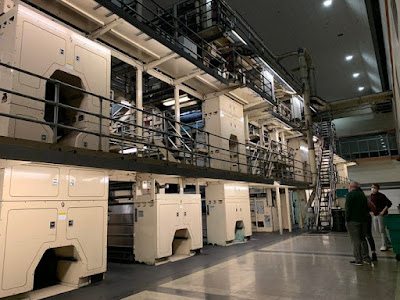
Sun readers were informed about an early step towards gutting towards gutting Baltimore's 185 year old flagship news outlet: The SUN won't be printed any longer in Charm City but in Delaware.  It went largely unnoticed,  but the last copies of the SUN were printed in Baltimore on January 30! Since then the SUN, The Capital of Annapolis, the Carroll County Times and other affiliated publications are printed at facilities of  The News Journal, a Wilmington paper owned by Gannett. This major slap in the face of Baltimore went down with little or no fanfare. There was no outcry, no effort to save the loss of 139 jobs, no heroic act of City leaders to prevent this move, no matter how drastically the gory details had been described in The Atlantic. 
SUN reporters watch the last edition being printed in
Baltimore on Jan 30, 2022 (From reporter tweets)
The only time The Baltimore Sun hasn’t been printed in house was for 2 months after the great fire in 1904. That streak ends after tonight. The paper will now be printed in Wilmington, DE. (Tweet of McKenna Oxenden, SUN reporter)
Given the SUN's storied history, the Sun Park facility in Port Covington is relatively new and state of the art when it was opened in 1992 to allow the SUN to print color.  Originally the newsroom remained in the large Calvert Street facility but in an effort to save money it was moved to Sun Park in 2018. The Sun Park building sits on land purchased by Sagamore/Weller Development in 2014 and was assumed to be eventually removed in Sagamore's masterplans. 

The SUN has seen a steady bleed of its talented reporters which fled even before Alden bought the paper. Cost cutting and staff gutting has been going on for more than a decade.  Famed investigative reporter Luke Broadwater who helped bring down Mayor Pugh is now thriving at the New York Times. How much so is illustrated by him being interviewed about the January 6 investigations by Terry Gross on NPR's national broadcast show Fresh Air. More recently his SUN colleague Justin Fenton went to the Baltimore Banner together with Sun reporters Liz Bowie and Tim Prudente. Many SUN readers have a hard time imagining a future of the paper without these high caliber reporters.

After 17 years, I'm leaving the Baltimore Sun this month to join the new Baltimore Banner and help create a new non profit model for local news here (Justin Fenton tweet)

Which brings us back to the question, what The Banner is and how is it different than other Baltimore strictly online news media such as the Baltimore Fishbowl (former SUN architecture critic Ed Gunts writes there and former SUN reporter David Nitkin is executive editor) or the Baltimore Brew (Former Washington Post staff writer Fern Shen founded it and edits/writes together with Mark Reutter, a
Baltimore Brew

former SUN reporter). How does the Banner fit into a news media landscape with increasingly blurred lines between traditional TV and online print media? On the one side the alternative Real News Network as well as the traditional Baltimore TV outlets now all have online news updates, on the other the SUN, the WP or the NYT all feature online videos which in many ways resemble TV reporting. The online publication Maryland Matters reported in January about the drain that the SUN suffered from journalists moving to the Banner.
“They’re telling the public: ‘We are not going to be second-rate. We have big ambitions. And we are beginning to put together a team with reporters who know how to cover this region,’” (Sandy Banisky, a journalism professor at the University of Maryland and a former Sun deputy managing editor quoted in Maryland Matters).
Can the Banner stake out territory in this crowded field? On the bloody battlefield of the traditional print media local journalism is seen as a public service by philanthropically minded private investors. The Baltimore Brew has financial support from the Abel Foundation. Bainums funding of the The Banner is of a different order: The former Maryland businessman and
Business paper Daily Record

philanthropist intends to give or raise $50 million over 3.5 years to get the Banner going as an innovative but professional online news organization. A leadership team has been put in place and has been have been working for some months. Justin Fenton told me the Banner will go public in May of this year. Other than Fenton, Bowie and Prudente, the Banner has hired 7 other editors and reporters with a goal of 60 in two years according to an article in a current edition of Poynter, a publication of the The Poynter Institute in St Pete, Fla), which was founded in 1975 as an institute for media studies that supports journalism. 

Apparently the Banner wants to leave the gate with a stable of heavy hitters, long before there is a subscriber base or any type of revenue. The new operation will have a physical location with an actual newsroom at the Inner Harbor on Pier VI, but it won't have a physical print newspaper. It won't look like one either, but likely use the strategy that even traditional print media now use, a steady flow of news and headlines, as they occur, interspersed with deeper background stories that are not "breaking news". 

The Banner recently published a test article by former SUN reporter Tim Prudente of the kind they intend to produce (200 bodies awaiting autopsy in a parking garage). Prudente's research already found the usual path from its birthplace  to the TV evening news that ride on the coattails of the original investigation. This process of news proliferation proves that detailed and careful persistent investigations must be the foundation of original reporting, something the TV stations usually don't do, no matter how much they claim to be investigative.

The online news model has been tried in other cities, such as Denver, Memphis and Philadelphia. In Denver eight journalists who defected from the traditional print paper Denver Post founded the Colorado Sun. It appears that the 2018 start-up is a success.
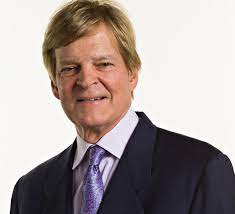
Stewart Bainum

 The Poynter journalist Rick Edmonds has followed Bainum's  attempts to save the SUN for some time and chronicles the Banner endeavor and was also able to speak at length with the somewhat reclusive Bainum about his new project. Edmonds writes:
At 75, Bainum belongs to a growing segment of the very rich, equally interested in distributing their fortune to worthwhile causes while still tending to business. He and his wife have signed the Giving Pledge, committing to donating half their net worth. Bainum expects to have an office at the Banner, but does not plan to move from his lifelong home base in Washington, D.C.’s Maryland suburbs. “I still have a day job here,” he said.

Meanwhile, the storied SUN is not dead yet and it remains to be seen if the Alden group will, in fact, milk it to death as many predict and as is evident at the Chicago Tribune. So far, other than the printing move to Delaware and the loss of some stellar journalists, the paper hasn't changed much since Alden took over.  New journalists have been hired to replace the losses. It remains to be seen how the SUN, the Afro, the BBJ, the Daily Record, the Brew, the Fishbowl and the Banner can coexist. All issue daily online local and regional news updates. As the Banner slogan says: Baltimore can become more with a strong media landscape devoted to thorough, independent local journalism.

Klaus Philipsen, FAIA 

Tuesday, February 1, 2022

MTA's long range plan - will it be worth the paper?

“Would you tell me, please, which way I ought to go from here?” / “That depends a good deal on where you want to get to,” said the Cat. / “I don’t much care where–” said Alice. / “Then it doesn’t matter which way you go,” said the Cat. / “–so long as I get SOMEWHERE,”  (Alice in the Wonderland)

The MTA works in rapid succession on the kind of plans that map out the future, some are firsts. The MTA never had a Strategic Plan, it published its first one in in September of 2021 under the title "Rebuilding Better". The agency never prepared a statewide 50 year transit plan, but it has one in the works now. 

The latest in a series of MTA plans: A 50n year plan

Many would argue, we don't need more plans, we need better transit. Indeed, there have been plenty of plans, including the Baltimore Region Rail System Plan of 2002 which was shredded when the current Governor killed the plan's crown jewel, the Red Line in 2015. The Rail Plan's successor, the Regional Transit Plan for Central Maryland (RTP), was mandated by the legislature to have a 25 year horizon. It was published in 2020 under the title "Connecting our Future" and must be updated every 5 years.

The Central Maryland Regional Transit Plan is a plan for improving public transportation in the region over the next 25 years. The Plan presents goals, objectives, and initiatives to enhance transit service, support the economy, and reduce impacts to the environment. The Plan was developed by the Maryland Department of Transportation Maryland Transit Administration (MDOT MTA) in coordination with the Central Maryland Regional Transit Plan Commission, the five jurisdictions that compose the Central Maryland region, local transit agencies, the Baltimore Metropolitan Council, and members of the public. (RTP Executive Summary) 

Just last month the MTA introduced a Zero Emissions Bus Conversion Report , also mandated by the MD Legislature. (I wrote about it here). A number of reports are mandated in regular intervals, including the Strategic Asset Management Plan about the state of repair of everything MDOT owns. 

The Baltimore Metropolitan Council, the metro area's regional planning construct, also prepares regular transportation plans, and so does MDOT, the parent organization of the MTA which prepares every five years a 20 year Maryland Transportation Plan. In short, there is no shortage of plans that would tell Alice where to go. In spite of all that resolve towards a better future, many would still describe the regions transit system as inadequate, even after the big bus reform that the Governor had provided as a $120 million substitute for the $3 billion lost Red Line. In fact, poor performance can now be seen on MTA's own transit dashboard. Covid did a number on transit performance and MTA stopped adding new data after September of last year when the bus on time performance (from 1 minute early to 7 minutes late) stood at 72.8% and Mobility Link on time performance had plummeted to 59.2%.

Seven goals adopted by the 50 year plan

So, does it make any sense for the MTA to create additionally a Maryland Statewide Transit Plan with a 50 year horizon? Does the the 109 page draft of this 50 year plan, unveiled  at the beginning of this year, say anything that the 25 year RTP doesn't? The RTP had three goals and six objectives. The 50 year plan has one vision and 7 goals. Each goal has a set of strategies and The public can weigh in on that question until February 18. 

The Plan presents both a collective vision and foundational goals for our transit system over the next 50 years in manageable 5- and 25-year timeframes. It identifies opportunities to achieve this bold vision by detailing actionable, measurable strategies, and uniting projects and investments across the state’s counties, cities, and towns. It was designed to reflect the diversity of Maryland’s landscape and unique needs across all its regions. It was accomplished with extensive outreach to and collaboration with more than 20 local and regional transit providers, partner agencies and staff, frontline transit workers, business and industry leaders, advocates, community representatives, and transit riders. (MTA Administrator Holly Arnold)

To be fair, the two plans serve different purposes. The one (the RTP) serves the core MTA service area, the other (the 50 year plan) includes transit services statewide, even though the plan remains mum on how any of it would actually be enforced at these 24 other transit providers. 

MTA's Manager of the Project Development Division, Jade Clayton presented the plan to the group Transit Choices recently.  To drive home what can happen in 50 years, the presentation included a 50 look-back all the way to 1970 when WMATA's metro system started construction and the MTA was formed from the Baltimore Transit Company.  The RTP is very focused on specific measurable metrics so that the 5 year progress reports can be evaluated by the Legislature. The 50 year plan provides fewer measurable goals and describes "what success would look like" in descriptive form.

Screenshot from the 50-Plan draft

Like it has become common for corporations, banks and many non-profits, the 50 year plan yields to the current political discourse, and puts equity front and center. That could be opportunism or an actual opportunity to set things right. (there isn't yet a term for fake equity discussions comparable to the term "greenwashing" for fake environmentalism). One should give the new generation of leaders at MTA the benefit of the doubt and also some credit. It is very likely that this plan represents a serious effort of re-calibrating transit service so it serves those best who need it the most. This was already the focus of the RTP as well. The draft 50 year plan appears to be more than an equity fig leaf, even if the methodology of determining equitable service could be further refined, in part by taking a page from the metrics of the RTP. 

Maybe the biggest difference between the 25 and 50 year plan is that the RTP avoids specific project commitments and simply identifies priority corridors for further study. (The east-west priority corridor study will be completed in a few weeks. The corridor also received a $50 million grant boost recently).

The 25 year Regional Transit Plan cover

The 50 year plan, by contrast, includes a list of  25 connections under the title "50 year vision". Those 25 items include everything that is in the RTP, but other items sound more specific. As for which projects have priority, the language in the plan is vague:

While many of these intercity and regionally significant connections will will take time to be realized, those that are expected to come online sooner are those for which planning and design studies or projects are currently underway. Several of these nearer-term efforts are informed by local Transit Development Plans that lay out goals with a five-year outlook, as well as Metropolitan Planning Organization (MPO) long-range transportation plans and the Regional Transit Plan for Central Maryland that have goals with a 20- to 25-year outlook. (50 year plan)

The plan includes as number of "illustrative regional projects" that are currently studied. Connections include the Western Maryland MARC study, the RTP studies, the Montgomery County "Flash Rapid Bus Transit", the Southern MD Rapid Transit Study for PG and Charles Counties, the Intercity Bus Study. The plan is richly describing current transit and Maryland's regions but is sparse on an analysis of current deficiencies, chiefly fare and service integration (one ticket and payment method for all transit systems with coordinate schedules and transfer points at transit hubs, a topic that would warrant its own goal and implementation strategy but isn't even listed among the 25 projects. 

When participants at Transit Choices asked about funding for the 50 year projects, Jade Clayton admitted that funding was not part of the study and would depend on the more short-term capital funding plans, such as the 5 year Ttransportation improvement plan (TIP). The 50 year plan includes this ominous language about money:

Achieving the vision, and goals, of the Statewide Transit Plan will require continual investment and commitment from state leaders as well as support from local and regional partners.(50 year plan).

Six objectives of the 25 yr RTP
It is clear that the 50 year time horizon begs the question whether transit should be reverted back from the State to the city or at least the region. This debate is already simmering in the background, but remains unaddressed by the 50 year plan.

Both, the 25 core area and the 50 year statewide plan are notable for being weak on climate change. Decarbonizing transport and the built environment is lamely lumped in under the title innovation and sustainability and "preparedness for the future". This is a fairly grave deficiency, given that transportation is the biggest carbon emitter in this state as well as nationally and that the MTA as well as all the other associated local transit providers have a big role to play in decrabonization and cleaner air. Not only by making buses and trains emission free but also by repositioning their entire building and vehicle inventory from yards and shops to mobility sedans and repair trucks towards a carbon free future. 

Naturally, for this there is another plan. The MTA has a Sustainability Plan as well. It dates back to 2018 and it, too is weak and without specific targets. That plan speaks about employee morale, about livable communities, transit experience, energy, water, waste, revenue, reliability and repair without committing to much of anything. This plan was signed by the previous MTA Administrator Kevin Quinn who is now at the helm of  the Vancouver transit agency TransLink. During his short time there, the British Columbia region has been hit by several severe weather events, including extreme heat and extreme snowfall. Quinn has already made combating climate change his signature activity at TransLink. A 17 pages Climate Action Strategy came hot off the presses this January. The MTA 50 year plan authors should look at that document not only on page 3 where they can admire their dapper looking old boss but also on pages 21-25 where the specific targets and implementation strategies are. 
Vancouver Translink Roadmap to Net Zero: Ambitious plan by MTA's
previous Administrator 

Given how uncertain even the next six months are, a 50 year plan seems overly ambitious. By its nature it has to be even more vague than the 25 year plan. Unfortunately, it didn't really tackle the big issues that are almost certain to define the next half century: Artificial intelligence, self driving vehicles, the change of work and the implication on transit, and climate change. 

In recognition of long-term uncertainties, the 50-year plans ends with a five year action plan with steps under each of the seven goals accompanied with an assessment for which steps the various statewide transit providers have the data to measure progress. But even this five year plan section should be fleshed out for funding, sustainability, climate change and implementation practicality.  This way it could result in truly improved service statewide that is guided by a longer perspective. 

Klaus Philipsen, FAIA

Submit comments to the MTA Plan HERE. (Deadline is 2/18/22)


Thursday, January 20, 2022

The suburbanization of Baltimore's waterfront

When Otis Rolley was Planning Director there was much talk about the MIZOD, anoverlay that protected industrial  waterfront areas from being gentrified into condos and apartments like so many parcels before, from Harborview to the Ritz Carlton, to the Anchorage and Canton Cove. 

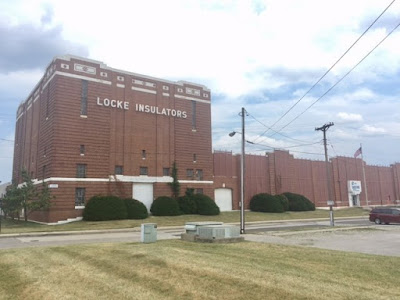
Locke Insulators: Not a trace left in the proposed plan

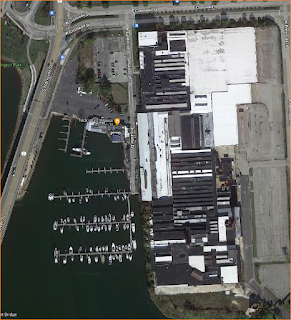
But in 2017 when the Locke Insulator company announced that it will close its 24 acre waterfront facility in Port Covington (known to all Nick Fishhouse visitors who park on Insulator Drive) the loss of 108 jobs was just another blow to Baltimore's industrial base. The company's porcelain insulators used by utility companies on its high voltage overland lines was not a winning proposition anymore. Reportedly China can make these cheaper. In 2017 Port Covington was still the big next hot thing and it was generally assumed that Under Armour would snap up this site located adjacent to the envisioned new UA World HQ.

But today UA has scaled it HQ down in size and back in time to a much less ambitious suburban looking campus. And the Locke site went to Sapperstein, a developer (28 Walker Development) with multiple developments in the Canton area. When he filed for a zoning adjustment in November last year, nobody muttered MIZOD or anything about Baltimore's industrial base. No matter that not getting stuff from China any longer is all the rage. The Locke site doesn't have deep water access and was never designated as a MIZOD area, still it is concerning how easily Baltimore's industrial past gets wiped out. And as we shall see below, at times without leaving as much as a trace.

Google satellite screenshot of the Locke site

Today Baltimore's Urban Design and Architectural Advisory Panel (UDAAP) could see that everything about Locke was literally wiped out and made place to what one could call the suburbanization of Baltimore's waterfront. To demolish every last bit of the site's intact industrial building collection is a steep departure from many other successful Baltimore projects which used industrial shells and filled them with new uses, from the American Can to Clipper Mill, Silo Point to Seawall's teacher housing in Hampden. Each of those projects derive an attractive and uniquely Baltimore authenticity that demolition projects like Harbor View or Ritz Carlton never achieved.

Sapperstein's design team, consisting of Hord Caplan Macht Architects, KCI, and Kimley Horn, explained the new masterplan, which the UDAAP panel acknowledged, was the result of careful analysis and work.

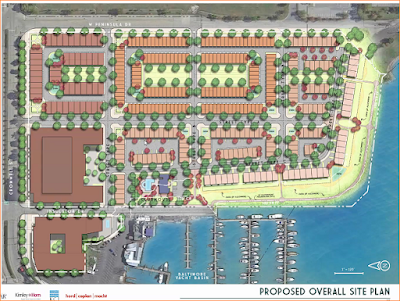
The 24 acres are proposed to be filled with a larger apartment building and parking structure and several  hundred townhomes lined up in what looks like an urban grid along the streets extended from Port Covington. Overall over 800 dwellings are proposed. UDAAP's closer analysis revealed that in spite of the urban pattern, this isn't entirely an urban neighborhood, but rather an assortment of homebuilder "products" (developer speak for their housing types) which are neatly sorted by 16' wide, 20' wide, two over-two, front and rear loaded as well as one and two car garage homes, all "products" by national homebuilder K. Hovnanian, one of the large burger chains of generic home production. Only the apartment building and clubhouse would be one of a kind designs. The UDAAP review of the masterplan will be followed by reviews of the architecture. 

UDAAP members Osborne Anthony, Pavlina Ilieva, and Sharon Bradley were careful in their critique, but all of them agreed on their assessment that the proposed development was too "suburban". Ilieva suggested to "see the house types more from a pedestrian experience instead block by block". All criticized the typical way how townhome developers do the corners, i.e. by ending the two perpendicular rows of houses with exposed sidewalls "with four random windows". As an enhancement, the design team suggested on every corner a "pocket park" to fill the gap and act as a small stormwater facility. That makes four such pocket parks at each intersection.

The prosed site plan (North is left)
(KCI/HCM/Kimley Horn)

Ilieva observed that "the sides ending in these corners are not architecturally welcoming", she suggested using "primary materials" on the sides as well (suburban developers always put all their expensive building materials on the front for curb appeal) "or develop a corner building".  As proposed, she found that "the streets are disjointed".  Reviewer Sharon Bradeley agreed and added that the corners give the design "a suburban feel". Osborne Anthony, the third reviewer had similar observations. He felt that the proposed concept did not sufficiently relate to what can be expected for Port Covington across Cromwell Street and Peninsula Drive. He called specifically the backs of the waterfront houses "suburban" for their garage driveways facing the street and producing "a lot of asphalt". "Cant you intersperse various townhome types like we come to expect in a real neighborhood, so it looks less contrived" he wanted to know. he also hope that access to the water and the promenade would not feel like "somebody's front yard".

suggested typical corner treatment (top) and "two over two" 
townhome facades 
(KCI/HCM/Kimley Horn)

Planning Department staff reviewer Tamara Woods ended the review session with the advice to "look at urban rowhouse neighborhoods how they deal with the corners and make it less suburban".

The Middle Branch is clearly the new frontier of waterfront development. The former industrial sites of the Carr Lowry glass company and the BGE facility there, also located on shallow waters, are also proposed for a large townhouse development with a very similar suburban feel. 

Sapperstein, who has a large portfolio of urban redevelopments  from McHenry Row to the Shops at Canton Crossing, has shown that he can do urban and suburban. Canton Crossing's success is probably based on its suburban retail convenience. This can't be transfered to urban waterfront living. Potential buyers would probably like to see something different than they can get in the surrounding counties. As Anthony observed, there are only a few opportunities of this type (of industrial conversion) left in Baltimore City. Better to get it right.  A short trip to Washington's Riverfront development along the Anacostia River can provide some valuable hints and so do Baltimore's many examples of integrating our industrial heritage. 

Klaus Philipsen, FAIA


Friday, January 7, 2022

Finally: Electric buses coming to Baltimore in 2023

Good news at years end

To provide good news at the end of the year the MTA topped out 2021 with a press release about zero emission buses (ZEB), MDOT Secretary Slater's last public announcement. There was nothing to look at, there was no electric bus in sight and just a press release that the MTA is "launching a transition plan to move to a zero emission bus fleet." Nevertheless, this announcement is worth celebrating, because it represents exactly what had been demanded at the Glasgow climate summit last year: A step from goals and commitments towards actual implementation.  Per orders already put in place, Baltimore will see its first 7 electric buses in 2023.

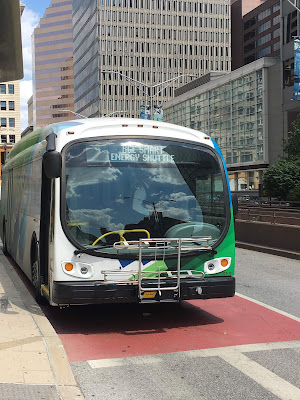
Unbeknownst to most: There are two full electric
buses in Baltimore run by BGE for its employees.
(Photo: Philipsen)

The electric bus implementation follows goals established in the Regional Transportation Plan and other State commitments about carbon reduction. Transportation plays a major role in combating climate change since transportation is Maryland's largest greenhouse gas emitter. Baltimore also is a dirty air area, in technical terms, a "non attainment area under the Clean Air Act". Diesel exhaust from buses and trucks plays a major role in this. 

Implementation steps

Specifically, MTA's December announcement  confirms that MTA would, indeed, comply with the Zero–Emission Bus Transition Act passed in 2020 and effective in October 2021. The Act prohibits the MTA from purchasing any more diesel buses, even if they call them "clean diesel" as they have in the past (already existing delivery contracts can continue and will extend into 2023). The law also requires MTA to provide a progress report by January 1, 2022, that report was submitted and matches the details provided by MTA in their press release. The following steps were announced:

  • Seven battery electric buses will be delivered in 2023 consisting of standard 40' buses and 60' articulated buses. These buses are added  to the current fleet as a pilot.
  • The new Kirk Bus facility will house the new buses and provide the infratstructure needed to maintain, and charge them
  • By 2026 the Kirk division will be converted to handle 100% electric buses
  • Starting 2025 the Northwest Division will be  retrofitted starting 2025 followed by the Eastern Division in 2026 and the Bush Division in 2028.
  • By 2030 50% of the MTA bus fleet (excluding Mobility buses) is required to be ZEB
  • MTA will continue to investigate the use of other ZEB options such a hydrogen fuel cell buses

The implementation steps show, that buying electric buses isn't all there is to do to get to zero emissions. Maintenance facilities need a charging infrastructure and the tools and the equipment to maintain electric buses. Charging hundreds of buses requires an upgrade of the electric grid, additional switchgear and transformers and should also include some resilience strategies for electric grid failure. Relatively long charging times will also require changes in how a bus is handled in the depot. The exchange rate of 1:1 between diesel and battery electric buses will only hold if the schedule allows enough down time for the bus to recharge in full, or if it will be charged on fast charge stations during revenue service. Downtime is also used to clean and maintain the bus, so charging and cleaning should be combined, whereby the bus would remain stationary. This is a change from today where the bus is driven through cleaning, maintenance and fueling stations. Another option would be to swap out battery packages during the stay in the depot. 

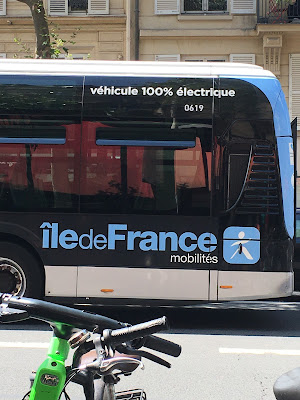
Paris has several bus routes running with full
electric buses (Photo Philipsen)

What will happen after next year?

MTA has over 770 buses, the conversion of 50%of the fleet  by 2030 requires to procure 70 electric buses a year. The current price of a battery electric bus is about $800,000 to $1million, depending on accessories, between 25-50% above the cost of standard diesel buses. Proponents of the conversion argue, that over the lifetime of a bus the reduced operating and maintenance costs of electric buses will more than return the extra initial cost. A cost benefit analysis prepared by MTA based on current known cost did not bear that out, even though operating cost of BEB is shown to be nearly half of that of diesel. but that it cannot make up for the high procurement cost. The MTA report to the State Legislature states that "Analysis provided should be considered a conservative assessment of BEB costs, as the industry in North America is still in preliminary stages of development. Production costs may decrease as production increases to meet future demand and economies of scale are achieved."

MTA's press release states that the purchase of the initial buses  for the "pilot program and the infrastructure for charging them will utilize grant funding from the Low or No Emission Vehicle Program from the Federal Transit Administration, and the Volkswagen Settlement.” It isn't clear, how many buses can be purchased with those sources or how much additional capital will be needed until 2030 to fulfill the requirement for 385 electric buses at cost of at least  $280 million at today's dollars. (It can be expected that the cost of battery powered buses will significantly decrease with advancing battery technology). The Maryland bill says that "the full cost of zero–emission and alternative–fuel buses purchased under this subsection shall be paid from the Transportation Trust Fund."

The MTA ZEB implementation schedule is similar to WMATA's bus fleet transition which also will also buy its first battery electric buses (BEB) for 2023 service with a goal of  full conversion to ZEB by 2045. Since 2018 the only electric bus that can be spotted in Baltimore is operated by BGE to shuttle employees from the BGE headquarters in downtown. With that Maryland is far behind other large cities in Europe or North America where battery powered electric buses run revenue service on designated routes in several large cities for some time. The largest number of electric buses rolls through Chinese cities, foremost the city of  Shenzhen where the entire fleet of 16,000 buses has been converted to electric in 2020. 

Electrification difficulties

However, experiences are not all rosy. When Albuquerque NM tried to employ the Chinese BYD buses, they decided in 2018 to return them for non compliance with their specifications, especially regarding the range which was only 177 miles instead of the specified 275 miles. Most buses do about 150 miles a day, but the electric range various widely depending on how hilly the terrain is, how much AC or heat is needed and how heavily the bus is loaded.  In order to overcome the range limit, several transit agencies install charging stations at bus "layover" points, the place where one "run" ends and the next one will begin. Usually these layovers are scheduled to be about 20 minutes. Depending on the charger's capacity and the frequency of full length layovers, those stops can add enough miles to complete its daily routes without having to go to the depot. MTA has selected overhead pantograph charging as the preferred option.

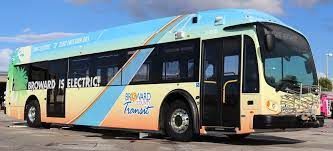
Proterra bus in Broward County 2021 (Photo: Proterra)

The city of Duluth ran into similar problems with their US made Proterra electric buses in 2021. To fix the heating challenge, Proterra retrofitted the buses with diesel powered heaters.  The electric heat pumps had reduced the range by 60%. As anyone with an electric car knows, an electric motor produces no heat and electric heat exchangers can significantly lower the battery's range capacity, which is already challenged in extreme temps. In Baltimore where buses need to master some steep hills, need extreme cooling in summer, and extreme heating on some winter days as today, the current latest model diesel and hybrid buses are powerful enough that they can heat or cool the bus, even when it is very hot or cold and when the bus is packed and has to go uphill. (older models had frequent engine overheating issues in the summer). This is an important comfort feature. Passengers can get very testy if it is too hot or too cold in the bus. 

Baltimore had its own electric bus failure: The initial Charm City Circulator was an electric bus with a gas powered small "turbine" for recharging. The innovative bus failed to deliver in Baltimore's summers and got frequently stranded with the batteries depleted. The model was eventually abandoned, forcing the City to buy new buses long before it was anticipated. 

Baltimore's original electric "Eco Saver"
Charm Circulator in 2009 (Philipsen)

It will be interesting to see how Seattle will do where King County's Metro Fleet has just finished a larger scale pilot test program for 40' electric New Flyer buses and has begun a second testing phase for 60' articulated electric buses. Seattle's transit agency also operates electric trolley buses, the oldest form of electric buses still in use in some cities such as Seattle, Vancouver and San Francisco. Trolley buses receive power from overhead wires, just like street cars. They are popular with riders for they snappy, quiet and emission free performance and have proven to be very enduring and long lasting. 

The Canadian City of Winnipeg switched their battery electric buses for hydrogen fuel cell electric buses (FCEBS). Fuel cells are a widely discussed option for cleaner buses, trucks, ships and even airplanes. They use liquid hydrogen to create electricity in a fuel cell which then charges a battery. The process produces waste heat that can heat the bus without local emissions. Fuel cell buses receive their hydrogen at the depot in a process that is similar to filling a tank with diesel or CNG and have a range of  200-300 miles, sufficient for a day of service. Canada with an abundance of clean hydro electricity made by water turbines is an ideal place to use surplus electricity for generating liquid hydrogen through electrolysis. That option makes only sense as a climate change contribution  if hydrogen is not generated with "dirty" electricity from coal or gas since the  production of hydrogen is quite energy intensive. 

The future is electric

Whatever the best technology, diesel isn't any longer it.  Electric buses are now offered by the popular US bus manufacturers, including New Flyer and Nova, brands the MTA currently operates as diesels. The bodies of the BEB models aren't any longer funny looking plastic contraptions, but are essentailly identical to what people are used to in the standard 40' and 60' long versions. BEBs continually improve, are quiet and have substantially more torque than diesel buses, making them quicker and more nimble. Drivers report that they are fun to drive. Electric motors don't need an oil change, have no transmission and no complicated exhaust management which means they last longer and are much easier to

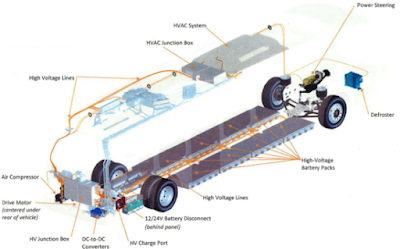
Components of electric bus diagram (Proterra)

maintain. With carbon based fuel prices expected to rise over time, electric buses should also be much cheaper to run than diesel buses that have a gas mileage of about 10mpg or less. The large bus facilities should be equipped with solar arrays that can feed battery back ups so that bus charging can occur even during power outages. For the case that electric buses should continue to present insurmountable technical problems in complying with the agency's specifications, the Zero Emissions Bus Transition Act provides a considerable loophole: The MTA then could buy "alternative fuel buses" which would include buses powered by natural gas, a fossil fuel. 

Klaus Philipsen, FAIA
ArchPlan Inc., in collaboration with Wilson T. Ballard engineers, provided 30% design documents for the new Kirk Bus facility. 

The article was updated after receiving the Zero Emissions Conversion Report to the General Assembly form MTA.


Monday, December 27, 2021

Old Town Baltimore - an unkind mirror of Baltimore's planning history

It is hard to imagine a place where desolation, abandonment and plain waste of space is more in your face than at Baltimore's Old Town, a place that has seen nothing but handwringing for the last 30 years or so with few plausible explanations why things are as bad as they are. 
While we will investigate the trouble (see also my 2016 blog article), inserted quotes from recent decades show how protracted the problems are.
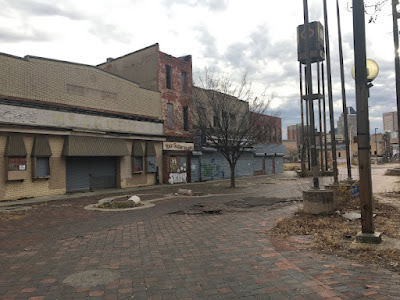
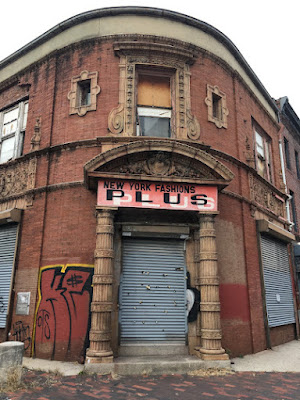
Old Town Mall today: Absolute desolation (Photo: Philipsen)
On a typical day, there's nobody inside Bernie Delay's little tailor shop on Old Town Mall. No patrons. No tailor. Sprawled on a folding chair outside, waiting for business and hoping for a breeze, he comes up empty. "There's nothing doing," he says with an old man's sigh.
Old Town - a walking mall lined with weedy lots, careworn stores, Civil War-era architecture and disco-era renovations - stands frozen. Caught between Baltimore's best efforts at urban renewal, long waves of municipal neglect and the mirage of redevelopment proposals that loom just out of reach, it is a place where business owners and neighbors wait for change and wonder why. Why does the nation's first inner-city neighborhood mall - which placed Baltimore on the map for urban planners in 1975 - stands a near-ghost town today?(Baltimore SUN, July 21, 2003)

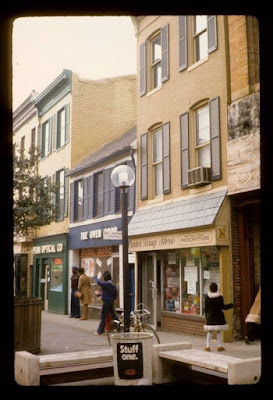
Old Town in its first years: A lovely Main Street

None of the many articles published about Old Town give really good reasons why an area so close to downtown, so close to Johns Hopkins Hospital, so close to Little Italy, Albemarle Square and so steeped in history should fall so far from its few years of glory after "the mall" was established in response to the 1968 riots as one of those then trendy pedestrian shopping streets which have since abolished in the US but are still common place in most all European cities.
Jesse Collins counts on 6-inch-long curled red fingernails the reasons she thinks the mall fell into ruin: Indifference. Politics. Racism. Greed. "If this was not a black mall, it would never have gone down the way it is," she says. "I'm like Forrest Gump: That's all I have to say about that." (Baltimore SUN July 21,2003)
No place in Baltimore is steeped more deeply in history. Oldtown is generally part of Jonestown (although it is not part of the Jonestown historic CHAP district), the oldest neighborhood in Baltimore, full with historic sites and stories, including the 175 years of the Lloyd Street Synagogue. Jonestown goes back to 1661 when an English settler, David Jones, made his home here.
The history of Oldtown Mall is depressing. Riots, looting, fires and a long-stalled development plan. One of the big property owners, Stanley Zarden, told me back in 1999, "Everybody that is here should get a medal."
I returned to Oldtown Mall, a pedestrian thoroughfare off East Monument Street in East Baltimore, yesterday after the owner of a Chinese carryout, Tien Zin Wang, was shot Saturday night while delivering $20 of food to what turned out to be a fake address on nearby Webb Court. (Baltimore SUN Jan 7, 2009)

When the region’s first European settler, the Englishman David Jones, built a house on the east bank of the stream that would later take his name, the Jones Falls, he laid the groundwork for a competitive relationship between Baltimore Town on the west side of the stream founded in 1729 and the emerging rival Jonestown to the east laid out in 1732. Eventually the Gay Street bridge created the link which allowed a merger in 1745. Jones Town became commonly known as “Old Town” a name that would resurface 200 years later. in 1813 the current Old Town Mall area was the site of one of Baltimore's public markets, the Bel Air Market which was leveled in 2002 to create space for parking for a dreamed about grocery store. 

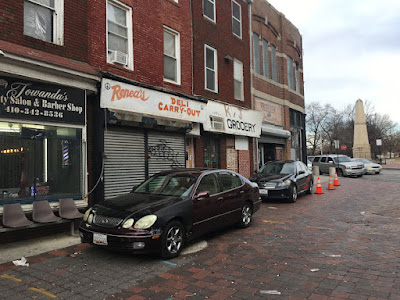
Old Town architecture: Eclectic mix (Photo: Philipsen)
Old Town Mall in East Baltimore is a centuries-old commercial district that has lived through periods of booming growth, recession and renewal. Once a shining example of urban revitalization, it has since largely fallen into disrepair, with more than half of the buildings standing vacant. (Baltimore SUN, Sept 27, 2012)
In spite of all this history, Old Town Baltimore has clearly not done as well as other historic neighborhoods such as Fells Point, Federal Hill, or Mount Vernon, to name just a few. Why?
The buildings themselves, though some are a little worse for wear, represent an impressive collection of historical architecture: Italianate Victorian storefronts; stout, turn-of-the-century commercial buildings; even a few diminutive two-and-a-half-story, dormered rowhouses from before the Civil War. If they were on the water or in Federal Hill, they would be filled with bistros, boutiques, and professional offices. But orphaned here in hardscrabble East Baltimore, they're dark and decaying. (City Paper, Oct 9, 2002)
The main reason, in my view, why those neighborhoods thrive is that the expressways originally designed in the 1950s and to be built in the 1960s, never materialized there. By contrast, Oldtown became the victim of two expressways: The pre-war Orleans Street viaduct of US 40 and the Jones Falls Expressway. Both landed just outside Old Town and recreated the old separation that originally stemmed from the stream. Although most historic roadway connections still exist under and next to the in part elevated freeways, in the minds of Baltimoreans the land under the freeways become "fly-over territory" and the places to the east became areas "far away from downtown", certainly no longer part of it. The fact that the street grid in this area has been challenging to begin with (for example with Gay Street as one of the rare diagonals) doesn't help. It is easy to get lost when one tries to get to Old Town.

Baltimore's planners and the city's Housing Department deepened the separation of downtown from the surrounding communities by arranging a number of large scale public housing projects like a ring around downtown. In many case these were high-rises that ignored the old city street grid and were plopped down as objects in modernist fashion, no relationship to streets. Most "projects" got blown up during the time of HOPE VI funding, some are still around, for example the Monument East high rise with its iconic round balcony cut outs. It sits just north of Old Town.
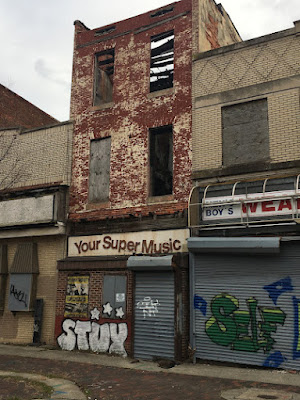
Stores shuttered for years (Photo Philipsen)


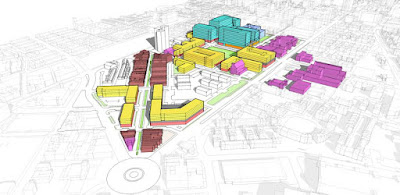
The low rise public housing projects of Perkins Homes Douglass Homes and Somerset Homes were around much longer. Once they came into play as well, new opportunities arose for the redevelopment of Old Town. (See my 2018 blog article explaining the overall project).
Some of Baltimore's most prominent developers have teamed up to work on the long-sought transformation of land near the city's historic and distressed Old Town Mall.
Beatty Development Group and Henson Development Co. are two of four firms behind a proposal to build a mixed-income community with rental and for-sale homes, a park, community center and a possible grocery store on roughly 16 acres in East Baltimore. (Baltimore SUN Feb 11, 2015)
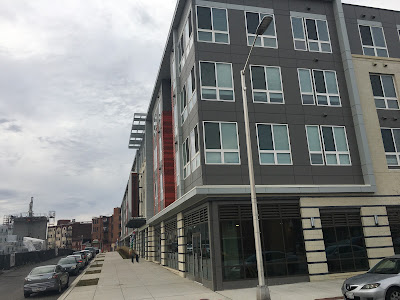
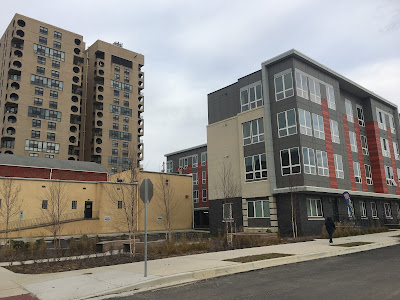
Now, six years after the latest development concepts were unveiled, the talk has moved to irrefutable action. The same Dan Henson who, as Housing Commissioner, had garnered record amounts of HOPE VI money to remove the housing highrises, some of which had provided the shoppers for the Old Town Mall. Now a developer, Henson has partnered with Beatty Development and others in a concerted effort of turning Perkins Homes, Douglas Homes and the former Somerset Homes area into a thriving new development. The approach is similar to the Flaghouse public housing redevelopment that has become Albemarle Square. Henson's first phase of mixed income redevelopment of the Somerset site, the McElderry apartments are now occupied. His plans for Old Town Mall have twice been reviewed by the city's design review panel UDAAP, in the latter version favorably.
Incredible: The north end of the mall has still active retail
(Photo: Philipsen)

The buildings, 64 in all, largely fall into three architectural categories: row house shops (mostly two stories with dormers) that date to the 1820s; Victorian stores, dating from the 1870s and wider and taller than the earlier rowhouse shops; and 20th century stores that emphasize Art Deco, Moderne and Sullivanesque styles. Some of the buildings are the last in the city to have cast iron fronts. The 500 block of Gay Street was closed to traffic in 1968 to create a pedestrian walkway that the city hoped would help business.(Baltimore Heritage)
It is too early to say if Old Town will really see the promised rebirth with all the bells and whistles shown on the plans. But the hundreds of completed apartments on the Somerset site are a good omen and they provide some of the demand that retail so urgently needs. On the other hand, retail's future is generally in question, and uncertainty about almost everything is what defines our time. Much could happen to derail even this most developed plan.
Beatty-Henson concept presentation 2016


The main cause of the decline of Jonestown and Old Town Mall, the JFX, is still in place. Lowering it south of Penn Station and converting it to an urban Boulevard is an idea that has been around for decades as well, yet nobody has yet collected the money for the realization of such a concept. For Old Town and the new Somerset to become an integral part of the City requires good connections on all sides. DPW traffic planners must go to work and see how better connectivity could be realized utilizing the complete streets concepts instead of the urban auto artery concept that is still prevailing here. This is a must-do compendium strategy if the massive redevelopment should become the success story that gives that part the Old Town part of Jonestown a new lease on life.

Klaus Philipsen, FAIA

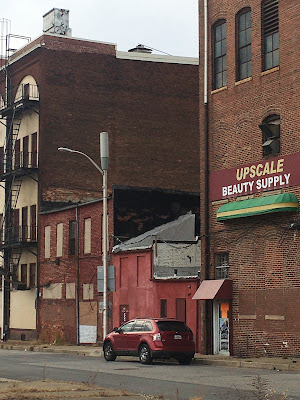
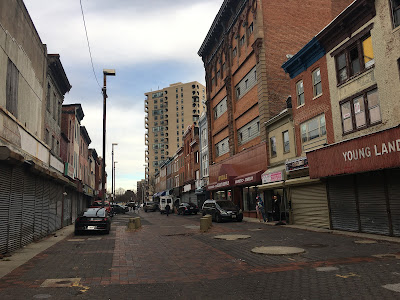
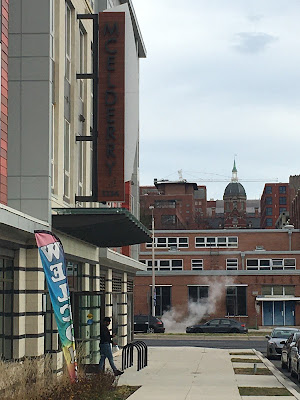
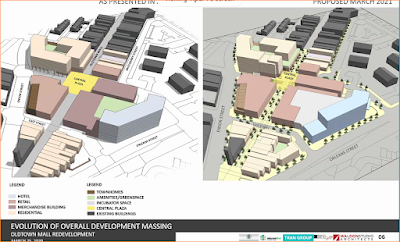
The below photos are all taken by me in December and show the existing Old Town Mall conditions as well as the new phase 1 completed Somerset redevelopment as well as the phase under construction. The concept renderings were presented to UDAAP earlier in 2021. 


https://baltimoreheritage.org/issue/old-town-mall/ 

A very comprehensive City Paper article from 2002 can be found here. I am quoted in it as well