Friday, August 25, 2023

When preserving a historic building shouldn't be called hardship

"Many years ago I was of the theory that if you tear all the buildings down and put something new up, that was the right thing to do. What a mistake that was." (William Donald Schaefer in the 1999 documentary Westside Stories)

Baltimore is a charming city, architecturally. As much as an architect hates to admit it, Baltimore's architecture charm isn't the result of modern interventions but indicative of the vast historic building stock of all scales, size and purpose that has survived the great fire and urban renewal.  Even in the decay that comes from abandonment, old beauty shines through. 

The old B&O HQ lobby, today Hotel Monaco and
State offices (HCD). Photo: Philipsen

It is no surprise, then, that our historic districts are the most successful neighborhoods with the highest building values and the lowest vacancy rates, whether it is Federal Hill, Seton Hill, Fells Point, Mount Vernon, Hunting Ridge or Ten Hills to name just a few. And they don't have to be part of the "white L". 

Given the success of preserving history it is surprising how often developers buy old buildings in historic districts and then try to bail out when it comes to fixing them up. They complain about "hardship" when it comes to going the extra mile and opt for the shortcut of just knocking them down. 

This lazy approach is usually accompanied by the argument that whatever new they would build would be be much better than the derelict, vacant and neglected old structure they want to tear down. Duh! But this obviously a misleading argument. Nobody wants to keep the old shells with sagging floors and roofs. The comparison would be a new structure versus a rehabilitated one. No doubt, rehabilitation is often more expensive than new but the issue here is that the rehabilitated structure is more likely to add character and authenticity to a project that can directly translate into dollars and cents but that rehab will likely also retain value much better. In other words: Historic preservation requires the long view. Whoever is just interested in the short term calculation shouldn't even go into a historic district or at least not buy historic and contributing structures. 

Historic Hunting Ridge, Baltimore (Photo Philipsen)

Claiming hardship in a historic district with the argument  that only demolition "pencils out" should be a losing proposition right from the start, especially when property is being transferred from the City in a public process. 

The long view for preservation is not only supported by the excellent value retention and market conditions of most historic districts but also by the failure of projects that relied heavily on demolition.  I will use two projects as examples that were recently in the news.

Exhibit one is the La Cite development in Poppleton, which was predicated on the notion that an entire neighborhood had to be wiped out in order to create valuable new things that would be marketable.  The reality is that the two lone  large apartment blocks that La Cite actually managed to build are pretty much a disaster, even though the developer still calls them a success. They look rather predictable, stood empty for a long time due to a slew of construction errors, have rapid tenant turnover and never succeeded creating an attractive new community. Meanwhile the local papers are full with stories of displaced citizens that saw their houses bulldozed without anything meaningful being built to replace them. 

Exhibit two is the CenterPoint in Baltimore's old retail district "Market Center", constructed in tandem with the Hippodrome which was a great adaptive reuse project.
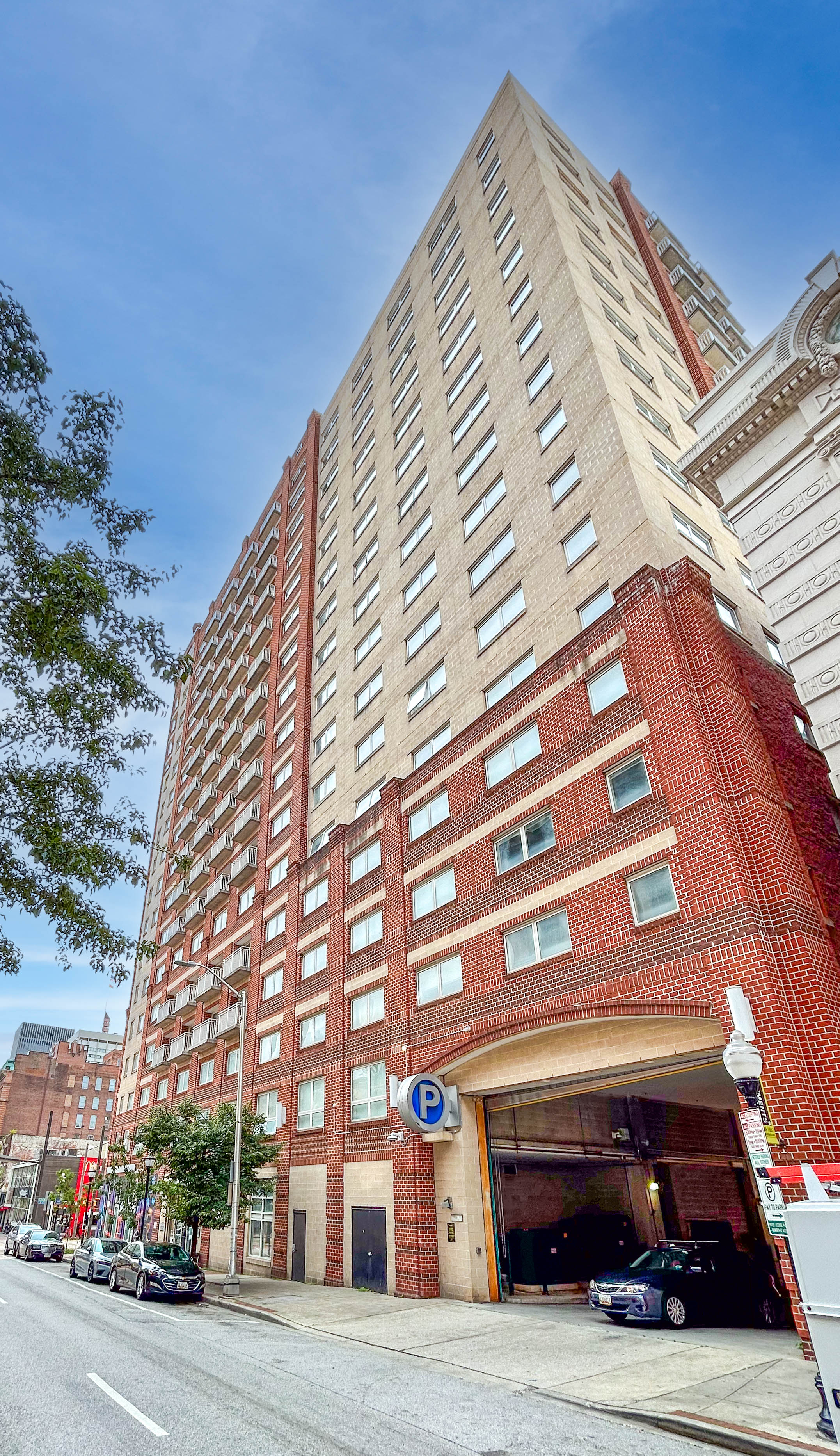
Centerpoint apartments
(Photo: Alex Cooper)
 By contrast, the bulk of Centerpoint was  new construction with several buildings on Howard Street being retained. After  17 years of existence the project is now being auctioned off. The ground floor retail was practically never fully occupied and whatever leases there were, they changed frequently. The last stores to close were Starbucks which had been seen as the shining star of the development and El Forno, a much liked Italian restaurant which offered the Hippodrome audiences a convenient place to eat before or after the show across the street. Conflict was in the DNA of the project, beginning with the protracted battles of several historic businesses such as the historic Hippodrome Hatter for being allowed to remain. They lost, had to close, relocate and eventually had to shut down, even though they had been re-planted in more modern facilities. 
The driver of the CenterPoint project is the newly constructed apartment tower of mediocre design and lacking the charm of competing nearby apartments in historic buildings, such as in the former Hechts department store or in the old BGE headquarters.   The maybe oldest westside example of successful adaptive reuse (from school to housing) are the Chesapeake Commons in Seton Hill and the sailcloth factory on Martin Luther King Boulevard, both still going strong

Far from learning from these experiences, the developer of the Superblock and a developer who wants to redevelop the corner of West Park Avenue and West Lexington Street, Chukeo Ukoro, both applied

The proposed replacement structure is shockingly unappealing
(Image: Okoro development)
for demolition of most historic buildings in their respective blocks, even though they knew very well, that historic structures in the local Five and Dime historic district are protected and must be preserved. Unless....This is where the "substantial hardship" argument comes in as the camel's nose in the preservation tent. Preservationist are no economists and time and again they got the wool pulled over their eyes by "hardship" arguments they couldn't verify. Time and again demo happy developers just look at a single building without considering their context next to them or across the street. Historic preservation is no longer just the single landmark "on a silver tray", but it is also context and meaning.
The second building from left: Proposed for demolition but CHAP
requested preservation (for now.) Photo: Philipsen

To their credit and in a sign of a new resolve, the historic district commission CHAP has lately shown some teeth and a new assertiveness in which it even preempted the City Council by banning the gas meter and regulator installations in front of facades in historic districts. For the two recent projects on the agenda in the Five and Dime historic district held a fairly admirable line and didn't fully cave immediately cave to the developers, no matter how much they claimed "hardship" in several sessions. 

Tearing down the seven buildings at Howard and Fayette streets would give the team land to construct an efficient, code-compliant, economically-viable replacement building that could meet the needs of today’s tenants.(Developer Janian's argument as quoted in Baltimore Fishbowl)

The center building: Proposed for demolition on Park Ave
(Photo: Philipsen)

For the Compass project on the "superblock" the panel initially rejected five of seven demo requests and stuck to their guns in a second meeting where the hardship argument was made in detail. In a third meeting on August 8, the Commission agreed to a third building to be demolished and to partial preservation of the facades for two others This solution was celebrated as a compromise. Facade preservation is usually being frowned upon by preservationists. However, it allows a consistent streetscape and can be a successful compromise in cases where floorplates and floor elevations of existing structures are too small to work with modern egress and fire codes and hard to integrate into a proposed project. An example of such facadectomy can be found on Baltimore's Braodway in Fells Point. 
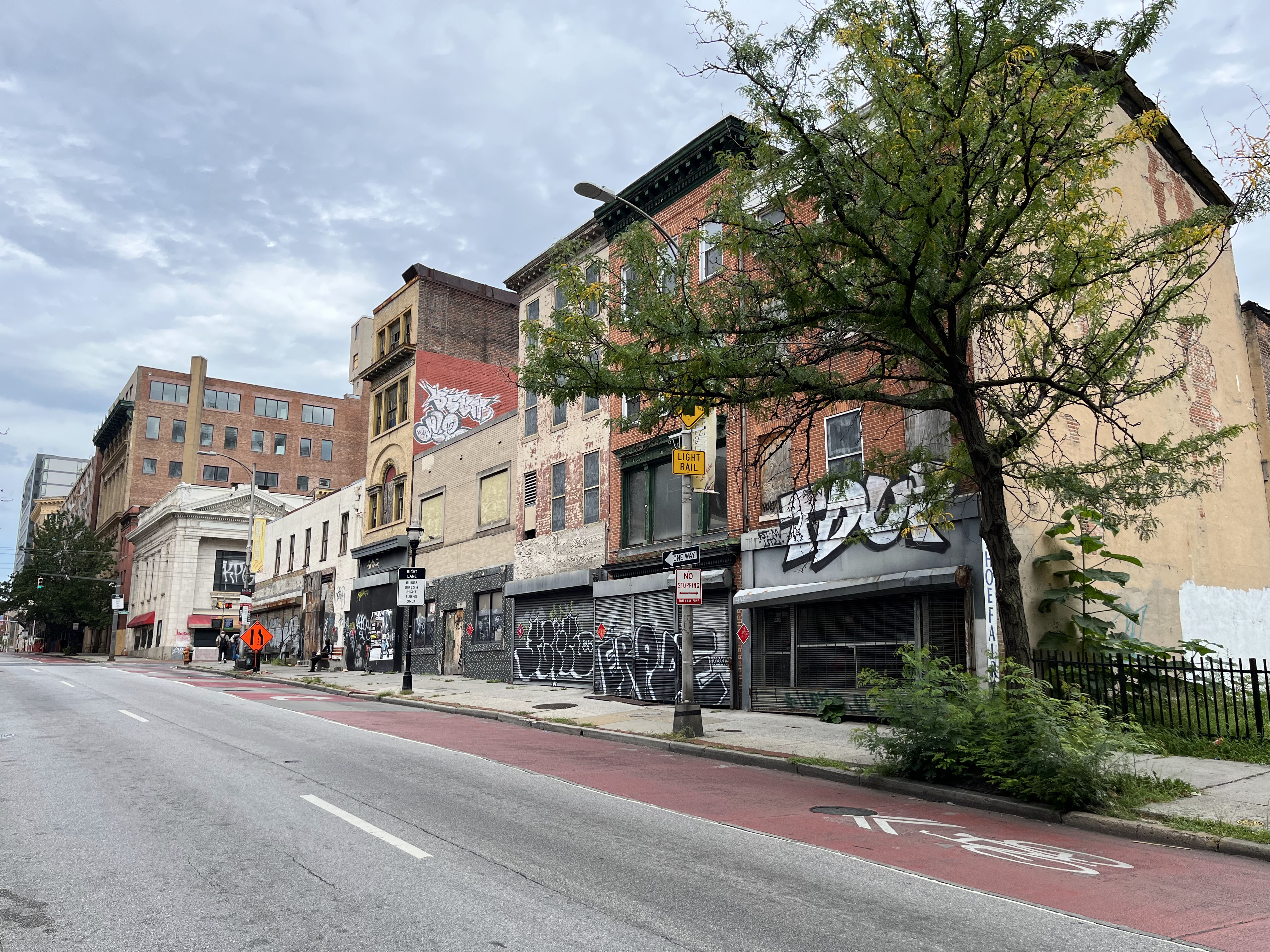
Fayette Street buildings slated for demo. The adjacent former
Trailways bus station (foreground) has long been demolished
(Photo: Philipsen)

For the second project debated on the same day, CHAP was more forceful. The developer asked for the demolition of the  three-story building at 114 W. Lexington St. that once served as the entry to a theater, the former Ann Lewis department store at 116-120 W. Lexington St., and the four-story commercial building at 207-209 Park Ave. CHAP agreed initially only to the non contributing corner building to be demolished. One building on Lexington and two on Park Avenue are to stay. The Baltimore SUN described  the developer as "dejected" but ready to come back with a revised proposal. 

CHAP should generally reject the hardship argument. It is no hardship if you have to do what the law has been saying all along. You can't buy an old car and the complain that it has a combustion engine. 

The developers should have known what they were in for when they applied to redevelop properties in a historic district. “It costs money to preserve buildings, and the developers came in and got a [land disposition agreement] and sought to develop these buildings in a historic district that you designated, and that should actually mean something – to CHAP, to the citizens who care about preservation and the history and the environment on the west side of downtown. (Nicole King, Professor of American studies at the CHAP hearing as quoted in Baltimore Fishbowl)

Howard Street buildings for which parts of the facade
need to be saved (Photo Philipsen)

As I have pointed out many times in this space, the success of Baltimore's own historic districts prove that proper historic preservation yields a return on investment. If our own examples are not convincing enough, look elsewhere. For example, in Cincinnati's Over the Rhine, a carefully preserved and now thriving historic district that had fallen on hard times, similar to our own "westside". 

Former industrial legacy cities like Baltimore and Cincinnati need to leverage their assets prudently. Like it or not with Fortune 500 headquarters gone, the garment industry decimated and manufacturing reduced to a trickle their biggest asset is  beautiful historic architecture. 

Klaus Philipsen, FAIA

Related content on this blog: 

How to invite demolition by neglect

Why the demolition of historic buildings remains a bad idea

Bombing Downtown

For an article explaining the history of previous redevelopment attempts for the mentioned buildings see here

Friday, August 4, 2023

Baltimore City and County Planning the Future: How they prepare their new Masterplans

Late to the party: The new 10 year plans

Baltimore City calls it a Comprehensive Plan and hasn't done one since 2006. Baltimore County calls it Masterplan 2030 and its last version is from 2020.  Both jurisdictions are in the process of getting new plans done this year and both are out of sync with the round numbers that the State required 10 year cycle for those plans suggest. This has to do with the idea that the plans follow the census.

Baltimore City Comp Plan logo

The City titling the effort "Our Baltimore- Your Baltimore" was looking for "storytelling ambassadors", the County posted the entire draft plan in the form of  story-maps. Planning as a "story" is quite departure from the dry Comp Plans of old as with the "plan elements" that are required and outlined by the State. The innovative approach comes from the American Planning Association (APA). Both City and County planning departments lean heavily on the  APA publication Best Practices for a Comprehensive Plan. As a result, both start out with identical vision frameworks (Liveable Environment, Harmony with Nature, Inclusive (or resilient) Economy, Healthy Communities). The County added Responsible Regionalism and Inclusive Planning.

Baltimore County Masterplan logo
Why those plans are so important

Comprehensive Plans or Masterplans serve the purpose of planning the future of an entire jurisdiction for over ten years in all those areas required by State law. These plans do not just cover land use (which is the responsibility of planning departments) but also housing, transportation, environmental protection, infrastructure and growth management. Unfortunately, these plans have often been treated as a necessary nuisance that sat on the infamous shelf  collecting dust while City and County leaders winged important decisions in a reactive and case by case manner, usually with less than stellar results.

Looking back over the last ten years, both, City and County have to admit, not all went well. More open land got paved over while established neighborhoods, especially in the City languish. Decaying and defunct shopping centers galore. More people drive, road congestion is high, so are traffic fatalities. Crime remains shockingly high. Infrastructure is crumbling faster than it can be fixed. Both jurisdictions feed about half of their trash into an obsolete incinerator which is spewing toxins while the other half goes to landfills that are about full. School performance is slipping, in spite of record investments into school facilities. Transit is inadequate and getting to jobs remains a challenge for those without cars. All the while climate change is an ever bigger threat and the set goals for CO2 reduction are easy to establish and hard to achieve. Lack of funds is perpetual.
MTA buses and trains cover City and County but the system
continues to underperform (Photo: Philipsen)


City and County leaders now often stand shoulder to shoulder and exchange data, yet true coordination is still elusive. All this means that the new 10 year plans must blaze a truly new course. They cannot be business as usual. On the long road  towards making a new plan, and even more enacting  and implementing it, it won't be enough to have a catchy new format with bold goas and principles, pictures and stories. The plans must survive  the buzzsaw of special interests thrown at them during planning commission and council hearings, but entire administrations need sing from the same sheets for a decade to come. 

Similarities and differences in how City and County approach the plans

The County's outreach started with a dashboard that included basic facts and figures about the County, even though there wasn't a systematic critique of the previous plan or some analysis of what goals of the previous plan have been achieved, not achieved or reached obsolescence. The City has a section that deals with the old 2006 plan and provides a progress report. For a 17 year runtime the results of the old plan are somewhat tepid.  Only 12 goals became adopted City policy, 40  were completed or need an update,  65 are labeled ongoing or in progress without specifying the rate of progress,  21 were never started or pursued. 

The County is ahead at this point. Its plan was presented a draft in April and since then has been heard by the Planning Board with the Council reviewing it next (On August 8th).  The Council will eventually formally adopt or amend the draft. The original print version of an article in the Baltimore SUN stated that the Council can only adopt or reject the plan wholesale without the ability to modify or amend. That is incorrect and has since been corrected. Initially the Council was to begin discussing the Plan on August 7, that has now been delayed. 

Baltimore County Places Map with City carved out

The City plan is envisioned to be before the City Council about a year from now. A small difference between City and County approach is the way outreach how has been organized: The City opted to install an advisory council as a second pipeline to provide community information in addition to the "open houses". The notes of the feedback so far can be found here. Another round of engagement is planned for the fall. In addition the Planning Department solicits input from all other City Departments, most of them have their own masterplans or strategic plans. (A list of all plans can be found here)

Our Advisory Council was not appointed, but selected through an open application process in 2021, during the pre-planning phase of this project. The selection process prioritized Baltimore residents with deep community involvement and leadership. Members of the Advisory Council helped shape the development of our Community Engagement Leadership Team.

The County had similar pipelines to gather community and expert input. The County website states:

Baltimore County Master Plan 2030 is an aspirational planning document that charts a course for the County throughout the next decade and beyond. The plan represents the culmination of a lengthy master-planning process which began in spring 2021 and included community outreach and public input phases, recommendations from local experts, stakeholders and County agencies, as well as, deliberation and coordination among numerous County agencies and Department of Planning staff. ... [the plan] is based on a systems approach, with three interwoven themes and six guiding principles. 

Neither the City nor the County plan adhere fully to the required elements set forth by the State. The County's housing element is weak and its implementation element is deferred to some future point. 

A Master Plan 2030 implementation page will be created after the master plan is adopted by the Baltimore County Council and will include implementation strategies and tracking of success. (County Website)

It isn't clear yet, how the City plan will shape up, but staff says it will include all State required elements  that are applicable in the City. 

Many systems know no boundaries

With a "systems approach" and this weird geography in which the County grips around the City like a vise, it appears obvious that these City and County plans for the next ten years or more would be developed in close cooperation. County Planning Director Lafferty and City Planning Director  Ryer said as much themselves. Indeed, Lafferty attended City open houses and both directors kept an open line of communication. Alas, regionalism in the County plan is vague under the vison framework title Responsible Regionalism in the County framework. 

Clearly, for all the interdependence, the Count and the City are very different animals, no matter the identical framework and titles.  The County has benefited from urban flight and racial fear all the way to the post WWII State law that prohibits the City from annexing any more County land. The City by contrast was landlocked and left with the folks who were either prevented by discrimination from fleeing or didn't have the means or both. In a short lived reversal of fortunes, urbanity had a revival and attracted young creatives to move back to the cities nationwide. But Baltimore didn't capitalize sufficiently from this trend and continued to shrink to the point that the County is today more than 1/3 than it was in 1970 while the City shrank at the same rate. Now the County is 1/3 larger than the the City. 

City information panel for outreach 

Smart growth versus sprawl

With its large land mass the County had the foresight  to  protect its vast open spaces as early as  the 1960s. It limited limit water and sewer service to land inside the urban rural demarcation line (URDL) which stands to this day and was recognized as a bold and progressive step in planning the future.  The result is that about 90% of the population lives on the smaller portion of county land that surrounds the city in mostly what has become known as "inner ring suburbs". Not surprisingly this has irked

Success: 90% of the County population lives in side the growth 
boundary protecting vaulable farms and forests. All of City residents
live inside an area that should grow but shrinks.

developers ever since the growth boundary was created, itching to tear it down and open the rural areas to sprawl. This round of masterplanning is no exception, with developers and their attorneys demanding that the URDL have to be "studied". There is now even a suggestion that [the URDL] "has contributed to past racial and economic segregation" That is a rather bold statement given that the reverse is closer to the truth. The large low density sprawl opportunities that the County offered even with the URDL in place fueled urban flight and segregation, not to mention the historic hostility in parts of the County against diversity. 

Cities with highest population losses (Baltimore = darker bar)

Not only does the County run out of green fields to build on within the URDL, inner ring suburbs increasingly experience the same "urban ills" as the City had experienced first, namely increasing poverty and all that comes from poverty, lower school success, lower life expectancy, more crime.  Hence, the County masterplan emphasizes "Retrofit" as the development strategy of the future, nothing less than "reinventing the suburbs". A good goal but not specific enough. Missing is a map showing the actual development capacity for the County based on the retrofit concept. 

"Retrofit" irks developers: Innovation gutted

The "retrofit" theme also irked County developers who feared that remaining open spaces inside the URDL could be locked up in favor of using previously developed areas that have infrastructure but are often underutilized or sit fallow. 

The County Planning Board in its review of the draft masterplan mostly heard from the lawyers of the development interest. In one session one law firm alone used the two minute testimony per speaker limit with four different speakers who conveniently wove a long story of how development would suffer should the original masterplan language be adopted.

The County's Board liberally gutted the major provisions of the Masterplan, namely the focus on "retrofit" and the intended sequencing in which major rezoning would follow the masterplan (and the community plans) and not run independent of it. They also wanted to nuke the APA idea of  the plan consisting of "story boards" which would continually evolve over the 10 year life span.  The lawyers argued that this was way too complicated and oped that the many "live" links and cross references be eliminated in favor of a static PDF plan that can be bound into a binder and collect dust on a shelf. 

Lafarge former mine in Baltimore County:(SUN photo)
What does the Masterplan say?

It will now depend on the County Council to breathe life back into the initially ambitious plan. One has to see whether the Council has the guts to end the unholy history of obtuse and corrupt County development planning. Given that council members have almost absolute power over re-zoning in their district or over introducing or not introducing a "Planned Unit Development" (PUD) its hard to be too optimistic. Especially the PUD process has opened the doors wide to all kinds of developments that in clear violation of typical planning procedures  entirely dispose of the restrictions of the underlying zoning. 

A recent  example may be the most egregious case: A PUD introduced on behalf of the worldwide cement company LaFarge which would have allowed a large potion of their 450 acre former sand quarry to be developed as a trucking warehouse area even though the land was zoned RC8 which stands for resource conservation and means low density resdiential uses to protect environmentally sensitive areas. The matter was so drastic a violation of good practice and cause such an upheaval in the Middle River community that the new councilman revoked the PUD of his predecessor. For Baltimore County this was quite a heroic act. The masterplan suggests a PUD process reform The developer already regsitered their opposition to change current procedure. Its unlikely the Council has much appetite to curb its absolute power. Still, given widespread public discontent there could be more heroic efforts of standing up to powerful interest. 

What are the emerging City themes?

The city's emerging big themes are less clear at this point, although there could be many: Growing population back, eradicating vacant homes, lower property taxes or split land taxes that tax land and improvements on it separately, TOD etc. Will the city recognize how much it is intertwined with the County and also have a "regional" component? The City planners in charge of the plan update identified three sections that emerge as the structure of the new plan: Policy, growth and  retention, and a geographic element (map and land use plan) that shows where what should happen.  Such a land use map had not been part of the 2006 plan conceived by the Planning Director Rolley who dubbed his plan a "business plan". 

dark red areas shows highest population loss, dark blue highest gains

The data section of the panels presented to citizens as part of the outreach effort were heavy on demographic data from the census, especially on population loss. Growing back has been a goal since O'Malley was Mayor and was made more explicit by Mayor Rawlings. However, the city continued to shrink more than any other large US city other than Detroit. 

Attention council members!

Most of the Planning Board or Planning Commission  members in County and City are not planning professionals One can safely assume that much of the mundane planning stuff of a 10 year masterplan goes over their heads making them vulnerable to special interest. The County's Board actions should be a warning sign to the City. In both places the last word is with the Council. Given the many problems we have in the Baltimore region council members should pay a lot of attention to plans that will define the region for a decade. 


Klaus Philipsen, FAIA


Monday, July 10, 2023

How to Invite More Demolition by Neglect: The sad case of the Hendler's Creamery

Born in 1892 the stately building proudly stood for nearly a 100 years as an example of  industrial Romanesque revival architecture that was easily able to accommodate as distinctly different uses as a power hub for cable cars, a theater and an ice-cream factory. Even after moving into public possession after some years of vacancy in the 1980s it still found good use as an employment facility of the City.

The Hendler Creamery structure around 2012 as shown on
Commercial Construction website


But then, in the 21st century, when the property was supposed to switch back into private hands via the Baltimore Development Corporation's "land disposition agreement" process, it joined the long list of projects that went off the rails and wound up eradicating history.  In 2007 BDC selected preservation expert Marty Azola from two redevelopment proposals. The project to convert the facility into a private office building fell through in the recession, forcing Azola to sell the facility in foreclosure.

What followed in 2012 was the lofty vision of building an apartment building inside the voluminous structure.  This vision was followed by the demolition of the eastern wall, roof, and interior, with the remaining walls shored up with the building's own bones, I.e. it’s steel beams.  But that was the end of sctivity. Then the building fell into dormancy and the vision evaporated into nothing.  The sad ransacked remainders of the once intact structure stood for six years left to the elements, fenced in and neglected.

Exterior shoring activity in 2018 as shown on Commerciial Construction
website. 

As observers of Baltimore's development and preservation scene already know and the title line gives away, of course, we are talking about the Hendler Creamery, a facility that once covered a whole city Block between Fayette and Baltimore and East and Asquith Streets in the Jonestown historic district.  The main structure was listed on the National Register as historically significant in 2007. 

Jonestown historic district exemplifies the physical culture of a residential, commercial and industrial neighborhood that housed and employed several immigrant and class groups throughout the late 18th, 19th, and 20th centuries (CHAP staff report)

In June, CHAP sealed the fate of the Hendler Creamery by approving neglect and decay by declaring what is left of the building unsalvageable and ripe for demolition. The owner could have gotten off easier  

Design Collective rendering of the originally envioned new 
project (Design Collective)

The Hendler Creamery building was designed by local architect Jackson Gott in 1892 as a cable car powerhouse. The building powered the run of cable from Gay Street to North Avenue. In 1899, the United Railway and Electric Company, a Baltimore street car conglomerate, purchased the building and replaced the cable cars with electric streetcars. In 1903 prominent theater owner James L. Kernan converted the building to a theater. Kernan hired architect Edward Glidden to install a lobby, manager’s office, box office and an auditorium. A new floor was also inserted in the former engine room. In 1912, Lionel Manuel Hendler purchased the property and converted it into America’s first 1100 E. Baltimore – Hendler Creamery – Demolition Hearing One: Determination of Historic Significance (Jonestown Historic District) 2 completely automated ice cream plant. Between 1914 and 1915, Hendler added a third floor, and a bay to the eastern side of the structure (Image 6). The Hendler Company continued making ice cream until 1971 when Borden Company acquired the business. Ice cream was made at the site until the mid-1980s.(CHAP staff report)

This last vote was the end of a chain of a long slippery slope that began when the developer The

Current state of the building (Photo: Philipsen)

Commercial Group
,of Hanover, MD (website slogan: I am integrity - I am vision") bought the Hendler for $1.1. million. In 2014 the group proposed to CHAP a $45 million conversion of the 97,500-square-foot main Creamery building at 1100 E. Baltimore St.into 276 apartments and 11,000 square feet of retail space. Already in 2015 they came back to CHAP with additional demo in their baggage. It was granted and executed in 2018.  Strange occurrences continued until this most recent hearing, including the loss of 1 hr of  recording tape of the previous session on the same subject  as well as the curious fact that the applicant for demolition wasn't the actual owner of the Hendler complex, Commercial Construction alias Hendler LLC but a non-profit that would buy the land, but only if the permission for demolition would be granted. And as it is frequently done, their application was based on CHAP's diffuse "economic hardship clause" in which an applicant has to show that preservation would not economically possible.

This application has highlighted anomalies in your current rules and procedures which deserve reform. For example- it is one thing for the owner of a designated structure to claim economic hardship, but it is nonsensical for a contract purchaser, someone who does not possess the property- whether that purchaser is HUM, or Mother Theresa, or Donald Trump- to declare economic hardship created by the owner in advance of ownership. Where is the current owner and what do you expect of them in effecting preservation? (Bill Pencek, former Deputy State Historic Preservation Officer in written testimony to CHAP)

Another strangeness of the CHAP demolition approval was that they blindly accepted the findings of an engineer that the Helping Hand non-profit has commissioned, ie. the very party that was very interested in demolition.  The applicant himself had provided drone footage of the structure and selected the photos showing the deterioration that the engineering firm. CHAP did not entertain a second opinion of an engineering firm not in the service of the applicant. Century Engineering

The south facade still exhibits all the decor of the
original facade from 1892 (Photo Philipsen)

confirmed in their report. Helping Hand  also provided the cost of stabilizing the walls in excess of the assessed value of the site, plus a half million dollars for engineering. There was no way to verify those estimates or the assertion that only "reconstruction" with all new materials would be a truly structurally viable solution.

We recommend that all three f a c a d e s be demolished as soon as possible. As discussed above, the degree and extent of deterioration eliminates the possibility of preserving the historic fabric.(Century Report). 

Further irregularities appear to be that the Century finding deviates from the determination of Baltimore City inspectors who were dispatched to the site in  September 2021 and then again this year to follow up on reports of unsafe site conditions and did not see any need for corrective action, let alone the danger of imminent collapse. The CHAP staff report of  March doesn't mention the "hardship clause" and doesn't discuss its potential merits, since the hardship discussion occurred in an additional meeting in June, however without any additional engineering insights or without an amended staff report.

Any day a structure or building gets demolished that has been around for a century or so as part of the Baltimore urban landscape is a sad day. Many people don't agree. They are somehow glad to get rid of an old burden, delight in opening up a blank slate full of opportunity or simply happy to avoid the more complicated route. What proponents of liberal demolition overlook is the extent to which the history of a City shapes its people and its future. It is no coincidence that Baltimore's most successful neighborhoods are neighborhoods with a very high precentage of preservation such as Mount Vernon, Bolton Hill, Fells Point or Federal Hill. It is not by chance that Baltimore's successful projects are "adaptive ruse", i.e. new use in old shells, ranging from the Tindeco apartments, the American Can, to Tide Point, Clipper Mill, Silo Point, the Montgomery Ward and the Mills on Falls Road. As well as the old B&O headquarters on Charles Street. The list is long and Baltimore is with its creative preservation on par with its more famous brethren Washington DC, Philadelphia and Boston.  

Current overall view (Baltimore SUN drone photo)

For a city to succeed, preservation and new development need to form a delicate balance in which change and anonymity are not overwhelming its residents and preservation does not stifle development. But this is not happening here. The choice isn’t preservation or new development. It is some preservation or nothing. There is just no way that an open space on the site of the Creamery can replace the richness of the old building that could have been so many things before Commercial Construction purchased and destroyed it for its ambitious project that it never realized. The thing is that CHAP's regulations are explicit  in prohibiting "demolition by neglect":

The Commission serves to promote the care and maintenance of designated historic structures in Baltimore City. As such, no property that has been designated by the Commission shall be allowed to deteriorate due to negligence, lack of maintenance or abandonment. The impact of such properties on the quality of life and character of the historic district is substantial. CHAP defines “Demolition by Neglect” as neglect in the maintenance or repair of a structure, resulting in any of the following conditions: (CHAP Regulations)

 Ultimately CHAP’s decision was largely hinged on the hardship and imminent danger argument, both entirely based on facts and data presented by the applicant. Aside from their accuracy, whatever the true current conditions, they were entirely created by the owner of the site when he proceeded with demolition of the roof and parts of the interior in 2018 without

Originally suggested apartment building inside the Creamery facades
(Design Collective)

consideration how the remaining structures would hold up over time. The exposure of the interior and tops of the walls to the elements is what created today's conditions.  

As attorney Murphy speaking for preservation stated during the hearing, Maryland laws states that you can't claim a hardship when you created it yourself. As  preservation architect and former CHAP chair Ton Liebel pointed out, the problems with stabilization could be mediated,  if a new structure would be erected behind the façade, just as originally intended, and as planned for another Baltimore landmark, the historic Mayfair Theatre.  As the preservation expert Fred Schoken testified, the building “did not get proper consideration”. The CHAP decision to allow the hardship clause in this case opens a slippery slope for ever more demolition by neglect. 
At least six more demolitions of historic structures are already on the CHAP agenda for June 11. 

Klaus Philipsen, FAIA

PS: Even with the approval for full demolition Helping Hand should consider leaving at least a small portion of the south facade around the main entry standing as a reminder of what there once was. Thtat would not be historic preservation but a nod and gesture towards Baltimore's history. (7/11/23)


Timeline per CHAP staff report:

o September 11, 2012 - CHAP determined that adjacent structures 1101-1105 E. Fayette Street, 1107 E. Fayette Street and 1110 E. Baltimore Street did not contribute to the Jonestown Local Historic District. 

o November 12, 2013 - CHAP approved demolition for the structures determined noncontributing (1101-1105 E. Fayette Street, 1107 E. Fayette Street and 1110 E. Baltimore Street). 

o December 10, 2013 - CHAP gave concept approval of the proposed new construction in height, massing, and scale. The Hendler development team presented a plan to construct a new six-story structure with 254 apartment units and two floors of underground parking, and to rehabilitate the Hendler Creamery building. In addition, CHAP gave concept approval of the Hendler building plans with the following amendments: 

▪ Preserve the “Laboratories” sign and second story window frames.

 ▪ Redesign the proposed complete removal of gabled roof area. (The staff report stated: “The removal of the gable roof as proposed changes the overall volume and shape of the structure, which will detract from the historic character of the structure.”) Next Steps: 

▪ The applicant will need to address all issues regarding changes to the eastern property line on Aisquith Street and other development procedure requirements prior to returning to CHAP. ▪ Landscape details will come back to the full commission. 

▪ The applicant will need to present final details (building features, materials and detailing) of the new construction to the full commission. 

▪ The applicant will need to present to the full commission the Hendler Creamery restoration plans for repointing, window details, masonry repair, and roof design. 1100 E. Baltimore – Hendler Creamery – Demolition Hearing One: Determination of Historic Significance (Jonestown Historic District) 3 

o August 11, 2015 – CHAP approved concept plans with final details to come to the full Commission for review. At the Commission hearing, the new development team presented its request to alter the previously approved 2013 plans. The new plan proposed the demolition of the Hendler building’s entire east elevation, one bay of the tripartite north elevation, and the building’s interior structure. A new east elevation wall would be constructed of contemporary materials that would support a replication of the existing gable roof running the length of the building. CHAP staff presented a finding of disapproval to the Commission due to the extent of the proposed demolition and the fact that the project had received conceptual approval in 2013 with the understanding that the historic building would be rehabilitated. Contrary to the staff recommendation, the Commission issued concept approval of the developer’s proposal, with final details to come to the full Commission for review. 

o April 11, 2017 – CHAP approved amendments to the previously approved plans affecting the building with final details to be reviewed by staff. 

o August 15, 2018 -DHCD APPROVED demolition permit to remove the following: 

• On the North elevation, remove the three-story easternmost (later) section of façade 

• Raze entire east elevation • Remove roof sheathing and roofing panels, remove roof trusses when shoring is complete 

• Remove all interior elements • Shore north, south and west elevations in accordance with shoring plan. 

o September 20, 2021 – DHCD building inspector investigated the building due to a complaint of possible dangerous conditions that could result in imminent safety conditions. The inspector determined that there was no cause for any action at this time. Fencing enclosed entire structure, and the structural steel supports entire front and west side of building. 

o February 9, 2023 - DHCD Assistant Commissioner evaluated the structural engineer’s report and concurred with the findings.

Wednesday, July 5, 2023

Optimistic about transition to electric vehicles

Maryland Matters recently published a Gonzales poll which showed that a majority of  Marylanders opposed an advanced transition to electric vehicles.  This is not a trivial matter since decarbonizing the transportation sector is a key element in meeting our emission goals as the just published MDE "Maryland Climate Pathway" document once again proves. (See also this SUN article about the "Pathways report".


In response I sent the below guest commentary which Maryland Matters published on 7/2/23 as below:


Commentary: Americans optimistic about transition to electric vehicles — and they should be

Electric vehicle charging stations in the parking garage at Union Station in Washington, D.C. Photo by Drew Angerer/Getty Images.
By Klaus Philipsen

The writer is an architect in Baltimore with more than 40 years of experience in architecture, urban design, land use and transportation planning. Since 2017, he has owned a plug-in hybrid vehicle.

A recent poll appears to show that many Marylanders are more scared by the misleading word “ban” in the poll question than by persistently unhealthy air when it comes to gas-powered vehicles. (“Poll: About 60% of Marylanders oppose plan to mandate electric car sales by 2035,” June 12, 2023).

At stake is Governor Wes Moore’s commitment to reaching Maryland’s climate and clean air goals by adopting the Advanced Clean Cars (ACC) II rule (“Moore recommits Maryland to highest national climate goals for electric vehicle sales,” March 13, 2023).At stake is Governor Wes Moore’s commitment to reaching Maryland’s climate and clean air goals by adopting the Advanced Clean Cars (ACC) II rule (“Moore recommits Maryland to highest national climate goals for electric vehicle sales,” March 13, 2023).

It is probably fair to assume that poll respondents critical about mandating manufacturers to advance EV production and sales do not yet have an EV and react to three common scares about Evs, namely that they are too expensive, that they are not technologically mature and that they get you stranded for lack of charging opportunities. The truth is that the ACC II rule is key to expanding consumer choice, making EVs cheaper and better and accelerating the charging infrastructure. As solar panels have already proven, incentives and scaling up production requirements help to lower costs and rapidly improve technology. For those with “range anxiety”: the rule also allows for up to 20% of sales of plug-in hybrid models, i.e. when the electric juice runs out a gas engine is at the ready to kick in. Besides, under the ACC II program, gas-powered vehicles will continue to be around especially as used vehicles (in Maryland, used car sales are about double those of new car sales). In short, the EV landscape in 2026 will not be the one of today.

Recent national polling by the Zero Emission Transportation Association (ZETA) showed that majorities of voters–both Republicans and Democrats–understand that increasing EV adoption will have a positive impact not only on the environment, but also on health, jobs, the economy, and vehicle safety. Similar polling found 55% of respondents supported requiring all new cars sold to be electric by 2030, five years before the ACC II regulates. A brandnew study of the American Lung Association states that zero emission passenger vehicles dramatically improve air quality and health outcomes. Air pollution continues to take a high toll especially in underserved and overburdened communities.

88 percent of asthma-related hospitalizations for children and 87 percent of emergency room visits in Baltimore City were for Black children--roughly five times the rate for white children.

On high smog days, frequent in the summer, pollution from cars and trucks alone can bring ozone smog and nitrogen oxide above the levels allowed by the Clean Air Act

The federal government has allocated $1.5 billion to help states get ready. Maryland is set to receive at least $63 million for the electric infrastructure needed for more EVs Additionally federal and state tax incentives provide substantial discounts for new and now also for used electric cars and plug-in hybrids

Unlike the Gonzales poll expressing high levels of concern about EVs, arecent Consumer Reports survey shows that 71% of Americans considering an electric vehicle for their next vehicle purchase or lease. The ACC II program which brings Maryland in alignment with all states following the accelerated California standards for clean cars is a critical step towards driving cleaner and with less impact on the climate.

Klaus Philipsen, FAIA

Saturday, June 24, 2023

How the Governor and MTA want to get the Red Line done

The Governor's Announcement

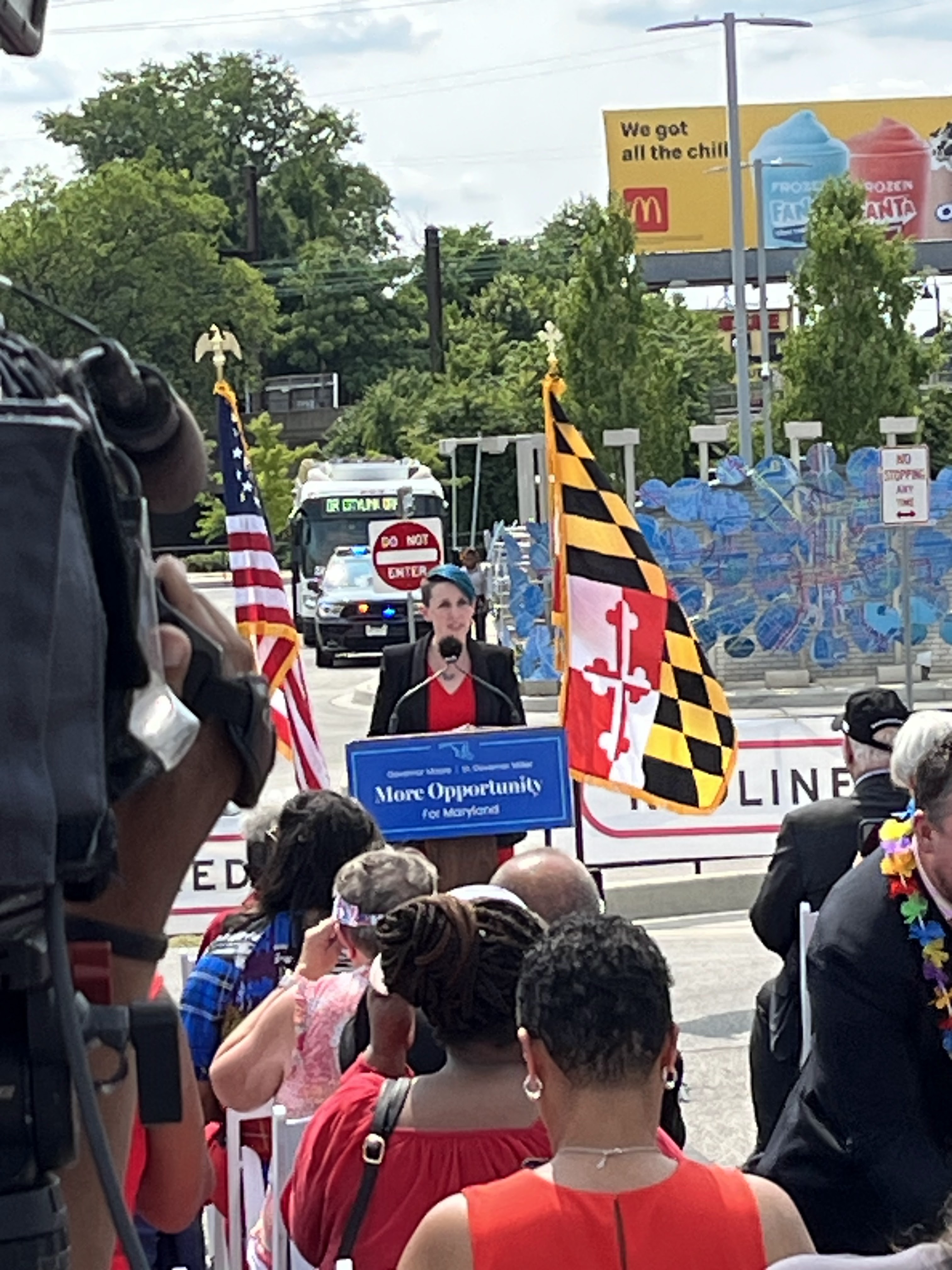
When the charismatic Governor stepped up to the podium seconds after the begin of the much touted event about the Red Line the first parking lot of the West Baltimore MARC station was filled with dignitaries of all stripes from federal to local. They peered against the sun with a full view of the MTA bus hub and Amtrak and MARC trains passing through the station. Moore wasted no time and got straight to his message: 

Governor Moore announcing Red Line restart
(Photo Philipsen)
This is a day that we’ve spent weeks planning for –A day my partners and I in government have spent months preparing for And a day that many Marylanders have spent years hoping for. Today I am proud to announce that we are officially getting the Red Line moving again here in Baltimore (Governor Wes Moore).
 But in his short talk the Governor also said this: "While we are grateful for the effort in years past" that went into this project "this initiative is not about pulling something off the shelf and plug and play". He spoke about "keeping a keen eye on very meaningful societal shifts" and invited the people of Baltimore "this is the time to leave your mark" on this project. 

In a WBAL interview with MTA Administrator Holly Arnold elaborated on next steps: 

"We need to hear from the community, what do they want, do they want Light Rail or do they want Bus Rapid Transit, ...We are looking at a tunnel downtown and surface running  options"  (Holly Arnold on WBAL)

As happy as transit proponents can be about this shift in State transit policy towards expansion, the discrepancy between getting the Red Line moving again and the warning that this won't be "plug and play" combined with the invitation for open ended questions about mode and alignment leaves many questions about how much this is really a revival of the Red Line versus a distant new project in the same corridor. Mayor Scott expressed the situation clearly when he bemoaned that "today we should be cutting ribbons" and board trains, instead we are standing here with another announcement, however happy he was about that the project is slated for restart.

MTA Administrator Holly Arnold
(Photo Philipsen)

The New Starts Process 

While "plug and play" seems logical as the quickest way of getting the project back on track, just dusting off the old project is not a feasible option, says Holly Arnold. It would run afoul of the requirements of the Federal Transit Administration overseeing a federally funded "New Starts" project. To get back into the New Starts process, the old "Record of Decision" has to be "earned" anew since the old one is no longer valid. 

The Record of Decision (ROD) is the conclusion of the NEPA EIS process. The ROD document is prepared after the final EIS and identifies the Preferred Alternative. The NEPA implementing regulations (40 CFR § 1505.2) state that a Record of Decision should contain:
  1. Statement of FTA’s environmental decision
  2. Identification of all alternatives considered by the agency, including the preferred alternative(s)
  3. Decision of all factors – economic, social, technical, environmental factors, financial considerations, and other New Starts considerations (23 CFR Part 771.127(a)).
  4. Discussion of national policies that were balanced in the decisionmaking process and how each factor weighted in the decision
  5. Explanation of whether the decision was designed to avoid or minimize environmental harm and, if not, why not

As MTA Administrator Arnold explains, data have to be updated leading up to a evaluation including a new "cost effectiveness" calculation, basically a cost-benefit analysis. As a first step the cost of the existing design would be escalated to a new expected construction period and the benefits be updated with new data, especially for ridership modeling, job access and equity as well as the expected travel time savings compared to the current baseline. According to Arnold, this work is well underway but it is too early to share the estimated new cost or the updated cost effectiveness.

The New Starts evaluation rating elements

Should the cost effectiveness ratio come out too low, it would be necessary to either reduce cost or boost projected benefits, namely ridership. That is where local government can play a big role by through transit supportive land use near stations which boosts ridership through maximal transit oriented development (TOD). Land use is one of the project evaluation criteria. On the cost side changes to the design may be needed to lower the construction cost, such as less tunnel which constitutes the lion share of the cost. Even bus instead of rail may be considered again.  Administrator Arnold describes a path that will try to use as much as possible from the previous design while also making the project  defensible under FTA's criteria. 

Once a plausible and qualifying transit solution is found, it would become the "locally preferred alternative" (LPA) and the project could be put on the New Starts bandwagon again for a new Record of Decision and eventually a Full Funding Grant Agreement.

The Schedule

So, even in the best case that the old design would still pass all tests, a shovel can't get into the ground anytime soon, even though that is precisely what transit proponents would like to see. 

Next steps display at the Red Line event (MTA)

Arnold expects the selection of a LPA in early 2024, not too far out, if that timeframe proves to be realistic. The promised study of an extension to Tradepoint Atlantic would run on its own schedule, but would eventually be also part of a New Starts process. 

The last time around the process from conception to cancellation of the near shovel ready project took 13 years. Secretary Wiedefeld and Administrator Arnold want shave off much time by using an abbreviated process called a "supplemental NEPA document", not an all new environmental study and report (EIS). The supplemental approach  focusses on what has changed since the last Record of Decision

Arnold assures that MDOT and MTA are closely working with the Federal Transit Administration (FTA) on how to navigate such an expedited process and are "constantly thinking creatively" about the fastest path forward. Maybe one way of acceleration could be to decouple certain up-front aspects of the project from federal funding, but that option wasn't mentioned by MTA at this point.  Current steps include hiring new consultants as needed to define, review and potentially design alternatives as they may be necessary to reduce cost or adjust to changed conditions.

The Challenges

From my 13 years on the Red Line team, I would identify at least six challenges that require a  creative approach:

  1. How to stick with the "supplemental" approach that updates demographic, economic and employment data as well as cost to whatever shifts there have been since 2013 when the last alignment decision had been made without slipping into the territory of an all new EIS.
    The new Red Line: How much is it like the old Red Line? 
    (MTA Display Board)

  2. How to bring the project back into the federal "New Starts" transit queue without being placed all the way at the back of the line. This type of queue jumping would be aided by language our congressional delegation put into the infrastructure bill, but it would be unprecedented. Besides, the 2015 estimate of $2.95 billion for a completion in 2022 would be more like $3.9 billion with a at least 10 year escalation.
  3. How to ensure that the local partners (Baltimore City and County) become active partners instead of bystanders as especially the County had been in the last round. Locals have to preserve the right of way and make transit supportive land use decisions such as implementation of some of the station area community vision plans developed during the Red Line planning process which were part of the creative Community Compact between MTA, City, County, non-profits and communities. For local government to become reliable partners in the Red Line revival the Mayor and the Executive need to appoint Red Line specialists who pay undivided attention to this project. 
  4. How to transfer the previous design and engineering of tracks, tunnels, stations and the maintenance facility as intact as possible to a new set of engineers and transportation planners without spending $270 million again  before the new teams become "comfotable" and are willing to assume the liabilities that come from signing off on a design. 
    County Executive Olszewski at the Red Line
    announcement event (Photo Philipsen)

  5. 5. How to include communities as partners without opening the floodgates to all kinds of new ideas, rumors and groups that prefer anything but what is proposed as the baseline design.  According to Arnold, MTA thinks of reviving the "community compact" introduced under Mayor Dixon and potentially remobilize the station advisory groups which had prepared vision plans for most station areas. 
  6. 6. How to construct and finance the line? In 2015 it was assumed that about half of the project would be constructed by a design-build contract in the P3 mode (Public-private partnership) and the other half in the traditional design-bid-build mode. By contrast the Purple Line was offered entirely as a P3 with a private contractor refining the MTA offered design, then build and operate it and finance a portion of it. The high hopes that this would be a faster and less risky process have long been dashed with the Purple line experiencing one cost overrun and schedule delay after another. No they haven't cut any ribbons yet either. It will be interesting to see how MDOT Secretary Wiedefeld and Governor Moore assess the P3 option.
It is useful to remember that the Red Line was designed to run almost entirely in public "right of way" and that it doesn't require condemnation or demolition of houses. Complete Streets policies, now fully endorsed by the City, should make the integration of transit easier, since complete streets means a recognition of all modes, walking, rolling, taking transit and driving. A project being realized almost entirely in the public domain should be easier than one that requires a lot of land purchases and easements. 

Still, in the last round the late baker and developer John Paterakis managed to force a station relocation so that the entry and exit of the Harbor East underground station would not have to be carved out of a corner of his property. This caused a crucial delay in 2013/14. In this round, the feds, the State, local government, private business and communities need to really support all aspects of the project to make it happen.

The restart of a project that is at least 14 miles long and had years of extensive public debate must focus on regional connectivity and not on minor local animosities. That is easier said than done: As in any larger infrastructure project, it is no problem to bring NIMBYs to the table and far more difficult to gather the support of the beneficiaries, i.e. future and current transit riders. 

Still, even with a better understanding of the mandated procedures, three of the things Moore and Arnold mentioned publicly require special scrutiny: 

  • "Meaningful societal shifts"

Yes, a lot of things have happened since 2013, notably the triple Baltimore handicaps that all came in 2015: The death of Freddie Gray in police custody and the unrest in the wake of it,  the State orchestrated termination of the State Center Project and the cancellation of the Red Line. Finally COVID that changed travel behavior significantly. Still, none of this makes the preferred Red Line alignment selected 10 years ago any less necessary, viable, or desirable. Even the temporarily sagging ridership figures slowly approach pre-Covid levels according to MTA.

The only really "new" thing might be the unexpectedly successful TradePoint Atlantic which already brought express bus service to that location. It made the County Executive request the extension of the Red Line to the old Sparrows Point area. Moore already promised that this would be studied. However, even this wouldn't constitute a material change to the existing Red Line plans which had all along included the notion of a future extension to Dundalk. 

Concept design for a new MARC Station (MTA/Amtrak)

Two other "shifts" are worth noting: Possibilities for transforming the "Highway to Nowhere" are much improved thanks to a $2 million federal "Reconnecting Communities" grant.  Secondly, the new Frederick Douglass Tunnel is now partially funded with an initial $450 million tranche for design and construction of some small up front parts. The new tunnel replaces the old B&P tunnel ending just north of the West Baltimore MARC station which connects to the Red Line. 

Both of these aspects are not jeopardizing the old Red Line design but allow the Red Line to become part of the precisely the type of catalytic change that the adjacent communities have long sought in the station area committees and elsewhere. MTA has begun conceptual design sketches visualizing the possible MARC station design within the existing Amtrak design contract.

  • BRT or LRT

BRT and LRT as alternative modes have been studied extensively as part of the 13 years of Red Line investigations. During the time of the Republican Governor Bob Ehrlich Bus Rapid Transit was the preferred mode and being explored in great detail. Comparative analysis showed that in the end a BRT in a tunnel is more expensive to build and to operate than light rail.  Buses tend to break down more often than electric trains and need bypass lanes at stations to get around stalled vehicles. Seattle found this out when they initially built downtown BRT tunnels and later gave up on further bus tunnels. and expand their system with only LRT.  BRT s more expensive in operation because the currently available buses don't have the same capacity as LRT trains and therefore require more vehicles and operators unless they would run fully automated. Urban transit with no transit staff on board is technologically possible, but hardly acceptable to riders in the foreseeable future.

  • Surface or tunnel

Surface running or tunneling was also extensively studied, for both BRT and LRT. It was the prevailing professional consensus that a full surface option would either be very slow (think Howard Street light rail) when running in mixed traffic or it would be very intrusive, when running in exclusive right of way. This would be especially true on Cooks Lane and Aliceanna Streets, where exclusive transit lanes 

Initial Red Line rendering for Edmondson Avenue: The original
Red Line was designed to be entirely in its own right of way.
would hardly be acceptable to the residents and businesses, since those streets are too tight to allow designated transit lanes, car traffic, and parking to coexist in any meaningful way. 

BRT proponents should also consider that we already have designated bus lanes in many places and must realize that they do not work in the same way as tracks in a designated area.


Conclusion

It is clear that conquering all these challenges and still get the project expedited for construction requires a tight rope walk. Not falling off the rope requires a unified voice that rallies around the already preferred, selected and designed and once fully approved project. This unified voice was briefly visible at the event in West Baltimore when speaker after speaker touted the Red Line as the best thing to move forward with. Adjustments to make the project defensible under FTA criteria should not be understood as a free for all to dust off the skirmishes from 10 years ago, especially not old hats that had already been refuted as unrealistic back then. While a few things have changed, Baltimore ist still Baltimore and the East West challenge remains essentially the same.

The unified voice is the only one that will be here in Washington. It will have to be loud and clear to overcome  the formidable obstacles of line jumping and financing that currently stand in the way of  straight up "plug and play".

Klaus Philipsen, FAIA

the article has been updated to include the P3 discussion.

The national publication The American Prospect wrote bout the Baltimore Red Line in this June '23 article 

Maryland Matters wrote about reviving the Red Line in this June 23 article

Previous articles about the Red Line on this blog:

Is there a better Red Line? (June'23)


Recycling bad ideas for the Red Line (Sept 2017)