Wednesday, July 11, 2018

Is North Avenue rising or sinking?

North Avenue is a bellwether for Baltimore. The east-west corridor is 5 miles long, goes from "black butterfly" wing (west Baltimore) to "black butterfly" wing (East Baltimore) and traverses the "White L" at Charles Street. North Avenue has been a central locale of the 1968 riots following the assassination of Martin Luther King and the 2015 uprising was centered at Penn and North. Once the City's northern border, it is today a central, but troubled artery.
North Avenue Market in the Station North area of
North Ave (Photo: Philipsen)

Given this history, and all the good intentions that came after the unrest in 1968 and then again nearly fifty years later, there has been astoundingly little effort made towards reversing fortunes by heavily investing in this particular corridor. Most would say that overall North Avenue today looks worse than it did in 1968.

Yes, there have been improvements, some pretty big: New affordable housing in the far west section (the Gateway projects by Woda Development with 130 units), the redevelopment of the former Walbrook Lumber site under construction now, new buildings at Coppin University, a MICA dorm east of Eutaw Place and the demolished "murder mall" public housing to be replaced by the Madison Park North redevelopment (Up to 500 units, currently still in a conceptual stage).  On the east side there are bits and pieces of the Barclay area redevelopment which reach North Avenue, there is the streetscape project from Asquith to Harford Road, big plans by the Blacks in Wax Museum. In the center of the corridor there is the much heralded Station North Arts and Entertainment District with the rehabbed Parkway Theater, the Motor House, the Centre Theatre and MICA's Lazarus Center.

But on the scale of a 5 mile urban artery, these investments remain fragmented and fail to add up to a convincing new prospect for North Avenue, an artery on which the world had set millions of eyes as the nexus to Freddie Gray and everything that had gone wrong in Baltimore. In this light the committed investments can hardly be described as the big lift that would be needed in this symbolic corridor to turn the sad narrative and the reality around. Especially missing: a large coalition of stakeholders coming together across all the boundaries and absolutely necessary to enact lasting change in the corridor.

Refurbished Center Theatre on North Avenue
(Photo: Philipsen)
How little resolve towards a big and comprehensive effort there is, came to light with a project that has the right name: "North Avenue Rising", a project described before here . Initiated by MTA in collaboration with City DOT as an application for a TIGER grant, the idea was to look at this corridor from end to end. But based on TIGER (Transportation Investment Generating Economic Recovery)

the project remained simply a transportation project, limited to a total investment of $28 million, not enough to do much more than striping a bus lane, adding a few bus shelters, a few benches and trees and a couple of altered curb radii at intersections such as Penn and North. The City has only $1 million in the project and most of that is road maintenance. Absent from the project is anything outside the public right of way, anything that has to do with land use, vacant storefronts, empty buildings or with economic development which a TIGER project is supposed to generate. Experience with Baltimore's Howard Street, redesigned numerous times, has amply illustrated that transit and streetscaping alone cannot spur revitalization of a street that has fallen on hard times.

North and Penn in 1922

Even the central area of North Avenue, the blocks east and west of Charles Street known as Station North, is not immune to setbacks, even though it boasts the most comprehensive and strategic approach towards renovation of buildings and new uses. The transformation was aided by MICA's Lazarus Center which became another important anchor on North Avenue. While the non-profit center of the Motor House, the Parkway movie theater, the Impact Hub and MICA's Social Design school have doubtless infused new life into the area, many other spaces remain vacant or struggle for survival.

Cafe BAMF, right around the corner from North Avenue on Charles Street, announced its closing earlier this month. Red Emma's, a clear magnet for art and culture, has closed its doors in anticipation of its move from North Avenue to the Cultural Center across from the Meyerhoff Symphony Hall. Especially the departure of Red Emma's is a blow.  Red Emma's expressed the aspirations of the Arts and Entertainment District in many ways, the departure of this iconic fixture cannot be simply written off as normal change. As a cooperatively owned left leaning bookshop Red Emma's had tried for years to balance the needs of addicts and homeless gathering at its doors every day with its programs of lectures, book-readings and music. No single institution or business, no matter how well meaning, can solve these large protracted problems alone or at its doorsteps.
Better bus transit on North Avenue: Near Metro at Penn and North
(Photo: Philipsen)
“We have absolutely loved being on North Avenue these past five years—we couldn’t imagine a better neighborhood to grow and develop our worker cooperative. While we’ve managed to achieve some of our goals as a project since moving, we’ve struggled to recapture the cozy community feel of our original location, and, at the same time, have outgrown the capabilities of the cafe space we designed back in 2013.” (Kate Khatib, Red Emma's co-founder in Baltimore Magazine)
It isn't clear whether the departure of the bookstore is only driven by a need for more space or whether the stress from the needy in front of its doors or economic constraints contributed.  Mike Shecter of Guppy Development, who owns the cavernous old North Avenue Market, and who has been a vital force in the revitalization of Station North, acknowledges that being open and inviting can be difficult on a corridor with so many social ills on display. "The area is not dying" he says. Quite to the contrary, he is hopeful that the old market will receive some new tenants this year which people "will be really excited about" which he doesn't want to disclose yet so to "not jinx it". Red Emma's at the prominent corner was so far the biggest tenant and Shecter says he has many prospects that would run the place as a restaurant. "I hope to have it up and running in a few months". Other existing tenants include the also iconic and gritty Wind-Up Space gallery and event-space run by Station North pioneer Russel De Ocampo, a print shop, a gallery and what used to be Liam Flynn's Irish bar. More extensive use of the former market with its large floor plate combined with some exterior upgrades would be an enormous boost for the area.

Charlie Duff of Jubilee Baltimore, who brought the Centre Theatre back to life as the Impact Hub with, among other things, a Hopkins film studio in the building, is "not worried" regarding the future of North Avenue. He and Ellen Janes from the Central Baltimore Partnership hinted that good news for North Avenue would be right around the corner.

Emma's bookstore presentation (Photo: Philipsen)
Even where progress has been made,  backsliding is an everyday danger which must be stemmed off through vigilance and ongoing initiatives; In the Station North segment of North Avenue the Central Baltimore Partnership along with risk takers such as Shecter, Duff and BARCO guarantee vigilance and strategy, the Arts and Entertainment District provides the programming. East and West North Avenue are not so lucky. Developers such as Woda and institutions such as Coppin University are still largely isolated islands without an area-wide coordinated effort.

Stakeholders and public officials are currently trying to unite forces for a coordinated effort and strategic investment in the two wings of the corridor for much bigger action than individuals and individual community organizations have been able to pull off to date.Councilman Leon Pinkett, in whose district some western portions of North Avenue fall, has emerged as a leader and has held had a number of stakeholder gatherings, initially geared towards a more comprehensive MTA project.

Constrained by TIGER deadlines and funding conditions, MTA's "North Avenue Rising" project will moved towards realization with its limited scope. Some work could begin as early as the end of this year. Pinkett's group now must try to get private, institutional, non-profit partners and the Mayor to realize that North Avenue Rising needs much more than better bus service and some cosmetic changes.
Arch Social Club at Penn and North (Photo: Philipsen)

While it is easy to forget North Avenue when sipping a drink on Sandlot at HarborPoint, shopping at Harris Teeter on McHenry Row, gazing at the luxury apartment tower at 404 Light Street or the Anthem House from the comfort of the waterfront promenade, North Avenue cannot be forgotten for long. Residents in flourishing communities may not see North Avenue as a bellwether for the entire city, but there are good reasons to believe that Baltimore won't thrive unless, what was once a wonderful avenue, gets back on its feet.

Klaus Philipsen, FAIA
updated for requested quote deletion

Related articles on this blog:

Tuesday, March 27, 2018

North Avenue, Charles Street and Baltimore's equity question


Monday, August 1, 2016

North Avenue Rising From Hilton to Milton

North Avenue, from Hilton to Milton (MTA Graphic)


Monday, July 9, 2018

How MTA succeeded in building a landmark bus transit center in a disadvantaged community

This blog about urban matters, architecture, and transportation covers a broad spectrum of topics but it practically never touts the work of my own architecture and urban design firm. I am assuming this would turn readers off who are interested in a critical, factual non-commercial discussion. Here is an exception: A transit project, completed at the end of 2016:  So many stars aligned for this monument to public transportation that it is worth an article, even though my firm was the architect of record.
Takoma Langley Crossroads Transit Center (Photo: Wilson T. Ballard)


Interesting aspects of the project are, in part, surprising, innovative or should be part of daily practice on any transportation project:
  • how a Baltimore centered transit agency comes to build a transit center where none of its services operate
  • how agencies within the Sate DOT can collaborate
  • how federal funding is important for good infrastructure
  • how transit design can promote equity
  • how design and engineering can complement each other
I will address each separately.

How a Baltimore centered transit agency comes to build a transit center where non of its services operate

Maybe the most baffling aspect of the Langley Park transit center is that the MTA built it, even though not a single MTA bus will likely ever run through it. Users are Washington's transit agency WMATA, Montgomery County's Ride-On, Prince George's The Bus and UM shuttles.  (Metrobus C2, C4, F8, J4, K6 and K9; Montgomery County’s Ride On 15, 16, 17, 18, and 25; and Prince George’s County TheBus No. 18).
Scattered bus stops consolidated: Transit Center at black dot

What many Marylanders don't know: As a statewide transit agency, MTA, through its Office of Local Transit Support, provides support services for locally operated transit systems all around the entire State. In other words, MTA earns the M in its name not only because it provides commuter train service from Perryville in the north to New Brunswick in the south, but because of its coordination with local transit providers. As such it facilities and sometimes funds and designs facilities outside its service area. Eaxamples include the Metro/bus Paul Sarbanes Silver Spring transit center, the Purple Line and the Corridor City Transitway.  The justification for the Langley Park Transit Center in MTA's construction program read this way:
This area is the busiest transit transfer point, outside a rail station in the region,
with 11 Metrobus, Ride On, The Bus and shuttle van routes. The project will also address pedestrian safety issues. The project will accommodate a future station and connection to the Purple Line. 
The initial cost estimate was $12.31 million with funds coming from Montgomery County, Prince George's County, WMATA and Maryland Transportation Infrastructure Investment Funding. The Silver Spring Transit Center is operated by WMATA. This was originally also planned for the Langley Transit Center but the changed to MTA operating it as a more cost effective solution.
A landmark in a sea of cars and asphalt (Photo: Philipsen)

How two large state agencies can collaborate

At the root of the idea for a transit center was the fact that Langley Park at the confluence of University Boulevard (MD 193) and New Hampshire Avenue (MD 650), was the locale of a very high rate of pedestrian crashes.
At least 138 pedestrians have been struck by vehicles in the past eight years on a lethal 2-mile stretch of state highway that runs through this low-income immigrant community. Eight have died. (Washigton's Top News, May 2017)
The area provided a perfect storm for those crashes with two very wide and extremely busy suburban arteries bisecting in a community  with a very high rate of immigrants from South America. Langley Park residents use transit at a much higher rate than more affluent populations. Langley Park today is a working class community of about 19,000. Three quarters of its residents are Hispanic, 65 percent are foreign-born, many from Central America. In 2000, 68 percent of households had either one or no car, and more than 20 percent used public transportation. The path from the area apartments to the many bus lines operating along the arteries included almost always crossing one or even both of the busy roadways.
25,000 square feet of glass with 44PV panels: (Photo Kyro systems)

The MTA transit center was adopted into the official Montgomery County 2012 Sector Plan.

The high crash rates eventually had SHA make improvements near the area where the two State routes intersect:  A slew of changes were made including $191,000 for fencing on the medians, a new pedestrian signal, reduced  pedestrian wait times at signals, a lower speed limit of 25 mph in this area and increased use of speed cameras. No pedestrians have died since then.

A key safety feature, though dealt with transit: A center where all bus stops would be concentrated on a part of an older 1960s style shopping center would reduce the need to dart across the street to transfer from one bus to another and aggregate all road crossings at two signal protected crosswalks leading to the center. The transit center would be planned by SHA's sister agency MTA.
Langley Park Transit Center: Room for 11 bus bays (Photo: Philipsen)

35,000 bus riders a day transfer among 11 bus routes. They brave the congested terrain, walking as far as a quarter mile through a dangerous gantlet to their next bus. A Takoma/Langley transit center would consolidate the bus stops, creating a safer environment and bringing more consumer foot traffic to local businesses. (Maryland Newsline, April 2010)

CAD model rendering with future Purple Line (Image: ArchPlan)
The collaboration between MTA and SHA didn't end with designing for pedestrian safety but had to be extended to negotiations with the owner of the shopping center when the company was unwilling to accept two State offers to purchase the tip of the shopping center where a Taco Bell franchise sat and where the transit center was supposed to go. Only SHA has the ability to negotiate such deals and, should they be unsuccessful, condemn property via "quick-take". An eventual deal could only be reached after the owner had been offered a sales price far higher than the assessed value of the land as determined by various independent appraisers and after the transit center design at been peer reviewed by high powered consultants of the shopping center owner's choosing for its impacts on the remaining center.

How important federal funding is for good infrastructure

With the high cost of the land, the transit center would have become unaffordable if it were limited to the funds originally set aside for the project. The project was eventually saved by a federal TIGER grant of $13.9 million. The final cost came to $34.86 million, proving once more that infrastructure projects take a long time, face unforeseen hurdles, and usually far exceed original cost estimates.
“It’s a landmark,” It’s an area, a crossroads that’s always been sort of unremarkable." Takoma Park Council Member Fred Schultz
The federal money injection kept intact the intent of the center to become a landmark in the area signifying the importance of transit in a suburb heavily marked by the automobile. The basic functionality could have been achieved by simply arranging curbs and gutters the right way and by placing some standard bus stop shelters on some islands.
.
How transit design can promote equity and create value in a big engineering team 
No car parking but bike racks (Photo: Philipsen)

Designing for transit in the US typically serves a population which has an income below the median, less access to cars, consists more frequently of renters and belongs to a minority. All this applies even more when a transit facility is located in the heart of a highly segregated community such as Langley Park where 17 of all residents live under the poverty line (2000 data). When my firm ArchPlan was asked to join a team of engineers to work on a future transit center in Langley Park, equity wasn't foremost on our mind. Like most architects, we were glad to be able to assist in designing something.

However, it became quickly clear, that the project required much more than minimal functionality. It had to truly elevate transit in a sea of asphalt, cars, shopping center parking and bloated suburban intersections. That wasn't as easy as it sounds, even if sufficient funding is available. In the design of a transit center, the architect is a subconsultant to engineers, not the team leader as on building projects. The first challenge is the basic layout of the center, i.e. how the buses get in an out and how the various stops are placed, something which is typically worked out by
Ticket sale office, bathrooms,  transit police office: Facility building
(Photo: Brough Schamp)
transportation engineers, especially when it is as complicated as accommodating some 11 different bus lines on a tiny spot that previously only served a Taco Bell. The engineers think of turning radii, articulated buses, saw-tooth bus bays which make it easier to pull a bus tightly to the curb, and stacking lanes where buses can line up at the signal without blocking buses coming in trying to pull into their bays.

Naturally, the initial layout did not consider how a large roof could pull it all together and give the transit center a visual presence in the car centric setting. Luckily, collaboratively we were able to modify the layout so that it wasn't only functional but also compact enough to allow two large glass roofs. Steel trusses holding up the glass span up to 120' and arch to 42'. Two roof "shells" ride over top of each other and cover all the bays with an architectural gesture that stands out and gives transit and its users the signature structure that now defines the crossroads.

The project isn't just a proud center, it also features many green solutions: Rainwater is harvested from the large roofs and cleaned in an underground storage tank which also serves as an irrigation source for watering the plants. Small rains are collected in bio swales where plants filter it. The 25,000 squarefoot roof allows hot air to vent trough an opening placed above an area where no bus riders wait. An array of 44 solar panels around the vent opening provide electric energy that can offset a good portion of the energy needs of the 1,100 squarefoot facility building which is heated and cooled with environmentally friendly variable speed ductless ceiling units.
Under the roof the facility building (Photo Brough Schamp)

Without the rail service of the Purple Line, which will be constructed adjacent, the transit center is still smaller than the one in Silver Spring, but it already serves more bus riders than any other non-rail transit center in the State.  As far as I could find out, riders, people working in the center (there is an attendant selling tickets and a small transit police room) and bus operators have no particular complaints about the center. That may sound like a low bar, but in the real world that is about as good as it gets. The local politicians who made it possible find it beautiful. 
“Por fin!. This is going to be so much better. There’s more space. It is also looking very nice.” Zulma Berrios, bus rider
The project won a 2017 American Association of State Highway and Transportation Officials (AASHTO) Quality of Life/Community Development Award and a 2017 AIA Good Design is Good Business Honorable mention.
Installation of glass panels. They are "fritted' with
 white dots to reflect heat (Photo Kyro Systems)

There is much talk about changing bus technology and new operation models (related article here) The need, though, for the bus to interface with its riders in a safe and convenient way will not go away. 

Klaus Philipsen, FAIA
Client: MTA. Lead engineer: The Wilson T. Ballard Company (WTB); architect: ArchPlan, Inc., mechanical/ electrical engineers: AECOM, Inc., traffic engineers: Sabra, Wang & Assoc., Inc. and RJM, Inc., landscape architect: AB Consultants, Inc. Contractor: Costello Construction.

Greater Greater Washington Washington: Langley Park’s new transit center opened on Thursday!

Saturday, July 7, 2018

Secrecy and mystery around Baltimore Bikeshare's second nosedive

Move over docked pedal-power bike share, the docked electric bike comes. Oh, no, the pedal power dockless bicycle comes, wait, now it is the electric powered dockless scooter! Who wouldn't get out of breath with the relentless onslaught of what is alternatively sold as innovation, last mile, or active transportation?
Promise at restart: A full complement of bike at Inner
Harbor in October 2917.
In summer 2018: Maybe one bike

But Baltimore's problem is of a different kind. This city is so mired in feuds over bicycle lanes, fire-lane requirements and ongoing guesswork whether the presumably 200+ bikeshare bikes really exist, (according to earlier announcements there should be more like 500 bikes out there) that other cities who complain about the flood of alternative mobility options seem to from a different planet. In short, when it comes to the bicycle in this City it is another case of Baltimore exceptionalism., the kind one could do without.

In Baltimore, presumably the first large North American City with a electric fleet bikes,  even this traditional model with bikes in docks never really took hold. It started years late and had to be shut down within 9 months due to excessive vandalism and docks which relinquished their bikes if one yanked hard enough. The system sputtered back to life after a few month of fleet repairs and the installation of fortified "Baltimore locks"going into the winter of 2017/18.  Now, the still not even 2 year old toddler seems sick again. There is renewed whisper about Bewegen's ability to maintain the system. The online rumors are fueled by the many empty bike-stations, non functional bikes and an apparent lack of momentum towards the promised system expansion.
Bewegen Technologies: Electrc spark for share bikes

"We love Baltimore" the Bikeshare Company Bewegen which runs this city's system posted on their Facebook page in June, showing a video clip with three bicyclists on the trademark blue bikes riding by. The film clip was received by mockery. One incredulous poster asks, "How many kiosks did they have to go to to get 5 bikes is my question" and posts a picture of a station bare of any bikes.  Another responds: "So that's where all four bikes went". Both comments remained unanswered by bike operator Bewegen.  A recent company issued "service alert" showing an additional station #48 at Perkins Home as just added, indicates progress towards the promise of 50 stations and 500 bikes  not only in the so called "white L" but also in poorer parts of the city in the "black butterfly". But a glance at Bikeshare's online map where all the stations are marked with supposedly accurate info about the number of available bikes in each station, shows many zeros on Friday morning and maximally three bikes in any station on Friday evening. With somewhere around 40 stations open, there are nowhere near the 400 bikes that the system is to offer now. Greg Hinchliffe, a member of the Mayor's Bicycle Advisory Commission reports that a few months ago the Commission was told that  of "the 450-ish bikes the city paid for, only about 150 were available. Of the 300 bikes which were not available, 200 were damaged and 100 missing, presumed stolen".
The newest fad: Dockless electric scooters from
Bird. DOT: “We also see the potential of a new
 mobility pilot project and are in the process
 of investigating the effectiveness of a program
such as this.”

In February it looked like Bewegen got a big boost when the car share company Lyft declared they would become a sponsor of the Baltimore bikeshare system, sponsoring five docking stations. This caused Baltimore blogger Brian Seel to pen an enthusiastic article about  The Company that Believes in Baltimore.
Lyft appears to be partnering with Bike Share, not because they want five new billboads, but because they see the value in a thriving transportation system in Baltimore. (Brian Seel)
Overall though, Baltimore's Bikeshare  has produced mostly negative headlines: about stations routinely having few or no bikes, bikes not working, vandalism, theft and the mobile app giving wrong information. After the system reopened last October, just in time for the first anniversary,  it boasted revamped bikes and stronger locks, but winter wasn't the best time to expand.  So things began to drag. It didn't help that Baltimore's City bike share coordinator Jay Decker did the classic revolving door thing and switched from being a DOT employee overseeing Bewegen to being a Bewegen employee at the height of last fall's crisis.  The position is still vacant at DOT. Naturally, Decker couldn't work on Baltimore's system, otherwise the conflict would have been too glaring, DOT Director Pourciau sent a stern letter reminding the company of this.

Bicycles and uninstalled station docks seem to sit in Westport where Bewegen has its Baltimore headquarter. It isn't clear how the company justifies the absence of bicycles. The only one who said anything to me, Chris King, Baltimore's Bewegen rep hinted darkly about politics and vandalism but referred me otherwise to the Director of Business Development & Marketing, Braunyno Ayotte. He eventually provided an e-mail with responses to my questions which were posted below but removed again per his request. In his mail he confirmed his commitment to Baltimore, stated that "Bewegen has out-rolled all promised stations and bikes from the previous shut-shut plan" which may or may not mean that it also provided all bikes and stations promised for the expansion phase. He noted that "theft has been reduced due to a number of initiatives, [but that] general vandalism has reached extreme levels". He observes that "usage and member levels shows that Baltimore needs this service and that bike-share can work here.". 
Dockless share bikes in Denver: Too much clutter?

For this article I also asked DOT Director Pourciau to clear up what is rumor and what is fact, and how sound Bewegen's operation really is. But the response from communications officer German Vigil was quite tortured which one could take as a red flag in itself.
The Department of Transportation has been working with our provider Bewegen to assess current contract conditions to move the bike-share program forward. Data shows a strong demand for bike –share in Baltimore and membership is growing. DOT is proceeding aggressively to reconcile issues that are affecting the bike-share program.  DOT is working with Bewegen to overcome concerns, such as broken bikes and application issues. Through ongoing analysis and work with Beweggen, we have discovered that the bike-share program is experiencing higher than anticipated damage and ongoing technical difficulties. Contract discussions continue to ensure this program is successful. (Baltimore DOT).
The statements from the two contract partners indicate serious tensions and problems, those which the City has with the company and those the company has with the City and its politics. These tensions don't seem to occur in other cities in which Bewegen was hired: Howard County's smaller system in Columbia, a 16 station 160 bike system in Richmond Virginia and Birmingham, AL with a system of 400 bikes. There are also a number of very small systems in Europe. Birmingham like Baltimore is eyeing the dock-less bike as the next big thing with potentially over a 1000 bikes which could co-exist with the current Zyp system of Bewegen. Meanwhile, Birminghams bike station seem all well stocked on Friday night and also when a Baltimore transportation planner visited there recently. One can assume that the Baltimore Bikeshare problems will soon come to a head and it will become public what is at the root of the current dysfunction.

The dockless electric scooters from Bird are a small sign that mobility innovators have not yet given up on Baltimore yet. Meanwhile the City is working on regulations for dockless bicycle sharing, which is sweeping across the continent and flooding some cities with more bicycles than they care to see in their public spaces. It is hard to imagine that a city which can't handle orderly lined up docked bikes would do any better with bikes that must be searched via smartphone and could be found just about anywhere. Even in prosperous Dallas many of their dockless bikes wound up in some waterway. Baltimore's blue bikes also had to be already fished out of the harbor. The City of Milwaukee has sued the scooter operator Bird for operating unlicensed vehicles on public right of ways. The road of alternative share vehicles is bumpy.

Klaus Philipsen, FAIA

updated for information from MBAC member Greg Hinchliffe and for Milwaukee suit on Bird. Updated for response received from Braunyno Ayotte 7/10/18


A recent article in Baltimore Fishbowl added here on 7/26/18:
The Baltimore Bike Share system is about to fail - again


Wednesday, July 4, 2018

Could a MTA bus be the next cool thing?

Forget bikeshare, Uber and Lyft or even electric scooters. The next cool thing could be the bus! Yes, that's right: A transit bus, of all things! The Atlantic's CityLab and the Wall Street Journal agree on it, so there must be something to it. The former wrote a whole series of articles about the future of the bus, the latter gushed on Tuesday this week about the good old bus under the headline Meet the Future of Urban Transportation: the Bus. Pair this with recent pronouncements of Baltimore  MTA that their real time bus information finally works reliably on the Transit App (as far as I can tell, it is true) and, maybe most remarkably, a positive tweet by local councilman Ryan Dorsey:
Bus, the new darling of urban transportation? (WSJ article)
I’ve been taking the 54 or 154 downtown pretty frequently lately. I’ve taken it repeatedly at different times of the morning, from 7:00-noon, and my experience is that it’s reliable, frequent, and at least as fast as driving, and I never have to park. (Ryan Dorsey on Twitter, July 2, 18)
Transportation Secretary Rahn must be rubbing his eyes, he and his boss who side by side snubbed rail transit and called Baltimore "a bus town". Could it be they accidentally hit on something?
Bus on Transit App: real time

For anybody who hasn't ridden a bus in a decade or so, a few pleasant surprises are obvious: The windows are large, boarding is almost level, the ride is as smooth as Baltimore's terrible streets allow and the interior design is clean, modern and pleasant. The front destination display is bright and so large that one can, indeed, read it from a block away. There are about a dozen cameras on board and automated announcements about keeping your smart phone safe are also a relatively new feature. The lastest buses even have a LED screen that could theoretically show the location of the bus and the next three upcoming stops, but for now they just show vintage buses to remind riders, how far bus design has come.
Councilman Dorsey praises his transit ride (Twitter)

But aside from those new touches, the truth is, MTA's transit buses today are pretty much like those yesterday and the day before, as far as the bus as a vehicle goes.  It is diesel powered (Hogan-Rahn actually discontinued the purchase of diesel-electric hybrids favored under O'Malley for being too expensive) and, in spite of low sulfur diesel and filters and uric acid injection, they still spew a fair amount of  particulates and nitrogen oxides just like those VW diesels that got the world's largest automaker into so much trouble.  On a code red day the 700 or so MTA buses plying Baltimore's Streets contribute quite a bit to the smog cooking over the city.

So the cool new thing about the bus that even corporate types who read the WSJ would want to read about is clean electric propulsion. At least according to Jason Bordoff, who wrote the WSJ article and whose credentials include to have been Obama's energy adviser. A clean purely electric bus which would quick-charge through induction pads at major bus stops is Bordoffs dream, much more than a Tesla 3. Why? Because buses matter more. He says even today the world's electric buses have already reduced fossil fuel use six times more than all the world's electric cars combined. He says that from 2015 to 2017 the number of electric buses has doubled. Unfortunately, almost all those clean buses run in, yes, you guessed it: China, a country in which the air is often nearly as thick as that of London in 1952 when the "Great Smog" killed 4,000 people directly and many more indirectly and caused the  British to enact world's first comprehensive clean air act of 1954.
British "Bobby" during the 152 London smog

US transit agencies today run only 1% of their buses electric. But they are also ambitious: LA has vowed to run an all-electric fleet by 2030, New York's MTA by 2040 and Seattle's Sound Transit, WMATA and  CMTA in Chicago have already ordered electric buses. Lexington KY's Lextran ran an experiment with overhead induction charging. (See my previous blog article). Ok, an electric bus without a lurching transmission and the noisy engine in back would be nice. Quieter, cleaner, smoother and with faster acceleration. Provided the kinks get worked out. Baltimore's DOT, for once really innovative had purcheased all electric "Ecosaver" buses for the then brandnew Circulator bus service. Those buses had a small on-board gas powered  turbine for charging the electric propulsion. But the bus was a bust in Baltimore's summer heat. The experiment failed, the DesignLine manufacturer went bankrupt in 2013 and the City was stuck with buses that needed to be replaced with regular diesels, still dragging down the books.
Friendly interior: The modern bus (Photo: Philipsen)

What else could make the bus cool? The biggest deal, is the way it is deployed and what riders and the transit agency know its whereabouts. In other words, if staring down the road to see if the scheduled ride would actually show is replaced by a look at the smart phone where a bus symbol steadily moves closer to your location  just like that little black Uber car: That is cool, especially if it is reliable and the buses show up in roughly the scheduled intervals. (In the recent past those buses on the map often proved to be phantom buses, appeared and disappeared at random and estimated arrival times were far off due to an older GPS technology that has now been replaced.) If heading out the door isn't that great guessing game anymore, taking the bus isn't as much of a time waste any longer, compared to driving.
Chinese electric bus fleet: The green revolution

The reliability concern is still the biggest reservation riders have, especially those who don't have the  option to drive. While it seems that MTA has made progress in dispatching its buses more reliably and matching buses with drivers with greater success through lower operator absenteeism, a convincing set of data to prove this system-wide is till not available. But as it is with many things, incremental progress on operators showing up on time and better bus maintenance causing fewer breakdowns, for example, has a ripple effect that can quickly lead to a tipping point. Pair some of the mundane improvements with cash free payments to eliminate pesky delays by riders clogging up the front door while fingering for their coins, and all of a sudden riding the bus could actually be quite a pleasant thing. A bus that runs on time, in the scheduled interval and without too many unscheduled delays is also a bus that is less crowded and much more likely filled with riders in a good mood. Whether Quickbus is already a success or not, sure is that with the new shorter routes, the MTA has a much better foundation to tweak the system than with the convoluted system that had evloved in the decades before.
DOT's unfortunate foray into electric buses:
More Wienermobil than reliable transit

Lastly the bus could become really more like Uber Pool if its dispatch would be informed by actual demand. If potential riders could register their intent to ride on their smart phone and with an upfront cashless payment, a computer algorithm could optimize fleet and demand accordingly, similar to the new way on how elevators are dispatched in high-rises. Overcrowded buses failing to pick up riders could become a thing of the past. No longer would a bus have to ride out a late hour run all the way to the terminus and back once it was clear no riders would wait on those outposts.While such demand based service fluctuation would still not pick you up right at the door, it could do a lot to make bus service much better and way more efficient.

Less clear is, what the last but biggest innovation will do to the future of bus transit: autonomous vehicles. Will self driving cars and ride share vehicles kill transit as some fear based on current evidence that transportation network companies (TNC) such as Uber and Lyft siphon riders away from transit. Feared by the unions is another possible future: That driverless buses could become so much cheaper than current transit, where the operator is the largest expense, that transit companies could be early adopters of the technology which is fairly easy to implement on predictable well mapped routes that characterize transit. It is very conceivable that buses in various sizes could fan out across the metropolitan areas in larger numbers than today;  operators would be degraded to on-board transit ambassadors who would assist riders on busier routes. They would finally be able to chat with passengers, because the bus, it would drive itself.
Soon obsolete: The bus operator?

All of these technologies are readily available and already in use in many places, at least on an experimental basis. Even though all the talk is about Tesla and TNCs, it may in the end be the smart, electric self driving bus that is the cool new thing. Which wouldn't only be cool, but unlike Teslas and TNCs,  it would actually solve a transportation problem.

Klaus Philipsen, FAIA

Expanded in the section about self driving buses


Monday, July 2, 2018

Is Baltimore on the verge of a manufacturing renaissance?

At a time when the nation debates its future around steel, coal and Harley Davidson motorcycles, it isn't surprising to see that the Baltimore SUN explores the city's options for a manufacturing renaissance. Not steel, coal or automobiles are the topics, though, but maker spaces, wood-work, routers, and recycled traffic signs.
Making in Baltimore: Open Works Exhibit 2017 (Photo: Philipsen)

Heading on the Gowanus Expressway in New York towards the Verrazano Bridge, one gets an upper story view of Brooklyn's industrial waterfront, one of the nation's petri dishes of post industrial reinvention. Many of the stately multistory industrial buildings, pressing hard against the edge of the elevated expressway, are no longer vacant. A particular handsome and stately collection of buildings advertises its new content with a long line of banners. Makerspace is one of the new uses. Co-location of multi-use innovation hubs, Forbes calls this, specifically the re-birth of Brooklyn's 1906 Bush Terminal as "Industry City". The once largest multi-tenant industrial property in the United States was a trailblazer 112 years ago. Can it be a trailblazer once again, this time for integrated industries of a new age of making in the US?
Industry City, Brooklyn (Photo: Philipsen)

In Baltimore the scale of the same idea is naturally smaller, but the dream is the same. Baltimore's most famous maker space sits in City Garage and is dubbed Foundery Place as part of Kevin Plank's reclamation of a Baltimore former municipal bus garage on the waterfront and his own corporate foray into local production. But what caught the SUN's attention is a maker space in a much less illustrious location on Greenmount Avenue, an endeavor, funded and supported by the non-profit Deutsch Foundation and conceived as part of the Station North art eco system.

Whether in Brooklyn, at Sagamore or in Greenmount West, the idea is once again to integrate industries to realize synergies. A hub for learning, making and technology that can reignite making in new ways. But this time, the motor is art and the goal isn't foreign trade but local production and consumption through workforce development, job training, re-entry and job creation for those left behind in the shift from industrial production to knowledge, service and research.

Open Works Executive Director Will Holman, an architect by training, has studied maker spaces around the world, their history and presence and their potential in an age of accelerated innovation before his space even opened two years ago. I have reported about his dream baby several times in this space. (here, and here).
Open Works is a 34,000 SF non-profit that provides "access to tools and technology and knowledge" said Will Holman, General Manager in a presentation about the project the evening before the ribbon cutting. Open Works is a project of The Baltimore Arts Realty Corporation (BARCO), a non-profit real estate development corporation focused on neighborhood revitalization and economic development in Baltimore City. (Article of Sept 20, 2016)
As the SUN reports, the concepts of training and providing expensive tools for those who need them to produce their ideas on a lease basis has now been expanded into contract work.
The cavernous lower floor of the Open Works Maker facility
(Photo: Philipsen)
The new workshop will allow the center to expand the commercial work it’s been doing for about a year, rather than working around members and equipment reservations. It features a full wood shop with an industrial-scale CNC router that can quickly turn out furniture, signs and other items. (SUN)
During the last holiday season Open Works makers produced articles from recycled MTA bus stop signs and CNC routed wood product were a hit when they were sold in a pop-up shop at the corner of Charles and North Avenue. The articles were quirky and authentically Baltimore. The pop-up space is now supposed to run all year long. Open Work's Production, meanwhile, is moving to the next level with an order from the furniture chain store Room and Board.

In a city that has shed 92.3% of its industrial jobs between 1996 and 2016, craft production like the one in Open Works is just a drop in the bucket. Still, maker spaces are small scale experiments of a new concept of making. Can production of the future can happen in small, shared facilities or even your own basement or garage thanks to new tools and technologies such as 3-D printers? Instead of in the huge and capital intensive corporate production facilities of the past? Can it be highly customized, made in small batches instead of the assembly line which required economy of scale? And, most importantly, can it be local, close to the consumer instead of in China or other far away cheap labor places?
Cutting wood with a CNC router at Open Works
(Photo: Philipsen)

If the answer is yes to some of these questions, it is because of technology and not because of federal trade wars. And the winners won't be coal, steel and automobiles, but new products, many of which we haven't even thought of. It is good that Baltimore with its rich tradition of making is part of experimenting and dreaming.

Klaus Philipsen, FAIA


Friday, June 29, 2018

Who controls Baltimore's public spaces? (Part 2)

 The more successfully a city mingles everyday diversity of uses and users in its everyday streets, the more successfully, casually (and economically) its people thereby enliven and support well-located parks that can thus give back grace and delight to their neighborhoods instead of vacuity.” ― Jane Jacobs, The Death and Life of Great American Cities
Like the German philosopher Walter Benjamin in his 1924 writing about Naples, Italy (see part 1), the American journalist Jane Jacobs had lovingly observed and described a city's public spaces. In 1961 New York and many other American cities were in peril: lively public spaces were threatened by urban renewal, the automobile and autocratically engineered solutions a la Robert Moses. Jacobs suggested as her antidote mixed use, small scale development, physical diversity and less dependency on the automobile. All would result in more eyes on the street. She had concluded all this under the ominous title of "life and death".  Her city New York has since been near death and seen several rebirths. Even though Jacobs was not a planning professional, her views are now widely adopted by urban designers. Yet, the issue of "life and death" is still around for many US cities and "recovery" is far from uniform. Especially legacy cities such as Baltimore continue to suffer from an often lifeless and also deeply segregated public realm.
Via-San-Gregorio-Armeno, Naples, Italy

The French philosopher and sociologist Henri Lefevbre expands beyond Jacob's largely physical analysis of urban space with a wider theory. In 1974 he subjected "space" to the Marxist categories of production and interest, asking whose interest does (urban) space serve?

Integrating the different perspectives into a system he wrote "The Production of Space" in which space is described not as an "absolute" (a geometry) but as a social product with different meanings for those who conceived it (produced it) to those who perceive it (consume it) and those enduring it (living in it). His tri-part theory of space aims to integrate "physical, mental and social space". It allows urban designers and sociologists to go beyond design as a matter of geometric order to consider embedded non-physical aspects such as control and power (hegemony).
"It is not the work of a moment for a society to generate (produce) an appointed social space in which it can achieve a form by means of self-presentation and self-representation - a social space to which that society is not identical, and which indeed is its tomb as well as its cradle. This act of creation is, in fact a process." (Lefebvre, The Production of Space, Intro)
Armed with this more comprehensive understanding of space it is easier to decode what is going on in our urban spaces. It is obvious that Baltimore's transformation from an industrial city to one of service, science and entertainment would inform public space. In fact, the old maker-city didn't have much time for ceremony and display. The front stoop was all that was needed. Baltimore's spaces were mostly formed in an industrial age with strict ethnic enclaves. While residents would walk to their respective ethnic corner stores and churches, they would not mingle with strangers. The city of neighborhoods was also a city of strongly separated enclaves. The city was certainly not seen as a playground nor was it really a mixing bowl, no matter how ethnically diverse it was overall.
“The only thing different between the South and Baltimore was trolley cars. They weren’t segregated. Everything else was segregated.” (Thurgood Marshall)
In the urban renewal phase planners wanted to introduce downtown plazas: Amidst the rubble of demolition that preceded One Charles Center they conceived of three new spaces, strung together by (by now demolished) pedestrian bridges but tucked away from Baltimore's main street: Charles, Center and Hopkins Plaza. One could say that these designs ignored Jane Jacob's observation and the lessons from historic cities. As a result these new urban commons never performed well, exept for large events such as the City Fair. It was the converted waterfront of Harborplace that created the kind of leisure space which characterizes the post industrial city: A place of leisure and fantasy which promises a kind of mini vacation. Except, once discovered by tourists, Baltimoreans grew soon tired of HarborPlace and its growing lack of authenticity. But the vacation theme remains: The latest leisure space is the temporary "Sandlot" at Harborpoint. Erected on top of the Inner Harbor peninsula that was originally entirely devoted to industrial production, this latest creation of space is full of irony. Meanwhile, attempts of giving the Inner Harbor a makeover continue when Rash Field will be upgraded soon as a permanent leisure space, with an eye on serving everybody.
Rededicated street space in New York (Herald Square, photo: Philipsen))

Sensitized by the 2015 unrest and its own analysis, which confirmed that much more planning money had been spent on predominantly white neighborhoods than on black neighborhoods, the Baltimore Planning Department has recently presented a Green Network Plan with a focus on space creation in disinvested communities. While well intended, it is to fear that Jane Jacob's lessons will be once again forgotten.

In segregated Baltimore spaces were frequently not there for everybody, a fact that had found its particularly unpleasant manifestation in the openly racial segregation laws which, Lefevbre would argue, were a social product, reflecting the history of the US production system and its forced labor.

Space can become a tool in the Arsenal of Exclusion. (Dan D'Oca). Exclusion (or inclusion) can go many ways. It can be subtle through monuments which express power through meaning ("expression of space") or it can be explicit through prohibitions which ban begging "loitering" or assembly outright. Exclusion can also come in the form of bad design: it can exclude women, the elderly or the disabled by disregarding their special needs. Even the privileged and affluent can be excluded if they don't feel safe, welcome or able to navigate what they perceive as threats. In whatever form, such exclusions reduce the diversity which Jane Jacobs considered a key ingredient for a successful public space. Nothing makes people feel better than a lot of other non threatening people that are also out and about. It seems to be important for feeling comfortable and secure, though, that everybody can find others in the crowd that look like them. The frequently quoted "eyes on the street" make the public spaces work, the trick is to get them there. Watching the otherness of others in the public roam  is such a basic form of human enjoyment that it has recently enjoyed a renaissance in cities around the world. With the right balance in such a space, otherness is not a threat.
Downtown Detroit (Steven Lewis)

Since 1961, both the civil rights movement and a more community oriented design thinking among planners, have reverted many of the anti-urban trends which Jacobs had observed. Successful US cities, including those noted in part one of this article have once again lively streets and parks to such an extent, that the question of exclusion strikes again, this time as displacement through gentrification. For the most part, though, Baltimore and many other former industrial hubs such as St Louis, Cleveland or Louisville still suffer from empty and sometimes anarchic streets and continued high levels of segregation.

When Detroit design director Steven Lewis and I  talked about the "reinvented American legacy city" with a special focus on equity  at the AIA Conference in New York last week, Lewis, a long time "Angelino" showed a slide showing a lively scene of downtown Detroit, photographed during a special event. But Lewis had to admit, this wasn't normal:
"Sometimes in the morning when I look up Woodward Avenue there is not a soul in sight in two blocks" (Steven Lewis, Planning Department Detroit)
Jane Jacob's object of observation was New York City, by most accounts, a quite unruly place throughout its history as a city. Yet, today the lively chaos of Manhattan is an island of peace compared to the stillness of Baltimore's public spaces.

This contradiction of chaos and peace becomes clear if one considers that one can walk in Manhattan for miles without having to fear much of anything. Yes, there are way too many cars and there is too much horn blowing and the sidewalks are often so thick with a walking and gawking public that getting somewhere swiftly is difficult, but there isn't "anarchy". The sheer mass of people requires a common etiquette. On the subway escalator stand to the right, walk to the left. Drivers usually stop for pedestrians who, in turn, mostly don't walk right in front of moving cars while they have the red hand. There are plenty bicyclists generally contently riding in the many bike-lanes, buses ply their dedicated lanes as "Select" service. To keep an eye on it all the police department deploys an army of traffic patrol officers in small non threatening "smart cars" but they have full police powers and can issue citations when needed. There is also surprisingly little trash blowing around in spite the big ugly trash in plastic bags, black for landfill waste, clear for recycling, still put out for collection, a practice that Baltimore has largely eliminated.
Pennsylvania Avenue, Baltimore (Photo: Philipsen)

In spite of the considerable gentrification, the public in the streets of Manhattan remains very diverse, a mixed crowd of different ages, races and appearances, a jumble of languages hangs in the air. The mix is a bit different in Hells Kitchen than on Wall Street, but whether on the sidewalk, the park or the subway, the bikelane or the bus, no population segment dominates entirely and one can walk feeling safe in any part and almost any time. Given the the national housing crisis, the high cost of city living and the rising inequality across America, New York, Seattle or Boston all see large number of individuals who have fallen through whatever safety system. Since their plight remains unresolved, it may sound cynical to point out that in a lively city the homeless, beggars and addicts don't dominate the space and thus don't make others feel unsafe. But it is an important ingredient of a successful public space that no one group should dominate.
In Baltimore, by contrast, being out and about in the streets is largely limited to downtown and even there only to a brief time during lunch hour that too often the unfortunate urban underclass outnumbers any other group.

The reinvented Baltimore of universities, health industry and tourism is still standing on much feebler legs than the economies of New York, Boston, Seattle or Zurich. In Baltimore, public space has largely been an after-thought, and even where it became the focus of attention, it was largely hampered by a lack of diverse uses which would fill all the surrounding buildings.
Pints in the Park: Event at Center Plaza

A case on point is Center Plaza, When the Downtown Partnership (DPoB) spearheaded a re-design it listened to New York's Project for Public Spaces (PPS) group which is helping around the country to make public spaces work.
IT TAKES A PLACE TO CREATE A COMMUNITY AND A COMMUNITY TO CREATE A PLACE. (PPS)
DPoB traveled to New York's Bryant Park, a national posterchild of a reclaimed public space, which once had also fallen into a state of neglect and unsafe emptiness of the kind which still plagues so much of Baltimore. Center Plaza was then beautifully redesigned and rebuilt, but to this day it lacks, what PPS considered the key to success: Active uses around the plaza and a lot of programs taking place on it. In spite of thousands of new downtown residents populating converted downtown retail and offices spaces, surrounding ground floor space remains vacant, underused or used without benefit of the plaza. Outside of programmed events mostly homeless use the space.

The Center Plaza problem is being repeated in Baltimore's neighborhoods in the name of Project CORE and the Green Network Plan. Here demolition is slated to create urban squares such as Druid Square, once again without ensuring that enough people and active buildings face and frame the space to put eyes on the square. Druid Square will never look like Lafayette Square without the stately structures which make that West Baltimore square so beautiful. But even it struggles under the weight of vacancies and the absence of people to populate it. Baltimore public space will get a large boost once Ryan Dorsey's complete streets bill passes and becomes official policy. Its entire purpose is to elevate streets to a level where they serve people and not just cars. Even though, while public spaces help to solidify the public consensus which every city needs, the people to populate the streets are still needed.
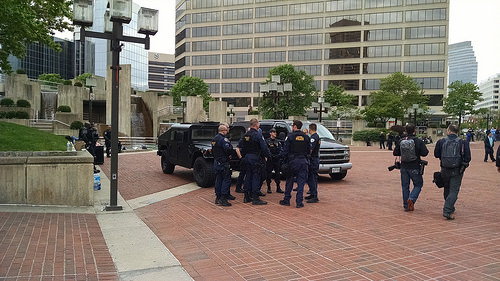
Police protecting HarborPlace at the  free speech area
of the now demolished McKeldin Fountain in May 2015 (Photo: Kim Stark)

The solution to scarcely populated public spaces in Baltimore is not a strategy of reduction which bans or further discriminates against the less fortunate. Instead, what is needed is a strategy of addition: More people, more uses to make spaces inviting and safe for even more people to go out into streets, parks, and plazas.

Although neither Jacobs nor Lefebvre talk about it, I would suggest to add the theory of the tipping point. The obvious conundrum that empty spaces would benefit from more people, if there only were sufficiently many people to begin with, requires a dynamic view in which a system is fueled with energy until it tips into a self feeding positive feedback loop. To achieve such a tipping point, a lot of things have to be calibrated just right. One of them is the right balance between control and freedom. Another is a redirection of resources away from the big projects which create even bigger dead zones such as a Convention Center. Full focus on reviving depleted Baltimore neighborhoods would most likely create the critical mass needed to fill Baltimore's public spaces and make everyone feel safe.

Klaus Philipsen, FAIA

See also  see part 1 of this article