Monday, February 4, 2019

What is going on with Port Covington?

There were days when Marylanders could imagine Kevin Plank next to Steve Jobs, Mark Zuckerberg or Elon Musk. At least those who root for strong leaders and believe that economic development is tied to big business. Plank managed to grow his company in a nearly exponential way for twenty years and create a brand loyalty matching that for Apple, at least locally. In various articles on this blog it was discussed if Plank was a Baltimore Medici (Do Cities Need Sugar Daddies?) or if he could even solve the affordable housing crisis.
Local brand pride: "Protect this House" (Photo: Philipsen)

The winds have changed and with it the opinions about those heroes of innovation, disruption and refreshed capitalism. "Pride comes before the fall" is a German proverb that I grew up with and heard many times. A puritan Calvinistic dogma of not getting too uppity, because after the rise would, inevitably, come the fall. But isn't the American risk taking can-do attitude a lot more attractive than Old World admonitions not to stick your head up too far?

Still, all the heroes of the innovation industry now have egg in the face, from Zuckerberg to Musk, and, of course, also Plank.  Gone are the days of spending money on anything along the way, from horse racing to whiskey distilleries, from fish houses to luxury hotels, and from a maker space to water taxis, and a 30,000 sqft home in Baltimore County. Not to mention a new corporate headquarters surrounded by a $5 billion new town designed to make Nike look old. The  LinkedIn page of the CEO of Plank Industries, Tom Geddes, still exudes that optimism:
Plank at the height of his reputation
Plank Industries is a privately-held investment company with diversified holdings that include commercial real estate, hospitality, food and beverage, venture capital and thoroughbred horse racing. The company is based in Baltimore, MD, and serves as the family office of Kevin A. Plank, the founder, Chairman, and CEO of Under Armour, Inc. Key investment holdings include Sagamore Spirit and a major equity stake in the Port Covington redevelopment in South Baltimore. 
Geddes still sounded giddy in 2017 when Curbed quoted him as saying: 
“We haven’t done this in a transactional way; we consider this development fundamentally important to the city. What the team has put together is so significant, by the time it’s done, it won’t be thought of as the Under Armour project in the same way it’s thought of today.” Tom Geddes
Plank contrite: Responding to shareholders (SUN photo)
But later the same year Plank  told the Wall Street Journal."2017 sucked".
To assure his shareholders he had to tone it down and emphasize that his focus is on the company and not his private investments.

Now in 2019 it has become much quieter around the transformative Port Covington development; the "we build it together" commercials have long disappeared from the airwaves. It has become also quiet around the brand and its leader who in earlier days had issued inspirational pamphlets such as the Under Armour "bible" ("Protect This House - The Under Armour Code of Conduct") and had inspirational slogans printed on any available office wall.  Gone are the interviews with media from around the world.
The four pillars of greatness:
Make Great Product. Tell a Great Story. Provide Great Service. Build a Great Team. (UA Code of Conduct booklet)
At times of adversity, some of the hype and hyperbole which American media like to spin around corporate heroes can turn into assaults on their character in the way of the WIRED article about Elon Musk this month titled "Dr Elon and Mr. Hyde".
Under Armour auditorium in former
Sam's Club (Photo: Philipsen)

Proverbs and the media turn-around would be entertaining enough, were it not for the fact that communities and employees depend on the success of the disruptive companies and their celebrity leaders. The City of Baltimore hitched its wagon firmly behind the Plank horse. How much so is illustrated by the numerous events for which the Mayor and the City Council had appeared at Sagamore Development. It was also exemplified by the City doubling down on Port Covington for the failed bid for Amazon HQ2.

Port Covington was presumably the ready made bed into which Amazon could simply drop and rake in the entitlements and the big tax increment financing (TIF) benefitsWisdom on the street is that Amazon didn't select Port Covington and Baltimore because of crime, poor schools and insufficient public transport. But the reason was likely much simpler. Amazon's Bezos never wanted to rescue a struggling city, never intended to be economic development and always wanted to go where everybody else would also go. Without the glamour factor Kevin Plank brought to Port Covington while his brand was shiny, the spot looks rather sad.

In Smalltimore it is very difficult to get hard facts. Many real estate deals happen on a level of high secrecy which even the Baltimore Development Corporation BDC or well connected commercial real estate players can't quite penetrate. Which pieces of real estate are "on the market" and why? Is the Westport land sold or are Plank Industries looking for a $50 million equity partner? Who has signed leases for what in phase 1? Those who know don't want to reveal anything about the big players, especially not Under Armour and Goldman Sachs, the saviors that were supposed to lift this city out of its pessimism and inferiority complexes. Even if now under headwinds, they can still hurt you if you don't toe the line.

Who builds Port Covington? (WYPR photo)
In spite of that,  a few facts are well known:
  • No bonds have been issued for any part of Port Covington even though we are far beyond the construction begin anticipated in the TIF application (phase 1 in 2017).
  • Instead of expansion and a new campus UA is in the news for layoffs and contraction.
  • The private 35,000 sf Plank mansion to be constructed in Greenspring Valley has been put on hold
  • No new grant application was filed for the planned light rail extension into Port Covington.
  • Plank Industries which had invested in the Foundery maker space, taken a financial stake, and brought it into its own City Garage let the organisation "run out of runway before it was airborne" (Foundery CEO Jason Hardebeck to Baltimore Fishbowl)
  • The voice of Port Covington is no longer Kevin Plank or Tom Geddes but Marc Weller
The much touted community benefits agreement for the surrounding six communities called SB7 (Port Covington counts itself as one of the communities making it seven) would be a good bellwether. If the Port Covington project would be in trouble, the communities would likely feel the effects. The chair of the SB7 board, Michael Middleton who is also the executive director of the Cherry Hill CDC told me that the communities wondered about the future themselves. Inquiring about it,  they were told last year that whatever difficulties Under Armour may have, that there will be no effect on the community benefits agreement. Middleton says that so far "they have lived up to the agreement". He cited as examples the $50,000 grants that were dispersed to each community in two chunks in 2017 and 2018, the completion of a SB7 Strategic Plan and the ongoing technical assistance they keep getting including trips to a Purpose-Built Communities conference in Atlanta paid by Weller Development and the subsequent designation of Cherry Hill as a Purpose Built community two weeks ago.

Early this year, Weller Development is expected to fund a "Lego room" for early childhood support in the completed 21st century ES/Middle school in Cherry Hill. "Trust is so important", Hamilton says, explaining how Weller Development contact Alicia Wilson, Senior Vice President of Impact Investments, continues to play a key role in this trust. (She was just featured in Forbes). He continued "we [the six communities] have come together, we are now working together on all aspects of community life...this would never have happened without Port Covington".
That big investors, on which the City had pinned a lot of hope, fall on hard times is nothing new in Baltimore. Nor is it new that the details of the fall receive much less media attention than the rise. There was little specific info to be had when Bill Struever fell from his local hero status in the Great Recession when his, until then successfully expanding development and construction company Struever Brothers, Eccles and Rouse, went under. Or when developer Pat Turner fell from the lofty heights that brought Baltimore the first million dollar plus penthouse in Silo Point and later Baltimore's first big Middle Branch dream: Westport, envisioned as a new waterfront development with 2,000 residences, a 65-story skyscraper, offices, a stadium, a beach, a kayak launch area and running paths. Then, in a blink it was gone in foreclosure. (Plank Industries picked the cleared land up shortly thereafter). Struever and Turner have been staging a come-back lately, proof that scrutiny during the downfall can be risky, especially when fate of the City is so woven into their business. But no developer had ever been engaged in a community benefits agreement of the size of Sagamore's SB7.
Port Covington history as a coal transfer yard 

Little information is percolating outside the nearly impenetrable information management of  Sagamore/Weller Development: The Foundery closing its location in City Garage and planning to move back to Fells Point could be an indicator for bigger change at City Garage, but it is hard to verify this.

Is the fact that no tranche of the $600 million plus TIF has been bonded a sign that Weller's phase 1 development in Port Covington announced last fall is in trouble or further delayed?

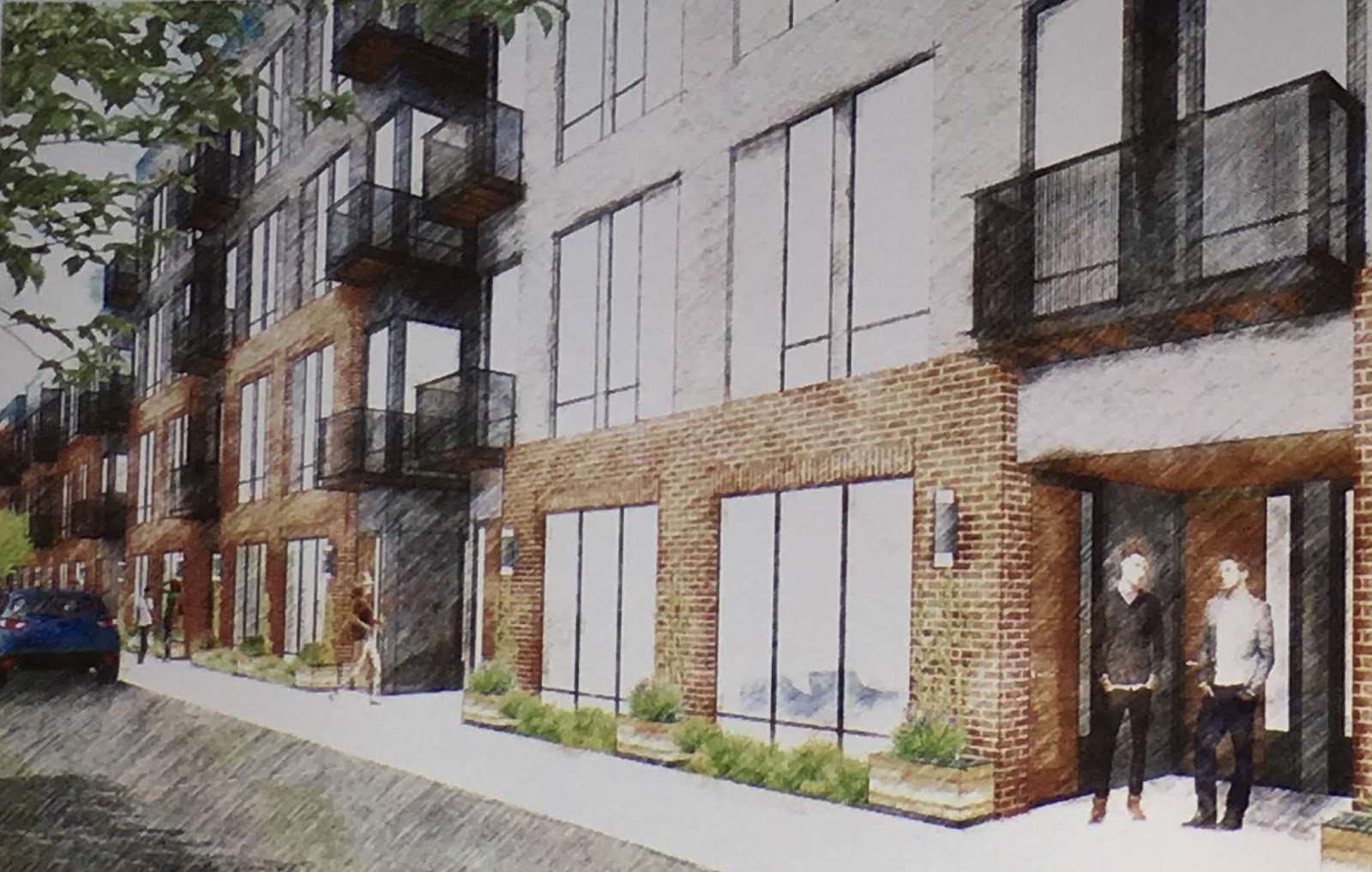
In September 2018 Weller staged a media event showing renderings (here). This was followed  by a coup on October 18, when Weller announced a new twist for Port Covington: "Cyber Town USA". The Mayor and the Governor showed up when Weller Development revealed to have"nabbed" three tenants for a first phase of development on the mostly barren Port Covington lands:
Fulton-based cyber incubator DataTribe and Silicon Valley-born cyber investment firm AllegisCyber have both committed to moving to the South Baltimore project as it begins to take shape. They hope to help establish Baltimore as a global destination for technology and cybersecurity companies — "Cyber Town USA." (BBJ)
Under Armour headquarters rendering (2016 Screenshot)
The move came just in time to quell doubts that anything at all would happen on the massive land holdings of Plank Industries. Since then it has been quiet, too quiet. The fact that no money has been drawn to build roads and utilities nurtures doubts again. How firm are those commitments to lease in the Rye Street Market project? The project covers only a fraction of the overall area, but is still quite big: A mixed use complex with loft-style offices adding up to 162,000 square feet, plus a 13,000-square-foot outdoor market and food hall and 50,000 square feet of retail/restaurant space, plus a fitness center, all nestling around the already existing Sagamore waterfront distillery.  The time for build-out was given as late 2020 or early 2021. It seemed not impossible, even without UA as a direct player. Marc Weller can still work with the Goldman Sachs funds of $233 million said to be available for Port Covington.

For the project to become reality in the promised time-frame, design and construction on infrastructure would have to start very soon. Some of the proposed "Chapter One" development uses existing streets,could it mean that no TIF money would be needed? Is a groundbreaking imminent as soon as the ground thaws?
Rendering of phase 1 development "Chapter One" (website)
Goldman Sachs' investment promise came in 2017 when being in the orbit of Under Armour was still guaranteeing some pixie dust. The same isn't necessarily true today. So the October announcement pivoted away from Under Armour and its future headquarter to cyber security as the new driver. Each speaker at the announcement offered more hyperbole than the other:
“This will be the corporate headquarters of cyber innovation in the United States,” Bob Ackerman, AllegisCyber founder).
“The impact they will have cannot be overstated, some of these highly respected businesses are leaving Silicon Valley, which is thought to be the nation’s tech capital, in order to become part of something new and exciting. … With these companies on board, Port Covington is on course to become the first-of-its-kind cyber ecosystem.” Marc Weller, president and founding partner of Weller Development, as quoted in the SUN)
“Maryland has the largest cybersecurity employee population in the United States. We have the oil, the cyber-oil.” Mike Janke, co-founder of DataTribe
“Today, we are setting the tone for the great future of Port Covington, more innovative, pioneering companies for Baltimore, which will help to further establish Maryland as a national leader in technology and as the cyber capital of America.” (Governor Hogan)
The Foundery in UA garb at City Garage 
As usual, the proposed development was cast as nothing less than a "national model".

The 2018 idea of turning Port Covington into a world cyber hub is reminiscent of Bill Struever's turn of the century dreams of a "Digital Harbor" for which Tide Point was supposed to be the North Star. There is a lot of irony in how reality unfolded:

The dot.com bubble burst and Struever's Tide Point, of course, eventually became Under Armour headquarters. The shift from digital to apparel is still a great Baltimore success story and an example of a good use for an old factory, but it certainly wasn't planned that way.  What could be next?

With UA's lay-offs and contractions, the sprawling former Proctor and Gamble campus seems no longer as crammed. A much bigger new headquarters at Port Covington seems off the table for the foreseeable future. In other words, the question is, can the new town of Port Covington succeed without its flagship, Under Armour, as the trail blazer?  Can anybody market 13 million square feet of office, residential, retail and maker space with 40 acres of public parks on the waterfront without UA's new campus as the magnet? Especially in a time when it is more than likely that the red hot real estate market will contract? Can "cyber" once again be an engine that yields unforeseen results?
$5billion, 13 million square feet: Is there any need? 

This question should give Baltimore leaders sleepless nights, even though, so far, little public money has left City coffers for Port Covington. "The City is protective of it’s money – no bonds have been issued and the project will be well scrutinized", Kimberly Clark, Executive Vice President at BDC told me upon request. As it stands, nobody likes to scratch the already fading dream of the big economic engine named Port Covington. City leeaders believe in the professional integrity of development team and that the latest cyber dream is based on hard commitments.
Slogans at Under Armour's Sams Club
building (phto: Philipsen)

Nay-sayers and pessimists are numerous in Baltimore. Not everyone has bought into the notion that Port Covington could save Baltimore or even the surrounding communities. Not even after the record community benefits agreement had been signed. Cynics have poked fun of the Port Covington plans all along, never believing that Baltimore could pull off such a thing. Many people who lived most of their lives here love their city, but also harbor a deeply rooted skepticism around what is possible in Baltimore. The continued sub-par performance of Baltimore compared to most peer cities seems to prove them right.

There was something very inspiring about the fact that with Kevin Plank (and before him Bill Struever Pat Turner and others who didn't grow up here) there was someone who trusted the capacity of Baltimore and its people so much, that hundreds of millions of investment seemed fine. It was inspiring to see plans that were ambitious and stretched the envelope, using the best available practices and accommodating the common good with trails, open spaces, parks and even a new transit line. But except for a few bike paths and waterfront trails, the distillery and City Garage, all remains just an aspiration to date. Even if the cyber companies will actually come, how can the promised high standards of design and development be assured?

The notion that exceptional things can be done in Baltimore should persist. But deep down everyone knows, what this city really needs, is less physical and must focus on people instead. Investments of all kinds are needed als in in communities further away from the water. Better health, more security, better education, more equity, more access.

The SB 7 agreement ties physical and human development together. Cities are not zero sum games and a growing tax base is especially needed in Baltimore. Glitz and investment in communities is not necessarily mutually exclusive. That is why the communities surrounding Port Covington still hope for success.

Klaus Philipsen, FAIA
the article has been updated and corrected in various places

Westport sells for $6 million (Baltimore SUN Jan 28, 2015)
Kevin Plank's Sagamore amasses more land, this time in Westport (Baltimore SUN, July 10, 2015)

Tuesday, January 29, 2019

Scooter regulations: A tempest in the teapot

In a city beset with big almost intractable problems, the happy-go-lucky electric scooter users have once again fetched the limelight on page one of the paper and become a headliner in the local evening news. The occasion? Bill 19-0324 introduced by Council President Young on behalf of City DOT to give DOT "enabling power" to issue regulations, fees and permits for the operators of scooters and bikeshare. The bill comes in anticipation to the end of the 6 months trial period in which dockless scooters and bikes were allowed under certain conditions in Baltimore.  How would such a dry affair get so  much interest?
Councilman Dorsey tweeting about the scooter tempest

Included in part 4 of under "penalties and enforcement"  the draft bill, which was introduced this Monday at City Council, includes  language which threatens "any person" violating any of the provisions of the bill with a misdemeanor with, on conviction, would result in a fine of maximally $1,000 or 30 days in prison.  The SUN headlined their first online article: "Baltimore officials propose 30-day jail terms for riding electronic scooters too fast". (Later versions and the print edition toned this screamer way down).

DOT immediately clarified, that the language was intended towards the operators and not the riders and that the rider section of the bill enumerates fines of $20 for unlawful operation or parking. The bill will go through three "readers" in the council, plenty of opportunity for the error to be fixed. The City Council President made it clear that he doesn't like the criminal provision, (“I don’t want to criminalize any more citizens in Baltimore,” he told WMAR), he is also no fan of scooters. "Some people like them, I don't" he said on WBAL. "I'll keep why to myself", he continued, but then gave the reason as "There are various criminal activities that's associated with some".
Council President Jack Young on the evening news of  WMAR 

Such a negative attitude isn't necessarily the tenor of the draft bill. Overall it is an extension of the rules spelled out during the trial period with various modifications:

  • the bill would allow not only 2 but up to six providers of dockless vehicles
  • the bill would allow not only 1000 vehicles per vendor but up to 12,000 vehicles total
  • it limits speeds to 15mph (some scooters are currently reaching 17mph)
  • allows sidewalk use where speed limits on adjacent roadways are higher than 30mph but requires that on the sidewalk scooters go no faster than 6mph
  • increases the fees charged on vendors from a flat rate per vehicle per day to a 10 cent "excise tax" per each rental payment)
I had asked Baltimore City shared Mobility Coordinator Meg Young last week about the future of scooters in Baltimore beyond the pilot program which ends at the end of February. She mentioned the upcoming bill and stated that the trial would be extended until the Council had voted on the enabling legislation. Asked whether DOT feels that there has been sufficient public input regarding the pilot program she pointed to the Dockless Vehicle Committee that had been created to advise DOT and had met six times to discuss details. When I asked what effort had been made to include actual users  Ms. Young pointed to the online survey and the around 5,000 responses DOT received. ("More than surveys in DC and Seattle"). When initial responses didn't seem to represent the population properly, DOT reached out to Coppin and Morgan universities as well as AARP to extend the responses to the survey. My inquiry happened well before the bill was made public and the tempest about the fines. Today Councilman Ryan Dorsey tweeted  "In months of meetings of an ad hoc group to come up with this scooter bill  there was not one young black voice in the room, even though black teenagers seem to make up a significant part - maybe a majority - of users."
BC-DOT Dockless Vehicle webpage

The upheaval about the scooters must be seen in the Baltimore context, where the overall transportation system is still very car-centric, where congestion and air pollution are high, where commute times for transit are too long, where transit is still performing below expectations and where on most streets almost empty sidewalks show that walking isn't a popular option of getting around. Additionally, the initial docked bikeshare system failed, even though it was introduced here long after other cities had already learned their lessons. A city where the installation of protected bike-lanes was long torpedoed by the fire department and are hated by merchants who fight for survival and think they need every single parking spot in front of their stores. This is a city where high crime rates instill fear in suburbanites so they frequently don't dare to walk even downtown beyond the minimum necessary to get from the car to the workplace.  Squeegee kids and young black people on scooters easily bring the stew to a boil and unpleasant perceptions and racism to light. In this volatile setting Jack Young's comments about crime on scooters just validate stereotypes without serious data back-up. 

The proposed legislation (once the penalty error has been fixed) seems like a good balance that recognizes issues on both sides of the matter. Of course, it is a question how the 6 mph on sidewalks would be monitored, how fines would be administered (since riders don't have to carry ID) and whether the "excise tax" is too high.  No doubt, those questions will be and should be asked in the upcoming council hearings.

If in doubt, the City should make use of these scooters less onerous and not more. Baltimore needs something that is fun, something that tips the balance towards transportation that is not a car and towards the preferences of younger residents who are the future of this city. 650,000 rides in the time since scooters first showed up in Baltimore in July 2018 certainly indicates that people are using them. 

Klaus Philipsen, FAIA 


Friday, January 25, 2019

Ride-share: Heaven or hell for Cities? Here Lyft's numbers for Baltimore

American transportation technocrats lately have thrown water over the initially raging fire of excitement about car sharing companies which they have dubbed Transportation Networking Companies or TNCs.

For a while everyone saw TNCs as harbingers of a future in which cars are shared and eventually being automated. As a result cars would need much less space in cities and open up a whole new urban renaissance. The new generation of "millennials", which gave the concept of car sharing a boost, would abdicate the self-owned SUV, use small urban apartments without garages and would hop on Uber or Lyft after a transit ride in order to cover "the last mile". The option of using one's own car to drive commercially would give hundreds of thousands of people a space in the "gig economy".
New Lyft Report: Not necessarily a deeper story

Recent studies in large cities such as San Francisco and New York showed a different story. Instead of reducing car travel, TNCs added to congestion. Instead of being complimentary to transit they started taking a significant bite out of the already shrinking transit apple.

170,000 vehicle trips are made by TNCs within city limits on a typical weekday, which is about 15 percent of all car trips, and 9 percent of all trips, across different modes.(San Francisco

Additionally, various leadership missteps at Uber have shed a light on car share drivers as a new class of exploited people and elevated especially Uber into the loathed class of global operations which steal our data. Uber's problems helped polish the smaller competitor Lyft's standing, but both companies are now no longer small start-ups but international corporations with an image problem.
Baltimore Lyft website
Lyft was founded in 2012 by Logan Green and John Zimmer to improve people’s lives with the world’s best transportation, and is available to 95 percent of the United States population as well as select cities in Canada. Lyft is committed to effecting positive change for our cities by offsetting carbon emissions from all rides, and by promoting transportation equity through shared rides, bikeshare systems, electric scooters and public transit partnerships (Lyft website)
This week Lyft published a nationwide report to polish the brand. Not surprisingly, according to Lyft, the news are good for cities, for drivers, for riders and for transit. Lyft, initially with a mobile app that wasn't as convenient as Uber's, has not only matched the competitor's app but has recently pulled ahead in innovation by introducing those little glowing dashboard flip signs that make Lyft cars recognizable anywhere and through color coding allow riders to identify their own in a place where many rideshare vehicle pull up at the same time like at events or airports.
Baltimore Lyft driver statistics

The online Lyft report is interactive and can be tailored to specific states and cities, including Baltimore. It is based on surveys of 30,000 riders in 54 cities taken in 2018. The report also gives numbers on "economic impacts" on local businesses and restaurants. As any economic impact analysis, those effects have to be taken with a grain of salt.

More telling are the numbers about drivers and riders. For example, that 90% of drivers use driving only to supplement other work and drive less than 20 hrs a week or that 65% of drivers in Baltimore identify themselves as "minority", a pretty good reflection of the population overall.

Counter to public perception and traditional taxi driver demographics, 39% of Baltimore's Lyft drivers are female, compared to 27% nationally. Nationally 35% of Lyft users don't own a vehicle (43% in Baltimore). As far as Baltimore, Lyft maintains that it doesn't take away transit riders but increases transit ridership by 5%. (it derives that claim from another study which it cites as its source. Interestingly, that source actually studied Uber's impact on transit). 46% of Lyft riders take transit at least once a week. In Baltimore 58% of all rides begin or end in low income areas. (44% nationally). According to Lyft Baltimore, the most sought out destinations are R-House, Sagamore Pendry and Lexington Market. Indeed, a very diverse set of destinations.
Baltimore Lyft rider profile

The new national report is easy to read, interactive, and full of simple statements but poor on actual data sources or methods (at least on the public facing side). No PDF with the data background is available on the main website.

The strategy is effective. Already business journals across the country report the happy numbers which will, no doubt also heat up the tweeter-sphere.

Klaus Philipsen, FAIA


Tuesday, January 22, 2019

Clipper Mill: Additional development plans revealed

Tonight the Clipper Mill and Woodberry communities will hear about two additional projects on the Clipper Mill campus. Here some details about the projects:

Clipper Mill history 
The 17.5 acre $88 million transformation of a defunct industrial site dating back to 1850 into a model of historic preservation, sustainability (including the nations presumably first green wall) and transit oriented development (TOD) opened in 2006 under the name Clipper Mill. By all accounts, the redevelopment was a huge success. 13 years later, its restaurants, studios, offices and residences form a vibrant community that has become a regional destination and a must see demonstration of authentic redevelopment of brownfields in an industrial legacy city.
Clipper Mill site plan (Cho, Benn Holback Architects)
The Urban Land Institute published the development as a successful case study. ULI described the Clipper Mill development this way:
[...] a long underused 17.5-acre (7.1-ha) site that once housed Maryland’s largest and most productive machine manufacturing complex into a vibrant, mixed-use community. The development team reused the 1853 historic site and its five deteriorating buildings to create 61,500 square feet of office space, 47,500 square feet of studio space for artists and craftspeople, and a wide range of housing, including 34 townhouses, 38 semidetached houses, and 62 condominium and 36 rental apartments. [...] Clipper Mill is a transit-oriented community that integrates many elements of sustainable development. It offers a unique sense of place that is created in part by the preservation of the site’s history and the incorporation of the work of resident craftspeople into the project’s design. [...] SBER wanted to provide safe, code-compliant, and affordable studio space for resident artists; preserve the charm of the historically significant site, which contained five buildings in varying states of disrepair and convert the complex into a viable mixed-use community that would attract families from outside the city of Baltimore. Its goal was not just to rehabilitate the property but also to inspire the neighborhood.
Valstone Partners' proposed projects

However, the original planned unit development was never completed. The financial crisis and the downfall of the developer, Struever Bros. Eccles and Rouse intervened. Eventually SBE&R offloaded their development and in 2009 parts fell into foreclosure. In 2017 ValStone Partners, a Michigan-based private equity investment firm, bought the commercial buildings and properties of the Woodberry site and began planning for the remaining gaps. A preliminary study that investigated what could be done on the undeveloped lots  showed hundreds of new apartments, a potential coffee shop and sandwich place, small offices and parking garages. The new density brought neighbors and Woodberry residents out en masse to discuss and question what Valstone proposed. Existing residents and neighbors were especially opposed to repealing the 2003 Planned Unit Development Plan (PUD) in favor of more density.
Aerial of the Clipper Mill site with a view of the Tractor Building
(Photo: Baltimore SUN)

This Tuesday the community will receive an update presented by Caroline Paff, a principal at VI Development, which is shepherding the entitlements for ValStone. The proposed development is limited to just two sites (The Tractor Building and the Poole & Hunt parking lot at 2001 Druid Park Drive. The density and uses are based on the the existing 2003 PUD, even though the underlying zoning was changed as part of the new City zoning code to be a TOD-2, a zoning category that favors density around transit stations. The proposed projects are further developed from the feasibility study presented in 2018, done by Marren Architects who are also retained to be the architect for the Tractor Building in concert with Design Collective. The designers for the townhomes will be BCT architects. Valstone selected two developers as partners for the two projects, Commercial Development for the Tractor Building and Garver Development Group for the townhomes. The sites will be subdivided from the rest of the Valstone holdings.
Valstone considers the properties in Clipper Mill long term investments. [..] Valstone understands the significance of the clipper mill aesthetic and is prepared to invest in a plan that preserves the tractor building. The plan is keep the building and remove the old roof and rear wall to enable redevelopment (Paff)
No use of historic tax credits or any other public funds is planned, Ms Paff told Community Architect Daily upon request.
Potential Valstone development parcels in green
(Site plan as shown at 2018 meeting)

The development plans foresee approximately 99 apartment units, between 140 – 155 parking spaces, and a small amount of street level commercial space for a 6 story tall redevelopment of the Tractor building with one level of below grade parking. For the Poole & Hunt lot 48 rental 2-3 bedroom townhouses are envisioned, three and four stories high. The total square footage is to be about 48,000 s.f. The proposed developments are far less than the 336 units that were discussed in prior meetings, but they also do not include all potential development parcels.

VI Development states that the development team hopes to start construction for the townhomes in the fourth quarter 2019 with about 15 months until completion and that construction on the Tractor Building could start a year later, estimated to take 16 months to complete.

At a community meeting at Poole & Hunt building on the Clipper Mill site Caroline Paff opened the meeting and had the two development and design teams present the concept plans for the Poole and Hunt parking lot site and for the Tractor Building. The site plan is done by Colbert, Matz and Rosenfelt, Carla Ryon explained the subdivision plan associated with the development. For BCT architects Bob Gehrman explained the townhome design and for the Tractor House architect Martin Marren and Design Collective's Mike Goodwin took the floor to show their four story building inside the building concept. The plans showed a completely new apartment building on top of two parking decks installed in the old shell. The new walls will be around 5-8' set back from the existing walls but will receive light and ventilation through the large opening of the existing Tractor Building facade. Design Collective is using a similar approach on the former Hendler Creamery project in Jonestown on East Baltimore Street.

"The Tractor Building" needs "a longer runway" (Paff) and has less developed concepts to date. The townhomes will be presented at the UDAAP meeting this Thursday at 2:30pm right after a presentation on the design of the Woodberry Station right around the corner on Clipper Mill Road.

The meeting was attended by far fewer community members than the one in the summer of 2018. Except for some concerns about traffic and the scale of the proposed townhomes vis a vis the existing houses there was little discontent. Caroline Paff observed "this was the fastest Clipper Mill meeting in history". Below some of the images that were presented.


Site plan showing lot lines and outline the VS properties

Overall rendered site plan showing in green the forest conservation area

A massing rendering showing the townhouse development (BCT Architects)

Site location plan for the townhouses (BCT Architects)

Basement parking level for Townhouses (BCT Architects)

Section showing existing houses on the right and Clipper Mill buildings on the left
(BCT Architects)

Eye level view of the townhomes 

Rendering illustrating the intended materials  

West elevation of the Tractor Building  (Marren/Design Collective)

Tractor Building: Rear wall to be removed (Marren/Design Collective)

Tractor parking parking level and corner retail (Marren/Design Collective)

Tractor building, apartment level  (Marren/Design Collective)

Tractor building section  (Marren/Design Collective)

Tractor Building, street level front view (Marren/Design Collective)
Klaus Philipsen, FAIA

the article was update 1/23/19  to include the meeting presentation and images

Baltimore Fishbowl reported about the developer selection
Baltimore SUN reported about a community meeting in August 2018


Friday, January 18, 2019

Shopping in Baltimore remains a challenge


There is a lot of irony in that Target and Marshalls should shut their Mondawmin stores. Not that the country wouldn't be hopelessly over-retailed in light of a diminishing demand for brick and mortar stores. Not that big boxes and malls are closing all over the country. The US has about 5 times more retail area per person than Canada or Europe. But Baltimore actually continues to suffer from being under-retailed.
Struggling Mondawmin: The new Planet Fitness won't cater to shopping
needs (Photo: Baltimore Sun)

In spite of a fairly high population density and aggregate purchase power, retail in Baltimore is scarce. Attractive and modern retail can basically only be found at the periphery in places such as Canton Crossing or, in an older less up to date version, out on the historical radials such as Reisterstown Road. A copy of Canton Crossing is planned as Yard 56 in Greektown and a redo of the Northwood Plaza by the same developer is also in a non central location and based on a typical suburban strip center layout with parking in front.

Real urban shopping like at the Gallery Place at the Inner Harbor and the stores of Harbor Esst remains rare, and hardly serves typical daily needs. The shops at the Inner Harbor and along Pratt Street struggle and rarely stick around for long. Even the ubiquitous drugstores don't always stay in the strategic downtown spaces as the closure of the Rite Aid at Howard and Lexington proves. In 2011 the Baltimore SUN was hopeful:
Shuttered Target at Mondawmin (Photo: BBJ)
"Downtown is ripe for additional expansion for retail companies that at one point dismissed coming into the city," said Mark Millman, chief executive officer of retail executive hiring firm Millman Search Group. "You'll continue to see more and more of this all over the country. Retailers are looking at cities closely as major profit areas."
Some retailers are expanding amid the recovery, and for many, urban sites are in high demand. Long after suburban retailers began tapping into urban markets, cities such as Baltimore still find themselves underserved in some areas, experts say. (Baltimore SUN)
Online shopping, robot delivery: Kroger test Phoenix AZ
But in spite of an ongoing recovery since 2011, Baltimore's retail never saw a really convincing wave of retail seeking out downtown as a "major profit area". Large parts of Baltimore continue to have trouble finding a decent full service supermarket and for the popular national chains like Target residents have to travel all the way to Canton, a place much more difficult to reach than Mondawmin Mall with its transit center and subway station. While several "main street" commercial districts such as "the Avenue" in Hampden or Eastern Avenue in Highlandtown see a certain renaissance, it remains difficult to find standard articles like hardware, office supplies, kitchen needs, furniture or toys in the city.
McKenzie market data 2018: A scarcity of useful data

In this complicated situation the historic downtown retail center known as Market Center is trying to define its future. It shouldn't be too hard to support retail with so many new residents in Baltimore's "fastest growing neighborhood" (Downtown Partnership slogan) and the large inner city neighborhoods to the west nearby. But retailers remain skiddish and the local offerings remain very heavy on barber and beauty shops or places selling luggage. That this doesn't have to be this way, has been pointed out by the Urban Land Institute when they were called to provide suggestions for the Westside in 2010. The national experts pointed to Cincinnati and its Over the Rhine area as a good precedent on how to revive an ailing historic retail area. In a visit not too long ago I found a bustling district full of shops and restaurants, mostly local specialty store, not national chains in an area that at the turn of the century looked much like Howard Street.
Retail on Howard Street (Photo: Philipsen)

As I have described in previous blog articles, the Cincinnati turn-around was the result of a big investment initiative in part fueled by  local corporations, an approach that is eyed with suspicion by many local activists. The new Opportunity Zones with their designated federal and state funds may make a difference. Baltimore has certainly designated a record number of those zones. But critics have already pointed out, that via the promised tax credits most of the money will go into the pockets of investors and will not necessarily fuel local entrepreneurs such as storekeepers.

As the national retail scene develops, it may well be that amidst online shopping, robot deliveries and failing malls the small, local, walkable urban storefront with the friendly owner behind the counter providing human based service will be the format that is most likely to survive.

Klaus Philipsen, FAIA

BBJ: Yard 56 article
Kroger CEO: Harris Teeter acquisition was a preemptive shot at Amazon
Harris Teeter has been expanding across the Baltimore area and its local stores include Locust Point, Canton, Severna Park, Columbia and Ellicott City.

Friday, January 11, 2019

Share what you think about those dockless bikes and scooters

Even though their real impact on the regional transportation problems is minimal, dockless scooters have captured a large portion of the national discussion about transportation, about cities and about the sharing economy. (For am overview see here). Even  Rolling Stone took notice: From Toy to Thrash: How Scooters Are Becoming Millennials’ Extreme Sport of Choice.
Latte sipping, helmet free scooter zipping on the sidewalk: Not the whole story

And as it has become common, unfortunately, two seeming irreconcilable camps have quickly formed, those who love scooters and those who hate them. In whatever city one travels in the US and increasingly also internationally, unused scooters are cluttering sidewalks and happy scooter riders are zipping around, all too often in the streets against the traffic or on sidewalks stealthily and silently approaching from behind whisking by sometimes within inches of the walking public.

The debate mirrors most of the usual opinion blocks. There are those who want more regulation opposed to those who hate regulations, the young and the old, the able bodies and the ones with impairments, the ones who care about the environment and those who don't want car driving any further impeded. But the battle lines in the equity debate have become more complicated. Unlike in the earlier debates about bike-sharing, the scooter discussion is less racially charged because, unlike bicycles, the scooters have quickly been accepted by young people of color  and their use has penetrated well into the disenfranchised and disadvantaged communities; possibly this, in turn, has hardened the scooter opposition of suburbanites riding into town in their cars.
Old docked bikeshare is out, at least in Baltimore (Photo: BBJ)

Meanwhile new arguments are pouring in, injury reports from emergency rooms attributed to scooter crashes, reports about the near monopoly of one scooter manufacturer in China (Bloomberg: Almost Every Electric Scooter in the World Comes From This Chinese Company) and increasingly experience with scooters that don't operate properly. Not surprisingly, the lawyers are just waiting to pounce. Plenty to sue about: How do scooter companies enforce the rules that their vehicles are to be used with helmets, not operated by anyone under 18, not be operated on sidewalks?

Regulators in Cities are right behind the lawyers. Some cities have banned scooters altogether, some declared them motor-vehicles and others, like Baltimore take a wait and see attitude. Actually, Baltimore's DOT isn't entirely hands off. They provided the share companies of Lime and Bird temporary licenses with a maximum number of vehicles, fees per scooter and bike, a requirement to share data,  and certain obligations for facilitating access to the poor. (Details can be found on BC-DOT's website here). The pilot will end in February. In 2018 649,343 scooter rides were logged (starting August 15) and 4,635 Lime bike trips in December alone.
Bird and Lime scooters are permitted in Baltimore

Baltimore City, led by DOT, has launched a Pilot Program for shared dockless vehicles which will last from August 15,2018 until February 28, 2019.  These vehicles can include bicycles, e-bicycles, and e-scooters which are available to the public for rent. At this time there are two companies who have entered into agreements to operate during the pilot period (website)
In an effort to tally up experiences in Charm City, BC-DOT now wants your opinion and launched an online survey in which users and non-users, lovers and haters alike can voice their opinions.  The four page survey can be found here. No matter where you stand, take the survey before it is too late (the survey closes on Jan 20) and the City will decide whether to extend the program.
Dockless Lime bikes also have electric power. (Photo Stephen Babcock)

The scooter debate doesn't have to be all or nothing and using dockless vehicles doesn't need to become a regulatory nightmare either. Scooters could easily become safer and more comfortable with bigger wheels that don't get caught as easily on Baltimore's rugged streets, more protected lanes should be provided so scooters don't have to be used on sidewalks or amidst of cars and trucks and visibility could be increased with better front and rear lights. The companies could be forced to do better maintenance and better collection of damaged scooters. Nothing is more annoying for haters and lovers alike, than damaged scooters which litter the sidewalks and can't even be used. So there may be some common ground, after all. And in terms of equity: Dockless vehicle collection and scooter repair provide low threshold job opportunities as part of the burgeoning gig economy.

Klaus Philipsen, FAIA

online DOT survey

If the survey doesn't do your concerns justice, contact Meg Young, Shared Mobility Coordinator Baltimore City Department of Transportation, e-mail for comments: dot-community@baltimorecity.gov


Wednesday, January 9, 2019

Is New Orleans like Baltimore?

After the comparison with Fort Worth was just too much a stretch and, as far as policing, is obsolete now, how about New Orleans? There is a general sentiment in Baltimore, that the Big Easy has a lot in common with Baltimore, in terms of problems, and in terms of attractions.
Baltimore and New Orleans (Data USA)

As has been discussed on all platforms since the Mayor's new favorite police commissioner was announced, NOLA and Baltimore both have had lots of issues with their police departments which brought a federal consent decree to both, to NOLA, in fact, much earlier and possibly for even more egregious transgressions. Both cities regularly rank tops in crime and murder rates. Are there other commonalities?

New Orleans lost a lot of its population as well, although not only in a steady trickle like Baltimore, but through one big catastrophe, hurricane  Katrina which hit the city in 2005.
New Orleans cultural cliche: Music and jazz
(Photo: Philipsen)
Both cities are the largest in their state. Both dealt swiftly with their Confederate Monuments, both have a majority black population, both have now a female black mayor.  Both share high poverty rates.

New Orleans isn't doing as well with job creation as Baltimore, but home values are a bit higher there. Baltimore's metro area is twice as large as that of NOLA and, obviously, the Big Easy sits far away from the nation's capital and has no nearby city to lean on. Baltimore's history has strong German influences, New Orleans' is French. Both are port cities. Both are known for their historic architecture. Both cities know entrenched poverty and an economy that benefits some and leaves many behind. Both cities seem to be perpetually at the crossroads.
New Orleans cliche: The historic red streetcars
(Photo: Philipsen)
As New Orleans approaches its 300th anniversary next year, it ranks as the third-most unequal city in the U.S. based on income gap, according to a recent Bloomberg analysis. The metro economy is adding lower-paying jobs at a faster rate than higher-paying jobs that could build a stronger middle class. The poverty rate in the city remains a staggering 27 percent, twice the nation's rate. [...] minority-owned businesses represent 27 percent of businesses in the New Orleans metro area and get only 2 percent of all revenues generated in the city, according to The Data Center. That 2 percent hasn't changed - nationally, it's 4 percent - despite all of the post-Katrina spending.(The Times-Picayune Sept 21, 2017)
New Orleans cultural cliche: Bourbon Street (Photo: Philipsen)
Of course, the Baltimore Convention Center would be glad if it had the occupancy and conventions that NOLA can regularly attract.  Fells Point and the Inner Harbor attract day tourists, but Bourbon Street and the Mississippi  attract tourists from around the world. In fact, New Orleans residents may find it a stretch to be compared to Baltimore. Yet, they mourn the departure of their police chief and Baltimore leaders are celebratory:
Six weeks ago, I had the opportunity through the Baltimore Metropolitan Council to visit New Orleans and meet Chief Harrison to learn what was working there that may be applied in our City and region.
Within minutes, it became clear that Chief Harrison was the type of leader that Baltimore needed, that Baltimore deserved. He understood the role of a police department to rebuild trust among all as the basis for safer communities. He spoke of the federal Consent Decree reforms in New Orleans as the driver for culture changes that reduce violence. And he spoke of partnerships with human development agencies to reduce crime by empowering people. 
Ethnic diversity, Baltimore and New Orleans (Data USA)

And it has worked. As of 2018 and four years with Chief Harrison at the helm, New Orleans saw the lowest violent crime rates in the City since 1971. They are in the midst of exiting their Consent Decree successfully. And they've restored trust and accountability between law enforcement and the residents of the city. That type of experience and leadership is what our Baltimore Police Department and the citizens of Baltimore deserve.(Senator Bill Ferguson in an e-mail)
Median income, Baltimore and New Orleans (Data USA)
New Orleans is a much less densely populated city and spreads over a much larger area (about twice the land area of Baltimore). NOLA police offers about 3 officers per 1000 residents, Baltimore has 4. In spite of a hefty budget increase in 2018, the NOLA police budget with just shy of $200 million is still less than half of Baltimore's.

Endless rows of boarded houses are uncommon, but 5 years after Katrina the city counted 47,700 abandoned properties, in 2018 there were still 14,700 vacant residences, based on population that is on par with Baltimore.
Sinking vacancies in New Orleans (Report)

Even though it, too had serious leadership problems with a mayor who was indicted and sentenced, the city seems to be less inclined to self loathing as Baltimore's residents, not even after Katrina when the entire state of Louisiana was frequently compared to a third world country. Mayor Mitch Landrieu who followed Nagin was well respected not only in his city but across the US until he left office in May of last year.

All in all, in the end New Orleans may not be all that similar to Baltimore, but unlike Fort Worth it is a city with which we can identify, and maybe even one, we would like to be compared with, at least when it comes to reforming the police department.

Klaus Philipsen, FAIA
Downtown glitz does not spread into all neighborhoods
(Photo: Philipsen)

New Orleans on pace in 2018 to have fewest murders since 
New Orleans Police Chief Michael Harrison leaving to head Baltimore policeNOPD Budget presentation 2019

Also on this blog:
Confederate Monuments: Learning from NOLA?