Friday, February 19, 2016

Affordable Housing and demolition on North Avenue

Woda Development, headquartered in Ohio, has become a hero of affordable housing in Baltimore, especially after the record time re-build of the Mary Harvin Transformation Center with 61 affordable apartments for senior citizens and a community center with job training, counseling for those living with HIV/AIDS and other services after the devastating fire on the day of last April's unrest.

The current conditions of the north side of the 3000 block proposed for the new affordable apartments 
Woda had already completed affordable housing in Penn North, a few hundred feet from where the unrest had started, the 91 unit Penn Square Apartments. And further west on North Avenue, in 2012 Woda had completed  the Gateway South development, affordable units designed by Cho Benn and Holback which I highlighted in a architectural critique as an example that affordable housing doesn't have to be ugly.

Yesterday, Kevin V. Bell, Senior Vice President at the Woda Group was back in Baltimore for the presentation of the Gateway North Apartments, right across from his earlier project in the 3000 block of West North Avenue. The project sitting within view of Coppin University will be 82,000 sf, 41 apartments and a smattering of retail and community spaces.
Proposed Woda Design (Marks Thomas Architects)

UDARP was not entirely smitten by the proposal. They criticized that the two sole demo survivors, previously rehabbed rowhouses were too isolated to be convincing. Panelists requested that the differentiation between the part of the block with retail and the part without should pick up the language of the existing conditions in which the rowhouses are set back from the sidewalk. They suggested that the massing should be broken up to reflect what was successfully done on the south blocks. Especially the two lane drive that takes up almost the entire backyard drew comments. It was seen as a waste of space when a narrower one way circulation system could easily be conceived. Developer Kevin Bell got visibly agitated by some of the suggestions, signaling to his design team members to object.
The south block is broken up with access in the center
While the south-side was built on largely vacant land, the north-side requires demolition of an entire row of dilapidated historic houses and a large villa. The missed preservation aspect of the design got short thrift in the review because the presentation aerial had craftily photo-shopped away what was to be demolished, no historic preservation rules apply here and clearly, the developer didn't want to deal with rehabilitation and single rowhomes or villas to complicate the project supported by low income tax credits.

The two rowhouses were only spared the wrecking ball because they are owned by the City which is also the offerer of the land for this project and were fixed up with City funds. The most significant but dilapidated corner house was suggested to be taken down and replaced by a row of trees to cover up some of the now exposed firewall in plain view when going west on North Avenue. All other structures, including a once fairly splendid villa were not even mentioned, much less discussed.
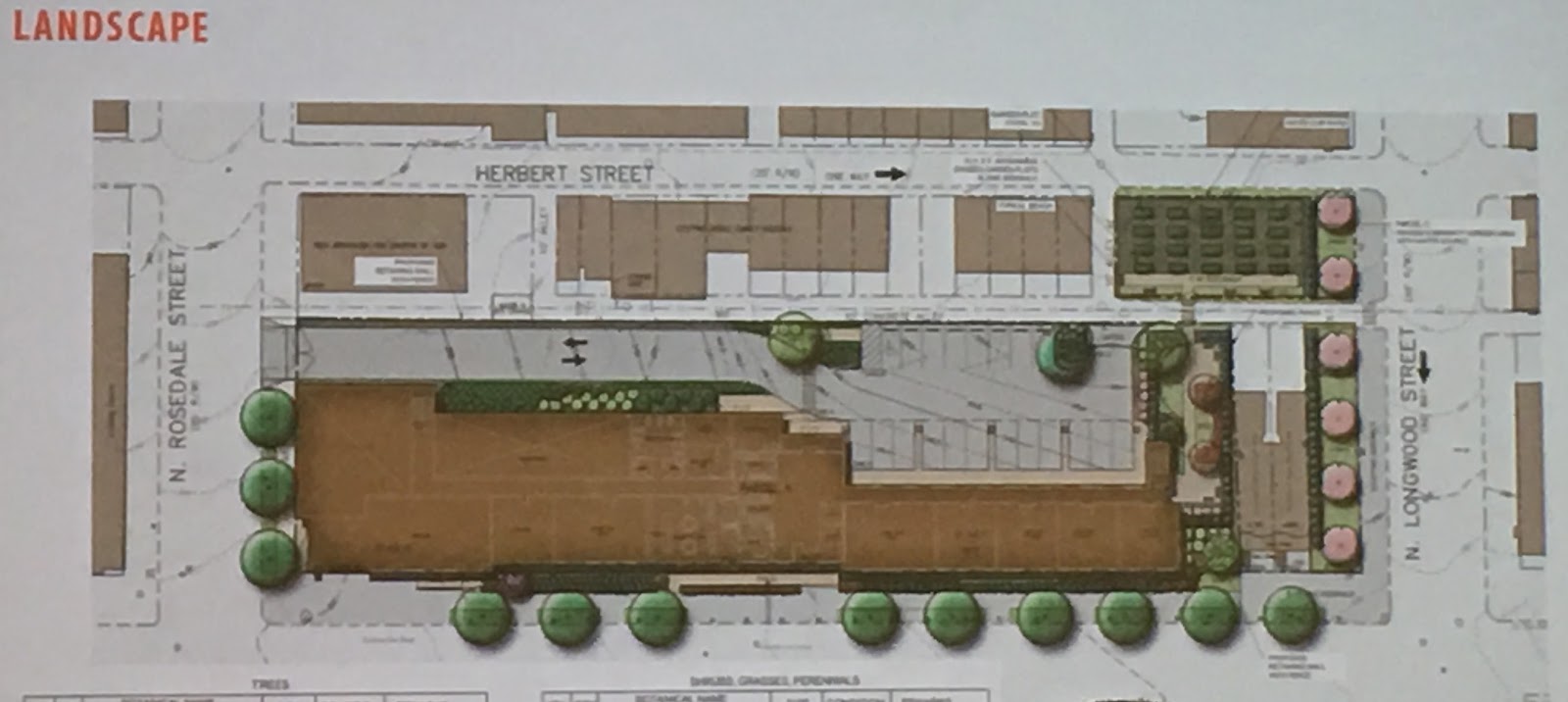
The proposed north block (Marks Thomas)

Sure, the villa is completely devoured by weeds and is not in stable shape anymore, but as everybody knows by now, those buildings can be restored beautifully and can add an authentic note to new construction.

How beautiful would it be to take the corner-house on the east end out of the deal and let HABC find somebody to renovate it and use the villa for the community functions. With all this new demo money flowing into the City, Housing should prove, that demolition is their last resort as Commissioner Graziano never tires to emphasize.

Klaus Philipsen, FAIA

BBJ article about UDARP (subscribers only)

Looking west on North Avenue, Coppin State is not far

Current abandoned rowhouses along the 3000 block are set back

the demolition of this opulent manison was not even mentioned in the UDARP presentation 

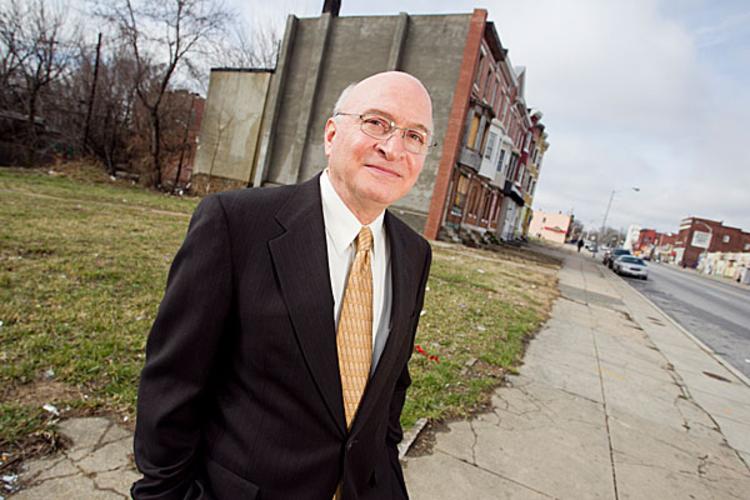
Woda Senior VP, Kevin Bell (Photo: BBJ)


Thursday, February 18, 2016

Smoke and mirrors or a dream come true?

What if a developer would buy a big chunk of land ideally located along a major interstate, next to a thriving historic community and adjacent to a long winding waterfront?

What if this developer would employ a renowned national urban design team to come up with plans for an ideal city that includes everything urban designers currently dream of?

Such as a grid of streets that allows traditional city blocks but has just enough irregularity to make them interesting?
A quirky grid, plenty of open space

What if those roads would relate in "desire lines to visual anchors beyond" the new city?

What if the developer would give the public not only waterfront access but provide a string of parks with it?

What if he would transform a major but bland, non descriptive and car oriented gateway into the larger city into a memorable place with sidewalks and retail?

What if the plan was truly multi-modal with bike and hike trails leading in and out and through the site, with a light rail spur and water taxis?

What if the developer would include adaptive reuse of existing structures and landmarks to achieve or retain authenticity?
a near eye level view of the suggested massing across the water

What if ecology consultants would ensure ecosystem systems which perform in terms of "pollinator routes, bird nesting areas and being community catalysts"?

What if landscape architects emphasized the public realm with amenities and place "moments" into the landscape of habitats, with considerations for water filtration, diversity and resilience and the "cultural legibility of urban systems"?

If traffic engineers would design transit into the plan, protected bike lanes and protected intersections with pedestrian refuge islands, crossing distances and eco-medians instead of performance optimized levels of service for cars? 

In short, if a developer came in and promised to build an entire city designed to the best standards currently available in terms of architecture, ecology and mobility and would do so right here in Baltimore, what should one say? 
Framing views form the street ends at the water with "perches" and
architectural follies (the view west)
Would this be nothing but smoke and mirrors or a dream come true?

Should the response be that it could be the best thing that ever happened and embrace it as much as possible?

Or should one suspect that this is just a bunch of high-paid out-of-town consultants having well rehearsed the vocabulary that is currently en vogue? That whatever would really be built, would not live up to any of these goals anyway; and if it did, it would still not help the poor, the disenfranchised, reduce crime or do anything to diminish the huge rifts we see in our city? 

I am talking about the Port Covington, of course, the new Plank-Town and today's design review session in which the western portion of Under Armour's new city was presented in some detail to the design review board UDARP. What to make of this largest ever privately proffered proposal with its 266 acres and 13 million square feet of suggested development? How should mayoral candidates think about this? How the City Council?
UDARP rejected the idea of a bike ped bridge across Hanover Street

Not that the high-octane design team led by Elkus Manfredi Architects and the developer represented by Caroline Paff, VP at Sagamore Development, intimidated UDARP or make those reviewers be awestruck.

Not at all, the team received a fair share of criticism for aspects of the design they presented.

In fact, the architect, David Manfredi, received the brunt of the critique with the observation that the massing of his buildings wasn't nearly as thought-out as the streets, parks and landscape designs of his consultants.

Hanover Street, as it is re-imagined north of the to be reconstructed bridge, received a good dose of skepticism as well. The biggest gripe: a proposed pedestrian and bike bridge designed to safely bring those walking and biking along the shoreline across Hanover Street. UDARP panelist wouldn't want any of it, truck traffic or not, they wanted a design that keeps pedestrians on the street level and that slows Hanover Street traffic so that safe crossing was possible.
Bike boulevard along the waterfront street

But there is no doubt that these self confident design review responses were informed by the big-picture thinking and the extremely high standards that the designers and the developer have set up themselves.

Planning Director Stosur encouraged even bigger thinking with the suggestion of a tunnel for the through traffic to I-95.

Except for that one suggestion of the road tunnel ("that may be beyond our scope"), the design team and the developer never responded defensively or with the usual explanations why it couldn't be done. The dialogue was truly focused on finding the very best design. That this was a serious attitude, was evident through the inclusion of previous UDARP comments that had already been worked into the concept. 

Only who has observed how this city has moved from hardly having any development to review, resulting in the most modest expectations of being happy with anybody who would build anything anywhere, even if it was a CVS next to the Symphony, can truly appreciate the miracle of what is going on with the Kevin Plank sponsored masterplan.
3-D view of the waterfront boulevard
Naturally, there will be lots of water flowing down the Patapsco River before the plans will be finalized and even more before shovels in the ground will prove that the plans can become reality.

But the level of discourse, the high expectations and the constructive manner of response, these things won't be forgotten, they will have lifted Baltimore to a new place, even if Kevin Plank would walk away from the plan tomorrow.

But the good thing is, that is not nearly as likely as the many other developments that have evaporated would suggest. Under Armour's management has shown that they mean business, various small components of the big plan are, in fact, already underway and their company is on a trajectory of success that is all too rare for Baltimore corporations.
Little love for the skinny median: Suggested Hanover Street interesection

Even without tired platitudes of "the rising tide that lifts all boats" or trickle-down theories often employed to justify developments that chiefly serve the well-to-do, even if one assumes that none of this big development will really solve Baltimore's protracted poverty problems, it still needs to be welcomed that this city is finally shedding the obsession that big things can't be done here. I for my part would advocate for a heavy dose of optimism regarding Plank-Town.

Oh, and yes, at the foot of Hanover Street the architect should really solve the "gateway" issue with a sense of arrival, a gesture of massing and architecture that forms an urban plaza instead of those two strict parallel rows of equal height buildings that currently line Hanover Street in a pretty relentless manner. As far as Hanover Street as a truly urban boulevard, give it a beefy median as UDARP suggested, constant width, no left turns carving pieces out like in a suburb!

But I am pretty sure, that will be precisely what we will see in the next round of design review anyway.

Klaus Philipsen, FAIA

corrected for Caroline Paff's title

all images are screenshots of the UDARP presentation. Renderings Elkus Manfredi, Boston


Transit: Light rail along I-95

Protected intersection: Protected bike lanes and bulb-outs for shorter crossing distance 

The massing model was considered lacking by UDARP: Not diverse enough, too much of the
same, no clear typology regarding "interface and connections"

Suggested eco-system topics: "Provisioning, supporting, regulating, cultural"

Wednesday, February 17, 2016

Why there is so much waste in road construction

Pork roads are those which are not built based on need but on political favor. The practice is alive and well and now there is a bill in Annapolis to put a damper on it.
"Unfortunately, today's reckless power grab over transportation funding shows that certain members of the legislature are still more interested in playing politics and advancing their own agenda than working together for the good of the entire state."(Governor Hogan on Facebook).
But the reality is a bit more complex. Even when Hogan's predecessor Democrat Martin O'Malley collected votes for his Maryland Transportation Financing And Infrastructure Investment Act of 2012 (the gas tax increase), transportation and environmental advocates were concerned about giving the State more money for transportation without stronger requirements that would ensure that the money would be spent wisely.
Transportation bill announcements in Annapolis (Sun photo)

O'Malley's tax increase, chiefly a means to fund the Maryland's large transit projects, the Purple and the Red Line, ultimately passed precisely because such measures were not in place. The common practice of bartering allowed O'Malley to collect rural votes with a promise of "pork-roads" all across Maryland.

What broke the camel's neck was Hogan's move to kill the Red Line anyway even after those roads had been committed. Hogan redirected the freed transit funds towards even more rural roads to nowhere. Thus, HB1013  and Senate bill SB908 - The Open Transportation Investment Decision Act - were introduced this year and received support from Senate President Miller and House Speaker Busch.
"Getting rid of the mystery of how, why and where roads get built in Maryland will only increase citizen confidence in the process." (Mike Miller, Senate President)
The Senate bill is summarized this way:
Establishing State transportation goals; establishing measures by which the Department of Transportation is required to score the extent to which major capital projects satisfy the goals; requiring the Department to evaluate, score, and rank specified projects for inclusion in the draft and final Consolidated Transportation Program; requiring, with a specified exception, that capital projects with higher scores be ranked ahead of capital projects with lower scores; etc.
Road projects receive little scrutiny: HOT Lanes on I-95,
interchange with I-695 (photo JMT)
 The desire to score transportation projects according to purpose and need is certainly not a new idea.

In fact, the national landmark ISTEA transportation bill enacted by President George Bush Senior in the early 1990's tried to do just that. But as it turned out, criteria and metrics were diligently applied to (federally funded) transit projects like the Red Line under the strict regulations of "New Starts" while frivolous road construction continued almost unimpeded.

Given how much the entire country is vetted to the car as the only mobility option, it is not surprising that a culture of mutual back-scratching has evolved between the road industry, politicians and anybody else with a stake in current policies. The asphalt lobby is a powerful force across the nation which is neither interested in less or in longer lasting construction.

Roads to nowhere, bridges to nowhere, widening of roads barely used and pristine pavement in the hinterlands of America while urban streets are in shambles, who would not have seen that? Hogan's road dollars went, among other projects, to a road from Cumberland to Pennsylvania and one on the Eastern Shore to better reach Rehoboth, in both cases the  dollars would widen the roads in Maryland only to lead into a narrow unimproved section as soon as they reach Pennsylvania and Delaware respectively.
Governor Hogan when he announced to kill the Red Line

The irony is that efficiency in government spending should be where Republicans and Democrats find common ground. If new government revenue (taxes) are off limit (Republicans) then it would only stand to reason that efficient and effective spending would be in order. The proposed bills do just that. Similar measures have been enacted in Virginia, Louisiana and Texas.

"We're hardly talking about the most progressive places in the world", said Dru Schmidt Perkins Executive Director of 1000 Friends of Maryland, one of the groups calling for years for better oversight of MDOT's spending. Schmidt-Perkins is a strong critic of the annual "Road Show" in which MDOT officials travel the state to compile the list of projects to be funded in the Consolidated Transportation Program CTP.  Too often the squeaky wheel got the grease without much proper vetting.

Klaus Philipsen, FAIA

Sun article
SUN commentary regarding the bills discussed here

Tuesday, February 16, 2016

Little Italy selling out?

Of all of Baltimore's ethnic enclaves Little Italy is probably the most authentic as the last vestige of Baltimore's original time as a city of immigrants. (Greektown is a close second and Highlandtown/Upper Fells Point may soon be serious competition for a modern version of an ethnic village).
St Leo the Great, Roman  Catholic Church
(Photo: ArchPlan Archive)

Little Italy is not just Italian restaurants, it is also Italian churches, Italian past-times (Bocce),has the popular outdoor movie night showing classic Italian films but it is home to actual Italians or descendants of Italians.

Little Italy's charm comes from the fact that here people still live above the store and that in this community residents never left the community for the suburbs. Until recently, that is. Now many of the first generation immigrants simply became too old to stay in the small rowhomes or died. Restaurants are vacant. For some years there has been great concern in the Italian community, who would sell out to whom and if the neighborhood could hold its own against the ever more popular Harbor East.

The now demolished neighboring post-war public housing project of Flag Court had represented a challenge that residents of Little Italy solved with resolve and vigilantism. But the gentrification coming from Harbor East represents a more difficult problem to combat, especially if the flow of new immigrants from Italy has long subsided.

The Della Notte restaurant slated to be replaced by a 16 story mixed use tower was an easy to absorb loss, even though it would cut the enclave off from the view from President Street, it was a late and not very authentic addition anyway. But a Secret Santa style real estate offering of an entire block of small homes, that is another category of onslaught.  Those little houses to be sold and replaced with something much bigger? That can only mean Harbor East is marching right right into the heart of the small scale community!

Joseph Scalia, the real estate agent behind the secret offering sees no problem, he received "unbelievable offers". With a frankness reminiscent of the late Supreme Court justice namesake Scalia told the BBJ:
"The neighborhood is ready...  I can say that the listing includes institutional icons, These properties have not been on the market for three or four generations and currently house businesses which are fixtures in both the neighborhood and the city. The idea is to redevelop it as a mixed-use residential project — maybe senior, market rate — for people who want to move back to the neighborhood. The location is really hot"
well kept rowhouses in Little Italy
(Photo: ArchPlan Archive)
There is no local historic District designation for Little Italy, no protection at all. Now when the actual people of Little Italy are not there anymore in the necessary number to hold the place, it may be time to think about regulatory restrictions.

As far as design and historic protection goes, the tight knit community doesn't have a good history. Critical gateways and vistas for the approaching visitor have been a large parking garage at Pratt Street and a few vacant lots along President Street.

Is it already too late to save this iconic Baltimore community?

Klaus Philipsen, FAIA


BBJ article: An entire block of Little Italy for sale
History of Little Italy

Below a little photo tour of the community


Film night

wall painting

St Leo's interior 

Bocce, a national pasttime

Old World backyard charm (Photo: ArchPlan Archive)

Like stepping into a home in La Puglia: The modest quarters of an old lady on Exeter Street whose crafty realtor
relative relocated her into a nursing home. (Photo: ArchPlan Archive)

Exeter Street a few years back with Harbor East rising in the background
(Photo: ArchPlan Archive)

In Little Italy the church is still the largest structure. Roofs with St. Leo in the background
(Photo: ArchPlan Archive)

Sunday, February 14, 2016

Why care about gravitational ripples?

Once in a while one has to lift the gaze from the alleys and streets and set the eyes higher for a bigger view. What bigger view is there than the one of the entire universe?
Ligo, precision architecture

This is about the celebration of two pieces of architecture worth $505 million that had started in 1992 and had to overcome a bunch of congressional hurdles until they were positioned as a perfect L each 2.5 miles long.

Actually, for scientific reasons and also for nice geopolitical balance, the facility comes as a set of twins working in unison as a single “observatory”: one in southeastern Washington State and the other in rural Livingston, Louisiana, both collaboratively operated between CalTech and MIT. Of course, this is a reference to LIGO, or  the Laser Interferometer Gravitational-Wave Observatory and last week's official announcement of its experimental verification of gravitational waves first seen by Italian researcher Marco Drago on his computer monitor as a less than half second flicker in far away Hanover, Germany on September 14, 2015. After 5 months of intense scrutiny last week's official announcement was a nice post mardi-gras surprise. The measurement had been obtained on the equipment even before the official operation of the upgraded LIGO facility had begun. What was seen on the computer was the footprint of the spectacular collision of two super-suns 1.3 billion years ago which ended in an invisible black hole in a far away galaxy.
what happens inside those long "legs" of the L

The US could use a little science booster after the Higgs Boson had been discovered in Switzerland, even though CERN and LIGO are, of course, international collaborations which both include the US. Still, CERN is a manifestation of Europeans being able to build that collider whereas America's own Texas tunnel had been abandoned after it had been partially dug because it was deemed a too expensive boondoggle. So as a kind of balancing justice the large scale inference detector was not built in Germany, the home of Heinz Billing, inventor of the tool, now 101 years old, but in the US.

LIGO's infinitely small measurement is proof that gravitational waves exist not only in Einstein's imagination. This is a big story for anybody who cares about knowledge and discovery.
Einstein in 1921, six years after describing General Relativity

There are plenty of articles that explain gravity as a weak force and why it is so hard to work it into the standard model of physics. Einstein needed the construct of "space-time" and a fourth dimension to describe gravity in a more complete manner than Newton had been able to do it. That fourth dimension is still pretty absent in the thinking of architects and urban designers, (many students struggle to think beyond two dimensions) but that could change eventually.

The detection of gravitational ripples opens also a new dimension to how humans can observe the universe. No longer limited to light and electromagnetic background radiation, now darkness comes into focus, specifically dark holes and through gravitational disturbances the first 400,000 years of the universe when it was still opaque and light couldn't travel.

The successful measurement is also as symbol for engineering perseverance. For the past 30 years, new gravitational wave detectors were built, but failed to detect extra-galactic signals.  Scientists and engineers returned to the drawing board again and again to refine their instruments. 

But still, why should one care? 

The question of the practical utility of such expensive research has been asked time and again.

One response is, that what sets humans apart from the rest of nature is inquiry beyond the immediate needs of food, mating and defense. One could say that humans are condemned to acquire knowledge ever after eating from "the tree of knowledge" that got them expelled from "paradise" if we understand paradise as a term for of being in perfect sync with nature. Without better knowledge of natural systems including the universe humans will stand no chance to develop sustainable and resilient systems that can exist in harmony with nature.

Another response: Without what was then also exceedingly esoteric research of Newton, Faraday, Maxwell and Einstein one  could not read this article on an electronic device, nor would there be electricity, without it there would be no radio, no telephone, no GPS and not much of what is called civilization today.

It isn't unreasonable to extrapolate this trajectory forward and assume that finding the Higgs or proof of gravitational ripples will become in due time equally useful building blocks in the grand human endeavor of gaining knowledge, a quest which will never be finished. 

Just like electricity, electromagnetism and GPS already do, gravity research may one day help cities become better places. 

Klaus Philipsen, FAIA


Got Gravitational Waves? Science
Gravity waves from black holes verify Einstein’s prediction, Science News

Friday, February 12, 2016

Baltimore comeback communities (part 2)

Introduction from yesterdays blog:

People around the globe now know Sandtown as a neighborhood in Baltimore that doesn't work very well. Sandtown joined the company of Watts, LA, the Bronx , NY and the Paris banlieues.

The problem is that many residents of the Baltimore metro area have bought into a notion that all of Baltimore is a failed place. Harford County even banned field trips to the City. Even worse, many City residents themselves wallow in despair about how bad things are. Not to fall into phony boosterism but to keep a clearer perspective, a list of Baltimore communities that work well may be in order to show that Baltimore is not only an example of failed urban policies and de-industrialization blight but that the City is well underway of re-inventing itself as a vibrant post-industrial city with a new kind of authenticity.

And I am not talking about the glitter in Harbor East or historically affluent communities of Roland Park, Homeland, Oakenshawe, Cedarcroft, Guilford and Mount Washington, or the more recently affluent neighborhoods of Federal Hill/Riverside, Otterbein, Fells Point, or Canton here (to name only a sampling) but about neigborhoods that 10 or 20 years ago were struggling, communities that have experienced a significant turn-around.

The approach is anecdotal and not scientific, it is incomplete and one can debate what really constitutes turnaround or comeback. Nevertheless, scouring through Trulia "heatmaps" of home values, Live Baltimore neighborhood descriptions and indicator maps compiled by the Baltimore Neighborhood Indicator Alliance (BNIA) at the University of Baltimore and my very own explorations, I came up with a list that became too long for one article.

Part 2 of the list of Baltimore's comeback neighborhoods, again I want to begin with a well integrated and diverse community:


Reservoir Hill

Maybe the most perennial come-back community is Reservoir Hill, an area that on first blush looks strikingly similar to Bolton Hill, its neighbor to the south. But the construction of I-83 and with it the separation and destruction of Mt Royal Avenue as a vital link to the south and north and the conversion of Druid Park Lake Drive into an on and off ramp to the JFX dealt a severe blow to the community of splendid large houses and apartment towers overlooking Druid Park and the lake. Now seems the time when this community finally turned the corner for good. Like Pigtown, Reservoir Hill represents the promise that a truly diverse and integrated community can be revitalized and succeed.


Woodberry/Medfield

In 2002 an extensive community based workshop was held to invigorate development in the Jones Falls Valley. Too many old factory buildings sat fallow, too little was going on around the Cold Spring and Clipper Mill Stations of the Central Light Rail Line. Fourteen years later, the picture is of a decidedly different nature. The community of Woodberry had been concerned all along about the sanctity of their woods in the light of Loyola College's investments and MTA's idea to put a large parking lot where the gas tanks used to be south of Cold Spring Lane.

Today the Clipper Mill redevelopment has become a vibrant mixed use community with the destination restaurant Woodberry Kitchen, flourishing Gutierrez Studios, offices and new condos and homes. The former London Fog complex is a hub of activity with restaurants, offices and performance spaces and the area along Union Avenue up to Hampden is lined with breweries, pubs, the popular coffee shop Artefact, and the Union Mill redevelopment with teacher housing. The redevelopment of the Pepsi plant has been announced as well as a large transit oriented development west of the Coldspring light rail station. Mill # 1 has been developed as apartments by Tufaro and Mill #2 is on the drawing board. The area can also be reached by the completed Jones Falls trail currently connecting Cylburn Arboretum with downtown.

Photo: Baltimore SUN
Remington

Remington is also a community which didn't "turn" easily in spite of its location near Charles Street and just South of the Johns Hopkins campus. Between proud community old-timers and staples like the Dizz Restaurant too many vacant buildings and abandoned industrial sites had sneaked in over time; until Seawall Development did the teacher housing project called Millers Court with the Cafe Charmington. Or until Price Modern took shop in an old industrial complex on Sisson Street. Or until WC Harlan opened. Or the Single Carrot Theater opened in a renovated gas station or Walmart was defeated. There are probably as many reasons why Remington has become a popular destination as their are people, many fearing gentrification would threaten the old charm of the community.


Photo: Baltimore Brew
Harford Road, Lauraville

Lauraville, Hamilton, Montebello and Herring Run are part of a large swath of communities on the northeast of Baltimore stringing along the Alameda, Harford and Belair Roads which for the most part never fell into complete disrepair and never garnered the attention in the debate about Baltimore's future that Parks Heights or the communities to the east and west of downtown did. Streetscape efforts and charrettes trying to revive the commercial nodes along those roads resulted in a surprisingly successful rejuvenation of areas like Lauraville, with its farmers market and a slew of new restaurants and shops like the Red Canoe bookstore and cafe. The Hamilton area is currently embroiled in a debate if a Royal Farm mega gas station and convenience store is the right answer on a fledging "main street". (The area has a Main Street organization but is not participating in the National Main Street program).


Locust Point as seen from Silo Point (Tide Point on the right)
Photo: ArchPlan archive
Locust Point

Locust Point, a white working class community surrounded by railyards and port uses but also adjacent to the National Park of Fort McHenry, also never disintegrated or became dis-invested to the point that it appeared to be a lost cause. Yet, there were vacant houses here and there and many vacant industrial lots. The turning point came when developer Bill Struever created a vision of a "Digital Harbor" and acquired the vast vacant Procter and Gamble facility later known as Tide Point. Even though tenants wound up to be less digital after the dot-com bubble burst, the old soap buildings filled with many "creative" businesses and made Locust Point a new destination. Developer Pat Turner followed with the unique conversion of old grain silos into luxury apartments (Silo Point). Gentrification has become unstoppable after Under Armour took over from Bill Struever and began its expansion. Mc Henry row went up, it is an entire small town in itself. Currently Baltimore's possibly most high-end apartments outside Harbor East are rising at Bozzutto's new Anthem House complex on Fort Avenue.


Charles Village

Another community come-back, mostly driven by large anchors, is Charles Village. This area, too, never failed entirely but it got a large boost when Johns Hopkins started engaging in caring about the safety in the neighborhood east of its campus and actively promoted additional student housing and facilities east of Charles Street. The City re-built a whole section of Charles Street and active retail management led to a new bookstore and an entire set of restaurants along St Paul Street (Donna's Cafe just recently announced it will leave its anchor location there). Last year the final large lot between Charles and St Paul Streets, just south of 33rd Street, became the construction site for a large mixed use building with student housing, a project that Struever Bros never began before the firm became defunct. The new developer is developer Michael Beatty known from Harbor East and Harbor Point, a sure indication that the area is seen as a good investment. Anybody who would revisit the 33rd Street area near Charles would not recognize a thing, so much has changed here.


The list of turn-around communities could be continued and the stories about the individual neighborhoods could be fleshed out much better. But that would be an undertaking beyond the scope of a "Daily Blog". So there is nothing here about Brewers Hill or Butchers Hill. Nothing (yet) about partial come-backs like in Poppleton, Oliver, or Middle East.

Nevertheless, this partial listing of success stories should illustrate that Baltimore is certainly not the "basket case" that many suburbanites think it is. Quite to the contrary, it seems like that neighborhood stabilization, investment and infill marches steadily from the neighborhoods of strength towards those in desperate need of opportunity. That this march is driven by real estate investors and market forces is to be expected in a time when vast public investments, like those of the HOPE VI projects, are beyond the means of city agencies.

Creating "markets" where none were before is Baltimore's best hope. Fending off the negative consequences of "gentrification" requires communities to be organized, on-guard and equipped with the tools to hold their own. Most of the examples in my list show that win-win outcomes are possible, even if these outcomes in the past  relied too often on enlightened and socially conscious developers, on tax breaks and subsidies, and in some instances, on the self interest of large anchor institutions.

Klaus Philipsen, FAIA

Links:

Trulia home price heat map
Live Baltimore
City Data
BNIA Community Profiles
Baltimore you are Marvelous Blog

Thursday, February 11, 2016

Baltimore's comeback neighborhoods (Part 1)

People around the globe now know Sandtown as a neighborhood in Baltimore that doesn't work very well. Sandtown joined the company of Watts, LA, the Bronx , NY and the Paris banlieues.

The problem is that many residents of the Baltimore metro area have bought into a notion that all of Baltimore is a failed place. Harford County even banned field trips to the City. Even worse, many City residents themselves wallow in despair about how bad things are. Not to fall into phony boosterism but to keep a clearer perspective, a list of Baltimore communities that work well may be in order to show that Baltimore is not only an example of failed urban policies and de-industrialization blight but that the City is well underway of re-inventing itself as a vibrant post-industrial city with a new kind of authenticity.

And I am not talking about the glitter in Harbor East or historically affluent communities of Roland Park, Homeland, Oakenshawe, Cedarcroft, Guilford and Mount Washington, or the more recently affluent neighborhoods of Federal Hill/Riverside, Otterbein, Fells Point, or Canton here (to name only a sampling) but about neigborhoods that 10 or 20 years ago were struggling, communities that have experienced a significant turn-around.

The approach is anecdotal and not scientific, it is incomplete and one can debate what really constitutes turnaround or comeback. Nevertheless, scouring through Trulia "heatmaps" of home values, Live Baltimore neighborhood descriptions and indicator maps compiled by the Baltimore Neighborhood Indicator Alliance (BNIA) at the University of Baltimore and my very own explorations, I came up with a list that became too long for one article.

So here is part 1 in no particular order. I like to begin with Pigtown, also known as Washington Village, because it is one of the more integrated and diverse come-back neighborhoods and a beacon for the proof that revitalization is not limited to communities dominated by whites.


Baking Bread owner Kimberly Ellis (Baltimore SUN)

Pigtown

Like many Baltimore stories, the revival of Pigtown is not a fairy tale with a straight trajectory of success. Progress has been slow in coming, there have been set-backs and even today the balance is somewhat perilous. But there are great signs of stability. The redevelopment of the former Koppers Foundry site just south of the B&O museum is already more than a decade old. It brought new residents to the area, a prerequisite for the revival of the commercial strip along Washington Boulevard. The participation in the national Main Streets Program has helped as well to manage and strategically place new businesses in the corridor which include a consignment store run by Senator Catherine Pugh. The area is bordered by Carroll Park and the Mount Claire community to the West, Ridgely's Delight to the east and barre Circle to the north, all communities of relative stability.
It's one of the most diverse neighborhoods in the city, socially, racially and economically. It lies in the shadows of downtown's skyscrapers, the city's ballparks, the glittery new Horseshoe Casino and the University of Maryland. It has easy access to I-95, 295 and public transportation.
"Our location is so great, but people might drive by and not know that we're right here. We're just a block off MLK," said Ben Hyman, executive director of Pigtown Main Street
In the last seven months, at least seven new businesses have signed leases to open along the neighborhood's small commercial district, where vacancies have been the norm for years.
In addition to Ellis' Breaking Bread restaurant, two new boutiques for men have moved to the strip. Around the corner on Carroll Street, Shakers, a new wood-paneled cocktail bar, opened in May. A gourmet food market called Culinary Architecture is in the works to launch this winter. HomeFree-USA, a housing nonprofit, had its grand opening last week.

"People are starting to notice Pigtown," said Ellis, 44. "You have this whole re-emergence of life."
Pigtown has limped along in the shadow of the stadiums and Inner Harbor, frequently eyed by investors as a next frontier despite some problems with crime and violence fueled by the drug trade. And like many neighborhoods in the city, its most visible sign of struggle was the commercial corridor, where many buildings were boarded up for years. (Natalie Sherman, SUN)


Ridgely's Delight

Ridgely's Delight is a small quaint historic community of devoted urbanists who have succeeded in stabilizing and reviving the community for some time. The 107 apartment unit Sailcloth Factory on Fremont Avenue facing Martin Luther King Boulevard was one of the earliest adaptive re-use conversions in Baltimore. A building at 337 Fremont is still awaiting conversion. The former Church and later vacant rec center called Lions Club took many attempts but eventually also became new apartments, many of the tiny rowhouses on streets like Dover and Portland are lovingly restored. Below a story about a small store re-use that is typical for the community spirit in Ridgely's Delight.
“We moved in on May 2, and the protests that got violent were on April 27,” Mount says. ...we had a few days to be involved in the ‘community unity’ efforts happening in Ridgely’s Delight before we had the chaos of moving in!” Mount quickly immersed herself in the community, joining the Downtown Baltimore Family Alliance, where she’s served as the director since September. With money in the budget for an office space, she could have leased something formal downtown, “But I didn’t want to do that. I want people to come to us, not just for the events and workshops.” Instead, Mount jumped at the opportunity to lease what used to be the Sidewalk Espresso Bar in Ridgley’s Delight. “It was in this coffee shop [in the fall of 2014] that my husband and I decided to move to the city,” says Mount, a Ph.D. candidate at George Mason University.Now, the newly established Community Blend—which opened last Thursday—offers a space for young families to hang out. They offer free coffee and tea for DBFA members (which non-members are welcome to enjoy too after a suggested donation of $5) and a play area for children. Mini armchairs, vibrant walls and towering shelves filled with picture books and toys dominate the shop. (Mount’s son, Liam, is almost two.) “It’s a space where people can meet organically and learn from each other’s experiences.” There’s even room for a small office space for Mount and DBFA staffers.The new DBFA space also serves as a venue for workshops and private events. Mount and the DBFA aim to “show families all of the resources that are in the city. Help them navigate the public schools and find where they can go when you want to do something fun,” she says. “I want to work with all sorts of diverse families.” (Baltimore Style)


Station North, Greenmount West, Barclay

Station North, Greenmount West and Old Goucher communities were long amid the list of places that many considered "a basket case". But strong community will, dedicated stakeholders and institutions brought about a transformation that is astounding. The ingredients include the Central Baltimore Partnership, the creation of an Arts and Entertainment District, socially minded property owners and Universities such as MICA, Hopkins and UB willing to collaborate, the Housing Department willing to buy and invest and enlightened funders and developers such as TRF, Jubilee and Telesis. The area is on the way of becoming a model for a type of "gentrification" that does not displace residents or spit out pioneering artists as soon as "the market" begins to kick in.
Barclay
For decades Greenmount West has been marred by crumbling, vacant rowhouses and drug-fueled crime. Now, as economic development in recent years has begun to fulfill the promise Turner remembers, the community is grappling with what gentrification, Greenmount West-style, will look like. (NextCity)

Hampden

Mostly white working class Hampden was for many years a posterchild of many things Baltimore: quirkiness, parochialism and and good dose of bigotry. Today, it is a posterchild for a desirable very livable and walkable community with a decent school, a great main street ("The Avenue") that has remained quirky and unique and has become also a bit more integrated. The area continues to transform, most notably through the large Rotunda mixed use development that many see with mixed feelings, half looking forward to all tyhe new shops and the movie complex, half fearful of over 700 new renters and their traffic.


Highlandtown

Highlandtown's turnaround is driven by new immigrants mostly from Latin America just as the original community was driven by immigrants from Italy, Poland and Germany. The area was also helped by the managed revival of Patterson Park and the community around the Park and the strong market of the Canton area (Brewers Hill) relentlessly pushing north. To the east and somewhat isolated sits Greektown, a very stable immigrant community which, too has seen an influx of development pushing up from Canton. Like Station North, Highlandtown is a designated Arts and Entertainment District and the re-use of the long vacant Patterson Theatre as an arts hub of the Creative Alliance has played a major role in revitalizing Eastern Avenue, a ever more vital commercial street with many small local stores, tiendas and ethnic restaurants and one of the busiest branch libraries of the Eunoch Pratt system. The long vacant former German restaurant Haussners will be razed and a new mixed use building built in its stead.


Comments, suggestions, critique and neighborhoods stories are welcome as well as suggestions for additional come-back communities to cover. For part 2 I have the following tentative list:

Woodberry/Medfield
Harford Road/ Lauraville
Remington
Reservoir Hill
Locust Point
Charles North
Seton Hill
Butchers Hill-Patterson Park
Union Square

Lessons learned from comeback neighborhoods and from those who did not come back (yet) should inform the mayoral race.

Klaus Philipsen, FAIA

Links:

Trulia home price heat map
Live Baltimore
City Data
BNIA Community Profiles

Wednesday, February 10, 2016

What SRB did right

Pundits, bloggers and the always angry have long decided that Stephanie Rawlings Blake was an ineffective mayor heaping snide comments on her perpetual inability of emotional connection.

Now that those folks can be certain that there will be a new Mayor come fall, it is time to find out what SRB did right.

These are the things the new Mayor should continue:


  • The goal of growing the City by 10,00 households over ten years.
While it isn't clear if there was any net gain in households and residents since the goal was proclaimed, the goal is right.
Certain demographics, namely millennials, are clearly flocking to the City. The population loss has at least been staved off even in difficult times.
Most importantly: The Mayor has not settled with presiding over shrinkage and decay but set a clear expectation. Every department in her administration has been put on notice that whatever they do it needs support population growth. That is a pretty good direction!

Growing the City is the closest things to a silver bullet for most of its ills: It adds tax revenue and resources, it fills vacant structures, it revitalizes retail and allows new stores to open and it adds voices who demand services and excellence from the administration. The new Mayor should absolutely double down on this goal.


  • The $1 billion program to improve Baltimore's schools
The 2013 Baltimore City Public Schools Construction and Revitalization Act was an important step towards getting a handle on dilapidated and disinvested schools. The administration of the vast school system has not been always smooth, the transition from Superintendent Alonso to Thornton not easy, even the process of the physical transformation administered through the Maryland Stadium Authority had its setbacks when the initial cost estimates were deemed too low and the number of schools to be rehabbed was scaled back. Recent adjustments to the State funding formula result in losses of school support which are difficult to absorb. Still, the initially citizen-led initiative to lobby Annapolis for unprecedented school funding was effectively supported by the Mayor and the program should be seen through as planned.


  • Vacants to Value
Like the schools program, V2V can be seen as a tool to achieve the 10,000 new family goal. Five years in the making, V2V has taken on the huge task of reducing the number of vacant houses, estimated to number anywhere between 16,000 and 40,000. The Abel report, issued on occasion of the 5th anniversary of the program, found that vacants have not been significantly reduced even though thousands have been demolished and thousands have been rehabbed. The reason is continued flight out of the city especially from very disinvested neighborhoods. But even the critical Abel report admits that progress has been made in areas such as Barclay. All mayoral candidates seem to agree that they want to get rid of Housing Commissioner Graziano. However, they should not throw the baby out with the bathwater: At Housing there is now a really good body of knowledge and practice how to deal with the pesky issue of abandoned properties, tax liens, finding investors and neighborhood development. The program should be further refined and be made more efficient, but it must continue and the Governor should be taken by his word to support it with State funds. 


  • The Baltimore Circulator
Yes, true, SRB inherited the project in 2010, it was not her idea, but she ran with it, implemented it as planned, and expanded it several times, plus she added the water taxi connector service. All these services are very popular in Baltimore. Downtown Partnership Kirby Fowler calls the service "a gateway drug to transit". The system was designed to be self-supporting through parking tax surcharges and private donations; it now runs a significant and growing deficit. The new Mayor should stabilize the service and ensure that it does not drain the General Fund by assessing contributions from those who benefit the most from the service. 


There would be more good things to mention such as the controversial plan to close, build and revive recreation centers, the fight for pension reform that significantly improved Baltimore's financial standing, her reduction of property taxes, and her Youth Works summer jobs program.

Political leadership on the local level is one of the key ingredients towards success. Good mayors have been able to turn cities around, even if they were in dire conditions or make their already successful cities national leaders in innovation. Examples abound around the country, from Pittsburgh, Chattanooga and Charlotte to Salt Lake City and Denver. But no leader starts from scratch, each successor must build on what worked before and expand on the successes of his predessor.  

Klaus Philipsen, FAIA
 

Tuesday, February 9, 2016

The Senator's Intervention: Misguided

One can argue whether Morgan really had to expand its campus further and cross Hillen Road to create those two large landmark buildings, the completed business center designed by Kohn Peterson Fox and the new  Behavioral Science building designed by Cho, Benn, Holback now under construction. Or if those two buildings constitute overkill in a construction bonanza that seems to overtake the strive for excellence in education.
Senator Carter Conway (2014, The Daily Record)

But one can hardly take issue with Morgan's goal for additional student housing, even if they are not the ones constructing it.

Nor can one dispute that the Northwood Shopping center would need some major overhaul.

Or that building a mixed use center with buildings replacing bleak parking lots would generally be a great idea.

Nor can one seriously argue that a four story mixed use center would make an appropriate transition between a community and a college campus with purchase power to revive the center coming from both ends.

Unless one's name is Joan Carter Conway and one is a State Senator with an urgent sense to insert oneself into Morgan's business and into local land use, a private investment, at that.

The Senator should know better than to hitch her horse to the NIMBYism of one community association that came out against the student housing on the grounds of, you guessed it: density, traffic and parking, the trifecta of anybody who wants to kill any development. Four story student housing can't really overpower anything, not even residences across Argonne Street. Two other local associations favor the project.
The Northwood Shopping Center with the new Morgan School of Business to the right and two story townhomes
on the other side of Argonne

I do not pretend to know all the details of the project ,issues in the area or all the players; nor do I have detailed information about the proposed mixed use development. There may very well be some kinks to be ironed out as Gerry Neily proposes in his Brew comments on Ed Gunts very factual articles. Maybe Argonne Drive needs more attention, maybe the obligatory raoundabout inside the development is silly. The designers, Martin Architectural located in Philadelphia and Annapolis gave Baltimore the design of McHenry Row and developer Mark Renbaum would probably be willing to discuss modifications.

But a Senator sponsored State bill to prevent Morgan to place students on the shopping center site even if it is a private development? That's like positioning a full size tank to kill a mosquito. Not to mention that the tank is positioned outside one's own borders. Aside from the fact that such a bill is likely dead on arrival, its mere introduction may already have killed the $50 million project.

A university president like Wilson walking in the minefield of the HBCU lawsuit and all the mumbo-jumbo going on with that (Should Morgan take over UB?) can ill afford to get into a war with a State Senator who chairs the Education, Health and Environmental Affairs Committee.

Rendering of the proposed mixed use redevelopment (Martin Architectural)
It continues to amaze how Baltimore can trip itself so frequently by employing the most myopic tactics and arguments when an opportunity arises to do something that would actually be transformative,  Such as converting a failing strip shopping center into a dense urban development.

In the interest of Morgan University and the communities one can only hope that the parties will come to their senses before the development has been fully killed.

Klaus Philipsen, FAIA

Links:
SUN article
Brew article
Brew article on original clash