Friday, July 15, 2016

Profits, taxes, and community benefits

Just in time for another hearing of the Port Covington project at the Planning Commission the Developer and six community leaders signed a compact that both sides described as unprecedented.

 Photo: Baltimore Brew, Fern Shen
The benefits agreement ups the cash payments to surrounding communities above the $10 million originally envisioned. Maybe more importantly, it established a long term framework of collaboration combined with milestones in which additional benefits would accrue based on actual proceeds. Delegate Brooke Lierman and Senator Bill Ferguson, both no slouches when it comes to standing up for their constituents felt that there was enough to lend their name and reputation to it. In a Facebook comment Ferguson explained: 

The agreement sets up a 30 year partnership. Community leaders in these six neighborhoods fought incredibly hard and reached an excellent deal. Feel free to armchair quarterback all you want, but I watched these communities come together and fight for their future. They didn't sit back and post on social media, they organized together, engaged in respectful yet pointed negotiations, and established a historic partnership to aid their efforts to improve their communities. I was also impressed with the folks from Sagamore throughout the negotiations. They were honest, thoughtful, and creative. It's easy to throw stones from afar, these community leaders actually did work. We need more of this in Baltimore and less complaining from the sidelines.
Ultimately, the value is less in the total dollars and more in the ongoing partnership with technical assistance, advocacy, and support for community driven projects. This wasn't sagamore saying we'll do x, y, z; it was communities saying we need your partnership for next 30 years to accomplish major community development and people investment objectives. Of course the money matters, but the coordinating partnership is as important.

Not everyone is so positive. Councilman Stokes who has to still review the deal in his Finance Committee said something about not needing someone "to give us fish" as the SUN reports. The BUILD Coalition, not having participated in any negotiations to date, is still trying to deliver a letter to Plank in person, with another list of requests. The ACLU still testified against the plans as they are on the grounds that they will deepen the divisions in Baltimore. 

But State Delegate Lierman was part of the announcement  and is, like Ferguson won over by the Benefits Agreement. She said this on her Facebook site:

 SB6 - the community members from 6 South Baltimore neighborhoods (Brooklyn, Cherry Hill, Curtis Bay, Lakeland, Mt. Winans, Westport) announced a new partnership with Sagamore Development Corporation. This 30-year agreement and partnership will create a new entity (TBD) that will be a central organizing and resource hub for community development in all six neighborhoods. In addition to a hard dollar commitment by SDC ($10 m in first three years, $10 m raised together over the next 5 as a minimum), Sagamore will also be sharing the wealth - an initial annual charge per square foot for each for-profit user of commercial space and a transfer fee on each sale of real property will go to the new entity to be used in the neighborhoods. Just as important as the money, though, is that SDC will be at the table working with and providing resources and knowledge and advocacy for the SB6 neighborhoods.

Mt Winans Community leader Anne Robinson

Although it may be tempting to see the rich Kevin Plank and the poor Cherry Hill through an almost Marxist lense of class struggle, especially in a polarized city like Baltimore, it is also necessary to understand that doing well and doing good doesn't have to be mutually exclusive. There is such a thing as social impact capitalism. It should occur to us that there may be a baseline understanding on both sides that Sagamore/UA's fate is, indeed, intertwined and that there may be enough overlapping interest to create a foundation for workable collaboration. I think it is dawning on a small but  increasing number of investors and developers that even the successful won't succeed in the long run if everything around them crumbles. 

That could well be the reason why UA doesn't just propose an isolated HQ, but surrounds it with a small city. It is, then, only logical that the small city can't succeed either if the six communities around it don't succeed as well. 

That larger Sagamore mini-city project entails a hell of a lot of risk. Most of the critics seem to assume that the proposed development must be automatically super profitable. Anybody who knows about development knows that this isn't so, especially not on something that large.  Broad consensus on what success should look like is a prerequisite for any community to achieve it.  Success is a very elusive thing unless it rests on many shoulders.

As Andrea Mayor, the Brooklyn association representative, who saw her neighborhood go down with now 746 boarded houses and a deadly shooting the day of the announcement put it at the Planning Commission meeting: "This is an important deal. It makes me sick to think it doesn't go through."  

The Planning Commission debated three City Council bills dealing with 

  • the Repeal of the Urban Renewal Plan. (Permitted uses would only be M1, M2 but the underlying zoning is limited to M3 creating conflicts within the URP and with the proposed Masterplan. Jon Laria, Sagamore's legal counsel said:"It is not clear what purpose that URP ever served". 
  • The establishment of the Port Covington  Development District 
  • The establishment of the Port Covington Taxing District (Only Sagamore parcels)
During the presentation to the Planning Commission it was clarified that the affordable housing criterion is 60% of AMI (area income) and not 80% as first intended. The requirement is still 10% of the planned 7,500 units. Commissioner Graziano added that 60% AMI for a household of three persons equals currently $43,700 and that vouchers will be used in the area which have no income bottom.

The benefits agreement (CBA) is a legal document which was crafted with professionals and attorneys (Lawyer's Committee for Civil Rights under Law, Washington DC, Diane Glauber) supporting the participating community associations. The up front cash payments may seem low to some looking at the overall project cost. The key provision in the CBA may be the ones that stipulate that there will be surcharges and transfer fees to channel money into a benefits fund that will be managed by a mutually agreed on entity for 30 years. In other words, the CBA avoids to front-load the project with cost that may prevent it from getting off the ground but guarantees the communities a continue participation in proceeds that get accrued over time.

This article was revised and updated due to uploading errors in the earlier version.

Klaus Philipsen, FAIA

The Benefits Agreement is temporarily available here
Baltimore SUN article about the benefits Agreement
2011 City TIF Task Force report


Thursday, July 14, 2016

Why the real estate market isn't always like musical chairs

Sometimes the chain of vacated and occupied offices is not like the proverbial musical chairs when it comes to Baltimore's urban office market.
Current RKK headquarters: Roads, rails and bridges (Google streetview)

Contrary to the permanent fear of the static thinkers, real estate is not a zero sum game, not even in Baltimore. While the children's game has a fixed amount of players and a fixed amount of chairs in which inevitably one would be left standing once the music stops, development in a city is more complex.

Not being a zero some game requires that there is a dynamic element of growth in demand, but that demand doesn't have to be in the same field.

Here is an example: The engineering firm RKK, a longstanding Baltimore stalwart, never tried to locate in the suburbs as so many other engineering firms did ("hey, we design roads and bridges, so let's go where the roads and bridges lead us!") and instead owns a building right adjacent to historic Bolton Hill. More widely known, the building is also adjacent to the JFX, so close, in fact, that expressway drivers know the feeling of  almost clipping the corner conference rooms of the office building. I suppose the headquarters is where the roads and bridges are, after all.

RKK has been growing steadily and even though they just recently redecorated their headquarters, they have now outgrown the Mosher Street facility and want to move where it is more urban. A step that other engineering firms such as Whitman Requardt, AECOM, Jacobs, Kittelson and Parsons Brinckerhoff have also taken.

The chain of vacating and occupying goes like this: Exelon builds a shiny tower on Harbor Point, as is widely known, Constellation is now Exelon and it will vacate its former shiny new tower on Pratt Street along with associated various other nearby office spaces in the historic Candler Building. The typical Baltimore pessimist would despair, "OMG, what will happen to all the empty space on Pratt Street?" (I must admit, I wondered that same thing).

And here is where RKK comes to the rescue, or at least to a partial rescue, since they are not yet as as big as Constellation; but renting 116,000 sf is a good chunk. Now the RKK building at the JFX would stand empty, right? Not so: Here MICA comes to the rescue. The Baltimore based art college has also been growing by leaps and bounds and has been expanding its campus in all directions, most fruitfully along North Avenue. According the BBJ the art college has bought the RKK building on Mosher Street which sits fully surrounded by MICA buildings.
Candler Building and Constellation tower (JLL Properties)

The end result? No new vacancy! A better Baltimore! Clearly, the real estate market doesn't always works so nicely and there is never a guarantee that something will not remain vacant in the end. Often times that means adaptive re-use. Lots of tired old office space has been converted to housing, occupied by new tax payers that often come from out of town.

In the corporate buy-out saga of BGE turning into Constellation and finally Exelon, the beautiful old historic BGE headquarters, for example, have become apartments in Baltimore's burgeoning downtown 401 district.

If a city can't stay dynamic like this and respond to new demands, it will wither away and fail. There is always risk associated with building new stuff and nothing can grow perpetually. But as it is, Baltimore cannot afford to shut its doors and freeze the status quo into permanence. Why would anybody want to do this anyway, as big as the needs for improvement are?
Exelon Tower now complete

I like trickle-down economy as little as any progressive. But one has to recognize that the ripple effects in the real estate market can work such that there doesn't have to be someone losing in the end only because someone else is winning. This is true even though HarborPoint got a large TIF which is about to be made even larger.

Klaus Philipsen, FAIA

BBJ article


Wednesday, July 13, 2016

Baltimore: When exactly were things better?

At a time when a significant amount of Americans likes to make "America Great Again" one has to wonder to which time the clock should be turned back to. The sentiment that there have been better times than the presence is strong even among liberals and it is often applied to Baltimore as well.

When we still had nearly a million people, when Pennsylvania Avenue was flourishing, when people still cared for each other in the community, when Baltimore still had streetcars running in every block; there is no shortage of nostalgic rear-view mirror longings.

This year is my 30th year in Baltimore, just long enough to look back some distance and explore, if things were really better in the past. At least the recent past going back to 1986 when I started by work in this city.

This will be a multi-part look-back in no particular order meant as light summer reading. I will try as best as I can not to slip into the typical view through the aging eyes of one who confuses the vigor of the younger self and the heroic deeds done as a younger man with the condition of society at the time.
Freight train on Boston Street 1987 (American Can in the background)

Part 1: Discovering the Canton Waterfront

In the summer of 1986 I had been hired by the architecture firm then called Cho, Wilks and Benn (sign in the storefront: "Concerned Architecture") to assist in the phase two of the Aquarium for which the architects had won a design competition. But the Aquarium folks went with the second prize winner, instead and so in October I was redirected to the roof of a four story can decorating factory whose conversion to loft type apartments was just about to be finished.

To get there one had to navigate behind a lumberyard that sat where now Harbor East is, drive through a rather sleepy Fells Point and then navigate Boston Street lined with abandonment and empty lots, an industrial track going down the middle of the street with the occasional freight engine bearing down on you. Cobble stone, potholes, tracks: an SUV would have been useful, but that term hadn't been coined yet and the only truck that people drove at that time were pick-ups with hard tops on back. The four story Tindeco Wharf loft type building was topped by a rusting water tank at its northwest corner.
Tindeco and what used to be a Power Plant in front of it

The view from the roof was exceptional in all directions. But the oil tanks, abandoned cranes and dilapidated piers so close by were somewhat alarming. Industrial chic had not entered the vocabulary yet either, let alone become a mainstream style and there was very much the question: Would people come out here just because there was water?

The only new investment in sight were about three acres of new townhomes and the Anchorage tower just finishing up, a development bringing a suburban touch to the city. The development was reportedly the brainchild of then Mayor William Donald Schaefer who had convinced a Louis Grasmick to build there on what would later be dubbed the "gold coast". Bill Struever, another guy who had come to Baltimore in a run-down pick up truck (remember the mayoral election?), took Schaefer's idea a few notches further: Adaptive reuse, something that had happened already in SoHo, a thing that was talked about in London and Rotterdam and that had been done in Baltimore only once, at the Sailcloth factory in Ridgely's Delight.
Loft living with 15' ceilings

The Canton row-houses were still the homes of the working class. The set-up, tall stuff along the waterfront cutting off the community had been really part of the industrial DNA of the City with large scale industrial uses ringing the Inner Harbor all around. But with the Anchorage bringing new income level people directly to the water's edge, the seed for a narrative of class and gentrification was already planted. When it came to the redevelopment of the American Can Company a few years later, that topic would become front and center. (to be continued).

Klaus Philipsen, FAIA

Tuesday, July 12, 2016

Its all about food

It was canning that moved William "Bill" Struever into the major league of development when he converted three tin and canning facilities into apartments, condos and mixed use. The projects are by now part of Baltimore's vernacular: Tindeco, Canton Cove and the American Can. Struevers come-back after a rough stretch takes the reverse approach: converting an old Hoen Litograph company building into a canning facility. Even though Spike Gertje's canning isn't all there is to the project, it is still illustrative of how strong a driver food has become in the Baltimore economy.
Private food market 

From innovative gourmet restaurants that combine new seating arrangements with local food sourcing to battling food insecurity through community gardening with food trucks and markets in between, the spectrum of food driven initiatives is almost endless.

Food has become an element of community and economic development, job creation, workforce training and social justice. 
Baltimore is well positioned in this trajectory where many communities score well when restaurants, coffee shops, brewpubs, bakeries, edible gardens and food trucks are applied as metrics of community success, or as some would say: gentrification.
Rendering of the Food Hub

With the Baltimore Food Hub located north of the Amtrak tracks in East Baltimore in an area of high abandonment and disinvestment, a food themed investment gains another dimension. The hub combines aspiration for healthy food with social impact from job creation to training and addressing food insecurity. The social impact project has been in the making for quite some time. It looks like this fall will be the time when the shovel will in the ground. 

Klaus Philipsen, FAIA

BBJ article about the Food Hub
BBJ article about Hoen Lithograph conversion
Hoen Lithograph 

Food Hub current condition

Monday, July 11, 2016

Harlem Park- only memories intact

It may be fitting that Lisa Millspaugh heads up the Baltimore Parks & People Foundation, a non-profit organization going back to the days of William Donald Schaefer that picked up where the City Park's department leaves things behind. Her father, Marty Millspaugh in those days had already spent decades as part of the Charles Center  and the Inner Harbor Development Corporation (both later combined and eventually becoming BDC), a semi public group that picked up things where the City Department of Planning left them at the time.
“Harlem, the Country House of Dr. Edmondson,”
by Nicolino V. Calyo, 1834.
Courtesy Winterthur Museum Collections, 
1968.0060 A.
source:  Baltimore Heritage

This is to say two things: Firstly, diminishing City power and resources required ever new initiatives to augment what the old structure of governance used to do but couldn't do anymore. Secondly: The need for green spaces and action in the neighborhoods has been recognized for quite some time.

Lisa Millspaugh's Parks & People organization does a lot of things. One of them cleaning up green spaces in Harlem Park which had been created in a then much disputed act of urban renewal going back to 1961 even before the nearby "Highway to Nowhere". Inner block renewal began with "the block 314 demonstration project". The demolition project included also the planting of 800 new trees.
One of the most ambitious elements of the urban renewal plan for Harlem Park was the city’s goal of demolishing the hundreds of four and five-room houses on Woodyear Street, Vincent Street and other back alleys. Decades of neglect created difficult conditions for tenants. Some houses still lacked indoor toilets or other plumbing facilities. The neighborhood’s urban renewal plan (adopted in 1961) envisioned replacing these homes with 29 small parks and playgrounds. Demolition started in the 1960s, requiring the relocation of hundreds of local residents, but development of the parks proceeded slowly. Debate over which city agency should maintain the parks contributed to their disuse. (Baltimore Heritage)
Mayor William Donald Schaefer negotiating with Harlem Park
community leaders Carmena F. Watson, Barbara C. Ferguson, and 
Madeline Pullen, 1983 (source: Baltimore Heritage)
The dispute over maintenance was never settled it seems since the spaces deteriorated from day one. Public parks in the backs of houses seemed like a misguided idea and the Harlem Park Neighborhood Council had said so back then. When I analyzed the matter some 12 years ago, I concluded that inner block green spaces are only useful if they have controlled access limited to those who live around the space. This would require locking up the alleys. The Neighborhood Design Center (NDC) once worked out how that can be done and still allow emergency access. The City enacted a program and toolkit.

Uncontrolled the Harlem Park inner block spaces became nuisances instead of being common playgrounds and gathering spaces for the neighbors on the block. Even  a controlled space in back, though, would be more of a suburban concept, counter to the urban culture of communing from front steps and front porches on the public street.
Harlem Park Community Clean-Up
(Harlem Park Community Association)
As the BBJ reported this week, citizens and Parks and People are back to the task of making these open spaces assets to the community. The article says nothing about controlled access and nothing about targeted approaches to fill the vacant houses around the renovated green spaces (Vacants to Value). I don't know if plans are in place to address those two issues in Harlem Park. If not, the cycle will simply continue.

For the astonishingly rich history of Harlem Park visit Baltimore Heritage which has taken a special interest in West Baltimore's Squares, the gorgeous urban parks in the front of houses.

Harlem Park is a microcosm reflecting the full sequence of all the problems that continue to vex Baltimore to this day, from red-lining to abandonment. The study of this history reveals that current demo plans combined with project CORE and the Green Network seem to be very close to the same urban renewal that has been tried so many times before.

Klaus Philipsen, FAIA

Note:
Due to summer, conferences, vacations and book writing this blog (over 120,000 pages views to date) will have less regular postings for a while.
Check also out the weekly blog here. (Over 700,000 pages-views to date). 

Thursday, July 7, 2016

The Bridge to Nowhere (Again)

A $10.4 million bridge to HarborPoint is not a bridge to nowhere in the sense that HarborPoint wouldn't be a worthy destination. Not even in the sense that there is nowhere for cars to go: Quite to the contrary, there will be more than 3,000 parking spaces on the peninsula and one can foresee that cars would want to use them.

So what is the problem then?

The issue of "nowhere" is more one of the street capacity in the area. While the bridge may allow cars to get elegantly on and off the HarborPoint peninsula, the streets are so clogged that they don't have the capacity to take thousands of additional cars, no matter how quickly they can pass the four lane bridge.

Proposed Bridge design. Source: BBJ/JMT
The bridge is now a done deal and part of the $47 million Central Avenue streetscape and reconstruction project. The funds come in part from the approved TIF, in part from the City and federal sources. The job was bid and awarded, JMT is the engineer. According to the BBJ, UDARP didn't much care for the design suggested by the Design-Build team.  But the bridge designers can hardly come up with an adequate design for a bridge that is way too low, too wide and too overloaded with lanes and wrongly conceived in the first place. Additional enhancements may come from the inclusion of art managed by BOPA per a RFP issued late last year.
Streetscape rendering Central Avenue
(Source: City of Baltimore)

The new development on HarborPoint needs access, of course, even more so, after the Red Line with its nearby underground station was cancelled. The prospects for transit are dim: The Baltimore Link bus 2.0 system only touches Harbor East at its northern edge at Eastern Avenue with the exception of the newly extended Express Link 150 with three buses each in the morning and evening servicing the area directly. Of course, there is the Circulator which was created to connect peripheral underused parking and centrally located downtown areas too valuable to build parking. Then there is the water taxi that needs a stop at HarborPoint and is currently in negotiation for a renewal of the license. There is no reason why water access could not become a solid transit connection.
City dock before the bridge

Once self driving cars will become common, (hopefully in the form as for-hire service vehicles like automated Uber or taxis) the thousands of spaces planned for HarborpPoint become an obsolete investment and will probably never fully materialize. But the city bridge will be constructed as a monument to failed transportation, just like the "highway to nowhere". In that sense, this, indeed, is already now a "bridge to nowhere", no matter how much UDARP will succeed in making it prettier through tough design review.


Klaus Philipsen, FAIA

BBJ article

Previous article about the bridge on this site making the same point


Wednesday, July 6, 2016

Why Baltimore really needs a beer garden

“Beer, if drunk in moderation, softens the temper, cheers the spirit and promotes health.” (attributed to Thomas Jefferson)
Now that we have a good crop of local beers and are no longer dependent on re-imported Natty Boh and bars with a good craft beer selection are proliferating, it is really urgent that we return to the question of outdoor beer drinking, namely in a beer garden.
The real thing: Flaucher's beer garden in Munich (Photo: Philipsen)

A beer garden is not just a bunch of tables under an umbrella. It requires gravel, trees and long share tables, to name just a few important elements in no particular order. I will get back to those.

This isn't about importing German culture, mind you, rather to the contrary. On the beer selections,for example, we don't need to limit ourselves to the standard edition German selection of three or four types of beer (Lager, Pils, Weizen, sometimes a Dunkel). Some of our Baltimore brews can give those German ones a run for the money. (The only thing our brew bars still need to learn is to ditch those clunky English pint glasses in favor of a variety of glasses that adjust to the particular type of beer).

But ah, the garden. This isn't a German domain any more, beer gardens are proliferating in the US as well, just not in Baltimore. Remember, when we were proud to have our first Starbucks and then topped it with Charmingtons, a coffee shop which even the President visited? Well, we tend to be a bit slow on the uptake at times, but when we do it, we do it with a vengeance. So we should have the biggest and baddest beer garden of all! Maybe we could even out one into Druid Park, instead of that traffic garden? It helps to have a beer garden where its a bit green and not so hot. (It could provide revenue for the ailing parks department).

The gravel of a real beer garden helps to keep the place cool as well. It is environmentally friendly because it reduces run-off. And those long tables where you can't hog the whole place with your one partner but have to allow others to sit next to you, they were a beer garden staple all along. And now you find them from Dooby's to Parts and Labor. They help to get to know people!
Bohemian beer garden, Queens, NY

I get that we are a waterfront community and that our crab houses and seafood places like Nick's Fishhouse are our own authentic version of enjoying a beer outdoors. I think the one doesn't exclude the other and am still rooting for a Baltimore are beer garden.

Especially since Blob's Park is demolished.


Klaus Philipsen, FAIA

Links:

BBJ Monument Brewing story

Lowry beer garden, Stapleton, Denver CO (Photo: Philipsen)
Blob's Park, Jessup, MD (demolished)

historic Scholz beer garden, Austin TX
Each type of beer deserves the right glass

Tuesday, July 5, 2016

The Sinking Infrastructure of the Westside


The North Sea has a number of tiny islands (Halligs) which get fully inundated in storms except for the wharf on which the main house sits. The house is then surrounded by a roiling sea.
Hallig island in high water (Photo: Creative Commons)

Sometimes I feel like that in my perch on the second floor of what was once UM's Dental School, the oldest dental school in the US and is now my office.

Sometimes it is fire, sometimes water.

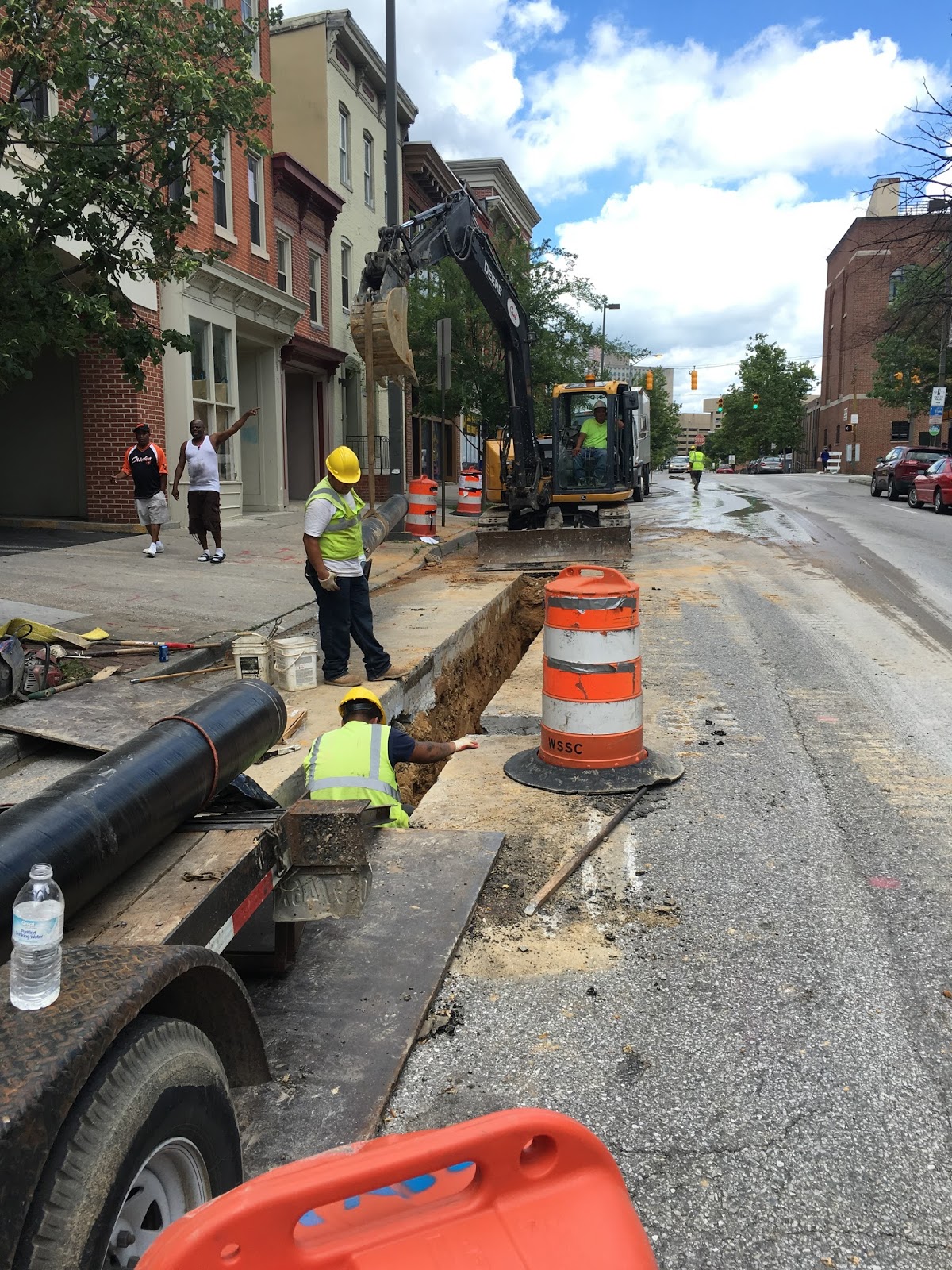
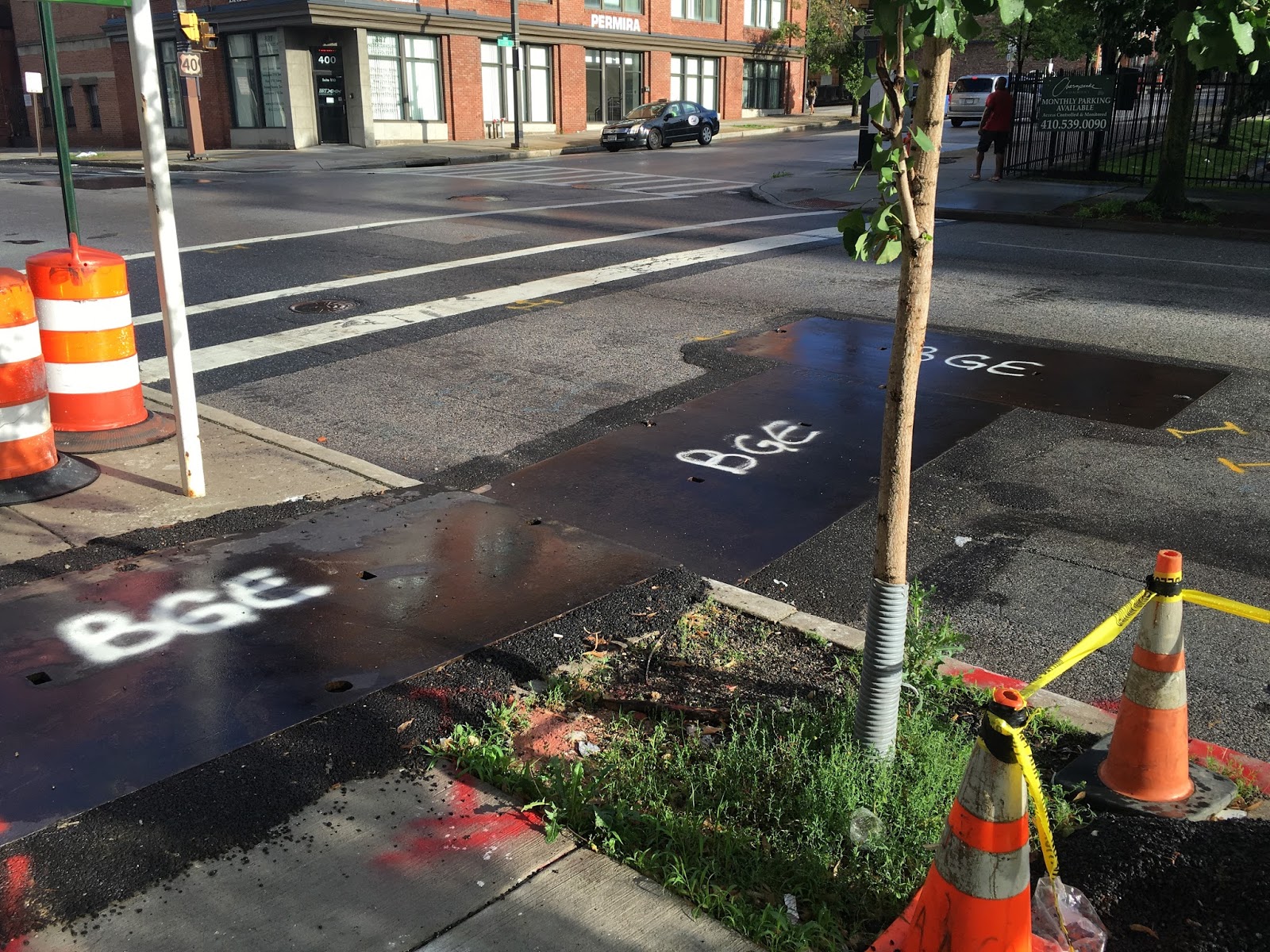
Lately it has been water, or more precisely, the effects of water. Sinkholes all around, trenches, ditches, pipes above and below ground. The most notable pipe is the sewage line that now runs in big swoops and dives between Centre Street and Saratoga Streets exhibiting the colon of the city like a colostomy as a piece of art.

Traffic is only an afterthought, the diggers, the backhoes, the sawcutters and the giant vacuums that suck up chunks of concrete as if they were birdseed have taken over: Operation orange cone on steroids. For months.
Once there were three lanes of roadway: Mulberry Street sinkhole
(Photo: ArchPlan. Inc.)

But this flood isn't followed by ebbing water. To the contrary, the more trenches, the more new sections of pipe are buried in the ground, the more seems to go wrong. Whole sections of a street giving way like so much brittle frosting. The sinking ground shears off the life lines of the city buried under the roadway and exposes the ripped and frayed ends like an cut away drawing done by engineers to illustrate infrastructure.

The company with that giant open- ended emergency contract can spring into action at a moment's notice without bidding. It is having another field day. The businesses around all those sinkholes beached like on a Hallig: not so much (BBJ article). All we need to complete the sequestration is another mishap in the nearby Howard Street tunnel.

Maybe we should use the time in quarantine to figure out what the future of the Westside should be. Like the cardinals in Rome, we can signal a result with white smoke.But I doubt the sinkholes will be fixed by then.

Klaus Philipsen, FAIA

Baltimore SUN, Mulberry Street sinkhole
Baltimore SUN, Centre Street sinkhole

Mulberry Sinkhole: just finished trenching it (see on the left edge). The activity level is inverse proportional to the size of the hole. 
 (photo: ArchPlan)

The Cemtre Street sinkhole: Three months in the making and counting  (photo: ArchPlan)

Night shift on Franklin Street  (photo: ArchPlan)

Dayshift on Eutaw Street: More trenching  (photo: ArchPlan)

Temporary covers over building connection trenches  (photo: ArchPlan)
No alley remains un-dug (photo: ArchPlan)

Sewage flowing through the streets (Franklin): Operation Orange cone
 (photo: ArchPlan)


BaltimoreLink 2.0: Improved Bus Access

The second incarnation ("version 2.0) of the radical Baltimore bus overhaul (Re-imagining our bus network") was revealed early this morning and those who had digested the initial Link Plan have to study it all over again because according to Kevin Quinn of the MTA 86" of the previous plan have been revised yet again.
Kevin Quinn, MTA Planning Director explains
the Baltimore Link System version 2.0

The first chance to discuss the new plan with MTA was offered this morning at State Center at a public meeting in which Planning Director and leader of the bus overhaul Quinn presented the new plan to the two dozen or so members of the public that had found they way to State Center on a Tuesday morning, among them transit and bus advocates that know the MTA operations sometimes better than the MTA themselves.

Quinn had a slide show that will be up on the web shortly: Quinn repeated why the bus overhaul was needed, chiefly because some existing routes were "too long to manage" and "some routes downtown are too congested, especially  on Lombard and Fayette Streets with up to 800 buses a day".

Three types of services will replace the current system, the new service types are:
City Link, Local Link and Express Link. The latter began operations already on June 20th with three new lines and one modified line. 
Improved access

Quinn stressed that the MTA had listened: In the first round of outreach 76 events yielded the comments that led to the new system map. Comments can still be made on the My Sidewalk feature of the website. 

Main changes based on complaints include that Greenmount Avenue will keep service and is now serviced by City-Link Red. Eastern Avenue and Highlandtown will get their #10 back as a color coded Link Bus line as well. 

Quinn reported about a number of metrics against which the new 2.0 version was tested using mostly the regional travel model maintained by the Baltimore Metropolitan Council and additional data from the Department of Planning. Based on this analysis, the new system will

  • keep transfers at the same level as today (there is a 1.7% increase)
  • 53% of all trips would not need any not transfer at all. 
  • Travel times would remain the same
  • there would be better access for more households and better access to more destinations
A before and after analysis comparing the current system with the proposed one is now available for specific areas in the network ("better new route sheets") giving riders the ability to compare their travel options now with those for the Link system. There is also an interactive Google map for the same purpose as well as a trip planner.

For State center the comparison looks like this: 
Current service: #19/119, 21,27, 31 and 91. 
The 19/119 are back as local links. 21 will be replaced with city Link Lime, MTA 27 comes back as LL 94, the 91 replaced with CL Yellow from Mondawmin to Halethorpe. 

The unveiling of the new plan will be followed by three months of public outreach. 
Better new route sheets. (Book).
The proposed new bus stop signs (draft)

Questions revolved around a new real time bus app (It will probably be rolled out after the new service is up and running, Bus USA is already being procured, about the destination displays on the buses ("Get rid of "Happy holidays" and "Go Orioles" and focus on relevant legible information"), whether there will be additional shelters (Yes, 200) and whether there will be fewer stops.  The interesting response here is, that the exact number of current stops seems to be somewhat unclear. About 6,900 are proposed, but the last word on locations and the metrics and standards under which they will be placed has not been spoken. "We will optimize, not delete stops", said the operations manager of MTA.

The question when the existing light rail will see expanded Sunday service hours was also left somewhat open ("Probably 2018"), pending how off service track maintenance can be organized. 

Someone asked "What are the waiting times for transfers? Will the new system target reduction of transfers? Is there analysis of travel time within system?" The answer was soft. "Insofar as there will be more frequent service, transfer times should decrease". Specific transfer times will depend on schedule coordination between lines, a step that hasn't been taken yet.

There is no plan to increase capacity through more articulated buses. When asked by transit advocate Ed Cohen (who also sits on MTA's Citizen Advisory Committee) if certain service reductions from less redundancy in certain corridors wouldn't raise the question of capacity, Quinn admitted that this was "an excellent question", apparently leaving the option open that those lines could run more frequently than every ten minutes.
Consultant Josh Diamond stands in front of
the proposed systems map 2.0

The so called "school tripper service" analysis isn't complete yet either, except that there is a commitment to provide service to all schools. 

Other than the bus service itself, there was talk about making the Charm Card better and more common to reduce the delays stemming from cash being counted into the fare-box upon boarding.  Only 3% of riders use the chip cards today which one can recharge at ticket machines but not buy on them.

Transit activist Jackie Brown said "issues go beyond the technical issues and have to do with adequately funding the system". Quinn repeated that the system received $135 million additional capital and operating funds.

Joe Nathanson of Bolton Hill wanted to know how a year from now how MTA will prepare people for the change when one day they arrive at their stop and a different or no bus will show up. 
The bagged sign approach. Quinne elaborated on the bag strategy for stop signs in which plastic sheets will be placed over the new bus stop signs. The bags contain the old (current) bus stop info. The bags will "be popped" overnight and the new signs be revealed. To soften the shock for riders, there will be also foam-core signs placed on the poles preparing folks to the specifics of line changes at a particular route.

When the presentation and discussion wound down after an hour or so, the last question was a concern about the elimination of the current #3 route. The issue remained open.
Better access

Consultant Josh Diamond who helped with configuring the new system feels that the revisions largely address the complaints he had heard.
The precedent for MTA's endeavor is Houston. Quinn and his boss, MTA Administrator Paul Comfort visited Houston a while ago and came back encouraged: The entire bus system had been revamped last summer. Since then ridership and service efficiency has gone up.

Klaus Philipsen, FAIA

The writer serves  to MTA regarding the Link project in a small capacity as a consultant regarding hub and sign design.

See additional workshops below:
Wednesday, July 6, 20166:00pm- 8:00pm
Arbutus Library
855 Sulphur Spring Road 
Arbutus, Maryland 21227
Local Bus Nos. 35, 77
Express Bus 107
Tuesday, July 12, 2016

6:00pm- 8:00pm
White Marsh Library
8133 Sandpiper Circle 
Baltimore, MD 21236
Local Bus Nos. 35, 58
Express Buses 102, 120
Thursday, July 14, 2016
6:00pm- 8:00pm
Medstar Harbor Hospital
3001 S Hanover St 
Baltimore, MD 21225
Local Bus Nos. 27, 29, 51, 64
Express Bus 164

Monday, July 18, 2016

5:00pm- 7:00pm
Waverly Library
400 East 33rd Street 
Baltimore, MD 21218
Local Bus Nos. 3, 8, 12, 22
Quick Bus 48
Wednesday, July 20, 2016

11:00am- 3:00pm
War Memorial
Memorial Hall
101 North Gay Street
Baltimore, MD 21202
Local Bus Nos. 5, 7, 8, 10, 15, 19,
20, 23, 26, 31, 35, 36, 91
Quick Buses 40, 46, 47, 48
Express Buses 105, 115, 119, 120, 150, 160
Thursday, July 21, 2016

6:00pm- 8:00pm
Pimlico Race Course
Triple Crown Room
5201 Park Heights Avenue
Baltimore, MD  21215
Local Bus Nos. 27, 44, 54, 91
Tuesday, July 26, 2016

6:00pm- 8:00pm
Baltimore Metropolitan Council (BMC)
1500 Whetstone Way, #300
Baltimore, MD  21230
Bus No. 1
Thursday, July 28, 2016
6:00pm- 8:00pm
Coppin University
Talon Center
Room 218 A
2500 W North Avenue
Baltimore, MD 21216
Local Bus Nos. 1, 5, 7, 13, 16, 21, 22, 51, 52, 53, 54, 91, 97 (Mondawmin Shuttle Bug)
Metro Subway

Friday, July 1, 2016

Jobs leaving - townhouses coming

The story reported by Melody Simmons in yesterday's Baltimore Business Journal has all the ingredients of the American narrative that is trumpeted around the country these days: An Asian company buying out an established American company, making promises about jobs, not keeping them and then closing down the plant.
The next chapter are townhouses. (or as in the case of the Solo Cup company in Reisterstown, a Wegmann's). The reality, as always, is more complicated.
Hedwin on Roland Heights in Baltimore near I-83

Most Baltimoreans probably never heard of Zacros (or Hedwin) or of the Cubitainers they make, not unlike the milk cartons we all know. The plastic containers are used for pharma, paints, food and also disaster relief. But the Hedwin company was founded right here in Baltimore in 1946. Like may other things that came from Baltimore (for example, the crowncork invented here) the company started with ingenuity. Tom Winstead had developed a patented process of forming and sealing sheets of plastic with heat that was suitable for mass production. (He proceeded with a number of other inventions).

Hedwin has been once before in danger of being bought up and moved. But in 2004 employee stock was issued to avert the sale and an employee owned company ensued. But then the company went bust and in 2014 Hedwin was bought by Fujimori Kogyo for $22.2 million at a bankruptcy auction and the word was that the 300 Baltimore jobs would move to Delaware. various reasons were given at different times. The company had outgrown the Baltimore location with six buildings and a warehouse according to the company's spokesman, who also said in Delaware that they had the best workforce. In Baltimore it was told that the Japanese owner's strict standards for purity in the plastic products could not be met at the current leased plant.
Emergency water containers

A search for a new location led to Newark’s Pencader Corporate Center in Delaware, where another plastic molding company had left a 158,000 sf facility after it had folded into another company from Illinois. The company was awarded a Strategic Fund Performance grant and a Capital Expenditure grant of $703,505 from the Delaware Economic Development Office (DEDO) to offset costs associated with relocating its operations to Delaware. “Our goal is to partner with the State of Delaware and the community,” Hedwin’s vice president and COO, Maurice LeCompte told the Delaware Business Times in 2015. He added that proximity to primary customer Siemens Healthcare Diagnostics and Delaware’s commitment to manufacturing played heavily into the company’s decision to relocate.

The swooping in of a mean Asian Tiger that grabs American assets seems to feed the narrative. But Fujimori and Hedwin collaborated since the 1960s when the Japanese had bought a Hedwin license to produce the Cubitainers in Japan. The relocation was fueled by a competing state's incentive payments and by locational advantages
Cubitainers: Wine from a box

Now in 2016 the time has come that the remaining but dwindling Baltimore jobs will disappear altogether. Technically the employees could have re-applied for the work in Delaware, but most selected not to do that. Delaware's DEDO Director Alan Levin is happy: “Adding jobs to the manufacturing sector will provide a major boost to, and help to diversify, our economy,” he said about the company's move. “What we really liked about Zacros’ Hedwin division is that they have the desire and the ability for future expansion."

It is an open question if Hogan's "open for business" policies would have made a difference in 2014. Those manufacturing stories are never simple.It seems to me, what we need to do is foster and retain the inventors and innovators of today. They are still here and right under our noses.

Klaus Philipsen, FAIA

the article is compiled from press reports and press research.

BBJ 2016
Delaware Business Times 2015
Baltimore Sun 2014

NOTE: During the summer months articles on this blog will become less regular due to travel, conferences and book writing