Friday, November 17, 2017

Maryland's transportation only gets a D

Whatever Baltimore's transportation woes, with Maryland's highways and transit being almost entirely controlled by the State, Baltimore area problems are reflective of Maryland's transportation woes in general and a result of the State's current priorities.
CMTA Executive Director Brian O'Malley at Friday's
press conference at the Impact Hub on North Avenue (Photo: Philipsen)

Friday morning the Central Baltimore Transportation Alliance (CMTA), a regional transportation advocacy group released its second transportation report card,  the final grade is a dismal D.

"Did your kid ever come home with a D on the report card? What did you do?" asked Brian O'Malley executive director of CMTA. "Is just not a good grade".

The overall grade is the same as in 2015 when the first report card was issued. Two of the twelve indicators actually slipped in spite of the LINK bus overhaul that took place since then: Job access went from D to F in spite of all of MTA's efforts to the contrary and so did air pollution. The report card doesn't include any improved indicator. A possible candidate, transit reliability wasn't graded at all due to incomplete data, due to the system overhaul for buses and a still ongoing assessment of its impacts.

Interestingly, Baltimore area transportation just isn't good, regardless whether transit or car access is measured. Only 30% of jobs can be accessed within 20 minutes whereas San Diego is referenced  to have 37% and San Antonio with 45% access rates. This is surprising since those areas are so much less dense and distances to get to any place are larger there than in Baltimore. A metric where the Governor's preferred auto transportation network achieves a higher grade than transit is "State of Good Repair".  State bridges get a B-, but the State roads themselves receive only the same C-  as transit's state of repair. Again, that is surprising, since roadways around the region seem generally in pretty good condition compared to what one finds in other states and compared to the well worn tracks of local rail transit.
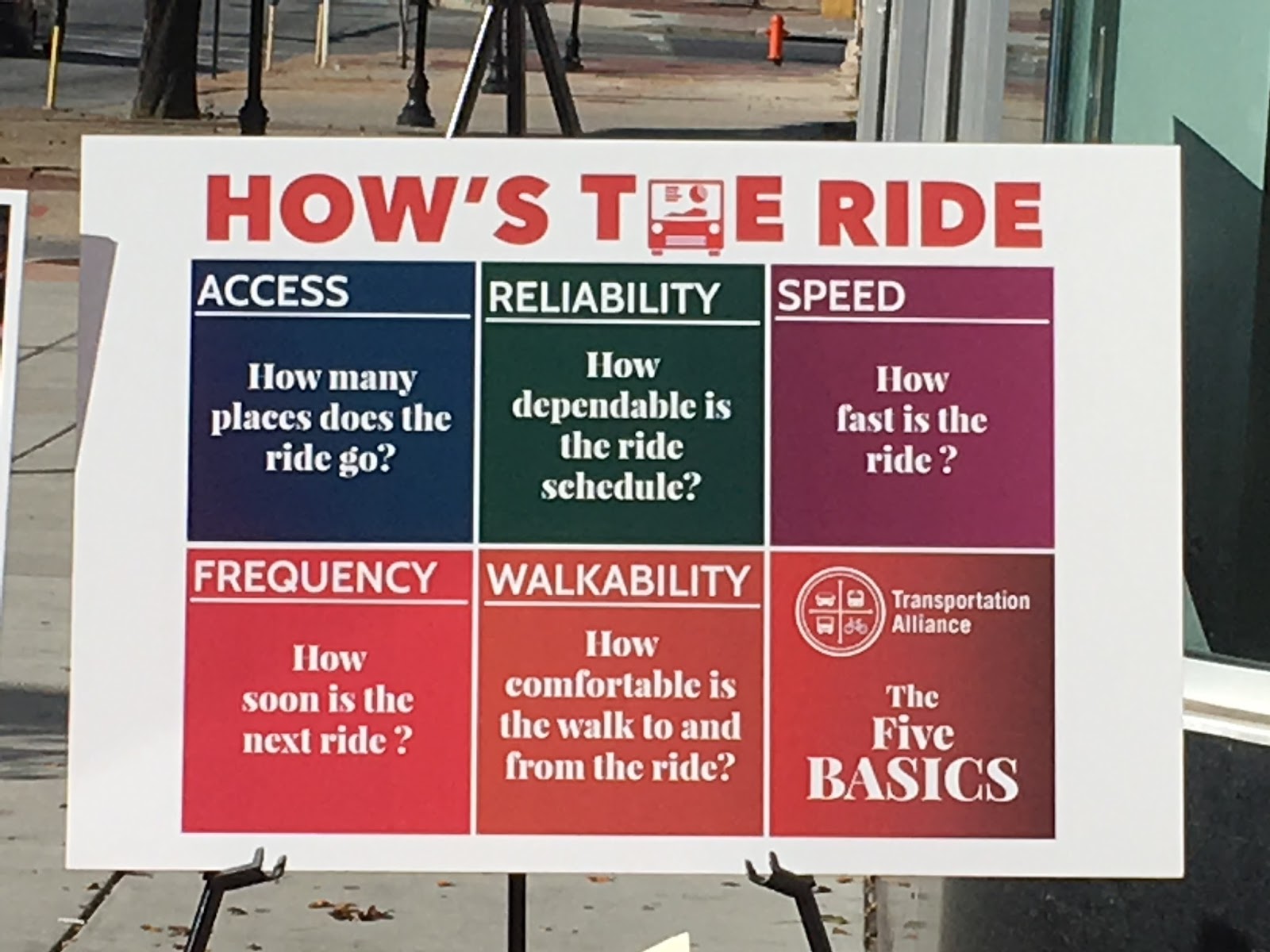
New rider oriented evaluation of transit launched by CMTA

The metric where the Baltimore region fares the worst is % of employed people with travel time over 45 minutes. Per the report this portion of commutes is 23% of Baltimore's employed population, indicating poor transit speed and high level of congestion on the roads.

Once again the regions with long commute distances (Orlando, San Diego, Seattle) are all indicated as being well below Baltimore's 23% share, i.e. more people can get to their jobs faster. They also all have healthier air than Baltimore, another metric where Baltimore received an F.

The report card is based on three goals (access, connection, environment) with four indicators each. O'Malley emphasized that the indicators were measured on a curve, i.e. compared to other cities and regions and not against and ideal or absolute mark, and that all data come from independent sources. While one can probably quibble with the one or the other aspect of the methodology, the report card confirms what pretty much anybody knows, the regional transportation system performs rather poorly and begins to become an albatross around the neck of economic competitiveness and certainly on any attempt of creating greater equity.
Poor grades across the board: CMTA report card

The reasons why Baltimore area transportation continues to score below peer cities could be found during an instructive two-hour grilling of MDOT Secretary Pete Rahn at the Montgomery County council on Thursday.

Rahn had been asked to appear before the council to respond  to questions the council has about the Governor's intention of building new toll lanes on Washington area highways including the  Beltway. Those toll lanes are frequently referred to as Lexus Lanes because drivers don't qualify for their use through high occupancy but through payment.

Transportation advocate Ben Ross who wrote on this blog earlier this week on the same topic was at the hearing and filed this report:


Hogan Lexus Lane Promises Collapse Under Questioning 
Ben Ross, chair of the Maryland Transit Opportunities Coalition and author of Dead End: Suburban Sprawl and the Rebirth of American Urbanism.  
Two of Governor Hogan's key promises about his Lexus lane plan -- that taxpayers won't get stuck with the bill, and that the new lanes will fit into existing rights of way -- were retracted by Transportation Secretary Pete Rahn yesterday. 
Rahn also offered a rationale for the Lexus lanes that is sure to raise eyebrows in Baltimore. Over 90% of Maryland's traffic congestion, he told the Montgomery County Council, is in the Baltimore and DC regions. Why, then, did Hogan cancel the Red Line and transfer money to rural areas?
Under council questioning, Rahn admitted that the state will have to pay "gap funding" to some of the private companies that the state picks to build new toll lanes. He expressed the "hope" that bidders would pay premiums for the rights to other, presumably more profitable, highway sections and that the premiums will be big enough to make up for the gap funding.
Another answer pointed to the reality that taxpayers will get stuck with a big piece of the bill. Councilmember Tom Hucker asked about the Maryland Transit Opportunities Coalition's calculation that the governor's plan requires a $41 toll from Frederick to Shady Grove. The toll will be much lower, Rahn said, because drivers won't pay that much.
But no one has questioned MTOC's finding that $41 is the toll needed to pay for construction. That means that the operator of the I-270 lanes will need lots of the state's "gap funding." On the Beltway, where double-decking is expected, construction will be more expensive than on I-270. Unless the Beltway toll is even higher than the $41 Rahn admits drivers won't pay, the operator of those lanes will have to get taxpayer dollars too. The majority of drivers will be stuck in traffic on the free lanes as cars whiz by on Lexus lanes they paid for but can't afford to use. 
Meanwhile, earlier promises that construction won't need to take land from nearby neighborhoods turned into a mere "desire." Asked what will happen if the bidders don't satisfy that desire, Rahn wouldn't answer. The question, he said, is hypothetical.
Other questions from the council uncovered additional gaps in the state's plan.
Why not run more MARC trains to Frederick instead of widening I-270? Rahn said that rail is too expensive. This is simply wrong. The state's cost estimate for the northern segment of I-270 alone is triple the estimate for a third track on the MARC line.
Where does the $9 billion cost estimate come from? Rahn said it's based on an average cost of $100 per mile for urban interstates. But the Intercounty Connector, built on empty land, cost $136 million per mile. It will cost far more to build Lexus lanes in the middle of busy highways, let alone a double-decked Beltway and a new American Legion Bridge.
What will happen to roads that cross the Beltway? Rahn admitted Lexus lanes will put more cars on roads like US29 and Georgia Avenue, which are already jammed. He will ask private bidders to tell the state what the impacts will be.
What's the schedule? This question uncovered a new issue. Rahn said that environmental impact statements won't be finished until after the winning bidders are selected, because the state won't know what the project is until then. But it's not clear whether this will be legal, since the whole purpose of an EIS is to inform the decision.
It's more and more apparent that the Lexus lanes are, at best, an empty promise that will vanish after election day. At worst, they are a boondoggle that will burden Marylanders for years to come.
The poor Baltimore area transportation report card combined with the current State's auto-boondoggles such as  additional lanes or another Bay crossing allow little hope that the State's transportation woes will be alleviated soon in any meaningful way. More roadways, Hyperloop tunnels and Maglev spurts won't do anything to make daily commutes to work for average residents any better. They are at best empty promises reaching far into a future in which the Governor can't be held responsible.

Klaus Philipsen, FAIA

Thursday, November 16, 2017

Normalcy and mayhem in Baltimore

Life in Baltimore hasn't been normal for a long time by any number of metrics, notably by comparison to other similar cities in the US. Baltimore is #2 in the nation with its murder rate of 55.37 murders per 100,000 residents, topped only by St. Louis. It was also declared the worst city for African American boys to grow up. The city is also one of only a few that fails to thrive in terms of population growth.

"Failure to thrive" is a serious diagnosis when it comes to your child. It is also serious when it comes to your city.
Lafayette Square normalcy Wednesday 3pm

No individual  can thrive with a sense of daily emergency. To live as normal a life as possible, humans seek out what is good and cling to it. Or they cling to a mode of living in which anything goes. This is a matter of survival and Baltimoreans are very good at both strategies and "normalcies", even if normalcy looks quite different in those two groups, whereby the second group is very small and the first easily large enough to span across the two cities that Baltimore has become.

I was thinking this when I had an appointment in Harlem Park Wednesday afternoon to scout out the rehab options for a boarded house on Lafayette Square. There was a hint of sunshine, when I turned into Lafayette Avenue and then crossed Bennett Place, traversing one of the hardest hit  inner city neighborhoods in America to get to Lafayette Square, a historic green space surrounded by churches and stately buildings. The remaining leaves had brilliant colors, a woman was sitting on a bench, a few people walked the streets, everything looked perfectly fine, no matter that even around this beautiful park many buildings were boarded up, missed roofs and clearly showed that they had been abandoned for decades.
Press conference after officer was shot at Lafayette and Bennett Place

A couple of hours later, I set off on my bike to attend a meeting at the Planning Department to discuss Baltimore's parking regulations and whether the new zoning code was sufficiently reflective of a transportation environment that would not give the personal car the highest priority at all times. But now the City didn't seem normal at all. Helicopters overhead, police cars and black SUVs with flashers and sirens were racing through city streets going west: A police officer, a homicide detective, had been shot in the head in an attempted execution by a suspect who is still on the loose. The crime happened on a spot I had traversed earlier the same afternoon. Biking among the racing emergency vehicles and the helicopters overhead, normalcy collapsed and the daily emergency intruded undeniably. Would it matter what parking regulations we have, when criminals can shoot a police officer in the head in broad daylight?

In the morning of the same day I had discussed how the 1000 Friends of Maryland can reinvigorate the concept of smart growth and suggested that we need to see how smart growth can address equity. No city, no state and no country can succeed if half or a third of the people are excluded from making progress at all. I had said this many times and I repeated it at the strategy meeting over a cup of cappuccino with the brandnew Park Avenue apartments in front of my eyes. It isn't a particular creative insight, more an obvious truth, but I felt more than ever that Baltimore has reached the point where this truth can no longer be suppressed, even if one has the privilege to spend most of the time on the side of the beautiful Baltimore that appears to thrive.  Alex Wroblewski was killed with the even more beautiful Anthem House apartments in front of his eyes when he died. If those who had just moved into the expensive apartments cared to look out their window at 1am, they could see him lying in the alley and the trio of perpetrators drive off with his wallet.
Make-shift memorial in Locust Point

Would another blog article about MICA spawning a job conduit on its campus matter when a woman walking down their own street gets clobbered with boards by teenagers so young that they could be the women's daughters? Does it matter to discuss the 21 years of health discrepancy between Baltimore neighborhoods when a group of three, including a mother, her boyfriend and her son would in cold blood kill someone who just bought a gallon of milk because they had seen his hard earned tip money in his billfold when he paid his food? Does it matter if another house on Lafayette Square will be creatively renovated funded by successful entrepreneurial African American women from the DC suburbs? To ask these type of questions is hugely dangerous. No good outcomes are derived from everybody giving up what they are doing.

But the capacity of pretending that everything is fine has its limits. Sun columnist Dan Rodricks expressed it in his column when he noted a strong sense of foreboding about what will happen next in Baltimore. Baltimore's Mayor decided last week that business as normal has to end for her department heads and that they have to convene every morning at 8am to come forth with ideas what they can contribute towards fighting crime. Those emergency sessions are a good idea; until they become the new normal and their effectiveness will be replaced by routine.
Park Avenue apartments at Park and Franklin 

Last Friday I wrote at length about the vicious and the virtuous feedback loops and how remediation and enforcement can play a role in both. Nature not only knows about those feedback cycles, it also knows tipping points. In my recent book about Baltimore I argued that David Rusk was wrong when he attested Baltimore in Baltimore Unbound in 1995 that it was "beyond the point of no return". This city has not gone over the cliff since then, to the contrary. Normalcy can still be lived. There have recently been six days without murder. The capital still flows in and one half of the two Baltimore's can still celebrate its food hubs and happy hours. Neighborhoods in the other half has its normalcy, too, in many ways a happy one as well. There is also tireless work on neighborhood turnaround and yes, there is investment there as well, workforce training, daycare, small enterprises all around.

In what Rodricks calls foreboding, the flags are yellow. It won't take much more and in what physicists call "phase transition" a fluid situation will become rigid and the flags will be red. Judgement will gel and the influx of people and money will freeze and lawlessness will become even more unhinged. While even that may not constitute the point of no return, it will move Baltimore in a much more difficult place from which to recover.
Anthem House apartments in Locust Point

Some may say that it is frivolous to worry about the influx of people and capital when people are dying either by guns or from drugs or by slow neglect, when, as a Baltimore born poet Koni Fidel called it yesterday at Baltimore Breakout, there is a "genocide by zip-code" going on. The Mayor was supposed to address the event but stood at Shock Trauma next to the police commissioner instead to address the media about the police officer clinging to life.

Some may even celebrate the departure of out of town investors whom many see as vultures advancing gentrification and preying on Baltimore's vulnerable.  Such a viewpoint is understandable because, indeed, the very system that is supposed to bring the tools for renewal and rebirth has also caused the city's current situation in the first place. But as I said in my article last week, there is no new system waiting around the corner. The ones suffering the most from a strategy that builds on deterioration in favor of momentum for system change are the ones a "revolution" would want to protect. It is far better to find a strand that can untie the knot and get Baltimore on the same course that so many comparable US cities  have successfully taken without a revolution and without suffering anyway near as much daily mayhem as Baltimore.

Klaus Philipsen, FAIA

Wednesday, November 15, 2017

How Maven Gig coming to Baltimore fits the bigger picture

Just when one couldn't imagine another variation of car rental and car and ride sharing services beyond Taxi, ZipCar, Car2Go, Maven, Uber and Lyft, another service comes to Baltimore: General Motor's Maven Gig, a service innovative enough to make it into the daily newsletter of technical.ly, Baltimore's innovation and technology news platform.
GM vehicles opened and started by phone: Maven City

What is Maven Gig? It isn't Maven City, a more typical car sharing service that has already been launched in April of this year and is different from ZipCar, in that it unlocks and starts cars directly from a smart-phone app without any keyfob or membership, both needed in the granddaddy of car sharing, Zipcar.

Zipcar Baltimore has 250 cars on the street of  all kinds of makes and models, at dozens of locations around Baltimore. Its rental rates range from $8 to $10 an hour for such cars as Volkswagen Golfs, Honda Fits and Ford Focuses, but there is also a monthly or annual membership fee of $7 a month or $70 a year that Maven doesn't have.

Maven Gig is the provider for workers of the gig economy: Slogan, "our car, your hustle". The hustle could be the wannabe driver who has no car but wants to provide Uber, Lyft or food supplying services. Now such a person can get a car from Maven Gig for a convenient weekly rate instead of the customary hourly or daily rate for car shares. In that it comes full circle back to traditional car rental.
Car share and the gig economy

Interestingly, Baltimore is among a set of early deployment cities which so far include Boston, Detroit, Los Angeles, San Diego, San Francisco, Phoenix and Washington. Not bad company, with Detroit as an exception. Or one can take Detroit and Baltimore  as a sign that the old rustbelt city is well on its way as being seen as a cool place for innovation, regardless of the baggage these cities carry.

Folks who simply shrug off the whole sharing culture as nothing but hype, fashion and chatter of those who have nothing better to do than yakking about the latest trends, miss several important points. Co-working places, food hubs and transportation share models maybe a fashion that is potentially overrated, but they stand for a paradigm shift that can't be denied. They are simply "proof of concept" to stay in the innovation parlance, i.e. experiments on various scales.

Lets sort it out: Daimler (Car2Go), BMW (Reach Now-Sixt), General Motors (Maven and Mave Gig) and others got into car sharing when it was seen as the very next phase of urban mobility where owning one's own car wasn't any longer the most practical way of getting around.

Then came ride sharing via Uber and Lyft and took a lot of car-sharing's thunder to the point that Daimler and BMW found it hard to make enough money with their forays into their own car-sharing and even consider collaboration with each other.  The next big thing just around the corner will be the autonomous vehicle (AV). Then car and ride sharing may become synonymous because the driver has been taken out of the equation altogether, obviously fundamentally changing the business model for both types of enterprises yet again.  What could that next shift mean? This is where GM's Maven Gig seems to come in.
Zipcar also offers commercial fleet vehicles

The gig and the hustle are here to stay as new forms of work. As fluctuating as the gigs may be, people engaged in working gigs can and must avoid the large investments that came with more permanent businesses such as multi-year rents for office spaces, company cars or fleets of delivery vans. When even traditional trades, such as construction and farming, increasingly rent equipment as needed instead of buying it, it makes perfect sense when traditional commercial rental begins to utilize the innovations of passenger car sharing. The innovation isn't the vehicle or the equipment itself or who operates it, but the method with which equipment it is deployed into the hands of those who need it to conduct business.
Daimler's Car2Go car share model is large and international

When it comes to cars, vans, trucks and buses, the real revolution will be when sharing will be combined with autonomous driving. For the gig it will mean that not being a driver is at the core of the service but  providing it via shared AVs.

It is still entirely unclear how it will play out. Obviously the big car manufacturers are betting that they need to be at the table early on. Their attempts in car and ride sharing are efforts to be a player when it isn't popular anymore to own a personal car.

Unfortunately, it isn't all that easy to make money from car sharing. General Motors has already learned some lessons in the past from working with traditional car rental companies like Budget and Hertz. It has long been a supplier for those large traditional rental fleets and dumped low cost models into those markets without consideration how this undercuts the manufacturer's image and their pricing policies at dealerships. The budget fleet models even turned buyers off  when their bad renatl experience made them avoid buying the same model in the showroom. Car2Go, the largest car share globally, is run by Mercedes Benz and initially only offered electric Smart Cars as the vehicle of choice. This brought limited appeal in the US, where car buyers prefer vehicles on steroids and a Smart can look and feel like a crumb between the teeth by comparison.  In a reversal of GM's dumping strategy, Mercedes is trying to appeal to potential car buyers by now offering in select cities luxury sedans as part of Car2Go.
BMW's electric car share fleet is collaborating with Sixt car rental

If car sharing would become standard practice, the sharing and the AV technology combined could mean a lot fewer cars are sold. This would have positive effects for cities and the environment, provided the right policies are in place to prevent that transit gets starved out or AVs will be deployed in a frivolous manner. Either way, the impacts on the automotive economy is not clear at all.

Car sharing isn't all that different than tool, moving truck or backhoe rental and one can expect that those traditional rental functions will also become streamlined and app based allowing it to be used by a broader base that isn't just contractors or do-it-yourselfers but also by start-ups and gig entrepreneurs.
How to share the public domaine: Fleet parking
It will be interesting to see how GM's Maven Gig will play out in Baltimore and if the car companies' willingness to experiment finds any correlation in Baltimore's DOT  with corresponding innovative policies to accommodate the new trends. What those should be must be subject to another article.

Klaus Philipsen, FAIA


Tuesday, November 14, 2017

Baltimore Architecture firms keep merging

If one gets the impression that well known Baltimore architecture and engineering firms get merged into larger firms from outside the area, there are at least three examples, that support the observation: For many years Baltimore's largest architecture firm was RTKL until the firm sold itself to Callison in Seattle and become CallisonRTKL, all one word.  In April of this year Baltimore's Cho Benn Holback (founded as Cho, Wilks and Benn in 1979) merged with Quinn Evans in DC and became "Cho Benn Holback, a Quinn Evans Company". This week Marks Thomas announced in a press release, that it too will be bought by another firm and will likely loose its brand-name and status as a woman owned business enterprise.(WBE) .
Mark-Thomas 50 year anniversary celebration in June 2017
(Photo: Daily Record)

According to statistics, Tinder for architects and engineering firms is a hot item all across the country. with more than two thirds of all architecture firms indicated that they are considering acquisitions or mergers  according to a 2015 research by the Zweig Group.  In doing so A&E firms are not any different than start-ups or legacy companies that have been following the giant sucking sound of corporate concentration unimpressed by the counter slogan of "small is beautiful". Reasons to merge vary and go from the economic system to demographics and specific conditions in the A&E industry:
  • Capitalism is based on growth and expansion and staying small is antithetical to business development
  • Trends in the delivery of A&E services require broadening the model towards integrated services including engineering services provided by the same firm
  • Baby boomers holding CEO and principal positions in smaller or midsize companies they founded some 30-40 years ago are reaching retirement age and try to leave with a transition plan in place
Or in the words of  FMI's "Trends in Mergers and Acquisitions in the Design and Construction Industry":
As project sizes grow, and as the share of megaprojects rises as a percent of total construction put in place, the demand for large, technically sophisticated firms has increased. Coupled with this is the continued integration of design and construction, both in terms of project delivery and business models. Both trends have led large E&C players to increase their acquisition activity, especially 3 FMI's 2017 M&A Trends for Engineering and Construction engineering and design firms.
Founder Paul Marks in discussion with
Principal Tom Liebel (2016)
Marks Thomas, according to Principal Magda Westerhout in an e-mail to Community Architect,  is very excited about the merger and sees it as the result of a strategically planned approach:
Moseley has a primarily institutional practice with a strong focus on public schools, colleges and universities, local government facilities, and senior living. We have recently partnered together in pursuing several school projects and were successful with projects awarded to our team. This has reinforced our conviction that our cultures are similar and we will enjoy working together. 
The two recent mergers at Cho Benn Holback and Marks Thomas involve two very similar sized firms (#11 and 12 in the local size rankings). Both will keep their local operations pretty much as they were before the merger. In both the management of the original firms became stakeholders in the new business entity without laying any staff off as a result of the mergers.

As the drivers for mergers of this kind usually are given synergy and the added resilience that comes from a broader geographic spread and added competencies. As Ms Westerhout explains:
 Marks Thomas has been looking for the last several years to expand our footprint to Richmond and beyond and are very pleased that we have found an excellent partner to help us achieve that goal. Their footprint currently includes offices in Virginia, North Carolina and South Carolina, and provides comprehensive architecture, engineering, interior design, high performance design, and construction administration services to clients worldwide.
The bulk of US architecture firms, a whopping 77.3% is still very small (1-9 employees) but manages to get only 17.3% of the total billings generated in the field whereas firms with 50 and more people represent only 5.1% of all firms but generate 44.9% of all billings. Marks Thomas currently has 51 employees (BBJ), the combined firms will grow to 275 after the merger.
Baltimore's largest architecture firm by billing is Hord Coplan Macht with 164 local employees (2016). Marks Thomas was ranked on spot 11 in the BBJ's 2017 list of firms.
The Marks Thomas designed Mary Harvin Resource Center in East
Baltimore, known for having burnt to the ground before completion as
part of the unrest in 2015 and getting rebuilt and completed in 2016

Marks Thomas is most known for its multifamily and elderly housing but the firm kept a broad portfolio including historic preservation. institutional work and urban planning. The original founders, Paul Marks and Gilbert Thomas are both retired. Principal Thomas Liebel chairs the City historic commission (CHAP). The firm celebrated its 50th anniversary in June of this year.

As rational as these mergers may be, they further the notion of Baltimore as a branch town, not one of headquarters.

Klaus Philipsen, FAIA


Official Mark Thomas statement

Monday, November 13, 2017

Toll lanes ill conceived and unworkable

Democrats like to say there isn't a roadway project that Governor Hogan doesn't like, and even if one strips partisan bias from this quip, it rings true.When the Governor announced in September that he is set to solve the region's traffic woes with more lanes on the freeways, even non-partisan observers scratched their heads in disbelief. (see my previous article here).
Lexus Lanes and sound-walls on the Springfield Interchange in Virginia

Adding lanes has been a strategy for a hundred years now, a century in which scenic roads bloated into monstrous 12 lane beltways. To make them even wider seemed preposterous. Hogan and his MDOT Secretary Rahn nevertheless sold the idea as innovative, especially since all the money is supposed to come from the private side under obscure formulas known as P3, private, public partnerships. If this sounds too good to be true, well, it is. To defy the geometrical constraints and limited space for further widening, deputy Secretary Ports went pretty far out by talking about innovative designs that do neither stack the additional lanes above existing ones (a very costly typical Los Angeles solution) nor hide them in a tunnel (like the big dig in Boston, even more costly). Instead, Ports spoke about a "half open tunnel", i.e cantilevered roadways requiring the main roadbed to be lowered (considering the Washington Beltway near Silver Spring and other tight spots, lowering under traffic seems to be the most implausible solution of all).

In the spirit of regional collaboration, today's article comes from Harvard physicist and Washington area transportation activist Ben Ross who holds a PhD from MIT and is  chair of the Maryland Transit Opportunities Coalition and author of Dead End: Suburban Sprawl and the Rebirth of American Urbanism.

Ross looked a little closer at the promises, the cost and the physical restrictions for the areas where the lanes are supposed to go. He concludes that "Hogan's toll lane plan falls apart". He provided his recent article for posting on this blog.

Klaus Philipsen, FAIA

Hogan toll lane plan falls apart under questioning

by Ben Ross

Governor Larry Hogan's plan for toll lanes on I-270, the Beltway, and the Baltimore-Washington Parkway hasn't been thought through and can't do what it promises.  This became evident when Jim Ports, Maryland's deputy transportation secretary, answered questions from Montgomery County lawmakers on Thursday of last week.

Hogan and his transportation secretary, Pete Rahn, announced the plan for toll lanes running alongside the free lanes on the three roads -- what are popularly known as "Lexus lanes" -- on September 21.  They made three promises:
  • No state money will be used; private investors will earn back the construction cost with tolls.  The state might even earn a profit of billions of dollars, the Governor said.
  • All existing lanes on the three roads will remain free. Four new lanes will be added to each.
  • Demolition of existing homes and businesses will be minimal.
These claims began to unravel almost immediately.  The state was unwilling to say what the tolls would be, and in a post on the Maryland Matters blog I calculated a one-way rush-hour toll of $41 from Frederick to Shady Grove.  A State Highway Administration study from 2004 said that the only practical way to add 4 lanes to the Beltway is to double-deck it, and the cost would be "prohibitive."

Last Thursday the deputy transportation secretary came to Rockville for the annual presentation of MDOT's spending plans in Montgomery County.  Questions from state legislators fell well short of a thorough cross-examination, but Ports' answers (repeated in interviews with the county's online media outlet) gave further proof that the toll lane plan can't possibly fulfill the governor's promises.

Asked about the potential $41 toll, Ports went beyond a letter sent a few days earlier by his boss, which said simply that "This issue will be analyzed later."  He argued that "The tolls can't be too high, because no one will use it."  But this completely undercuts the claim that private investors will cover the costs.  If the tolls aren't high enough, the owners of the Lexus lanes won't make any money -- meaning that private investors won't be willing to build them in the first place.

The Grand Central Parkway in Queens, New York --
widened in 1961 using what the Hogan administration touts as
"innovative technology" from Texas
that will somehow dramatically lower highway construction costs.
Ports' response on double-decking the Beltway was equally lame. He contended that double-decking could be avoided by what he called "innovative technology" newly developed in Texas -- putting some lanes in a trench and cantilevering others above them.  But this isn't innovative at all.  The Grand Central Parkway in Queens, New York, was rebuilt this way in 1961.  It's an option that the State Highway Administration was surely aware of when it did its 2004 study.

Secretary Rahn is scheduled to appear before the County Council on November 16 to answer questions about the Lexus lane plan.  Of special interest will be the state's very questionable cost estimate of $9 billion, an issue that got little attention Thursday.  Asked  for the basis of that number, Rahn's earlier letter dodged the question, offering little more than "innovative solutions developed in other states that greatly minimized impacts through innovation."

Vague talk of innovative innovations is no substitute for engineering and financial analysis.  Unless the Hogan administration can come up with answers to the substantive questions that are being asked, Marylanders will have no reason to take its Lexus lane plan seriously.

Additional toll lane announcement (video)
Deputy Secretary Ports on the price of the tolls (video) and on the cantilever system (video)

MDOT Secretary Rahn is going to questioned by the MoCo council this Thursday afternoon.    

Friday, November 10, 2017

Disagreements about Baltimore’s lawlessness

Popular Baltimore debate frequently revolves around the Baltimore pathologies which people experience every day, from crime to grime and from poorly performing schools to a police force under scrutiny by the justice department to traffic infractions. In a way this represents a microcosm of the big national Occupy and Black Lives Matter debates on the one side and crime fear mongering on the other, with all the familiar complications which make any debate about urban conditions a treacherous field with more landmines than a road to Damascus.
Baltimore cameras (Photo: Afro American)

The position camps loosely resemble the traditional political lines of left and right but are overlaid by race, dog-whistles, and an increasing realization that history is in direct conflict with most of the country's proclaimed ideals. Even when it comes to the most banal cases of infractions and how to enforce every day rules of life about littering, loitering, red light running and speeding, the divisions show up and bring into focus the lack of effectiveness and fairness in local governance.

In the view that explains dysfunction with the history of class and race the causes are systemic and there is no quick fix. In that view the perpetrators of the minor infractions are the real victims. Enforcement, therefore becomes part of the problem instead of a solution. Councilman Bill Henry encapsulated this view in an editorial this week by saying that "Baltimore can't police itself out of its problems".
We're asking the police to do an impossible job. For decades now, we have largely abdicated our collective responsibility in the raising of the next generation. As a result, the unpalatable truth is that we already have more criminals than we will ever be able to effectively police (Councilman Bill Henry)
There is tons of research and data that supports the view that law enforcement has historically been deeply skewed and that even the rules themselves were ever applied to the advantage of those who had the privilege in the first place.
Minorities are gravely over-represented in every stage of the criminal process—from pedestrian and automobile stops, to searches and seizures, to arrests and convictions, to incarceration and capital punishment. Eric Luna, Duke University Journal
The other position camp is not even necessarily denying those insights, but says something needs to be done now. Under the title "enough is enough" Councilman Eric Costello is quoted in the same SUN paper in which Mr Henry's editorial appeared. He was walking his district with citizens who live in the so-called "white L" and was joined by police Commissioner  Davis:
This type of violence from juveniles is absolutely unacceptable there needs to be consequences for this type of behavior  and they need to be held accountable (Councilman Eric Costello)
Current data on crime in Baltimore prove that more and more people are affected by crime on all levels and that calling for urgency is not simply a result of hype but a need felt by many residents across race and class boundaries.

For simplicity I will call these two camps the explainers and the enforcers. I won't consider the city bashers, racists and "told you so" people which often participate in the debate from some distant suburban places by throwing gross generalizations around.  The rift between explainers and enforcers is complicated enough to describe even if one assumes that both camps love Baltimore and are genuinely interested in solutions.

Maybe the discussion about quality of life nuisances and how to best combat them is more illuminating and easier than the bigger debate about murder and mayhem.
For a small example consider some of the arguments around the new Baltimore $250 fines for parking in bus stops and bike lanes one can see piling up on the Baltimore Voters Facebook page where the conflicting arguments go somewhat like this:
  1. The city is just out for the money, these are hidden taxes and the city should get its act together instead of fining its remaining residents 
  2. Fines that high are regressive and impossible to be paid by the poor and are just another expression of  an oppressive system with systemic racism which is criminalizing the poor
  3. These fines are totally avoidable if people just follow the rules which is the whole point
  4. If you do the crime, you do the fine. Anything else is chaos and anarchy
  5. Why should everybody else suffer because a single person wants to conveniently park?
Each time Baltimore enacts any system of enforcement on whatever level, these same sets of arguments are used in the public debate that follows. Arguments are spiced up with colorful language and sometimes enriched with data, occasionally with fragments of theories and ideologies from social  and behavioral sciences.
Racial bias isn't necessarily about how a person views himself in terms of race, but how he views others in terms of race, particularly in different roles throughout his everyday life. And systemic racism, which has been part of the US since its founding, can corrupt anyone's view of minorities in America. (German Lopez, Vox)
Even the debate about a traffic fine is no small matter if one considers that Baltimore's sky high murder rate is frequently explained with this impasse between explainers and enforcers. The case is further complicated by ever new disclosures of infractions by the very ones whose job it is to enforce. Once an entire system threatens to loose its legitimacy, we are in trouble, indeed, from murder down to the lowest level of quality of life infractions.

Often overlooked in the generalizations and the 30,000 foot discussions, though, is how much they miss of what matters in the everyday life of people, no matter what class, race, age or gender. In other words, in spite of systemic racism, inequality and injustices there is much more that unites urban residents across all those boundaries than is usually given credit.  

It isn't easy to be critical about the city one loves without getting applause from the wrong side. But anybody who occasionally travels to other cities in the US or abroad can easily see that Baltimore is a city where a lot more doesn't work than in many other places, both in terms of the non functioning of simple services.and in terms of violations of simple rules and laws which are broken with impunity and high frequency

Buses coming routinely late, utilities breaking in rapid succession, communication getting lost, traffic signals failing to coordinate, water bills being faulty, public housing falling apart, inclusionary zoning not being enforced, roads being paved and then dug up again, all this and more is part of daily Baltimore experience because public agencies don't have the tools, the information or the morale to effectively do anything about it. None of this is unique to Baltimore, but it appears to be especially prevalent here.

Walking, biking or driving through our city on any given day at any given time will provide ample evidence of everyday quality of life infraction as well. People dropping their styrofoam drink or food boxes whenever they are finished eating out of them, sometimes by opening a car door at a red light and simply dropping the items into the street. People setting out trash on the wrong day or in bags instead of the mandated bins. Drivers holding their phones in their hands like a walkie-talkie, running into pedestrians on crosswalks, running red lights, turning where turning is prohibited and giving the finger to anybody who shows a sign of disapproval. Buses, City trucks and even police don't signal, drive without headlights in the rain or run red lights as well. Many people staggering along high on drugs, selling illegal items or services down to illegal hack rides all in plain daylight, just as walking into the street to cross  anytime and anywhere seemingly without regard to even their own life are all familiar occurrences. So are parking in the second row or in the no stopping zones, using bike lanes or bus stops as personal valet stations, driving block after block on the red bus lane, all this is common enough to be taken as normal. The list is endless and everyone moving around in Baltimore can tell their own story. Many examples comes from the street because the public space is most visible, but dysfunction certainly does not end there. None of these things are uniquely Baltimore either, but again they are encountered in a uniquely relentless manner here.

Some will say that these are typical worries of those who have the luxury of being bothered by minor stuff like that probably because they are afraid of losing their privilege. Indeed, many Baltimoreans have much more existential concerns and quality of life issues seem like a mere distraction. Together with the argument that rules and regulations are largely representations of white privilege, these objections are not only conversation stoppers, they also don't show a way forward. In effect, they accept these conditions because nothing than an entirely new system would be fair or just. The view that only a revolution can help was also dear to many who marched in the streets of the 1968 revolts here and in Europe. Today those revolutionaries are no longer waiting because all the alternative models they had aspired to have since collapsed.

Is the incompetence on the side of those in charge of running the city and their failure of making the city work like a well oiled machine a result of systemic racism or merely incompetence? To what extent are the missing resources the result of a bigger system that doesn't function well? As in the case of enforcement making things worse, one can quickly see  vicious cycles with seemingly no way out. But maybe the hopelessness comes from circular logic instead of a vicious cycle?

Enforcers argue that higher expectations and enforcement of higher standards can and will break vicious cycles on both sides, governance and infractions and can bring a city back from the brink. They have New York as a powerful example. The explainers quickly point to the discredited "broken windows theory"and its legacy of  thousands of mostly African American young man languishing in prisons. Certainly not a desirable, ethical or sustainable outcome. But isn't there the possibility that the broken window "theory" is correct on some level and that just its implementation was wrong?

The conundrum of incompetence and infraction and the conflicting arguments reasoning of explainers and enforcers comes head to head when discussing law enforcement. How can police enforce the law fairly if officers are badly trained or too little motivated? But law enforcement is also a place of consensus. Everyone wants a functional and fair police. Explainers and enforcers alike assume that officers are responsible for their actions and able to freely decide the very responsibility enforcers assign to all citizens.  

Neither social theory nor libertarian individualism will solve the problem. Simply explaining the chain of events that led to the place we find ourselves today does not provide a solution neither short term solution and not even longterm. Real life doesn't stand still and it is more complicated than the theories suggest. Asking anyone living or conducting business in the city to put up with all the dysfunction until a better society emerges is not really an option. The need for guidance for the here and now is where a consensus needs to emerge.

A good beginning for an emerging consensus is the expectation of better governance, for police and other services such as housing or transportation.   There is hardly anybody who wouldn't agree that there is plenty of room for improvement.

Finally, back to fines and enforcement: New York in the 1970's and 80's was a place full of grime, crime and dysfunction. The New York turnaround proves that a vicious cycle can be broken and turned into a virtuous one with increased agency competence and enforcement of even smaller infractions, regardless who commits them. Enforcement of law actually becomes easier when it begins on the small scale where trust must be built.

The dichotomy between the simplified hypothetical groups of enforcers and explainers can have a very robust bridge in the vast majority of people, whether rich or poor, whether of color or white which does not break laws, does not even commit the small infractions, let alone the big ones. Those who blatantly flaunt the rules of social behavior are a small minority and they victimize foremost exactly the weak and the disenfranchised which the explainers purport to defend. This is why the actual working citizens even in poor neighborhoods have little tolerance for the perpetrators who make their daily life miserable even if they may not trust police or officials either. The core of the broken windows theory is not to incarcerate thousands but to intervene early to prevent bigger crimes. Applying the same theory to agency competence was famously done by Mayor Schaefer in his hunt for potholes. In Schafer's pothole theory the pothole and how quickly it gets fixed stands as a symbol for how effective government is just as the broken window is a symbol of dysfunction that shouldn't be ignored.

The privileged in South Baltimore may make more noise about quality-of-life crime, but is the the person without a car that has to walk from the bus stop to a house sitting amidst boarded up shells and piles of trash who is most affected by incompetence in governance and the few without regard for their safety and well being. That is why, in spite of distrust in a largely dysfunctional police force, residents in disinvested communities still ask for more police presence and cops walking the streets.

Enforcement and the big systemic remedies are not mutually exclusive. Bill Henry rightly points out that spending more on police than schools doesn't make sense. The broken window theory properly applied must go beyond fixing potholes or windows or pursuing nuisance infractions of young men in the streets. Early intervention is cheaper and more effective than the attempt of a late "cure" but it still needs resources and tools that are sorely missing, for example a supportive instead of a punitive juvenile justice system. Increased enforcement of competent and effective governance would begin to target the minor infractions of public employees which cause the services to be so poor to begin with. The healthy public works employee or the bus driver calling in sick, the police officer working three jobs, the principal "fixing" grades all need to be held accountable because they enable low expectations and drag everybody down.

The result of such properly administered enforcement and early intervention would free resources currently wasted in one of America's largest police forces and in so many cases where the left hand doesn't know what the right one is doing. MTA administrator Quinn offered an example when he spoke to City Council this week. He said that the agency has 765 buses and 1345 operators.  Subpar service can be explained with too many buses are out of service and 20% absenteeism among operators, almost double the industry standard. This doesn't mean that it is the operators fault that MTA's Link doesn't work, but it could mean that a system run without accountability  creates low morale and poor outcomes. Similar problems can be found in the police force with, according to Bill Henry, similar sick rates.

Non performance and non enforcement come together in our examples case of the $250 fines for parking or driving in bus or bike designated spaces. In its quagmire of outdated technology and lack of urgency the city has not managed to get its fine codes update to actually charge the law requires. An ironic outcome which should please neither explainers nor enforcers.

Letting non-performance and non compliance slide is not a sign of tolerance or of being progressive. A culture of low expectations and non accountability will drag down a class, a school, a department and eventually an entire city. Importantly, it will not result in empowerment or social justice. That is why Baltimore City schools, Baltimore City agencies, Baltimore police, Baltimore Community College, Baltimore HBCUs and Baltimore residents don't need the excuses provided by the explainers enabling them not to perform. Instead all need to to be held accountable and measured by only the highest expectations of compliance and competency. It is in this way that enforcers and explainers need to come together and break the vicious cycles.

Klaus Philipsen, FAIA


Thursday, November 9, 2017

Pipe-dreams and tunnels

In the roulette of Baltimore area transportation played by Governor Hogan and MDOT Secretary Rahn who refused ("boondoggle" for the Baltimore Red Line)), endorsed ("transformative" for Maglev) and trivialized ("Utility" for the Hyperloop) the various transportation tunnels at will, the officials finally found their match in the CSX CEO who suddenly and unexpectedly took his Howard Street tunnel out of the game.
Derailed: Howard Street tunnel enlargement.
The image of the 2001 derailment shows the size of the tunnel in
relation to a modern boxcar
The Baltimore Brew wrote an excellent and quite entertaining piece about CSX's withdrawal from the enlargement of the Howard Street tunnel to make it fit for trains loaded with double stacked shipping containers instead of only single containers today.

The Brew's Mark Reutter nicely deflated Hogan's CSX tunnel narrative and his side of the story by rightly pointing out that Hogan's approach would have been unlikely to succeed in Washington, after the first denial of funding by the feds last year. Ask again, just for more would likely not be a winning strategy, no matter how dysfunctional Washington and how uncertain federal transportation funding is in general.
Howard Street Tunnel (SUN graphic)

But in his eagerness to poke a hole in Hogan's bubble and contrast a good "hardnosed railroadman" with the pipe dreams of Elon Musk (Hyperloop) and the Japanese Maglev consortium, Reutter gave CSX boss Hunter Harrison a wide berth. He went as far as excusing the man's withdrawal from a project that would fix his own tunnel to his company's benefit by saying "Harrison was within his rights to insist CSX needn't to pay anything, or not much of anything". That is an unusual position for the Brew, otherwise always critical about big corporations. It is also one that isn't justified when it comes to the Howard Street tunnel.
Howard Street tunnel section from project application

Reutter also poo-pooed the tunnel project itself as engineering-wise challenged.
the Howard Street project was a long shot from the get-go, a nice-sounding venture with serious engineering challenges given the age of the tunnel and the buried infrastructure of water pipes, sewer mains and electrical conduits around it. (Brew). 
Unless Reuter knows something that the engineers ready to begin an abbreviated environmental impact statement on the project don't know,  the manner in which the 122 year old tunnel was supposed to be made fit for double-stacking was really surprisingly simple. There was little structural rebuilding required in the suggested concept. The tunnel which once upon a time was designed for two tracks is wide enough for modern trains and just needed between 12-18" more height. The fix was suggested as in part lowering the tracks and occasionally heightening the ceiling. Because it seemed pretty straight forward, the suggested cost of $425 million seemed outright quaint when compared to the costs associated with previous alternatives. The tunnel has been heightened before in 1985. At points storm drain culverts traverse the tunnel below the tracks, a fact that was cited as a contributing factor in the 2001 derailment and fire which resulted in the shut down of parts of downtown for several days.
Maersk containership in the port

If the Port of Baltimore and actually, the entire mid and north Atlantic region could be freed from one of the last rail delivery bottlenecks with such a small amount, it sure would be a good investment. (The project would include the 1.7 mile Howard Street tunnel as well as various short tunnels under bridges in Baltimore at Mt Royal Ave, North Ave, Sisson Street, Huntington Ave, Charles and St Paul Streets, Barclay and Guilford Avenue, Greenmount Avenue and Harford Road).

Surprising, many who already had already conceded dominance in container shipping to Norfolk, the Port of Baltimore handled nearly 908,000 20-foot-equivalent units of containers between June 2016 and 17, according to the Maryland Port Administration, an increase in shipping containers in addition to a record 10.3 million tons of general freight (bulk goods) for which the port has carved itself a niche, especially as a destination for imported cars.

The Brew pokes fun of all the "caterwauling" about the CSX withdrawal, but doesn't really address the reality that the port is, indeed, important for this region and that doublestack railroad connections are key to bringing containers from and to the ships effectively and for efficient freight railroading up and down the coast.
Double stacked containers on train cars

While it may be true that Hogan and his MDOT Secretary were "daydreaming" if they thought they could get much federal FASTLANE money for the project, and apparently also failed to discuss the matter with the new CSX CEO, who got his job in March of this year, the actual problem still remains on the table. CSX' intransigence on its own tunnel is what really deserves the criticism, especially since Harrison's reasons and justifications for his step sound really flimsy.
“Since March, CSX has been adopting a new, and significantly different, operating plan called Precision Scheduled Railroading. The overall objective of this new operating plan is to drive better performance, which results in a superior service product for our customers and safer, more efficient operations.
Given the operating changes that CSX’s new leadership team has made over the [past] several months, and upon an updated evaluation, we determined that the Howard Street Tunnel project proposal no longer justifies the level of investment required from CSX and our public partners at this time.
Map of the double stack rail obstructions between north and south 
Given that CSX cost share for the Howard Street was only $145 million, this talk sounds like a bunch of hogwash unless it represents a major strategic shift by CSX  in a super-regional re-evaluation of the entire I-95 freight corridor and its container movement.

Nobody seems to be able to tell how such a move would benefit CSX in the long run, or anybody else, for that matter, except truckers and maybe railroad competitor Norfolk Southern. It seems that CSX's new CEO is playing a game to which Hogan and Rahn haven't quite caught up.

Klaus Philipsen, FAIA

CSX collapses Howard Street improvement project