Wednesday, February 14, 2018

How Ken Ulman turned a stunning loss into a big win

College Park bears the fact that it has a big anchor institution in its name, but the anchor sometimes felt like a drag on the town when drunk college students set trash cans on fire in the town center. In a national hitlist of memorable college towns College Park would land in the lower half somewhere below Tempe and Chapel Hill when the metrics are hipness, amenities or character. Too close to DC, too much a suburb, too much a string along development along highway one.
The University campus in College Park 

All that has changed with Governor Hogan's victory in the Maryland gubernatorial election in 2014. Not so much because of what the Governor did (except allowing the Purple Line transit project to survive on shoe-string budget) but because of what losing Democratic lieutenant governor candidate,  former Howard County Executive Ken Ulman, did. He quickly found a new job as a consultant advising the University of Maryland at College Park.
“I have often said the future of this university is tied to the future of the surrounding community, and we must make investments that spark economic development in College Park and across Maryland. We are pleased Ken is bringing his expertise from smart economic growth in Howard County here to our university and community.” UMD President Wallace D. Loh when announcing Ulman's appointment
Ulman came onboard at the right moment. UM had a new President since 2010 who understood that flagship universities have to care about the community where they reside, the University's Foundation was willing to leverage its assets and College Park was about to have a new mayor who was willing to bury the war hatchet that had been out between the university and the town when UM had a different president. Ulman's task was formidable: Diversify revenue streams, foster investment by businesses, philanthropies and venture capital firms in start-ups, incubators and programs at the University, create jobs, spark growth and bring investment to the university research park while furthering the Route 1 corridor as a vibrant college and commercial community.
The Discovery District creating a link between Metro station and campus

Of course, the economy was humming along  as well. As a result of this splendid constellation of forces Ulman today can look back at those last three years and see a fundamentally altered place.
  • US 1 is no longer a seedy strip but well on its way of becoming a main street named Baltimore Street (Ulman makes a point of not calling it any longer "US 1", he says "Connecticut Avenue in Chevy Chase isn't called MD 185  either"). There is a $170 million posh four star hotel on the north end and a mixed use development with a Whole Foods on the south, with smaller interventions such as a Milk Boy Art House in between.
  • the campus has a new face towards Baltimore Street with the 215,000 sf Iribe Center, a computer science and innovation center design by HDR, a multinational firm with locations in Baltimore and Washington
  • there is a new Discovery District (aka Innovation District) which is designed to straddle Baltimore Street near the hotel and Iribe Center
  • there will be five anticipated Purple Line  stations on campus with a campus fare free zone
  • a TOD and research district near the Metro Station is taking shape which will be connected to the main campus via a new bridge
    how it all fits together: Campus, innovation district and research park
Ulman, whose intellectual prowess hides behind the physique of a jock, set out to embed the previously isolated campus in the community. This gave the town a stronger identity and the university a new district for expansion and the accommodation of start-ups. Most universities now pride themselves of keeping young entrepreneurs around who like to not cut the umbilical chord to their alma mater entirely yet and prefer to hang out in incubator and co-working spaces benefiting form the glow of the academic setting. A typical win-win.

The fuel and glue for much of the action came from the university's Foundation which was willing and able to throw real estate assets and liquidity into the game to leverage pivotal properties change agents, such as the Milk Boy art house.

Ulman tells the story of a WMATA development site next to its College Park Metro station: The transit agency's real estate arm couldn't find a taker in spite of three rounds of requests for proposals. When they prepared for a fourth RFP, Ulman recounts, that he told them to wait until a joint developers conference showcasing the entire concept would be organized. The event took place in 2015 with a show-and-tell presented by UM and WMATA to which developers flocked to learn about the big masterplan for the college, the town and the innovation district. The event culminated in a bus tour with a stop at the Metro Station and the development site. In the bigger context the site didn't look quite so bleak and forlorn any longer. As Ulman tells it, WMATA's next RFP received eight proposals. Since then Gilbane has since been selected as the developer to build some 440 apartments next to the station.
The UM campus as everybody knows it (Photo: Philipsen)

Ulman delivers the anecdotes and stories in rapid fire, accompanied by a series of slides showing in diagrams, renderings and photos the dreams, the projected future, the pathways to it, and already realized plans. (Some of the images illustrate this article).  For example when he says he insisted on keeping the first floor of the giant garage between the new hotel reserved for an active pedestrian friendly use. It is now a University co-working space. A utilitarian space behind the garage will be transformed in a gathering space with outdoor seating setting the area up to be more inviting for the discovery park to jump across Route 1. Those small interventions can be catalytic and they never happen on their own. They require someone who follows a bigger vision and can see which smaller action could leverage a bigger one, setting off the virtuous cycles or positive feedback loops which I keep writing about.

One can't help but believing that a convincing narrative produced by a person strategically placed in a net of power (in Ulman's case with direct access to the UM President, the town Mayor, the financial resources of a Foundation that trusts his instincts) and equipped with connections from the past (in Ulman's case his time as county exec) is the secret sauce to get things going. That such a person is needed even when the stars are perfectly aligned.

The Iribe Center in its final stages of completion (Photo: Philipsen)


Coming from Baltimore, one can't help but wish that someone could put the Baltimore story together in such an infectious manner. I am in awe about the sheer level of optimism that Ulman exudes.  How could his vision not come to pass with the exploding District so close by, a flagship university, the succesful Hyattsville arts district, with a Metro station just waiting for being kissed awake and a light rail line which is already under construction?

When I joked, "you seem to have achieved what you had set out to do, there may be other things waiting for you next", he gave me a look as if this had occurred to him as well. Then turned to rush to his next appointment.

People from Baltimore know that all kinds of things can go wrong. Even wunderkind and Ulman class mate Kevin Plank and his "rocky year 2017" is proof of it. Yet, Baltimore has all the ingredients of College Park, and more. So many anchors, only so few who really have given it a go here as well.

Klaus Philipsen, FAIA

"downtown" College Park: Cleaned up and more street life (Photo: Philipsen)
NOAA is one of the tenants of the research park
The Purple Line as economic development driver with five campus stations
TOD vision at intermodal College Park Metro station

The luxury hotel on Baltimore Street: Hillman's last large project (Photo: Philipsen)


Whole Foods and mixed use: A new lifestyle center: Riverdale Park (Photo: Philipsen)


Tuesday, February 13, 2018

Why the Baltimore-Washington Parkway needs to be protected

There are drivers who prefer the  Baltimore Washington Parkway as their route to DC to avoid the trucks, the four-lane 80mph frenzy of I-95 and being calmed by the lush greenery that gives the route its name. One can call this "mindfulness", attributing a value to the journey itself and not just to the time of arrival.

The Parkway is still a reprieve, even though it has been blemished by big scars at BWI Arundel Mills, and route 32 where a third lanes has already been added and interchanges were rebuilt and although the two cities at its ends never paid much attention to receiving the grand old dame with any dignity at their respective gateways.
BW-Parkway today (NPS photo)

Maryland's Governor has little sense for such considerations when he proposes to take the Parkway over from the National Park Service, get rid of the remaining aesthetic restrictions and add a lane in each direction. The added lanes would wipe clear whatever skinny landscape buffers are left of the once bucolic route and would make the scenic route just another pavement nightmare framed by concrete sound barriers.

Now another threat has emerged for the Parkway: An elevated high speed train-line to be erected in its right of way or hugging it closely. As was reported this week, the environmental studies underway for Maglev have picked the Parkway for two remaining alignment alternatives.  The Governor has emerged as a friend of Maglev, presumably because the Japanese  Consortium not only invited him to a test ride ints 350mph train, but also because the corporation promises to bring a significant down-payment to the first leg of the super train which would end somewhere in Baltimore's Westport. Adding the proposed takeover of the Parkway from the National Park Service and the preferred rail route together one can easily imagine where the journey is supposed to go. And it ain't a pretty picture.
I-95: four lanes, trucks and no green median (SUN photo)

One would think that in anticipation of autonomous vehicles the aesthetics of a trip would once again come into focus since  when all riders in a car would become passengers with the leisure to look left and right and take in what a journey has to offer. That same consideration should also hold true for future train passengers. The proposed Maglev running on stilts along the Parkway and in a tunnel for 75% of its trip doesn't promise much in terms of scenic views, quite in contrast to the current Amtrak and MARC line. Today's trains surprise travelers between DC and Baltimore with unexpected expansive swaths of green landscapes swooping by the windows. Even the entry into Baltimore with long views over the cityscape is quite impressive, provided one looks in the right direction (east) and can take the eyes off the decay and trash immediately along the tracks.
BW Parkway tomorrow: Widened and with Maglev? (MTA image)

Historic preservation has become a widely recognized element in planning, architecture and urban design. It is time that transportation joins in with not only protecting scenic travel but making beauty once again an element of consideration.

It is not hard to imagine a near future where we look at our transportation arteries and see them with the same disdain which we developed for the time when urban-renewal and ugly pseudo-functional architecture replaced the patina of what had grown over time. One only needs to take a look at those recently widened Beltway sections, the ride on I-95 north of Baltimore, or the expanded NJ Turnpike between Philly and NYC, to see what easily could cause such disdain.

Already we see cities as places where quality of life should happen, where experiences are made and where streets need to be "complete", i.e. where they need to be much more than places for cars to travel. Why should the routes between cities be exempted from those same considerations?

Mindfulness means that we take a step back from the rat-race that our daily life has become so we can see trees, the sky, clouds and cows on green pastures. Scientists tell us that this makes us happy, lowers cortisol and adrenaline, and gives us the space to think creatively. It is time to rally against the destruction of the Parkway as a remaining "scenic" route and see it as an asset that connects two cities which through true collaboration could be global leaders in quality of metropolitan life.

Klaus Philipsen, FAIA


Monday, February 12, 2018

Community organizing can drop crime

In the midst of a record streak of murder-free days in Baltimore comes a front page article in Baltimore's SUN's print edition that has been online for a while: How "Baltimore mayor seeds grassroots network to aid violence reduction".
Pugh’s violence-reduction plan emphasizes community engagement, both to restore trust in police and to provide social support such as free tuition at Baltimore City Community College. At one recent meeting, the groups devised ways to promote programs that help families and students complete college financial aid applications.
The SUN duly notes that critics of a community based "soft" approach on crime, including Governor Hogan, have little patience for strategies which don't create an immediate drop in crime and don't use policing to attack crime.
Mayor Pugh's grassroots cabinet (SUN photo)

The split between crime-fighters and community reformers is as old as society. It follows roughly the political camps of progressives and conservatives. The conservatives want  enforcement of law and order, the progressives want to abolish poverty as a root cause for crime. Both sides can't quite explain, why crime rises and why it drops, as the New Yorker explained at length in a recent article about "The right lessons from the fall in urban violence" on occasion of a review of Patrick Sharkey's book “Uneasy Peace: The Great Crime Decline, the Renewal of City Life, and the Next War on Violence”  published by Norton.
New Yorker graphic (Eiko Ojala)

"Big events go by unseen while we sweat the smaller stuff; things happen underground while we watch the boulevard parades", Adam Gopnik of the New Yorker begins his review and concludes it by saying:
"The story of the crime decline is about the wisdom of single steps and small sanities. We have curbed crime without knowing how we did it, perhaps simply by doing it in many ways at once. It is possible to see this as a kind of humanist miracle, a lesson about the self-organizing and, sometimes, self-healing capacities of human communities that’s as humbling, in its way, as any mystery that faith can offer". Adam Gopnik, The Great Crime Decline, The New Yorker 
 Gopnik's article describes a phenomenon we certainly don't currently see in Baltimore, the dramatic decline of violent crime in US cities. In New York, the murder rate fell from over 2,000 a year to 290 last year, a number as we well know, which is below that of Baltimore, even though New York has a population of 8.5 million, i.e. about 13.5 times the population of Baltimore.  In that Baltimore's current rate of homicides is about 2.3 times that of New Yor's worst days. New York's 2017 homicide rate was its lowest in over 70 years, while Baltimore's was higher than ever.

But that is not the point here. The question is, what made New York's rate fall that much? The typical binary discussion between progressives and conservatives attributes the decline to aggressive policing or to gentrification and displacement, depending on whom ones asks. Baltimore's Mayor O'Malley  brought New York style policing to Baltimore through an application of the famous "broken window theory", which, as Gopnik explains, was neither a proper theory nor is it usually properly understood. The resulting "stop and frisk policing" and the ensuing mass arrests are totally discredited today, here and in New York. The Black Lives Matter movement isn't limited to high crime areas such as St Louis and Baltimore, it has swept across the nation and was followed by a critical review of the concept of the warrior police which is experienced by the community to be part of an occupying army.
Broken window theory: Misunderstood?

Gopnik points out that New York saw neither a noticeable closure of the gap between rich and poor, nor significant displacement. He maintains that while New York as a whole has become wealthier and more expensive, it has added economic diversity and not simply displaced the poor.
Even more importantly, Gopnik follows Sharkey's argument that a reduction of crime benefits the poor communities, where violent crime is rampant, the most. He quotes Sharkey: “Local violence does not make children less intelligent, rather, it occupies their minds.” He then elaborates further:
Thinking about a threat leaves you less room to think about anything else. The social cost of street crime, therefore, is far higher than the price of lives lost and bodies maimed; it can maim minds, too. Conversely, in places where violence has declined the most, kids do much better at school, and minority kids lag least. Anyone who says that the decline in crime is a white person’s prerogative and pleasure hasn’t been following the facts.
Gopnik traces Sharkey's sociological arguments back to the original meaning of the broken windows theory: Self policing. He then expands on what he finds insufficient explanations in the book he reviews and offers his own, one that involves feed-back loops, virtual cycles and essentially, phase transitions. Even though the New Yorker article doesn't use this physics  term,  anyone who has read my blogs over the last years will realize that feedback loops and vicious or virtuous cycles are one of my favorite topics. Just as in phase transitions, it doesn't take a lot of energy to move a phase from one state to another (32 degree water to ice, for example). Gopnik sees it this way:
With the crime wave, it would seem, small measures that pushed the numbers down by some noticeable amount engendered a virtuous circle that brought the numbers further and further down. You didn’t have to change the incidence of crime a lot to make people worry less about it. What ended violent crime, in this scenario, was not an edict but a feedback system—created when less crime brought more eyes onto the streets and subways, which in turn reduced crime, leading to people feeling safer, which in turn brought more eyes out. The self-organized response of society to crime was, in effect, to outnumber the muggers on the street before they mugged someone. One has only to get on the New York City subway at 3 a.m., and recall what 3 a.m. on the New York City subway was like thirty years ago, to sense the presence of this circle.
We all know that Baltimore has fallen into too many vicious loops. The crime spike of 2017 is one of them, regardless whether one sees it as cause or effect of other vicious feedback cycles such as poverty. The current break from murder doesn't yet reverse the loop or create a new one. Yet, Gopnik's article tells us that the Mayor's efforts of community-based action and self-policing is on the right track. That its multi-faceted attack on what is going wrong in the community, from lack of coordination between citizen organizations, to lack of communication with City departments, from lack of opportunities for the young, to lack of chances for those coming out of prison, is exactly what is needed. If the Mayor's community cabinet  can be paired with a fundamental reform of the BPD, even this very tangled vicious loop of poverty and crime can be untangled and reverted.
Baltimore, vicious feeback loops

The effort led by the Mayor together with all the community leaders which participate should not be belittled and besmirched. It toes a pragmatic path between conservative law and order and progressive comprehensive reform which, if the sociologist Patrick Sharkey and the journalist Adam Gopnik are only half right, deserves not only a chance but active participation and support.

Klaus Philipsen, FAIA

Friday, February 9, 2018

Why circling the wagons is probably not what the City needs

That the City's last big annexation occurred exactly a century ago and that the resulting boundaries were made immutable by a  not so secretly racist referendum in 1948 is an often cited reality which has served to explain Baltimore's particular problems.
 “It’s hard to think, looking back, of any single public decision that’s proved to be more important to Baltimore City than that question in the 1948 election. It was a very shortsighted decision.” (Bob Embry)
Indeed, aside from Virginia's cities, which under provisions of the Dillon rule are constitutionally separated from their counties, and the District of Columbia, which is an all around anomaly,  only St Louis and Baltimore are "independent cities", i.e. cities that are not part of a county but separate entities from it, which usually means they can't expand. In a region of over 2 million people, Baltimore is a geographically small entity which is choked by the ever growing surrounding  Baltimore and Anne Arundel Counties. This isn't so much a problem because the city doesn't have enough space, but it is a fiscal problem, because too people preferred living further out with more nature, areas the City couldn't annex. As a result, Baltimore County has now a larger population than Baltimore City and charges only half the property tax. Of course, Baltimore County hasn't been the latest frontier for some time, losing its more upwardly mobile people to Harford and Howard Counties. Neither a smart nor a sustainable pattern. To manage such "dumb growth" where one jurisdiction simply cannibalizes the next one, there is a State Department of Planning and even an Office for Smart Growth, but the Republican Governor isn't one who wants to interfere with "home rule" and local zoning. So he shelved O'Malley's "Plan Maryland", an attempt to better coordinate what each jurisdiction is doing.  A new State plan  is underway because it is mandated by law, but there isn't a clear agenda for it, certainly not one that could be called "smart growth".

Because of Baltimore's geographic insularity, plenty of people working in Baltimore don't live in the city, not even those who are employed by City government.

 "Do you live in the City" has become the litmus test that City residents like to apply with ever more fervor, the more a sense of crisis spreads. Many blame the corruption and poor services of the police on the fact that so many officers don't live "in the community" and the Mayor makes city residency a requirement for any new senior staff she hires.

Ryan Dorsey did some data analysis which he published in his most recent newsletter. It shows that almost one half of City employees have their home outside the City lines and that a majority of those with higher salaries live outside the City.
Graphic from Dorsey's Newsletter
Only 53% of City employees are City residents, but they take home less money than the 47% of City employees who are not. Employees who work in the City but live outside the City don’t pay income taxes here and don't spend their paychecks - funded by your property taxes - here.(Dorsey Newsletter)
Does the argument that the City would be better off if more of its own employees would live where they work? On the face of it, it makes plenty of sense. Surely it would be preferable that those who receive a paycheck out City coffers would pay their taxes back into those same coffers instead of enhancing the fiscal health of a neighboring jurisdiction; that they would buy their groceries and goods in the city and support local retail, vote in local elections and generally care more about their community.

On the other hand, the tendency to circle the wagons in crisis is not always a good instinct since casting the net wider may yield more solutions. Suspecting everybody as unreliable who wasn't born or raised  in a place or otherwise has bona fide citizenship credentials is already a national past-time, should we really repeat it locally? Would police born and raised in West Baltimore be any better in policing the disinvested communities there? One can easily argue that nepotism, corruption and unbecoming networks would be even more pervasive in that case.
Graphic from Dorsey's Newsletter
Transportation continues to be a huge driver of economic inequality and our policy priorities remain misplaced, having a real cost in money and lives. Consider that even though the vehicle non-access rate is 30% in the City, it is as high as 80% in Baltimore’s historically red-lined communities.(Dorsey Newsletter) 
Would a Baltimore based transit agency like the old Baltimore Bus Company provide better transit than the State run MTA? Many believe so. A transit agency that would respond to the Mayor and Council seems like an appropriate response when the State prefers rural highways over urban transit. Even aside from the cost question, would it really make sense in a time where systems need to integrate over a large space with a common fare-card and coordinated schedules and hubs?

A modern metropolitan area functions on a much bigger scale typically across several jurisdictions, Baltimore is not alone in this. Transit, water, energy, all those systems operate across City boundaries. No private company would ever consider limiting its talent pool to a small segment based on geography.

Baltimore City is still Maryland's economic engine, in spite of all the blood letting. Peripheral jurisdictions shouldn't get the idea that they are propping up the City, a narrative that the the Governor often feeds more or less subtly. Certain school fund transfers or token payments for Baltimore's cultural institutions notwithstanding, the region does not support the city in a manner that would be appropriate if one sees the entire metro area as an organic unit. Part of the lack of support consists in suburban locals not pulling their weight: The suburbs don't provide enough affordable housing, do little for the homeless or the addicted and generally happily let the City carry the many burdens of concentrated poverty. The maps and statistics of the Opportunity Collaborative tell the story and provide the data for what is needed.
Minneapolis area tax base sharing (MinnPost 2011)

“If Baltimore City and Baltimore County had consolidated—obviously, that’s something that’s not really possible any more, but if it had been possible and if it had happened—Baltimore would be the fifth largest city in America in population. It would have all kinds of different resources and tools and flexibility to deal with the urban problems.” (David Rusk as quoted in Baltimore Magazine)
What is really necessary, then, is not that each jurisdiction circles the wagons, but that regional collaboration increases and that a true cost sharing system is implemented. Tax base or revenue sharing between counties and cities is usually seen as deeply un-American and something that couldn't happen in our metro region, even though it is reality in several regions of the US, most famously in the Minneapolis region where such a compact exists since 1971.
The Fiscal Disparities Act, which took effect in 1975 after being upheld by the courts, requires all communities in seven-county area to share 40 percent of the annual growth in their commercial-industrial tax base. The tax base is redistributed to communities under a formula based on their fiscal capacity to provide urban services.The idea was to reduce the disparities between the "haves" and the "have-nots" — communities with a lot of commercial-industrial property and those lacking in such development.(Source)
In spite of the deep crisis of Baltimore police it would also be unpopular to hand city police entirely to the State where it structurally already resides in part. My birth-city of Stuttgart did just that a few years back. Not because their police was under federal investigation for corruption and rights violations, but because the City of Stuttgart found it too expensive to maintain its own force and City and State were in conservative hands. Nobody seems to mind that the cops changed their uniforms, even now when Mayor and Governor hail from the Green Party. In the US a growing number of mostly smaller cities ditched their own police as well in favor of control by the county, a solution that the "independent city" status of Baltimore clearly precludes.

The Baltimore crisis requires unorthodox responses and upending some of the long-held believes of the City, the counties and the State alike. The upcoming elections for Governor and Baltimore County Executive present excellent opportunities to move the needle in the right direction.

Klaus Philipsen, FAIA


Thursday, February 8, 2018

Smart Growth Includes Equity

From Sacramento to New Orleans to Kansas, Detroit and Baltimore cities are trying to be smart, innovative, resilient, sustainable and lately also: equitable. While those buzzwords are flying around at conferences and online webinars, developers, city planners and mayors are trying to figure out what all this could mean on the ground in their own actual city.
UN sustainability goals, copied by many cities, all the way down
to the graphics

For the most part the debates and buzzwords fall into three buckets: Environmental ("sustainability, resilience"), technological ("smart") and social ('equity"). However, a look at the definition of sustainability shows that real sustainability all along included the three legs of environmental, economic and social concerns. The term sustainability is, therefore probably more encompassing than all the others which have crowded it out. Baltimore has done pretty well in addressing sustainability in an office that was created inside the Planning Department and which has produced an astounding array of plans, reports and initiatives.

No city can be truly resilient without being sustainable on all three sustainability legs, neither can it be truly smart without those three legs. Which leaves the term innovative. Indeed, lately "creative" and "innovative" have become suspicious when seen under the lens of equity. The father of the term "creative class", Richard Florida, who could never get enough of "innovation" has recently called off his innovation troops and has begun to bemoan how everything has gone so terribly wrong. Now he says that the creative class and rampant technological change have increased inequality and inequity.  Never shy when it comes to coining terms, Florida called the unwanted side effects of innovation a "winner takes all" game in which a few clean up and the masses are left behind.
Sustainability issue: Equity and poverty

I suppose we in Baltimore would agree.  Baltimore's Office of Sustainability is in the process of updating its original Sustainability Plan of 2005 and has already expanded its goals to include equity.  From the initial hop on the bandwagon of sustainability the office has greatly expanded and prepared not only the original Sustainability Plan but also a Climate Action Plan, a Disaster Preparedness Plan and a Homegrown Baltimore Plan which deals with food.

Based on citizen suggestions the new Sustainability plan includes eight core themes, Cleanliness, Pollution Prevention, Resource Conservation, Greening, Transportation, Environmental Education and Awareness, Green Economy. If this isn't enough, there will be 29 priority goals under these themes and somewhere is also the Baltimore Green Network Plan which has the full attention of the Planning Director.

Like any city in America that wants to be something Baltimore also has an Innovation District. But Baltimore's district  which is dubbed "West Baltimore Innovation Village" is special: It has the "equity lens" baked into its creation. College Park with a more typical innovation district recently decided to ditch the ubiquitous "innovation" moniker and to rename it "Discovery District" instead. Of course, with the University of Maryland as the engine, the Discovery District there already has some real anchors whereas the West Baltimore Innovation Village is still more an aspiration than a physical presence.  The Mayor is also intent to remain innovative and recently hired an Innovation Director. She also works with Bloomberg Philanthropies who began work here last year advising an innovation team. Their first task: tackling recruitment and retention of police officers.

This assignment leads right in the middle of the latest mess in which Baltimore finds itself, the stories emerging from the court house where indicted corrupt police officers are on trial and unpacking years of dirty laundry which exceeds the wildest imagination. While the innovation team expedited the recruitment of new hires, it couldn't do much about the fact that highly qualified applicants are hard to come by and that several of the recruits initially couldn't pass a simple test. 
Money assigned to Sacramento innovation grants under their
Creative Economy program

How hard it is to make sense of the rapid succession of hot topics cities have to address becomes clear when one looks at the term "narrative". Whatever the popular goal, Baltimore has addressed it in some way. I listened to a podcast of Meeting of the Minds which  touted "Sacramento's Urban Innovation Agenda". 

Every last item the Sacramento innovation officer mentioned had a corresponding activity in Baltimore. Workforce development?- check, grant programs for incubators? - check, maker spaces? - check, hubs in art and culture? - check. Demonstration Partnerships? - check. The only area where Baltimore couldn't match Sacramento was an autonomous vehicle initiative. 

But the problem with the darn term "narrative" remains. The Mayor says Baltimore needs a new narrative. It is true, whatever Baltimore "narrative" is currently gelling in people's mind nationwide, it isn't the narrative a Mayor would like to see or create. It has been forever "the Wire" which we couldn't shake, now it is worse, because the new narrative is dealing with the reality of police and crime. 

Even Detroit is faring better. Somehow that city, which is far worse off when it comes to economic indicators or abandonment, has managed to associate itself with the term come-back city.  Somehow, the mayor, the planning director, Quicken tycoon Gilbert and the local academics managed to to spin a story where it shines as a place which  is slowly getting a handle on its decline. 
Branding Baltimore

With all our promising initiatives from workforce development and sustainability to innovation and "made in Baltimore", don't we deserve to be in that space? Reality is a hard nut to crack and even harder to spin.  If only we didn't have all those killings, if only our police could be trusted! If  only our poverty wasn't so pervasive. Still, we could probably also do better with aligning all the good initiatives to put forth a clear strategy for the future. 

Its time we take a hard look at all those buzzwords and put one of them front and center: Equity. There is no being smart or sustainable without it. The Mayor of Detroit says "Every neighborhood will have a future". Given the size of Detroit, that is hard to believe. But in Baltimore, the slogan is much more realistic. Why not just adopt it? 

Of course, a slogan is just smoke and mirrors, as long as there is no action behind it. We don't need so much a new slogan as a different reality. But to get there we need a simple and convincing strategy. Every neighborhood has a future is a worthy goal that encompasses resilience, sustainability and equity. What is the innovative economic development strategy that would make it happen? This isn't just a question to ask the mayor, its a question we all have to ask ourselves as well. 

Klaus Philipsen, FAIA


Wednesday, February 7, 2018

How should Baltimore developers prepare for the future of transportation?

In the seventies the German Railroad had a very successful campaign that stated "everybody talks about the weather - we don't".  Those days are long gone with modern transportation being much less resilient to weather. Adjusting this slogan to current day Baltimore, one is tempted to say "everybody talks about the future of transportation - we don't." And that includes the City as well as private developers.
Full steam ahead into the past: Reconstruction of
Central Avenue, the new Central Ave bridge to Harbor Point and the new
Whole Foods tower with 575 parking  spaces (Photo: Philipsen)

How else to explain the cranes towering over buildings going up right now which sit on top of giant parking garages, either above or below ground, on Baltimore Street, on Aliceanna or on Light Street, frequently even with those sloping floors that prevent any other use than driving and parking cars on it. When asked about the dead investment that these garages represent, developers usually shrug their shoulders and refer to the banks who just want to see parking before funding a project. The issue whether parking garages are a smart development investment has come up before. The old mantra of "one can never build enough parking" has long changed to regret.  Developers like Toby Bozzutto or Tony Rogers both bemoaned at a tour of their facilities that the huge garages already sit mostly empty at Symphony Center or at the Fitzgerald. This was a couple of years ago! To continue to pour more concrete into parking is a curious thing, considering that projects under construction now have a amortization period that lasts decades.

Most transportation experts predict that autonomous cars, taxis, buses and trucks will be here, like "tomorrow".  Opinions about the the future of AVs differ, some think that a complete conversion to AV's will take decades, some predict that the conversion will be much more rapid but all have to admit that AV's are already part of the mix in many places. All agree that AV's should reduce the amount of parking that is needed and relax the need for parking right in the same building.  Baltimore may come late to the party, but it will happen, here too!
Today, in the second decade of the 21•1 century, and as we anticipate the arrival of self-driving vehicles on city streets, we have a historic opportunity to reclaim the street and to correct the mistakes of a century of urban planning. This adaptation starts with a plan. (Janette Sadik Khan)
Other than cities and State DOTs, there would be nobody more affected by new transportation technologies and delivery models than developers who cast their best guess about the future in concrete, thus betting their money on the right prediction. So why are they so stuck on business as usual?
"The biggest impact is going to be on parking. We aren’t going to need it, definitely not in the places we have it now. Having parking wedded or close to where people spend time, that’s going to be a thing of the past. If I go to a football game, my car doesn’t need to stay with me. If I’m at the office, it doesn’t need to be there. The current shopping center with the sea of parking around it, that’s dead."Alain Kornhauser, Professor at Princeton
Imagining a comprehensive response to the new technologies would be easiest in large comprehensive new developments such as HarborPoint, Canton Crossing or Port Covington. They present excellent opportunities for policy pilots which ensure that AVs will be used with good outcomes and not run roughshod over the city worse than the auto-centric past.
Canton Crossing garage: 1,295  parking spaces on  seven7' low floors

I don't know why there isn't more done to anticipate the future unless there is a lot of planning going on clandestinely behind closed doors. Assuming that is not the case, here are a few suggestions and recommendations for developers:
  • Don't build more parking than the absolute minimum you have to build under zoning or lender requirements. Push back against the business as usual approach. "One can never have enough parking" is already dead!
  • Get out of building your own parking by forging agreements that include shared lots, shared garages, and payment of fees in lieu.
  • If you must build your own parking build it as a flex space that has enough height and facade frontage to be gradually converted into revenue generating space such as office, apartment, or amenity space, floor by floor, starting from the top. 
  • Include space for care share services such as Uber or Lyft, initially with drivers and eventually driverless. In either case there need to be clearly designated pick-up and drop off zones that allow a proper match between rider and vehicle, comfortable waiting and safe access to those points. 
  • Give transit a second look. Even if your project ins't on top of a subway station or otherwise doesn't qualify as transit oriented development, new technologies could bring existing transit closer than you think for example through
    • bikeshare, 
    • car share
    • automated shuttles
    • automated pods
  • Transit could look different than you think: Many experts expect that technology will allow a much more seamless transit delivery that combines fixed-schedule/fixed-route transit with demand-based van-type transit 
    Graphic: Buero Happold brochure
  • Consider different cars: Even private cars may park themselves and could use automated garages with lifts and stacked cars that occupy about half as much space because they don't need all the ramps and aisles and fool-safe wide spaces. Those compact garages would function much closer to those New York City garages where drivers leave the car to garage operators who pack the vehicles in without much space around them.
  • Build facilities for electric vehicles which need a charge. Charging technologies are rapidly changing but whatever they are, charging likely won't happen at a "gas station" but will be at places where vehicles are "resting" anyway, be it parked (as private vehicle) or staged as a fleet vehicle. 
  • Consider space for all the automated service vehicles that will deliver stuff to your building, including drones. Delivery of packages by USPS, UPS, FedEx or pizza cars is already a usually unresolved problem, whether it is for where these vehicles stop to unload or where their deliveries get stored. Time for create design solutions that have the potential to brand a new project!
Many developments which were built by clinging to old formulas sit on a surplus of parking because car ownership rates have already gone down and share-transportation models continue to be very popular with the younger generation. It is likely that semi or fully autonomous vehicles will accelerate this trend. Even Tesla won't be able to stop the fact that owning a car has become much less a status symbol or object of dreams than it was in the past.
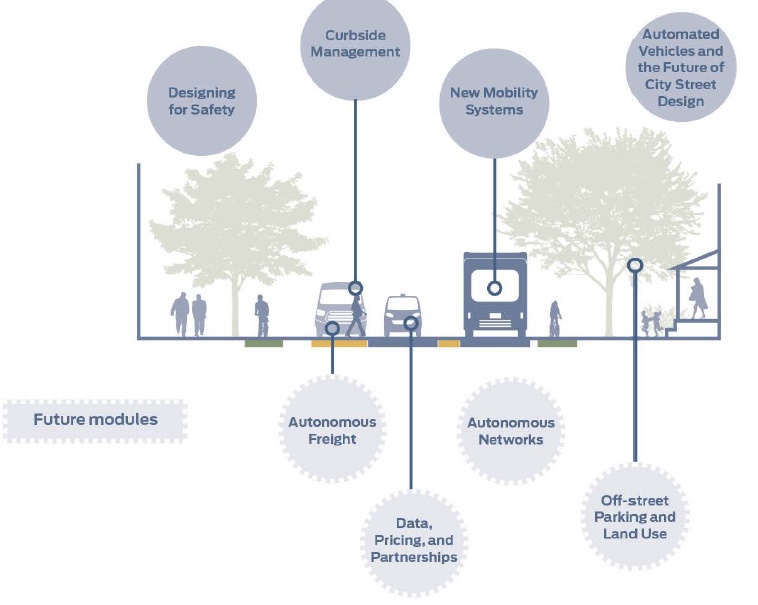
NACTO brochure: Blueprint for Autonomous Vehicle Urbanism

Cities will continue the trend to grow not so much for the old reasons (ports, highways, rivers, rail-lines) but because they offer attractive choices and experiences to live, work and play. The modern city can offer all that, the suburb can't. Key for positioning cities at the top of the heap will be to avoid the dirt, danger and congestion from old style traffic. To deliver, developers and cities must push in the  direction of clean shared vehicles and efficient modern mass transit. This will be the only way to avoid being choked by a new generation of cars, vehicles that can drive around without anyone in it. For Canton, Federal Hill or Fells Point, communities already suffocating from traffic, the future could easily be a nightmare as well.

Klaus Philipsen, FAIA


Tuesday, February 6, 2018

Bus lane enforcement

One of the few items pointing to progressive transportation policies in Baltimore are the growing numbers of dedicated bus lanes, often painted in bright red. Problem is, bus lanes don't have much effect on transit if everyone else thinks that they are a perfect way to bypass a backup.  Like many other traffic laws in Baltimore, there isn't much enforcement and lane restrictions are broken with impunity. Where going straight through a red light is common, driving on a red bus lane seems just a very small infraction. To combat this Baltimore already increased the fines for bus lane infractions and illegal parking in bus-stops when observed by law enforcement officers. This caused a flap when, even after the new fines became law, it took the City several months to code the new fines in their ticketing system.
Bus lanes in Baltimore: How to enforce?

To combat illegal driving on bus lanes more effectively, Delegate Robbyn Lewis submitted a bill with with Delegates Angela Angel and Brooke Lierman as co-sponsors. The bill is titled House Bill 749,  An Act concerning vehicle laws - Bus Lane Monitoring Cameras - Authorization.

The bill aims to take advantage of the fact that each transit bus has a forward aiming camera installed, one of about a dozen on-board cameras, which films everything happening in front of the bus in real time, including bus lane violations. To use these cameras to pursue traffic violations requires an enabling and authorization law.
Our five-mile network of dedicated downtown lanes only works if the lanes are unobstructed. These lanes have the potential to move more people, more quickly and efficiently, than car lanes. Unfortunately, thanks to our car-centric culture, drivers and delivery trucks continually obstruct these dedicated lanes, and undermine the performance of our entire transit system. (Robbyn Lewis)
As usual, Baltimore is not on the vanguard of neither bus lanes nor the question of enforcement. This has the advantage that legislators can learn from other jurisdictions who use bus cameras for enforcement. Two such cities are New York and San Francisco according to a study commissioned by the National Capital Regional Transportation Planning Board (TPB) in coordination with WMATA. The study was completed last year and has contributions from Baltimore's local brnach of Kittelson Associates. While the Baltimore Delegates were not aware of this particular study, they prudently circulated their draft bill to MTA for comment before officially introducing it last week.
intermittent sections for turning traffic

While it seems simple enough to allow buses to photograph or film violators, the devil is in the detail. Any automated camera enforcement is not seen as a moving violation in Maryland and is pursued in the same way as a parking ticket. While an officer stopping a violator pursues the actual driver, automated enforcement pursues the vehicle's owner since cameras are not allowed to positively identify drivers as a matter of privacy laws. This immediately lowers the fines from the $250 level of the City fine catalog to a maximum of $75. The MTA wants to get drivers off the bus lanes for sure, but isn't interested in a lot of additional cost to do so.

Bus camera footage gets downloaded when the bus pulls into the depot after a day's runs, but how to distill the moments of violation captured on hours of footage? In San Francisco "human officers" review the footage and issue the citations. The process poses similar problems as the ones with the red light cameras: Those "human officers" can easily be overwhelmed by the tedious task and issue mistaken tickets, for example to drivers that were legitimately on the lane. There are a good number of possibilities how one can be rightly on a bus lane: Near intersections where the right turn lane is shared with teh bus lane or in cases where the bus lane runs parallel to a parking lane and cars have to pull in and out across the bus lanes.

 A precedent for use of bus cameras to enforce traffic laws has already been set in Maryland with school buses which film traffic while they are stopped with red flashing lights and cars are not allowed to pass. Frederick, Montgomery, Prince George’s, Washington and Montgomery counties currently use school bus cameras to fine violating drivers. 
Cost benefit analysis (blue is benefit)

The MTA has employed a number of strategies to make their buses run faster and more reliable, including traffic signal priority, shorter routes and deicated lanes. The agnency reports that bus speeds have significantly increased after the bus only lanes were introduced on routes such as Pratt Street.
“With transit signal priority alone, we are seeing time savings of up to 21 percent on some downtown corridors in the morning. Combined with 5.5 miles of dedicated bus lanes in downtown Baltimore, certain routes are seeing a time savings of up to 25 percent, fulfilling BaltimoreLink’s promise of faster, more reliable transit.” Kevin Quinn, MTA Administrator. (source)
In the end it all comes down to cost and benefit. The aforementioned study provides an a Benefits-Cost Analysis (BCA) of various measures depending on their enforcement. Any number above 1.0 indicates the benefits outweigh cost. benefits are calculated as rider time savings and fleet savings when buses are used more efficiently. Apparently the fines are not included in the benefits calculation. Low cost lanes with high enforcement provide the best benefit ratio.

Bill 749 envisions that the enforcement cost shall be covered by the fines which must be spent to cover cost and "public safety" and that proceeds that exceed the cost by more than 10% should go into the general fund of the State.

Klaus Philipsen, FAIA


Monday, February 5, 2018

David Hillman's legacy

David Hillman was never my client, I met him only a few times in person and I even missed the news of his death when I traveled in India. Yet, when I learned about his passing belatedly when discussing development in College Park with Ken Ulman I was saddened and touched because Hillman had made in impression on me. I saw him as an immutable part of the Baltimore development landscape. Here is why.
Hillman in front of the historic BGE Headquarters he converted into
apartments (Photo: BBJ)

Of course, his biggest imprint as a developer may well be the brandnew hotel in College Park, an investment that exemplifies how Hillman was investing in areas where it wasn't yet fool-proof to do so. His empire is vast: The Vienna based firm manages 25,000 apartments in 78 locations, 1.5 million square feet of commercial space and three hotels.

His willingness to go where others fear to tread is what impressed me about him back in the 1990's when he came to Baltimore to rehabilitate an apartment building on Center Street (Gallery Tower) at a time when housing investments in the downtown area were not popular at all and Baltimore suffered from of those reoccurring bouts of self-doubt which he initially couldn't understand. He continued with Park Charles and the Charles Towers, maybe it was the other way round, large investments when there was at least as much hemming and hoeing going on about Baltimore's future as there is now.  Hillman asked at the time what was wrong with the people of Baltimore that they had so little confidence. It looked to me then that it took a clear-eyed outsider to see the city's obvious upsides and make a go of it.

Unfortunately, the story didn't end there. Hillman, always outspoken and direct, became one of the leaders of the redevelopment of downtown as a residential neighborhood. With 2000 apartments in downtown he learned soon enough that dealing with Baltimore City was, indeed, not as easy as he initially thought. He did a beautiful renovation of the Standard Building on St Paul Street and a successful conversion of the old Hechts department store on Lexington and Howard. With the latter he had landed in Baltimore's old shopping district and in the complicated morass that the so called "Westside" became through a whole slew of factors. Hillman, who prided himself of not needing government for his projects, did use historic tax credits and became especially dependent on city policies with his last two projects which he considered as down-payments on an inevitable revitalization.
The Standard (Oil) Building in Baltimore (Southern Management)

Except, in Baltimore things weren't set up so that focused government action led to a straight path of inevitable success. In spite of Hillman's large projects, and in spite of the government led catalytic project of CenterPoint as well as the successful opening of the Hippodrome, the Westside continued to limp along, greatly handicapped by the failure of getting the Superblock going and by risk-averse hedging of his development colleagues from the Weinberg Foundation and the overall lack of a compelling narrative what the new Westside should be.

Hillman grew frustrated with Baltimore's mayors and planners and certainly let them know. Normally not seeking the limelight, he went on the Marc Steiner show with me and a few others in 2006 to discuss Baltimore's development pitfalls and wrote an open letter to then Mayor Rawlings Blake in 2012 "to express [his] extreme dismay and shock" about how the City handled the Superblock and its selected developer. The same year he told the SUN that his apartment buildings are successful in terms of occupancy but that some don't yield enough rent to make money. He maintained that he loses about $2 million a year on the former Baltimore Gas and Electric Co. headquarters alone, pointing out that the building was assessed higher by the City than its worth, resulting in extra high taxes. Hillman was turned down by the City Design Review Panel UDARP when he tried to build a automated garage on Saratoga Street due to concerns about clashes with adjacent historic structures. Eventually he turned his attention to College Park. Ken Ulman, who advises the University of Maryland on development in College Park, describes Hillman's role there in a statement to me this way:
"David had a deep conviction for building community -- looking beyond brick and mortar to help transform neighborhoods from Baltimore to College Park, and everywhere in between. I was fortunate to get to know him while serving as Howard County Executive, but truly saw his labor of love materialize in the form of The Hotel at UMD. He deserves an enormous amount of credit for having confidence in College Park and for jump starting progress beyond the campus borders."
The $180 million College Park Hotel
Hillman didn't fit the developer cliche of the glib guy out for a quick buck. He appeared to be a modest straight shooter who took risks for long-term improvements of the communities he invested in. He didn't only build the adaptive reuse projects, he also stayed on to manage them, something one can only do successfully if quality construction has been a goal and not quick profit. He didn't start his projects as a "do-gooder" but as someone who liked the risk of the "the deal" and the art of thinking in long-term strategies. In that he was "old school" and socially conscious at the same time. That he lost his initial bullishness on Baltimore over time says more about this city than about him.

Hillman knew not only how to shoot back but also how to give back. He founded an entrepreneurship scholarship program which has this quote from him on their website:
To me, an entrepreneur is a person who thinks out-of-the-box, questions the status quo, and tries to find new and better ways to do things. We want to give people confidence to fail, to try, to walk differently than anybody else. People will be successful if they set high goals and aim to achieve them. It will make the world a better place. (David Hillman). 
Hillman died of cancer in late December. His company Southern Management has been led by his second wife, Suzanne Hillman since December 5, 2017.

Klaus Philipen, FAIA