Wednesday, August 22, 2018

1000 Friends merge with Preservation Maryland

While the need for smart growth remains undiminished, the 1000 Friends of Maryland, a voice for better and smarter growth since 1994, decided that their work will become more effective by joining forces with Preservation Maryland, a group that has long expanded its preservation advocacy beyond buildings to communities and open space.
"Sprawl costs us all": Smart Growth slogan

In an open letter to members, friends and donors, Executive Director Kimberly Golden Brandt describes the synergy between the two organizations this way:
Preservationists have long made the argument that revitalization of existing communities – and their historic places – is the wisest form of economic redevelopment. When existing communities are revitalized, sprawl is limited. This symbiotic relationship has kept the smart growth and historic preservation communities advocating on each other’s behalf for many years.
Preservation Maryland was one of the founding organizational members of 1000 Friends of Maryland in 1994 and has remained a partner throughout the years by advocating for the policies and programs that make redevelopment of historic communities and protection of open space a reality.
Healthy communities, healthy landscapes: Downtown Frederick
(Photo from Preservation Maryland webpage)
The launch of Smart Growth Maryland will further solidify this already strong relationship. Smart Growth Maryland provides Preservation Maryland with the ability to advocate for an even greater set of policies and programs that make preservation work possible. Alternatively, Preservation Maryland provides the smart growth community a unique partner to advance their common mission and to utilize historic places as a part of an overall smart growth message.
Nicholas Redding, Executive Director of Preservation Maryland issued a similar statement to his members late Wednesday of this week. For board members of 1000 Friends who have been around since the founding of the organization the decision was not easy, especially since 1000 Friends at the intersection of economic development, environmental protection, land use and transportation remained unique throughout the last 24 years. But the proliferation of non-profits for all kinds of cases has also created some kind of donor fatigue and an abundance of organizations vying for the same pot of potential funds. Kimberly Brandt describes this situation in her letter as well:
Competition for limited donor dollars is fierce. Joining forces with allies is a proven way to strengthen the mission of compatible nonprofits. As a result of this merger, both organizations will be stronger and fewer dollars will be spent on overhead and administration, leaving more funds to invest in programmatic work.
1000 Friends of Maryland report cards for County growth policies
For most of the history of the Maryland smart growth organization,  Dru Schmidt Perkins had been the spiritus rector and the face of the organization. Dru was a well known voice in Annapolis and influenced many bills around land use, transportation and environmental protection. She retired from her position in November 2017. Her successor surprised the organization with his decision to return to his home state after a short stint with the 1000 Friends, leaving the long-term financial stability of the organization unresolved. Kimberly Golden Brandt, long the trusted right hand of Schmidt Perkins, stepped up and became the ED. She will remain program director for smart growth after the merger with Preservation Maryland.
Kimberly Golden Brandt, a proven leader remains in charge

1000 Friends sold their headquarters on Calvert Street and will merge the proceeds and other assets with Preservation Maryland where their use will be restricted to the new Smart Growth Maryland Program of Preservation Maryland.
Smart Growth Maryland is administratively and programmatically supported by the staff of Preservation Maryland. Just as Preservation Maryland supports the rest of its programs (Heritage Grants, Six-to-Fix, etc.), the organization provides both leadership and support for Smart Growth Maryland. Preservation Maryland maintains an extremely low overhead rate and invests nearly 90 cents of every donor’s dollar directly into programs. (Preservation Maryland Program website)
The need for strong competency around land use and transportation is obvious with a State administration that is headed by a rural real estate developer who pursues a transportation policy which looks like a throwback to a forgotten past when more highway lanes were considered a solution to congestion and air pollution. (Comments on some of those current highway plans can be made until August 31 here).
Dru Schmidt Perkins at farewell event  in Nov 2017

A new Baltimore area regional transportation plan has been mandated by the State legislature in the msot recent session. Kimberly Golden Brandt who understands the local, the regional and the State land use perspective,  economic development and the intersection of land use, transportation and preservation will remain an important voice in the emerging process, amplified and supported by a much larger and better endowed organization.

Klaus Philipsen, FAIA

Event notification: Big Jump Block Party


Related articles on this blog:
1000 Friends CEO Dru Schmidt Perkins to step down

Monday, August 20, 2018

Self fulfilling prophecy at the Lexington Market

Like the head of a household with spouse and three children who is saving every penny towards a racy two seater Porsche,instead of tending to the oil and spark plugs of his trusted but aging minivan,  the City has neglected Lexington Market and accumulated money in favor of a fashionable glass box to replace the cavernous existing structures on both sides of Paca Street.
Demolition is the wrong answer (Current Eutaw Street facade)

The strategy of declaring the current Market obsolete worth complete demolition instead of seeing it as a jewel to be cherished and kept in ship-shape is now hitting home. The SUN reports that sales dropped 50% after a video showing a rat gnawing on cake in a bakery display case was widely shared. (Lexington Market sees business plunge since rat video).

Just like the Porsche wouldn't accommodate the family, the envisioned modern new 97,000 sf market building wouldn't accommodate all current merchants and likely not serve the current clientele. (The current east and west markets plus arcade represent 178,500 sf.) $17 million have been socked away to date Market Executive Director Robert Thomas told me during a promotional event earlier this year, money that is urgently needed to upgrade the current market. The SUN quotes Council President Young's spokesman Lester Davis describing the effort to maintain the facility while planning for its replacement as “a tricky balance.”

This high wire act is not only tricky, it is foolish. While it sounds reasonable and logical to pursue a rebuild option that leaves the current market in place until the replacement is ready for move-in, the strategy is deadly for the market if years go by to collect the money for a new market . Almost two years later there is still no firm design or timeline when to begin the $40 million new project first presented in 2016.
Fresh fish and fresh fruit: Serving the food desert

The demolition and rebuild plans hover like vultures over the current market which already suffers from a bad image, mostly based on perception and not on reality. If anything, it is the general environment and poor management and merchandising that plagues the market, not the building. The somewhat dumpy building had been visually upgraded some 15 years ago with new signage, additional windows and steel applications on the two sides facing Eutaw and Paca Streets. A 2015 report prepared by the Portland ME firm Market Ventures finds "not feeling safe" as the top reason for not visiting the market, followed by "unclean".  True or not, the rat incident and the unrest of 2015 have boosted those perceptions.
A multi story market won't work: Generic glass box proposed in 2016

The 2015 masterplan envisioned reconstruction of the east market and abandoning the west market for a total cost of then estimated as $26.7 million.

However, in 2016 the City departed from the masterplan in a dramatic way with the suggestion that an all new market building erected to the south of the current arcade and east market would be the way to go.

In February this year the City allocated $250,000 in design funds for the preparation of the design documents needed to build the new market. The initial two story design concept prepared by Murphy Dittenhafer Architects had been sharply criticized by the Baltimore design review panel UDARP for poor circulation and access, especially from Eutaw Street. Most UDARP members have since been replaced. No revised design has been presented since then. While the City has taken the path of private redevelopment on almost all other public Baltimore Markets, Lexington Market is supposed to remain a public market managed and operated by the City.

There is still time to put the plans for a new two story glass-box on hold and focus all efforts on getting the current market to work on par with its brethren around the country.

Even while the building itself isn't terribly charming, there isn't anything that couldn't be fixed for less money than an all new building. No need to throw the baby out with the bathwater. More importantly than cost, the current building deals with the 20' drop from Paca to Eutaw Street in a way that allows equal access from both sides. The sloped floor may not be ideal, but it is by far superior to the escalators, stairways and the two-story configuration proposed for the glass box.
The current  East Market as seen from the gallery

Necessary HVAC and electric upgrades in the current east building don't justify its demolition, nor does the lack of daylight. System upgrades, a set of skylights, better lighting, and new paint would solve those problems.

Beyond basic functions, most needed is a convincing merchandising concept that would ensure a good mix of market specific offerings. The West Market could initially be used as the area where merchants would be relocated during construction and later converted  to an open space as a downtown green plan by Mahan Rykiel once suggested, or it could be opened to become a covered outdoor market similar to the one in Rochester. If the West Market would become a park, the parking lot next to the east market could become an outdoor event space. Ideally, though, it should be a high density redevelopment conceived as transit oritented development right where Metro, Light Rail and buses connect.

Meanwhile go to the Market, buy stuff, help end the loop of self fulfilling prophecy.  You will be pleasantly surprised.

Klaus Philipsen, FAIA

Related on this blog:

Demolish the Lexington Market? (Dec. 2016)
"The approach is costly and the  money for such a radical project is just not there right now. Which doesn't mean it could be there in the future, but in the meantime nobody will invest a thing in the existing market, nobody will fill a vacant stall and those who are there will live in fear whether the new market would be affordable for them or would even have space for them. (It is smaller). How treacherous years of limbo can be to a market could be observed at the Cross Street Market which sits in an affluent area but began to be just a shadow of itself because its future was so unclear. For the approach to be effective it has to happen really soon."
"It would be awfully hard to brand a modern glass structure such as the one shown on the renderings as the oldest market in America. It will also be hard to convey the fondness that many people still have for the current market. Just in October market CEO Thomas wrote me that "we are actually developing our first phase plan to “transform in place” because many DO like the market as it is". 

Is the proposed Lexington Market "divorced from the street level?"  (July 2017)

Friday, August 17, 2018

Why the City could regret dumping docked bikeshare

So Baltimore City thinks it can jump to the front  of the line and embrace dockless bikes and scooters after a miserable failure with docked bike-share. Will Baltimore's mobility problems go away by ditching the docks?
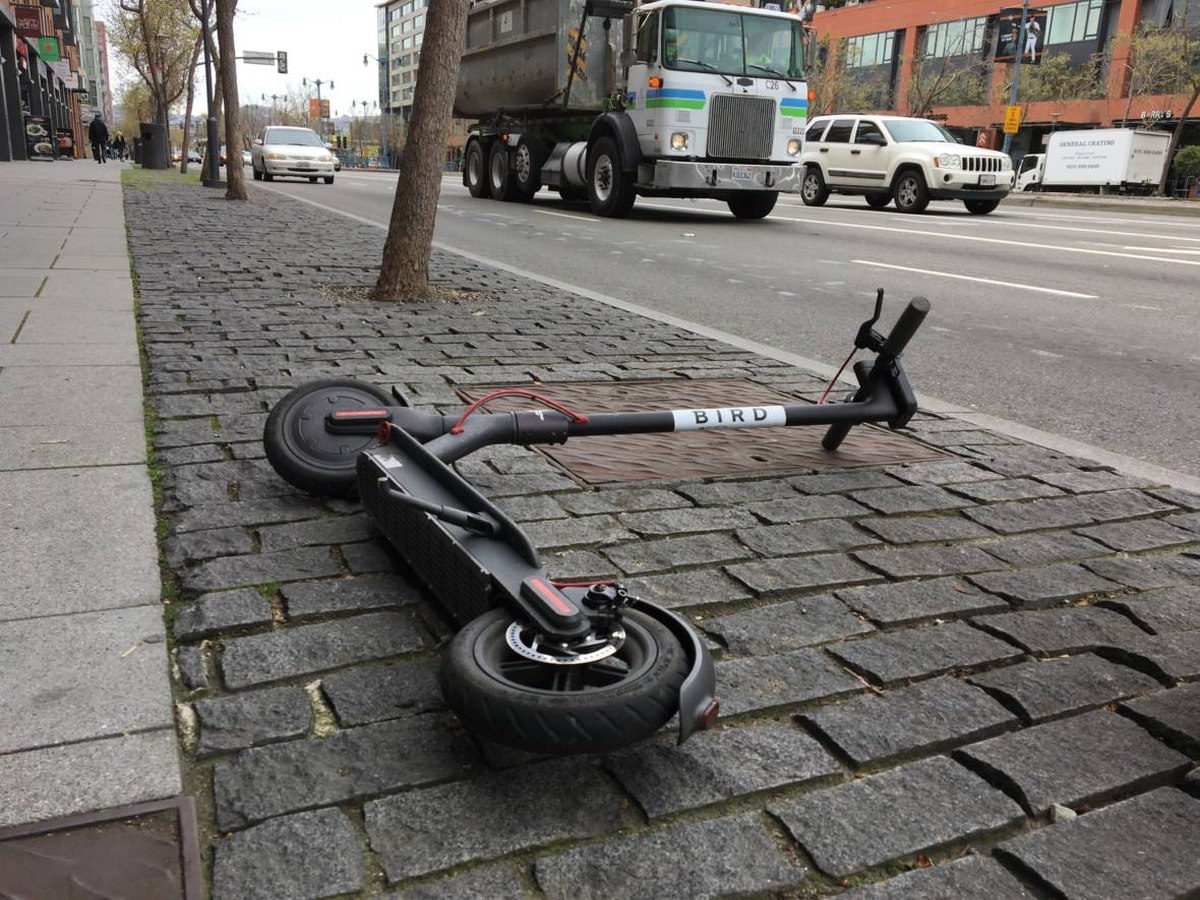
A future tied to BIRD Dockless electric scooters?

An answer requires a thorough analysis of what went wrong with Baltimore's traditional bike-share which, having been introduced a few years after other cities had gone through their learning curve, presumably benefited from those lessons. Alas, we proved unique and provider Bewegen, which by all accounts, runs the same bikes successfully in Birmingham, AL was kicked out of town. A lot went wrong with bike-share in Baltimore. We know that the majority of bikes was not in the docks or on the roads but at the bottom of the Harbor, stolen vandalized, or in a repair shop that never seemed to get ahead of its backlog. We also know that the app didn't show correctly where bikes were available and that the docks didn't withstand somebody intent on prying a bike out of its dock, even after all had been reinforced. We have an inkling that the system never carried itself, let alone made money and that most likely the private provider and the City lost a lot of dough in the process. These fragments of information do not represent a careful analysis of the successes and failures of the short life this system had here. Nor is a convincing explanation available, why Baltimore couldn't succeed with something that works in hundreds of other cities.

The City had been clearly annoyed by the way how Bewegen handled their bike share in Baltimore, and from what one can gather, Bewegen was equally frustrated with the City. With both being a party in a conflict, it isn't clear that the citizens will ever be able to truly know who is responsible for the poor outcomes.
Frivolous flooding of America's cities with Chinese capital: Dockless bikes

What one can easily see, though, is that the City's hasty embrace of BIRD, LIME and their dockless bikes and scooters has little to do that those providers manage their equipment any better or that a careful analysis showed clear advantages, nor that other cities had an excellent experience with dockless mobility in general, or those two players in particular. In fact, many cities expressed extreme annoyance with BIRD and especially with LIME for flooding their public spaces and the clutter and confusion this caused on sidewalks. It clearly seems that the City was primarily wooed by the fact that these dockless systems require neither planning nor money on the City side. DOT and the Mayor seem content with a few minimal requirements which are difficult to verify, such as equitable distribution of bikes and scooters in disinvested and red hot areas alike. Since users leave the mobility devices at their destinations, they inevitably cluster where the usage is the highest. That would be fine in a market economy based on demand, but it isn't fine in a city currently rightly glued to the equity lens.

As controversial and cynical as the debate about those electric scooters already is, with open invitations to dismember them or sink them in the Harbor, it is quite easy to imagine how the dockless devices will meet a similar fate here as their docked brethren.
In Venice and Santa Monica, where Bird is centralized, thousands of people live on the streets, which helps explain the scooter's popularity. With a press of a throttle button, one can be whizzing along, leaving it all in a blur. Bird calls this solving the "first/last mile" problem. Problem? Is it a problem for a twentysomething to walk a single mile? (LA Times Opinion)
If you think a bunch of electric scooters are the root of the Venice wealth gap and homelessness, you are deeply, deeply delusional. This is willfully ignorant, elitist drivel put up by a tired, cranky columnist in desperate need of a new lede. (Comment to the Opinion)
Where dockless bikes and scooters are common, complaints are plentiful about littered public spaces, endangerment of pedestrians and confusion about where scooters should be used. The electric scooters can easily be disabled by ripping the control board out which renders them non-usable and hard to find if the GPS locator has been discarded.

Europeans in their sluggish pace of embracing the latest trends and fads often come out ahead.  I used to find the German attitude towards Uber, in particular, quite annoying. (The service is hardly available anywhere since it was determined that Uber is a taxi service requiring licences). I haven't seen dockless scooters or bikes in Germany (they exist in Berlin and a few other places) and have no doubt, that all German cities already have a book of rules that makes it easy for cities to ban them.  But now, after Uber and Facebook have fallen out  of favor, the German authorities have the upper hand and are the ones collecting penalties, enacting privacy rules, imposing regulations and in general staying on top of the transportation network companies (TNCs). Generally, the tenor there seems to be that docked bikes are much easier to manage than dockless ones and cities don't seem eager to allow dockless bikes and scooters without scrutiny.
Solving transportation versus inducing demand: TNC's increase

Regulation-happy Germans and the inability of most US cities to manage the onslaught of new mobility technologies, both represent a lack of fantasy and creativity, making lawmakers equally incapable of managing the future.

Hardly any city has updated parking regulations for the likely complete collapse of demand for traditional self-parking in favor of fleet based dispatch logistics; or understands the spatial and planning implications of autonomous fleet vehicles for personal transport, freight or transit. There are even fewer municipal thoughts spent on drones or sidewalk robots making pizza or office supply deliveries. What do electric charging stations mean for parking or streetscape design? How TNCs need to dispatch their vehicles are not the topics on city council agendas or subject of the transportation element of masterplans even though these technologies will long be common before the masterplans expire.

As a result, New York and San Francisco have first been flooded by tens of thousands of Lyft and Uber cars and now with throusands of dockless bikes and scooters and are now scrambling to manage the damage. (New York announced strong restrictions on TNCs, San Francisco banned the scooters). The actual analysis of the problem is not coming from the affected cities, nor from the beneficiaries of the laisser fair attitude, i.e. the TNCs but was prepared by a former NYC deputy commissioner who is now a private consultant.
LIME bikes and scooter in Charlotte, NC

TNCs added 5.7 billion miles of driving in the nation’s nine largest metro areas at the same time that car ownership grew more rapidly than the population. (Schaller Consulting).
Baltimore, jumping now headlong into the dockless bike-scooter craze, has not come to terms with where scooters should ride (are they legal on sidewalks?), how they should be parked, at what speed they should be throttled when they have electric motors, who is responsible for dispatch and maintenance, nor has it imposed any kind of fee for usage of public space. Nor has it come to terms with Uber, Lyft  or the proliferation of private van and bus shuttles. It doesn't even have a convincing strategy for its own Circulator or water taxi. It must be possible to create win-win outcomes without just rolling over and let those private investors (lots of Chinese money behind dockless solutions) have their way. City planning, for example, would greatly benefit from access to the origin and destination data which the TNC's collect but not share. Why not charge license fees and require data sharing in return for a licence to use public space paid and maintained by tax dollars?

Unless Baltimore's DOT engages in a serious dialogue and with BIRD and LYME, learns from other cities and makes a comprehensive effort of studying mobility innovation and its implications, it will continue to simply react  to whatever crisis emerges. It is predictable that dockless bikes and scooters won't end Baltimore's last mile woes.

Klaus Philipsen, FAIA    updated for additional links, language, the timeline and clarity

Related on this blog:

Finally movement in Bltimore's bikeshare
Late but real: Baltimore Bike Share
Baltimore Bikeshare under water?
Secrecy and mystery around Baltimore's second bike-share nosedive

other links: 

CityLab: What ends up on the Sidewalk

Baltimore Brew provides this helpful timeline as a year-by-year account:

• 2011 – Plans for a 250-bike program are hatched – then dropped – at a time when Mayor Stephanie Rawlings-Blake is under fire for a budget that boosted downtown tourist activities while cutting recreation centers and other neighborhood services.

• 2012 – Rawlings-Blake enters into a bike share agreement with B-cycle  that requires the company to raise about $1.2 million in private funds to build the network. After the announcement, bike-sharing disappears into the maw of DOT bureaucracy and negotiations with B-cycle peter out.

• 2013 – The program pedals back to life thanks to $881,300 in federal funds. The money is to be used, in part, for start-up costs, and the program now has a new name, “Charm City Bikeshare.”

• 2014 – The city promises to launch the program after contracting with Alta Bike Share. But another setback comes when Alta’s supplier for the bikes’ software and the solar-powered kiosks goes bankrupt.

• 2014 – In come the consultants: Whitman, Requardt & Associates are paid $134,925 to look at the concept of a bike share program and help update the city’s bicycle master plan.

• 2015 – The city accepts a $2.1 million bid from Bewegen Technologies to start a bike share system. DOT rejects a much lower bid ($587,500 from Motivate International, formerly Alta Bike Shares) and a higher one (Zagster of Cambridge, Mass.).

• 2016 – Bewegen launches Baltimore Bike Share with fewer than 200 bicycles. (Its debut had been delayed by months because of what officials described as a manufacturer’s supply problem.)

• 2017 – A new mayor and a new set of problems, including poor maintenance and stolen bikes. Incoming DOT director Pourciau shuts down the program to install theft-resistant “Baltimore locks” and other improvements. Only about 50 bikes are in service when the program reopens.

• August 2018 – Pugh pulls the plug on Bike Share.

Thursday, August 16, 2018

How life-safety and narrow streets go together

In the drama of bike advocacy versus fire safety the Baltimore Fire Department lost and important round when the Baltimore City Council last week repealed a section of the National Fire Code which requires 20' clear street width and which had been used to block various Baltimore City bicycle safety projects.
Baltimore fire companies in action

Should residents begin to worry that bicycle advocates are really getting out of hand? That somehow bicycle safety trumped the safety of the general public which relies on fire trucks and ambulances to come in a pinch to safe lives?

The answer is a clear no. Old school binary thinking which pitches road safety and fire safety against each other is deeply flawed. To really understand the relationship between safe roads and safe homes one has to employ a dynamic view of safety which sees safety as the result of a complex network of conditions and not simply a numerical affair where a certain number of feet of lane width is a goal in itself. The old school approach which goes like "Either you are either for bike safety or you are for fire-safety", must be replaced with a dynamic view which sees the multiple connections between what the fire department does and road design.  In other words, the overall goal of saving lives has a lot to do with road design, but not only in the sense that fire trucks should be able to get to a fire as fast as possible. If road standards that make fire trucks faster in turn become deadly because everyone else goes faster as well. the goal of saving lives has not been met. This becomes even more evident when one considers that fire-fighting entails only about 5% of all emergency calls for fire departments. A much larger percentage deals with the aftermath of road hazards themselves, i.e. traffic crashes and other medical emergencies. The duties of Baltimore's professional firefighters can be seen on the BCFD website:
Maryland Avenue design of protected bike lanes and a single drive lane
We also provide the City of Baltimore with emergency medical services, fire suppression, basic and technical rescue, emergency communications, disaster preparedness planning and response, hazardous materials mitigation, community fire risk reduction, community recruitment, community outreach, public education, and marine fire rescue programs.
The lingo of Engine, Truck, Squad, Rescue, and Fireboat, Airflex and Hazmat companies can be confusing, so can be their dispatch patterns and the multitude of incidents that cause firefighters to rush to a scene. This renders the fixation on large fire fighting apparatus, its ladders and outriggers a bit out of place. But still, why would the fire code ask for 20' wide lanes for fire apparatus, if  this wouldn't be necessary? Can anyone seriously place the needs of bicyclists against the needs of something as elemental as fire-fighting? For a better sense of what the code requires: It asks for two full standard 10' lanes. A firetruck itself is about 9' wide (including mirrors).

The answer to these questions all go back to understanding complexity.  The width requirement of 20' for fire-lanes is anchored in the International Fire Code (IFC), a model code which States or local jurisdictions can adopt or modify. The code also gives the fire officials a right to review street design. As a result, recent Baltimore "complete street" modifications have been hung up for quite some time with no resolution in sight. Fire response times are regulated by the National Fire Protection Association’s (NFPA)Section 1710, the "Standard for Organization and Deployment
of Fire Suppression Operations, Emergency Medical Operations and Special Operations to the Public by Career Fire Departments".

To break the stalemate the Baltimore City Council voted last week to rescind the 20' lane width requirement in the adaptation of the code as it applies to Baltimore City. The fate of the bill now depends on the Mayor.
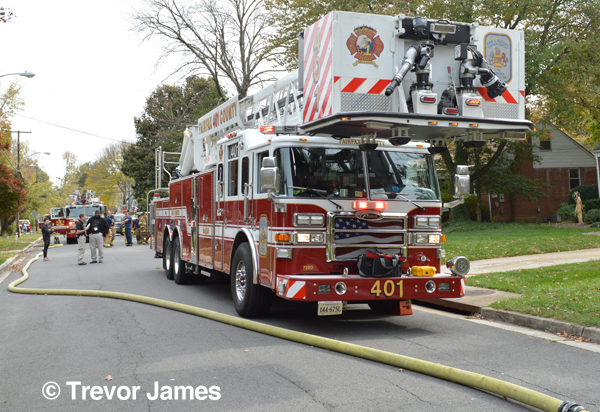
Large tower truck

The IFC 20' requirement was created not to redesign  cities with narrow streets and alleys but to give guidance for access lanes that were specifically built for fire-fighting apparatus, especially in the rear of larger structures in new developments where there are no alleys or where there is no street grid. Even though the code requirement stems from a suburban setting, the fire department expanded the requirement to all public streets, essentially stating that the roadways for access need to comply with the same rules as the lanes for fire fighting. This is not entirely without logic if one considers any point of a public street a potential operating area in the case of fire.

When confronted with the fact that very narrow roads have been part of the Baltimore fabric for hundreds of years, the fire officials easily concede this, but they don't want to create additional non-compliant conditions. This sounds reasonable enough if one employs the either-or mode of thinking.  It sounds less reasonable if one considers that lots of Baltimore Streets don't comply with the 20' rule, because of parked cars, a condition that could theoretically be changed by prohibiting curbside parking on one or both sides of narrow streets. One also has to consider that fire-fighting has worked in all those non-compliant conditions without anyone ever calling for compliance of the 20' rule or calling the substandard conditions life threatening. Lastly, the insistence on wide unimpeded lanes and wide turning radii has shaped suburbia and road design of almost any subdivision until very recently. Today we know that these suburban streets with their wide lanes and fast speeds are the most dangerous to pedestrians and bicyclists.
Baltimore house fire fought from a cross street

The call for a "road diet"didn't start with the concept of protected bike-lanes. Those battles have been raging for decades in the suburbs between engineers who are used to wide streets, rounded corners at intersections and cul de sacs turn-arounds with radii which allow a truck to turn around without having to back-up, all conditions perfect for fire-truck but bad for safety because they are conducive to speeding for everybody in or on a vehicle.

The insight that smaller streets are actually safer has led to the principles of "New Urbanism" which demand direct, redundant street grids of less width and lower speeds. New urbanist designs are now common practice in new developments all over the country and are what consumers want. In short, fire chiefs have long lost the battles for the biggest trucks and the widest streets even in new subdivisions which are designed from the ground up. There is no need to now revive the abandoned old suburban standards in the cities, of all places. After all, "New Urbanism" used historic cities as its precedent for design.
The issue boiled over in 2014 in San Francisco when the fire chief and a member of the city’s governing body, the board of supervisors, disagreed over optimal street width. The supervisors want narrower streets to slow traffic and decrease crashes; the fire chief wants wider streets to accommodate the department’s fire apparatus. The supervisors suggested the fire department look at smaller rigs. (Efficient Government, 3/16)
Enter NACTO, the National Association of City Transportation Officials, an organization founded in 1996 by a former NYC Transportation Commissioner,  ostensibly to tame the influence of car-centric standards as they were promoted for decades by organizations such as AASHTO, the American Association of State Highway and Transportation Officials. It is NACTO which also approached the issue how emergency services can co-exist with and smaller, friendlier and safer streets . One of NACTO's principles is this:
Design for the most vulnerable street user rather than the largest possible vehicle. While designs must account for the challenges that larger vehicles, especially emergency vehicles, may face, these infrequent challenges must not dominate the safety or comfort of a site for the majority of daily users. NACTO
NACTO tries to resolve the inherent conflict by differentiating between a "design vehicle" and a "control vehicle" such a a large transit vehicle or a fire truck, postulating that those less frequent vehicles should be allowed to use adjacent lanes to turn and maneuver, something has long been common practice in tight historic European cities in Italy, Spain or Portugal or the Netherlands.
The design vehicle is a frequent user of a given street and dictates the minimum required turning radius; a control vehicle is an infrequent large user. The design vehicle can turn using one incoming and one receiving lane; the control vehicle can turn using multiple lane spaces.
But those principles don't explain how apparatus would be put into position, how doors can be opened, hoses connected, ladders extended or those "outriggers" be placed that prevent ladder trucks from tipping over when the ladders (or hydraulic towers) are extended. To demonstrate how difficult those operations would be in a street with a protected bike lane, Baltimore fire fighters resorted to placing a big ladder truck on Maryland Avenue and video-tape the entering and exiting of the trucks and placing the stabilizers. The problem was, that the equipment was stationed right in front of Baltimore bike activist Liz Cornish's address which looked like spite to some. The video also didn't convince Council President Jack Young who viewed and it and found that it only showed that the operations were quite possible. Indeed, although Maryland Avenue leaves only a 11' drive lane with cars parked along a dual bike-lane on the left and other cars parked on the right along the curb, the cars don't form a continuous wall. Even if all parking spots are filled, the spaces between cars can be used for stabilizers, for opening cabin doors or for connecting hoses. Parking is already forbidden at fire hydrants, at driveways, at bus stops and near corners, all providing staging opportunities in an emergency.
European fire truck:Faster, nimbler and more agile

Games like the BCFD video charade don't help to address the possible conflict between safe streets (fewer crashes between cars, cars and pedestrians or cars and bikes) and saving lives from fast emergency response times. They can only be resolved with common sense and in recognition that both sides have good arguments and that tipping the one or the other doesn't have always the epceted outcome.

A tight grid of narrow roads can actually beat wide suburban routes if one considers that the windy roads usually mean longer distances to the destination. Suburban streets also have no redundancy, i.e. alternative routes, one blockage (such as a fallen tree) can end a trip of even an emergency responder. In a grid any obstacle can be bypassed on another route.

Solutions recognizing and reflecting these complexities are more difficult and require creativity and thought. It isn't sufficient to simply throw a few numbers around. Streets that protect users, residents and function for a wide range of users and conditions are better characterized by qualitative instead of quantitative statements. Emergency equipment along with cars and trucks have become bigger and bigger, a non sustainable journey. Just as Baltimore City uses extra small trash trucks so they fit into the narrow urban alleys, it is time that BCFD relinquishes the widely held notion that the biggest trucks are also the best trucks.

Baltimore has enough problems to solve. Animosity between fire fighters and street safety advocates should not distract the Mayor and the Council from their major tasks. Eeven though, Baltimore like to think everything is unique here, a dense historic street- grid, protected bikelanes and streets which are considerably narrower than 20' are not limited to the City of Baltimore. Unfortunately, Baltimore's statistics for fires fatalities, medical emergencies and car and pedestrian fatalities aren't very good.  Eliminating the root causes for the emergencies will always a better strategy than just a most efficient response.

If narrow streets are safer, efficient emergency response better adjust to them.

Klaus Philipsen, FAIA

Related article on this blog:
Do protected bike lanes really kill fire access?

On  the topic:
Are American Fire Trucks Too Big?

Wednesday, August 8, 2018

How the SUN move could become a catalyst for unplugging Calvert Street

The SUN's move of its offices and newsroom to Port Covington touches three questions: What will happen to the old site on Calvert Street, what happens in Port Covington and what is the future of the SUN? The answer to the last question is especially unclear: Represents the move a rise for the paper or is more of a very long sunset? But the answers to the other two questions are far from clear as well. Uncertainties represent opportunities. Baltimore needs to gear up to seize them.
Unfortunate brick modernism on Calvert Street

First announced in January the is year, the expiring lease at the current SUN headquarters on Calvert Street put the gun to the head of the SUN, although it had the option to renew the lease as well, with the SUN operations occupying only a small part of the building, not an attractive optioon, especially after the Tribune Media Company, which owns the SUN, had sold the SUN's sprawling 5.5 acre 435,000 square foot downtown facility in May of 2017 to the property management company Atapco Properties. Already in 2014 it had sold the SUN's Port Covington printing plant to Sagamore.

Atapco goes back to the Baltimore Blaustein brothers, who after a meteoric rise in oil business, merged with Exxon and later entered into real estate in 1961 with the still standing Blaustein building on Charles Street best known in the City. Atapco plans the revive the mostly dead SUN complex with mixed use, but no details or designs are known.
The SUN complex on Calvert and Guilford near completion in 1949. Note the
remnants of the elevated tracks from bygone streetcar days. (SUN Archive)

It isn't clear what Tribune Publishing, which had renamed itself Tronc for while, plans to do with the SUN. Tribune Publishing is currently in the news for trying the merge with Sinclair Broadcasting, a process that seems to have hit a bump lately. The sale of assets is never a good sign for the future of an enterprise and likely more part of the long decline of print-media than the beginning of a new rise. Sagamore didn't buy the SUN facility because newsprint was such a great investment but because the company has big plans for the area where the plant sits. So the future of the SUN in Port Covington is certainly not ensured. Nevertheless, Sagamore Development welcomed the move of the SUN newsroom and offices to their planned new town back in January, 2018 with this statement:
“We’re excited at the prospect of welcoming another tenant and continuing the on-going progress at Port Covington, Having the Baltimore Sun, an iconic presence in Baltimore since the 1800s – and most of its employees – come to Port Covington speaks to the excitement around the development and its momentum.” Sagamore Development President Marc Weller in a statement.
South Baltimore publisher Kevin Lynch, describes in detail how the SUN will be incorporated into the Port Covington plan in phase 1B of their phasing plan which began in April of this year:
The SUN complex is an ugly fortress like structure, no matter how one looks
at it. 
The Sun Park property includes The Baltimore Sun’s large building and two large parking lots south of the building. Sagamore Development is planning a reconfiguration of the 60-acre property to relocate the parking. It will also be creating a new street, “Purple St.,” to provide access to The Baltimore Sun building and new parking lots which are planned west of the building. Purple St. will be a northern continuation of Insulator Dr. at a newly-built intersection at Cromwell St.(Kevin Lynch)
While the initial phases of Port Covington keep the SUN in place, the final build-out plans envision it gone. Maybe that is symbolic for the meltdown of the paper that has gone on for so many years. On the other hand, Sagamore Development may find itself in a position where it wants to hold on to tenants and users it already has. So far, the SUN is an important business in the Baltimore economy, let alone that it's hard to imagine a city of Baltimore's size without a daily paper, real journalists who can do research and investigative journalism beyond what the online outfits can muster.
The SUN printing plant in Port Covington as seen from I-95. Friendlier
design, but already slated  to disappear

With the future of the SUN in the stars, the future of its headquarters on Calvert Street is the most tangible next thing of importance to Baltimore.  To fully understand that site one needs to look at the past, presence and future of the Jones Falls Valley.

68 years ago the SUN built initially a combined printing facility and newsroom facility, since 1988 Calvert Street is only the newsroom and office. In spite of its size the downtown location never gained any stature as a landmark or icon and did really nothing to revive downtown. One can drive by the giant complex a thousand times, and one would still not remember anything but a mass of bricks in a street that is not exactly rich in high-points except for the Courthouse Square. Going north one enters into a canyon of buildings choking the street with unremarkable facades. If Calvert Street feels decidedly peripheral, it is!

Up and down the JFX, the Jones Falls valley is a barrier, in part due to geography, but mostly because of the expressway and the land use decisions that ensued. The northern section currently see promising redevelopment that will help knit things back together even if the physical barriers remains. The Penn Station area is under complete redevelopment (See previous article here). The future of the southern end is responsible for nothing less than the future of Baltimore's historic downtown and the neighborhoods to the east. Wise planning could overcome all the barriers that have accumulated over time along the sunken river in its valley and the elevated expressway above it.
The elevated highway “is very disturbing from the viewpoint of architectural design and the impact it will have as a visual and physical barrier through the center of the city,” Local architects in 1962.
The SUN facility is part of the barrier, even though it was designed and largely constructed before the destructive freeway. Mercy Hospital and its mammoth garages and the SHA headquarters and its mega garage to the north are all part of a fortress and edge mentality. All are uses one would certainly want to keep, but all are designed as barriers because of the hostile freeway behind and the inability to have meaningful east-west views and connections. The assortment of uses on the east of the Fallsway is worse. Uses are marginal (such as BGE facilities, parking lots) or placed there because nobody else wanted them such as the prison complex.
Full build-out concept as submitted to Amazon
A much more fine-grained and permeable future arrangement should be part of a masterplan that Planning should adopt as a long-range vision. A guide that reaches far into the future would help currently being developed Jonestown and Oldtown plans and every neighborhood going north. Such a plan could build on the good work that has begun in 2009 when turning the JFX into an at grade urban boulevard had been studied.

It would also inform Atapco what to do with its acquisition of the SUN complex on Calvert Street.

Klaus Philipsen, FAIA

Sunday, August 5, 2018

Baltimore leading the nation in stress (Almost - thank you Detroit!)

One could measure the stress of a city by counting how many one encounters on a sidewalk scowling or smiling. How many are angrily screaming into their phones or yelling at each other. Or whether there are any people out at all.
Add caption

One you count how many drivers turn into crosswalks without yielding to those on foot. How many middle fingers one encounters per day. How often someone cuts into line, on the road or in a store. How many are sleeping on sidewalks, how many squeegee kids, how many asking for money.  How many can barely afford their rent, how many suffer from diabetes, obesity or ailments that go untreated for lack of insurance? How many liquor stores per city block. How many have to fear for their lives or that of their children and loved ones even when they simply go around the corner to a store?

Those would all be good ways to collect anecdotal evidence of the stress and how stress shapes our days. Those who live here know already that Baltimore is a stressful place. Travel to other cities provides additional evidence.
“The city is not merely a repository of pleasures. It is the stage on which we fight our battles, where we act out the drama of our own lives. It can enhance or corrode our ability to cope with everyday challenges. It can steal our autonomy or give us the freedom to thrive. It can offer a navigable environment, or it can create a series of impossible gauntlets that wear us down daily. The messages encoded in architecture and systems can foster a sense of mastery or helplessness.” Charles Montgomery, Happy City: Transforming Our Lives Through Urban Design (I debated his book with him on WYPR once)
Now there is a data-based study which validates the impression that Baltimore is a stresser. Baltimore sits on rank six of 182 cities total. It would be a great rank for something positive. The instigator of the study, Wallethub, describes its methodology  in which they compared the four stress factors: Work Stress, Financial Stress, Family Stress, and Health & Safety Stress, each weighing in with 25% this way:
Stress and city are often associated
We evaluated the four dimensions using 37 relevant metrics, which are listed with their corresponding weights. Each metric was graded on a 100-point scale, with a score of 100 representing the highest levels of stress.
Finally, we determined each city’s weighted average across all metrics to calculate its overall score and used the resulting scores to rank-order our sample. (Wallethub)
One could easily dismiss this list as one of too many lists already, coming from a more obscure web company to boot, wouldn't it be that those four stress categories mirror Baltimore's problem areas so perfectly. Baltimore has actual deficiencies in all four of those categories. Cities with a better stress score, no doubt, fare also better when it comes to work, money, family, health and safety.

Baltimore as stress central is especially worrisome in a period where other cities are climaxing in success and happiness and have long climbed out of the dark valley of the financial crisis.  But we are still sputtering along with our slogans having sunk from "A city that reads" to "Nobody Kill Anybody". That in itself is a stressful thought. What is the possibly smallest common denominator?
Where emotions sit: People color in their body reactions

Every Baltimorean knows the depressing metrics in their sleep: the only east coast city which continues to lose population, a singularly high homicide rate, stubbornly constant vacancy rates, long commutes, high truancy and now record opioid death rates. All this produces stress even among those not directly affected. The key to low stress is a sense of control and the feeling that things are moving in the right direction. In Baltimore any sense of control seems lost. We can't even control our traffic signals. Stressed out people express themselves accordingly. This recent exchange on the Facebook page Baltimore City Voters says it all:
Person 1: "u think it’s okay for other people to come at me sideways and I’m supposed to let it ride... Nah, slim... I don’t play that shit!!!! I expressed my opinion like everyone else. Ain’t nobody gonna come for me".
Person 2: "This idiotic woman sees a grown ass man threaten to send a 12 year old to the hospital and then threaten to “beat the shit out of him” if he sees him AGAIN, meaning one random day AFTER this incident has passed but she thinks she needs to see more ! If brains were dynamite, you couldn’t blow ure fuckin nose!"  (Facebook "dialogue" about Baltimore police arresting a 12 year old who was with his sister looking for their cat)
Whether these two people know each other, whether they meant it or thought they were joking, the tone is an indication of a high stress level. The barrage of bad indicators can wear down the most hearty optimist and city booster. How one feels about one's hometown has a lot to do with individual well being and, in turn, provides the backdrop for public perception.

Trust reduces stress. Citizens want to trust politicians, police and teachers to get things going and having good intentions. But if schools cheat on grades, police robs its own citizens, politicians are indicted trust is replaced with a feeling of powerlessness and suspicion that far exceeds the actual number of such occurrences.
Stress as a topic: Fortune 
Anybody who regularly reads my articles knows this would be a moment to mention the feedback loops: The vicious and the virtuous cycles, upward and downward spirals. It has become harder and harder to ignore the local stress, even for those who are doing well.

Progress difficult to enjoy when it is distributed so inequitably. Even simple fun (like an electric scooter) can be quickly squashed by wielding the large clubs of moral righteousness which declare the fun variably as exclusive, white, elitist, thoughtless or all of the above.

The gender gap, the income gap, the incarceration rates, supremacy, elitism, white privilege, gentrification and sexism are always at the ready for guilt and stress. In a city where so much is going wrong, it is easy, and all too often justified, to unleash those terms to accurately describe what is going on. Facebook and Twitter have become the battle fields in which the new civil wars are being fought, person against person, slur by slur and it has become difficult to find the pics of grandchildren in between it all. The victim of the wars of stress is the consensus without which a community can not make progress. The consensus that makes the people of Baltimore have a sense of common ground is lost. Stories suggest, it did, indeed, exist.

Nothing creates more hopelessness than having the light at the end of a tunnel declared an illusion or worse, light that creates more shadow for those on the right side of whatever issue. Generations too enlightenment, the Enlightenment with a capital E, that is, as seeing the light, once and for all.

Of course, it isn't just Baltimore which is caught in this conundrum, even though people in other cities seem to be a lot happier, it is the entire country which has lost the consensus what it means to be American. Hope as a concept is ridiculed by authoritarian leaders who are not plagued by any doubts (Putin, Erdogan, Modi and Trump) and stoke the fires of stress, fear and depression with ploys, that unlike good old warfare and torture, are too ephemeral to grasp, such as cyberwar, misinformation, lies, insults, election tampering, Twitter storms, hacking, and other stuff most don't even understand. Thus stress has become international. Enlightenment and the arc of history towards progress is not only once again uncertain, to many the entire idea has been suspect all along.

Weather is some kind of equal opportunity stresser.   Indeed, the happy go lucky Californians (Fremont, CA, stress rank #182) are presently choking in smoke and coughing in droughts while stress laden eastern industrial cities (Detroit, Newark and Cleveland, #1, 2 and 3 in the stress ranking) drown in floods. Climate change takes the crown as a stress inducer. Articles like "How Did the End of the World Become Old News?" (New York Magazine, July 26, 2018) are re-tweeted until the last spark of optimism is extinguished.
Surrounding ourselves with positive and encouraging people during stressful times can brighten our mood and help us put things in perspective. Who wants to be with someone who is negative all the time? There’s nothing more depressing or stressful, so avoid those who stress you out. (Tip #7 of 15 against stress, Fortune)
The best thing to do: Pack the bags, visit new places, shut off the Twitter feeds and read a good book. Of course, not everybody can afford this and pangs of guilt will reverberate long after one has left town.

Klaus Philipsen, FAIA

This blog will have fewer articles in coming weeks due to travel. 


Wednesday, August 1, 2018

The future of Penn Station

Baltimore has a tremendous asset which is not often talked about: It sits on Amtrak's Northeast Corridor (NEC), the closest thing the US has in terms of high speed rail and by far the busiest rail corridor in the country. Penn Station is Amtrak's 8th busiest station nationally, all positive top rankings that should be a strategy how to move Baltimore into the future just like the Port and airport.

With its comprehensive NEC plans, Amtrak hopes to double the 900,000 daily corridor ridership by 2040, not counting the riders which use Penn Station to ride MARC trains planning to offer an additional 16,000 seats a day on top of their current 30,000 daily trips by 2020. Penn Station needs a lot more platform and station space to process those passenger numbers and will become an economic engine in the process.

The lesser known backside of Penn Station (Photo: Philipsen)
Congressman Elijah Cummings has been promoting Penn Station for decades and he was there again on Tuesday night when Amtrak had invited to a "kick-off" event dubbed "Next Stop: Baltimore Penn Station" when he spoke to a filled auditorium in the UB Business Center.
“The Baltimore community has waited a long time, too long for the redevelopment of Penn Station” (Elijah Cummings)
In spite of the lack of strategic discussion about Baltimore's role on the NEC, Amtrak's call for envisioning the future of the station and the lands surrounding it, found a lively response from community members, transportation activists, train buffs and preservationists.

All the basics of a community planning session where there, the sticky dots to indicate the travel mode with which participants arrived, where they lived or worked and their motivation to attend. The round tables on which participants rotate from topic to topic and register their ideas, concerns and comments which a member of the project team staffs to record the essentials.
Visioning the future of Penn Station: Three rows of tables, three topics
(Photo: Philipsen)

Also part of the visioning session, the project overview and the obligatory declaration that this visioning session "was the beginning of a journey" (Natali Shieh, Amtrak), an assertion that is far from reality, considering how long efforts have been underway to get a handle on the future of the historic station itself and the fallow lands that surround it. The last step in this tiring journey was the December 2017 selection of  a master developer team consisting of developers, architects and contractors known as Penn Station Partners. The team includes Beatty Development Group, Cross Street Partners, Armada Hoffler, Gensler, RK&K and Cho Benn Holback.

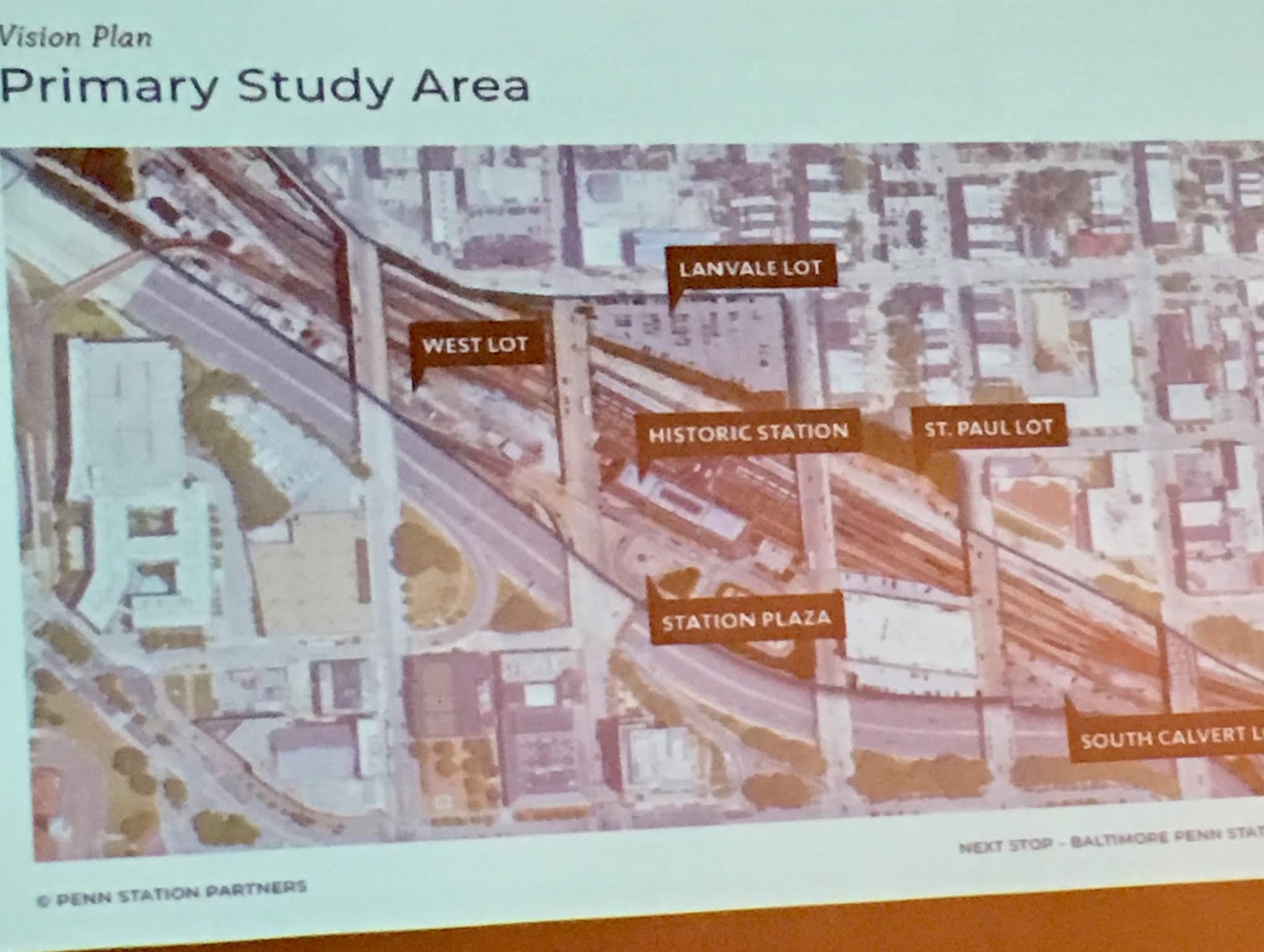
Whatever all those firms have done since December, they didn't show it in this session except that Gensler's Chris Rzomp asked a number of "what if" questions which suggested that the firm had done some initial analysis. One of the what-if questions dealt with the chopped up station plaza and its many conflicts between vehicles and pedestrians and the idea of moving all intermodal connections to the east and west of the station so a pedestrian only front plaza could be created. Another what-if question asked about taking all the transit functions out of the historic building to a larger modern building. Various renderings from the initial submission give an inkling that this design idea has been around for a while, showing a modern station hall on the north-side of the tracks. However, Elaine Asal, outreach specialist at Gensler, insisted that the community meeting on Tuesday was, in fact, a beginning.
Available real estate in the study area (Amtrak presentation)

Stripping the historic building of its main function, to be a glorious portal to train travel would be a rather alarming prospect. Technological changes in the way how people purchase tickets and how trains are operated may mean that less space is needed for ticketing, that waiting times would be shorther and that amenities would be more integrated with arrival and departure.  At the same time, changes in retail would also indicate that retail wouldn't have to play the predominant role it does in Washington's Union Station.

On the other hand, table discussions indicated a desire to open the station up to the north side and in that sense the northern station hall in Gensler's renderings is just the right move. The round-tables discussed the three topics Public space, station and transit, character and identity. Comments ranged from dislike for the Borofsky sculpture to considerations of how Washington workers could be seduced to buying homes near Penn Station in Baltimore and worries about pricing out the affordability of Station North. Several participants stressed the importance of integrating the inter-city bus service such as Bolt Bus better and make the light rail connection easier to use. The 18 table facilitators from Gensler, Cross Street Partners, Beatty Development, the Central Baltimore Partnership and Amtrak will huddle soon to distill the greater wisdom of it all.

Meanwhile Amtrak will proceed with improvements on platforms and tracks in preparation of the launch of the second generation Acela trains in 2021. Current Amtrak NEC trains reach about 150mph top speeds and sustained sppeds of about $120mph.

The hope for transit oriented development (TOD) on Amtrak owned sites near stations is part of a nationwide "asset monetization" effort by Amtrak which includes similar initiatives in Chicago, DC, New York and Philadelphia, all going through the same three part proposal stages Penn station completed. Amtrak is looking to leverage what real estate it owns towards a private public partnership (P3) that self funds facility improvements and the creation of attractive multi modal transportation hubs. One of the nation's larger P3 efforts involving a historic Amtrak station has been completed in Denver where TOD around Denver's Union Station has created a flourishing new development area.

Klaus Philipsen, FAIA
The front of Penn Station with security bollards, taxi lane and Male/Female sculpture
(Photo: Philipsen)

Penn Station hall ceiling (Photo: Philipsen)

Table topic 1 (Photo: Philipsen)

Table topic 2 (Photo: Philipsen)

Table topic 3 (Photo: Philipsen)

View south from vacant upper floors of Penn Station (Photo: Philipsen)

Old switch and signal control center on second floor of Penn Station ((Photo: Philipsen)

Old switch and signal control center on second floor of Penn Station ((Photo: Philipsen)