Wednesday, April 5, 2023

The HS Bakery Store: From Rags to Riches

I recall vividly my disappointment when, fresh from the boat in 1986, I followed my nose detecting the yeasty small of fresh baking to the H&S bakery outlet store.  The smells had been deceiving: There was no warm crusty bread ready to be sliced, there were no rolls that deserved that name. Instead the place had the charm of a wholesale grab and run where a forklift wouldn't have been out of place except for lack of space. The goods looked stale, just like the sliced white bread, the hamburger and the hot dog buns that masqueraded as the bakery section in the grocery stores of the time, except cheaper. Everything ensconced in plastic, the outlet had nothing that was reminiscent of a Greek bakery, even less of the German ones I was used to with their rich selection of different bread loaves, rolls, pretzels and sweets on display in traditional wicker baskets and served over the counter.

When a bakery becomes a "bake-lab". (Photo Philipsen)

So with great anticipation I visited H&S new bakery this week, some 36 years later when bread selections in the US have come a long way. H&S new incarnation is called Kneads Bakeshop and goes from thrift to luxury in one giant leap.  

On this warm and sunny spring day the place was buzzing. It is instantly clear that  lots of people wanted to check out how far the Baltimore icon bakery had come. 

 To cut straight to the chase: As far as it has come, the new brainchild of H&S "NextGen" isn't any closer to a European style bakery than grandfather's outlet store. I am sure, most people won't mind.

The “next gens” of the family, grandchildren of John Paterakis, teamed up to create Kneads, a bakeshop & café inspired by a shared familial history of artisanal craft, infused with the advancements in baking technology, enveloped in an elegant blend between rustic and contemporary aesthetics. The next gens, Adam, Kira, Shawn, and Ryan Paterakis, are proud to present, Kneads Bakeshop! (website)

The old thrift store in Fells Point (Archive photo from website)

It is nice to see that the grandchildren came to a consensus after the Paterakis family for years had garnered headlines for their feuding over the old man's estate. It is also nice to see that their bakery products can range beyond Hamburger buns. 

But even for folks who could care less about the character of European bakeries the product of the next-gen brainstorming may have strayed just too far.  

This isn't really a "shop" (kneadsbakeshop.com) but rather a very large well designed "wait to be seated" self-order restaurant cum gift shop plus a showcase bakery ("bakelab") operation behind glass in the background. There even is a loft to look down on the bakers in the "bake-lab". The design is from the local architectural branch of CI Design, also located in Harbor East.

While sweets get a prominent spot in a glass case at the counter where the orders are placed, the main bakery staples,  bread, baguettes, and bagels, are relegated to the side, where they are sitting in the sun of the storefront on a shelf , hidden behind olive oils, soaps and other giftshop style items. Set up for self-service, the "hand crafted" breads are once again encased in plastic bags which means, the crust will get soft, a mistake that most bakeries selling artisan bread learned to avoid.

Old world bakery (Amsterdam 2023, photo Philipsen)

Prices are generally reminiscent of a jewelry store. .Baguettes go for $4.and no bread is less than $7.   A multigrain bread costs $9, (a similar bread at Giant or Lidl costs $4.99). In the food section "two eggs any style" are $17, a hamburger costs $21 (one has to hope that it is significantly better than those $2.89 ones at McDonalds, famously featuring H&S' soft buns). A soup costs $14 and even a crème brulé desert sets you back $15. A bottle of Natty Boh can be had for a reasonable $5 but if you want to go for a glass of wine, nothing is less than $13! 

While the restaurant area is attractive and well appointed, this isn't a Vienna coffee shop where one can "park at a table", unfold the laptop and stretch a single cup of coffee for hours on end. To do this (slow food?) one would do better going to the nearby upper level of Whole Foods with its view of City Dock and the Living Classroom where one can even chill on an outdoor deck on Adirondack chairs without having to take out a mortgage first. 

Sweets and dessert display at Kneads (Photo Philipsen)

This conversion from the old thrift and wholesale  store to the new chic establishment befits the trajectory of Harbor East where Kneads is located, and there isn't much wrong that. A large city such as Baltimore should have at least one district with higher end stores and restaurants.

For the more budget minded lovers of Old World style crusty bread,  the new Kneads store isn't the only choice. 

Nowadays there are plenty of bakeries in the area that have recognized that there are, indeed, better things than sliced bread. 

Local bake shops that sell a variety of crusty old World style breads have become plentiful, even though, most of them charge significantly more than their counterparts in Paris, Amsterdam, Berlin or Vienna, for reasons that are not entirely clear. But if budget really matters, one can now get Euro style breads at Whole Foods,  at Wegman's and, even at the German discounter Lidl, where they sell for a reasonable cost. For a treat, try out Kneads, its worth a visit.

Klaus Philipsen, FAIA

Banner article about the Kneads opening


Photo Gallery (all photos Klaus Philipsen):

"wait to be seated"

The Kneads facility at Eastern and Central

Clearing the required "freeboard" (above expected high water levels) requires a ramp

Bread isn't front and center in this "bakery"

A view across the main dining room 


"All you knead is loaf"

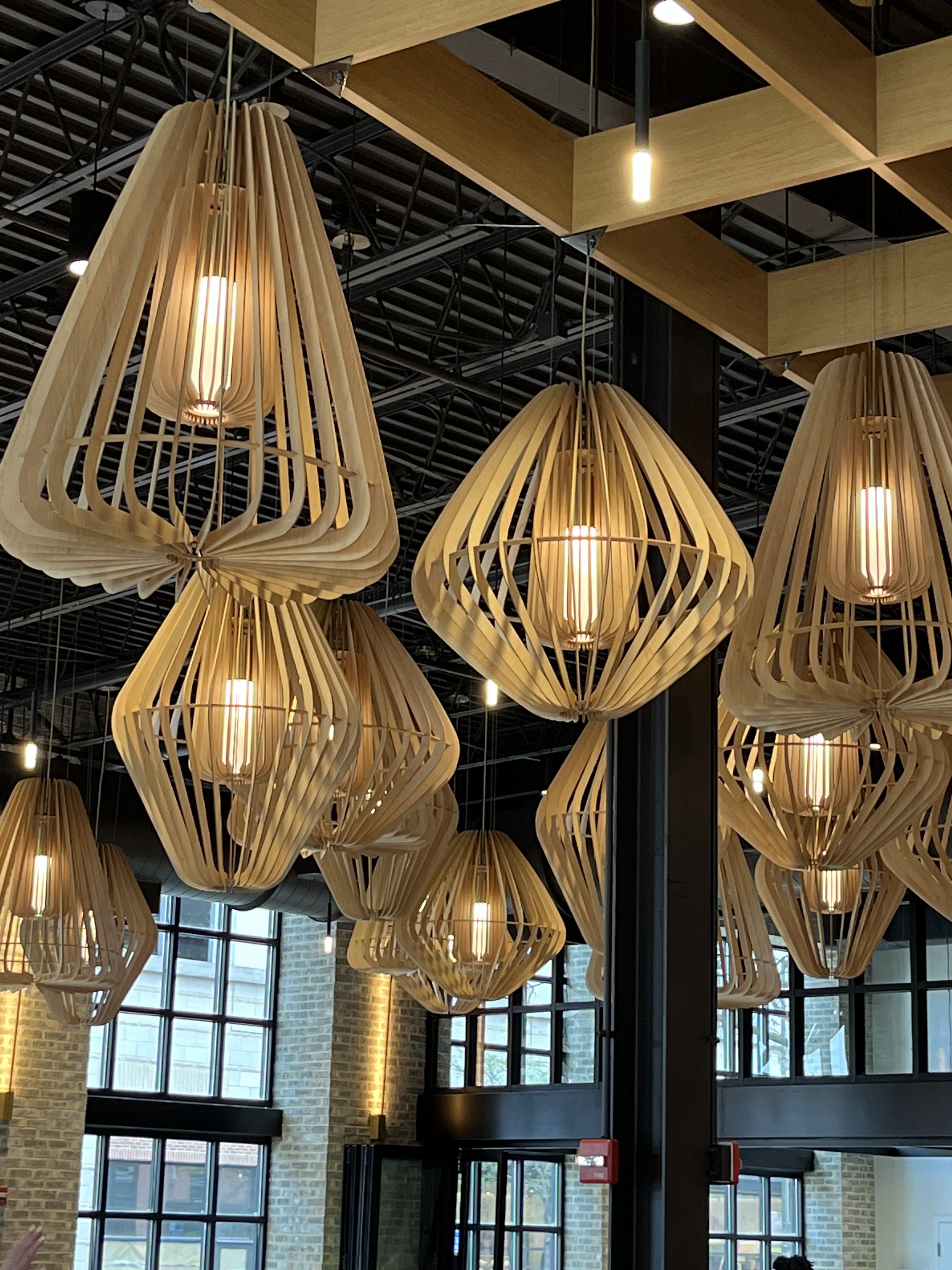
Custom designed light fixtures

outdoor seating is an option 


Friday, March 3, 2023

The loss of Sellers Mansion: “All or Nothing “ in Historic Preservation?

The loss of Sellers Mansion is the story of the decline of Harlem Park and Lafayette Square and the story of a shrinking city that often can't save its cultural heritage. But is it also the story of historic preservation stands in its own way in a reality in which historic landmarks are often in such dire straights, that the alternative is historic preservation or total loss. In such a stark choice, should preservation of a landmark have to fully adhere to the Secretary of the Interiors's Standards for Preservation? 

Sellers Mansion 1955 (SUN Archive)

Or is the question a different one? Should an owner purchasing a historic landmark be responsible for protecting it from deterioration and catching fire? Are owners suspect to hope for "hot demolition" or "demolition by neglect" if official demolition won't be permitted.

Let's parse out what happened in the case of the Sellers Mansion and then see how the bad outcome of total loss could potentially be avoided in the future.

Baltimore's Sellers Mansion had stood for 155 years first witnessing Harlem Park as the cutting edge of Baltimore's urban development and subsequently the urban flight, underinvestment and decay that followed. The mansion held up well well for a century. Even in1960 when affluence had left Harlem Park, it had been carefully restored and adapted for community uses. Neither "redlining" nor the "highway to nowhere" had been fully realized yet, but the ugly practices of segregation and racism had long begun to cast their long shadow over the churches and brownstones of Lafayette Square.  Then decline came rapidly. 

Sellers Mansion 2023 a few days before the fire
(Photo: Justin Hillman)

CHAP: The Sellers Mansion is architecturally significant for its late-High Victorian styling featuring Second Empire elements. The craftsmanship and fine architectural detailing is remarkable and a wonderful example of an opulent and comfortable residence of the socially affluent in post-Civil War Baltimore. The mansion is often compared with residences such as the Mt. Vernon mansion located at 105 Monument Street, which has a similar proportion and styling that Edwards Davis was emulating in the Sellers new home. The Sellers Mansion is a completely detached three-story building, five bays by eight bays with symmetrically placed windows. Sitting on the corner lot, the “front” of the mansion faces west onto the square.

In the last 55 years the building changed hands a number of times, no owner pulling off an adaptive reuse, until the mansion stood abandoned for pretty much all of this century. The decay had progressed to a point where the leaky roof rotted the floors until fthey fell even before the current owner, Ernst Valery had bought the building in 2018 to make it part of his "Care Haus" project in combination with the adjacent building. Attempts of stabilizing the roof from the outside failed when heavy snow made the the roof cave some years ago. In 2021 lightning struck, but that fire was quickly contained. The roof kept leaking.

Then last week a three alarm fire gutted the roof of the mansion entirely with a portion of a wall falling. The city bureaucracy acted swiftly and began tearing the still hot building down the very minute the fire fighters had declared the blaze extinguished. The owner stood to watch. He told me "the walls were swaying". He gave the media his view of what happened. 

Sellers Manion after the fire 2023 (Photo: Johns Hopkins)

“If your business is in preserving buildings, you can’t be all or nothing, because a lot of times when you’re all or nothing, you end up with nothing, and unfortunately we’re ending up with nothing,” (Ernst Valery, developer and owner as quoted in the Baltimore Banner)

Why was the building standing in limbo? Valery wanted to adapt the building to house 15 senior apartments, an approach that reconfigured much of the interior, including the former grand stair. The proposed design also included exterior modifications such as an addition for an elevator and a roof deck cut into the mansard roof. Valery's plans were developed with the help of a historic preservation consultant  had been approved by the city preservation panel CHAP with some cautionary note about the roof deck. CHAP looks only at the exterior modifications when they consider a landmark. 

That could have been enough to green-light the project, but Valery did not only want the local preservation tax credits, but also the state and federal tax credits which in combination can be 40% of the eligible rehabilitation cost. Such an application requires review by the Maryland Historic Trust (MHT) which brings the interior of the mansion into play as well. Valery's adaptive re-use ran into the buzz-saw of the rehabilitation standards of the secretary of the interior and their interpretation by MHT. The state agency has a certain discretion but generally follows the ten standards which have guided buildings under historic preservation protection since 1977. 

Sellers Manion, demolition in progress (Baltimore SUN)

Part of the problem is that these standards were not developed with buildings in mind that have stood vacant for decades and are in danger of falling down under their own weight. Nor did they envision conditions where the real estate market is so depressed that even the fairly generous historic tax credits can't make up for the cost burden historically accurate rehabilitation brings with it. For the interior of Sellers Mansion to stay organized around the grand stair only six apartments would have been possible, not 15, a significant difference for a developer who has to consider the cost effectiveness of the project. 

Cost effectiveness in Harlem Park looks vastly different than, say, in Federal Hill or Fells Point, two of Baltimore's more affluent historic districts. Valery sees the strict application of the same preservation standards across vastly different neighborhoods as a continuation of policies that have disadvantaged these communities for such a long time. 

If MHT doesn't approve the tax credit application, not only the state 20% credit but also the federal 20% credit is blocked, regardless whether the National Park Service would like and accept the plans. My request for a comment from MHT was denied. Valery's take is that he as a minority developer in a disinvested community was the victim of a rigid interpretation of the preservation standards. In his view MHT was failing to recognize the precarious condition of the Sellers Mansion and left him in limbo "with no recourse". This accusation comes at a time when the City is reviewing its own tax credit programs and has discovered that its local preservation credits  predominantly go to the more affluent CHAP areas. 

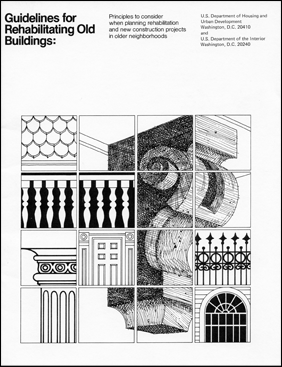
NPS Standards for Historic Preservation 1977 (NPS)

The distribution of this credit tracks directly to neighborhoods that have either a local or Federal historic designation. There are currently 87 historic districts in Baltimore that include approximately one-third of the properties in the City. Although the credit has been granted in 81 different neighborhoods in Baltimore since its inception, it does not reach all neighborhoods equally. The neighborhoods with the greatest count and dollar value of tax credit granted are among the highest per capita income areas of the City.(Report)

The loss of the mansion also falls into a time when CHAP has began a discussion to create a "lower grade" preservation category called "conservation districts" in buildings that are neither landmarks nor located in a designated CHAP district but sit in a "National Register District". Such a designation is currently under consideration at a committee studying the matter.

How could one avoid that a historic landmark falls in such disrepair only because it sits in a distressed area? How could owners be incentivized to stabilize a landmark building even before their plans are approved? How could the state tax credit process be streamlined to provide more certainty for developers who have to finalize their "capital stacks" before they can begin construction? How can premature demolition after a fire or partial collapse be avoided and the public safety be guaranteed at the same time? How can the federal standards be adjusted so they reflect the realities of Beverly decayed landmarks?  

 Here some ideas:

  1. Historic stewardship: A local law should be passed that requires purchasers of vacant landmarks to secure them in such a way that they are stabilized and do not deteriorate further while further steps are investigated. For this purpose stabilization funds should be made available tat would have to be repaid if a project doesn't move forward.
  2. Federal and State law could be modified so that vacant historic structures whose condition is severely impacted by decay and vacancy have more lenient standards regarding interior alterations. The criterium could be that rehabilitation cost at or above the cost of building new 
  3. A local law could give the chair of the historic commission (CHAP) the right to invoke a 12 hour delay on demolition to get a second opinion on stability and alternatives to demolition wherever alternative measures can protect public safety (such as closing a larger perimeter etc.)
  4. State historic tax credits could be guaranteed when compliance is achieved giving owners certainty instead of several annual applications and their associated delays. A state bill that was signed into law in 2022 already increased the available funds. To avoid that this would blow the State budget the credit could potentially be tied to a prove that they are financially not feasible without the 20% historic State tax credit (similar to TIFFs).
 Metrics for a reform package include:

  • Reforms should provide carrots and sticks  i.e. additional burdens on owners would be offset by additional benefits or an easier path towards benefits. 
  • Reforms should maximize the economic benefits to the community: Historic preservation tax credits have shown to be good investments in that for each tax dollar forgiven between three and five additional revenue dollars have been created via economic development and better communities.
  • Equity: Better equity in preservation should mean that historic assets that are severely compromised should not face a much more arduous route than those in better shape in more affluent areas. The goal is to have as many preservation benefits accrue in disinvested communities as in affluent districts.
Baltimore has a rich history and generally also a good record of historic preservation just not applied in an equitable manner. Historic districts perform better for building evaluation and community stability. It is high time to bring these benefits to the areas of the "black butterfly" which have wonderful historic buildings, except that they are often neglected and in bad shape through the systemic disinvestment that occurred over decades. 

The Sellers Mansion fire should be a wake up call that highlights the problems of historic assets in disinvested and burdened communities. The finger pointing regarding whose fault the loss of this structure was needs to give way to a constructive way of moving forward. The above suggested reform package should kick off a constructive discussion about the right steps towards avoiding another loss like the one on historic Lafayette Square. Each of the suggested measures has to be tested for unintended consequences and for how it could work optimally in concert with the other measures. 

The strong Baltimore advocacy community of Baltimore Heritage, Preservation Maryland, CHAP, the local chapter of AIA and many local conservation stewards should make it a priority to collaborate on a strong reform package that makes historic preservation even more successful, equitable and beneficial in all of Baltimore's historic neighborhoods. 

Klaus Philipsen, FAIA

The author was architect and preservation consultant for a number of completed projects including dilapidated buildings which successfully used state historic tax credits. 

Thanks to Tom Liebel FAIA, former chair of CHAP, Johns Hopkins of Baltimore Heritage, Eric Holcomb, City CHAP & Historic and Architecture Preservation Division Chief and Ernst Valery, of EVI Development for their insights in discussions leading up to this article.

Resources:
https://www.thebaltimorebanner.com/community/local-news/firefighters-battle-3-alarm-blaze-at-historic-baltimore-mansion-SJSNG2NFN5CTJJJCWA3BUUGEZU/

https://baltimoreheritage.org/fire-at-the-sellers-mansion/


Monday, February 6, 2023

Seven suggested Principles for the HarborPlace Redevelopment

So many ideas

Politicians, planners, architects and pretty much everyone interested in Baltimore have ideas for Baltimore's most infamously ailing and failing creation, HarborPlace, once the star of the city's renaissance.

Inner Harbor MasterPlan Harbor 2.0  (Ayers Saint Gross, 2013)
Ideas were created before it was clear that Baltimore developer David Bramble would acquire the buildings. The most comprehensive and far reaching was  Ayers Saint Gross' Harbor 2.0 Masterplan from 2013. The probably most creative and whimsical suggestions come from the founder and now retired director of the Visionary Art Museum, Rebecca Hoffberger.

Suggestions range from demolishing both pavilions or at least one to preserving both as market sheds (Lehr Jackson) to building high rises in their stead (Architect Craig Purcell). Architect Peter Fillat suggested to put convention center hotels in a volume that wouldn't be bigger than the pavilions. 

Meanwhile Bramble who refused to provide any ideas himself because he didn't have site control has now taken possession of the pavilions and is ready to embark on a public process to find out what people's aspirations are. Bramble had called HarborPlace Baltimore's "front lawn" a very suburban term and concept. I'd prefer to state the same idea in more urban terms such as "piazza, plaza, or square", all terms that define public gathering spaces which are perceived "commons" of a town or city to stress the public aspect. 

Rebecca Hoffberger proposes a "roller coaster bridge" (TBC)

The privatization of public space

HarborPlace has long suffered from tension between private and public (what is allowed there, who polices it and who is responsible?) based on a baked in ambiguity between public and private: The ground is owned by the City, the buildings are privately owned. So when the private side did no longer take good care of their buildings and operations and let the initial intentions evaporate by cheapening the pavilions to junk bond status, the public begin to lose a cherished asset and public amenity. This loss was comparable to the decline of the malls in the suburb which had taken on the role of communal spaces.   While private enterprise and public benefit can work hand in hand, quality urban communal spaces should never be left to the mercy of private investors. 

Generations of urban theorists, from Lewis Mumford to Jane Jacobs to Doreen Massey, have suggested that the place where cities get “remade” is in the public rather than private sphere. (Urbanist Bradley L. Garret in the Guardian)

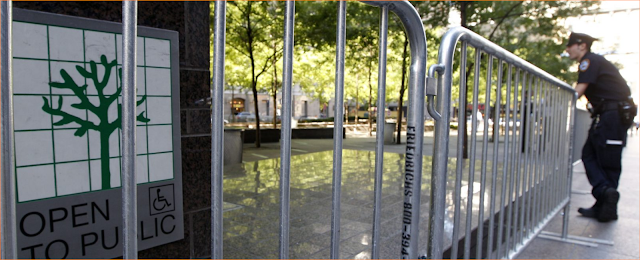
Empowering the public with a space they "own" in same way as "commons" or central plazas do would expand on the notion of McKeldin Square  as a "free speech" area which gained traction during the Occupy Wall Street protests. A strengthened public component at the Inner Harbor would be an important element in the ongoing Baltimore discussion about what should be allowed and banned in public spaces. 


How Privatization Impacts Public Spaces And Infrastructure


How to structure a design discussion starting with consensus on outcomes

From my professional experience I know that it is easier to build consensus on principles than on solutions but that most debates begin with solutions, nevertheless, long before there was an agreement on goals, objectives and desired outcomes. Sometimes solutions are debated that are in search of a problem. 

Starting out with guiding principles can positively define a process from early the discussion towards a consensus on solutions especially where the problems are complex, the solutions arenet obvious and where creativity is needed. Once alternative solutions or designs are developed, the guiding principles can be applied as the metrics by which the suggested solutions are evaluated and compared. It is amazing how often projects were selected based on irrational or political preferences without actually solving the problems they set out to solve or without achieving the outcomes that were initially desired.

Rebecca Hoffberger illustration of an observation tower (TBC)

So here a set of guiding principles that could get the discussion going. But before proffering my own list I want to mention something Rebecca Hoffeberger shared with me in a phone call about Harborplace. Her Leitmotif : "Whatever you do, it must have an element of fun"

Guiding principles
  • Embed the future of the pavilions into a broader planning context that includes McKeldin Plaza, Light Street and Pratt Streets all surrounding uses
  • Make the power of the waterfront felt blocks away so the surrounding areas relate and connect to the waterfront design in a cascade of expectation
  • The redevelopment should support the role of the Inner Harbor as Baltimore's "public square"
  • The redevelopment should serve residents and visitors alike and reflect the diversity of its users
  • Water and the history of the harbor should be thematic anchors for design and programming
  • The redevelopment follows best sustainability practices that include waste reduction (avoiding demolition if possible), resilience and energy efficiency
  • At no point during the redevelopment should the area be entirely closed down or sit fallow, there must be pop up and possibly temporary uses and attractions in or around the pavilions at all times (sounds like you said that when you talked about giving the pavilions uses)
This list isn't meant to be adopted or taken as anything but an illustration of what it would mean to begin this important project on the basis of publicly accepted principles. Developing principles should be the first step of meaningful public participation. 

Klaus Philipsen, FAIA

Related articles on this blog

Wednesday, January 11, 2023

Lutherville: Why "lovely suburbia" is in fact the cause of many troubles

 “Why can’t we just keep our lovely suburbia?” (Resident, Greater Timonium Community Council in a public meeting)

Sometimes real life provides quotes that are better than anything you can make up. The above exclamation is such a case. It is a headscratcher for the fact that few people would America's standard edition suburb as a thing of beauty. Especially if one knows the 13 acres of land in question that caused this exclamation, a largely defunct shopping Center between York Road and the Central Light Rail in Lutherville, the shopping center as well as the LRT station known as the Lutherville Station. Ok, the shopping center is a sea of asphalt, no green, non descript boxy buildings, in short: It is ugly. And so is pretty much everything else lining York Road a mile south or a mile north. 
Big, ugly and underperforming: Lutherville Station as seen from
the light rail station with the same name (Photo: Philipsen)


But maybe the "lovely suburbia" isn't meant so literally. Maybe it means the people, lovely people versus not so lovely ones? There are certainly many folks who took the NIMBY revolt in Lutherville that way, myself included, when I suspected "classism and racism" as noted in an article in The Baltimore Banner. The Lutherville dispute has been all over the media. (Here, here and here).

Many residents of the Lutherville Timonium area seem to oppose a transit oriented development proposal submitted in September last year on principle.even though the area in question is well removed from residential neighborhoods and surrounded by large lot commercial development. Too many apartments, too much traffic, not enough public input, not enough open space, not part of the masterplan and too much impact on overcrowded schools. The arguments run the gamut, not to mention statements about apartments and transit that are uttered on the sidelines. 
"There is a petition with thousands of people signed. They're against it. We just don't want the crowding," (Community member)
The well organized community associations have organized packed meetings to express their opposition. However, in all the outcry it hasn't become clear what the community really wants or what they suggest should be done with the large property. In many ways, the conflict has less to do with good planning and looks more like one of those currently popular culture wars.

Maybe "lovely suburbs" stands for everything that is the opposite of "urban" or "city", a verbal and mental relic from the 1960s when people fled cities in droves for the suburbs and when the word "city" became bad currency, associated with crime and grime, pollution, congestion and just about anything else that was bad. As everyone knows, the City- County construct was antagonistic with deep racial overtones, all the way back to when a constitutional amendment forbade the City to annex County land.  

But for the last 30 years cities had a great comeback and young people wanted to be in them, not the suburbs. New York's renaissance maybe the most famous example, but Nashville, Phoenix, Cincinnati or Philadelphia not far behind. The suburbs had lost their luster and cities were back, once again, although in Baltimore that was less obvious. Covid put a dent into the trend, but it won't last, even though some saw an opportunity to dig up the past with its unreasonable fear of the urban threat now brought in sync with a renaissance of populist hate of urban elites, an unlikely pair of red herrings. It isn't quite clear if transit coming from the city would bring criminals stealing TVs or yuppies that gentrify everything in their past or both. Hard to tell!
A sea of asphalt and parking isn't "transit oriented development
(Google Maps Screenshot)


All this comes to mind if one wants to measure not only the pulse of the Lutherville Station redevelopment debate but diagnose the maladies behind the high pitch noises that tend to come up every time there is a discussion about transit, transit oriented development, density or multifamily housing, or a diversity of incomes or uses in one area. 

The Lutherville debate encapsulates all of these aspects and each one represents a national crisis that also applies locally: A crisis of transportation equity and access, a crisis of  insufficient housing and finally a crisis about how unsustainably we use land..

Let's recapitulate what we have:
  • 13 acres of underutilized commercial real estate close to the Baltimore Beltway, I-81 and adjacent to an existing light rail line
  • a developer who thinks that there could be a better and higher use than half vacant retail .
  • A proposal for "mixed use" with 400 apartments, offices and retail and 2.5 acres of open space. largely mimicking the existing building heights and massing
  • An underperforming 30 year old light rail line
  • A single family neighborhood to the west of the north-south rail line with no formal pedestrian access to neither transit or shopping
  • A transit study investigating the options for an additional  north south transit corridor between downtwon Baltimore and Towson that would use the nearby York Road corridor and connect at Lutherville. 
  • Several alignment options for this new transit corridor would take away road space from York Road, a State Highway (MD 45) 

In the 30 some years since the station was built no
better connection into the neighborhood was created
than this dirt path on which one has to balance
across the Roland Run creek to get to the homes
(Photo: Philipsen)
It is no overstatement to say that the populist attitudes against transit, mixed use and density are in part the cause the cause for  the housing crisis, the climate crisis and the transportation equity crisis. 

The current light rail line is underperforming precisely because each of the jurisdictions the line traverses failed to change zoning so more people would live and work  near the stations and bring riders to the system. As a result far more people drive than would be necessary. 

As a result of failed land use planning, employees without a car have three times the commute times of those who drive, because where people live and where the jobs are isn't properly connected by anything but roads for cars. 

There is a housing crisis because somebody always objects when denser or more affordable housing is proposed. Finally, we have a climate crisis as a result of all of the above. Sprawl is the least sustainable form of land use there is, driving up the CO2 production of inefficient buildings as well as that of transportation (in the US each representing 40% of total CO2 emissions respectively.) To boot, as a letter writer to the SUN points out, the "lovely suburbs" are also fiscally not sustainable and tend to slide into worse predicaments than the maligned cities.

The suburban development pattern combines the openness of rural communities with the infrastructure standards of urban communities. The result is communities that are impossibly expensive to maintain (given the tax base). Extending the reach of roads, water, sewer, trash pick-up, etc., throughout (low-density) suburbs requires tremendous resources, both up-front and ongoing.
A train without development: Vast amounts of underutilized lands

Property taxes fall significantly short of covering the high cost of maintaining everything that many suburban residents have been led to believe are givens. The only reason our suburban pattern of development has been able to continue on for as long as it has without collapsing is because of constant growth, a set-up which amounts to a Ponzi scheme. (Strong Towns Baltimore)

The just re-elected County Executive Olszewski has all hands full trying to steer his county out of the treacherous "culture" of glorifying the suburban life as a juxtaposition to city life. His counterparts in Howard and Anne Arundel Counties are on a similar journey. In their second terms they all have an opportunity to show that no crisis can be mastered by simply listening to the loudest NIMBY opponents  who don't want to see any change.
 
"I asked [Olszewski] to put a halt to the process. He has. He's held it back from the planning board for their approval or disapproval. I think that the TOD is not the right way to go," (County Council Wade Kach on Jan 11,2023)

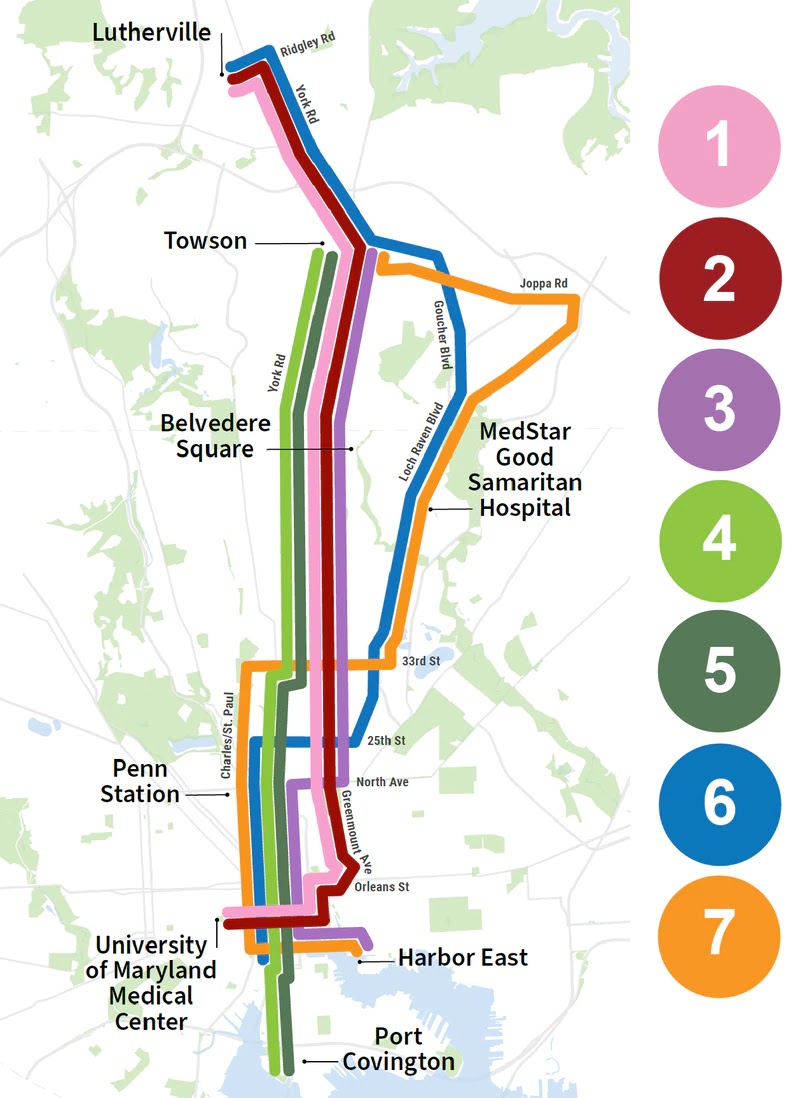
Alternative alignments and modes under study
for a City to Towson corridor
No crisis can be overcome without change and this is especially true for the housing, transportation and climate crisis. To bring down the high US emissions of transportation and buildings requires more transit, denser land use in the appropriate locations and the redevelopment of underutilized land of exactly the type we see at the Lutherville Station. Once a mixed use development with quality open space would be completed, the quality of life in the area will go up, not down. There are many examples of this around the US. Maybe one needs to put the opponents and the developer on a train and show them really successful TODs in other places.

Klaus Philipsen, FAIA

The article has been updated


Proposed concept plan from the developer's
PUD application


Friday, December 16, 2022

Baltimore: From sideways to upwards?

Why can't Baltimore stop its decline?

Why is Charm City known for its historic architecture, its neighborhoods and its quaintness as a quirky "Smalltimore" as well as a  city of firsts with the nation's first passenger railroad and the first gas light, a waterfront revitalization that became a global blueprint for industrial waterfront conversions and a ballpark that became equally influential the only city among peers that keeps losing population, Harbor East, Brewers Hill/Canton Crossing, McHenry Row and HarborPoint, Clipper Mill, Silo Point and TidePoint notwithstanding? 

How to get from a tangled mess to success?

Some use psychology to explain and combat the City's shortcomings attesting Baltimore an inferiority complex and lack of self esteem. Or describe the issues in terms of family relations: Baltimore suffering from sibling rivalry with its much more famous sibling Washington DC which overshadows everything we do, even though DC was smaller than Baltimore as recently as 2010, plus it is the younger sibling by nearly six decades. Of course, there are also social explanations such as systemic racism and the large social disparities it created. In this space I will try to explain Baltimore's problems to turn around in terms of systems and feedback loops. 

Baltimore isn't a backwater where nothing happens. The City continues to generate large projects that are all described as "world class", "game changers" or as "the biggest in the nation". All those projects are supposed to, in one way or another, pull the city out of its spiral of shrinkage and crime. We will set aside for a moment the mounting evidence that building big stuff isn't necessarily the right solution for societal woes. Physical projects alone won't do it anymore without having social components, such as community benefits agreements. In real estate there is much talk about impact investment and ESG. Regardless, why do these project never "change the game" in Baltimore? Why can't we pull off what Boston and DC could do, or Nashville and Chattanooga? Those cities are well beyond their tipping point and never looked back. 

Charm City

Let's take a look at projects in Baltimore, then and now, and what worked and what didn't.

Duds instead of "game changers" 

The currently most widely known mega project is perhaps Port Covington ("Baltimore's Port Covington to be the Silicon Valley of athletics wear", Archpaper, 2018), which at one point even competed to attract Amazon's headquarters. A few years after its introduction the project has already lost its luster. People are cynical about it, in part because many "game changers" before had been welcomed with enthusiasm but are almost forgotten now, because they failed to deliver what had been promised.

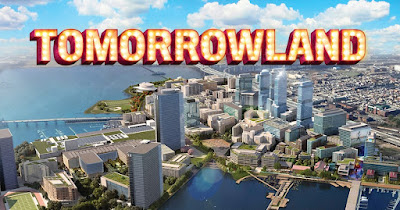
Remember Baltimore as a center of biotechnology with not only one, but two bio-parks at Hopkins and the University of Maryland that were supposed to put Baltimore on the map of biotechnology? ("The future of Baltimore's biotechnology industry remains to be seen. Industry observers put the city up to two decades behind the biotech hub that has taken root along the Interstate 270 corridor in Montgomery", Gus Sentementes in the SUN). Remember the concept of the digital harbor with Baltimore becoming some sort of Silicon Valley of the East with Tide Point as the catalyst?  Remember "the West has Zest", a slogan to promote the revitalization of the entire Westside of downtown with the Hippodrome as a catalyst?  Or recall Baltimore developer Jim Rouse's dream 30 years ago to revitalize Baltimore's then poorest neighborhood, Sandtown as an example that would guide cities across the country?  The list of high aspirations tied to large projects is long. None of the noted projects went into the history books as a "lighthouse" project that would shine a path for cities to pull themselves up by their own bootstraps
Game changers: Hype and reality

Too many big projects and ideas are either limping or never made it off the ground. Baltimore's big transportation projects are a league of its own, mostly with projects that belong to the category of limping or aborted. The half baked nature of Baltimore transit projects presents a pervasive pattern that may well be called the "great Baltimore sideways slide" and stands in contrast to, for example, Washington DC's transit story which one could describe as the "great DC stepladder". Starting with the highway plans which luckily were aborted a long time ago, continuing with the Baltimore subway, the Baltimore Light Rail Line, and finally the Baltimore Red Line, each conceived to be the public transportation solution that will be a worthy successor of Baltimore's once extensive streetcar system. But none of them could save Baltimore from the reputation that it just doesn't have good public transit. Even the MARC commuter train system is at best ambivalent. The commuter trains emanating from Baltimore are said to be the fastest commuter trains in America with speeds above 100mph and are generally highly regarded, but people in West Baltimore have to board via stepping stool, the system uses diesel engines on an electrified line, and with many federal workers still not fully returned to their offices, the rail system is desperately needing riders.

Baltimore's Urban ADD is pervasive. It looks feverishly for a new topic, pulling away attention and resources before the initial catalyst that isn't anywhere near complete. The malaise is not limited to big projects. The much touted first bike-share project failed spectacularly before it ever really worked, in part because the new scooters looked sexier than the bikes and DOT was busy handling those. Both, though, require a workable and well implemented "complete streets" strategy for these modes to function successfully. The wonderfully progressive Baltimore Complete Streets policy is littered with the corpses of abandoned or badly mangled bike lanes and road diets.

Pop up and no follow up
"The big jump" once had all the headlines as an innovative multimodal pop-up installation. Now it has only shards of glass, knocked over stanchions and barrels and does nothing but stain the reputation of bike and ped-ways even before they are proposed. Even after several years in the making, no cohesive bike lane system has emerged; even the one successful bike facility on Maryland Avenue sees little love, maintenance,  or enforcement against folks using it for parking. A previously much touted Green Network Plan is now collecting dust with no visible implementation or funding strategy. Many masterplans had the same fate without implementation of key promised components. Just one example is the Clifton Park masterplan of 2008 where many promised improvements remain unfulfilled to this day, for lack of funding, of course.

The Department of Public Works has a massive backlog of infrastructure work, often done re-actively after a main broke and a sinkhole formed. But while all this is going on, a huge treatment facility is found to be operated incompetently with massive failures, the water billing system keeps having problems after many years of attempts to fix it, but the department focused on two very questionable mega projects of turning drinking water reservoirs into giant underground tanks. Recycling and trash pick up suffer from worker shortages.  Most recently DPW had nothing better to do than design a new logo. A stepping stone approach is missing, there is no real success story to build on.

The sap of half-baked, compromised, or abandoned projects can be seen everywhere in Baltimore, whether it is in the implementation of  complete streets or inclusionary housing policies (35 homes funded in 10 years), or even mega projects like EBDI that after 20 years are still unconvincing.
From fanfare to nothing: Westport plans
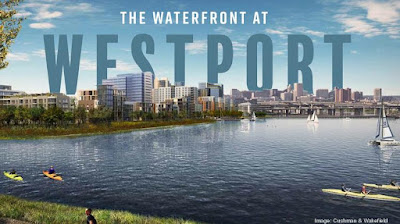
Sliding instead of stepping up isn't limited to public efforts. The abandoned high flying plans for Pat Turner's Westport or Kevin Plank's Port Covington UA "World Headquarters" are private examples. The ongoing hick-ups at Pimlico are mostly due to the private side not getting its act together, so is the half done Uplands project and the largely stalled Poppleton redevelopment. Sandtown Winchester is after 30 years and far over $100 million of well-meaning attempts as pockmarked by vacants and disinvestment as ever. All those examples will cost way more to complete or get right because of the initial failure. They may and eventually become entirely unaffordable.

Baltimore's success stories

Not that Baltimore never generated mega projects that most would describe as successful. I mentioned the Inner Harbor and Oriole Park and a slew of other, smaller success stories. Successfully completed mega projects also include  the redevelopment of no less than six low-income highrise districts, considered the largest HUD HOPE VI project group in the country; Those projects are, indeed notable and frequently referenced precedents. How do stalled or failed projects differ from the successful ones, what made the second set successful and the first less so? 

Success with follow up

Sometimes success comes through the backdoor of failure, such as in the case of the urban highways that would have bisected Fells Point, Federal Hill and Mount Vernon and created a giant viaduct across the Inner Harbor. Thanks to the highways failing to materialize all those affected neighborhoods went on to be Baltimore's success stories.  

One cause of the sideways problem is the fascination with the respective next shiny toy, to revert to psychology, a sort of urban Attention Deficit Disorder that makes politicians and investors to hop onto the next big thing before the previous one has been brought to a proper conclusion. The stepladder process, by contrast sticks with a vision until it has become a proof of concept, a success on which to build and expand. In fact, successful Baltimore projects used the stepladder process, just think of Charles Center followed by the Inner Harbor, Otterbein,  Harbor East and eventually HarborPoint. Or the six Hope VI projects unspooling in rapid succession, or Oriole Park followed by the football stadium.

What makes failure and what success? Transportation projects

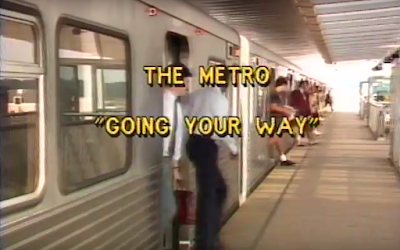
Transportation projects provide a good set of examples that go far back and illustrate shortcomings that explain why they didn't become roaring successes: When Baltimore received federal funds to build its first Metro line, it followed right behind Washington, San Franscisco and Atlanta, all cities that completed entire systems or, in the case of Atlanta, at least two coordinate lines intersecting at a downtown hub. Baltimore had a fine system plan but argued about the first alignment and built it on the route of least resistance (in the median of Interstate 895 to Owings Mills) instead straight west where the I-70 extension hadn't been completed. The project wasn't complemented with development hubs around the stations (transit oriented development) and even at its terminus it was shunned by the Owings Mills' mall developer who didn't want transit riders have easy access to his mall. When the line finally opened it competed with a freeway in the same corridor and ran in the city through areas of decline; it didn't go where people wanted to go. Meanwhile the federal money trough from President Johnson's New Society vision  had dried up and further metro lines remained a dream. To sum it up, too little, too late plus a complete lack of land use coordination.
Baltimore Metro: Too little, too late

A decade after the money for metro had dried up and Baltimore's highway projects had been defeated, the formerly highway-happy Donald Scheafer ("Highway to nowhere") switched to "light rail" as the new shiny thing that a handful of cities across the US were pursuing as a cheaper alternative to a subway: Less expensive than Metro but more effective than the small streetcars of old. The Baltimore central light rain line system was conceived as a north south line to serve Oriole Park, a single line that was not only designed but also constructed in record time. The new line had a few problems in its DNA: It hardly complemented the sole Northwest Metro Line, nor did it exactly go where the most people were. Instead it went where old railroad right of ways made it easy to build. It didn't connect with Metro in a hub and once again, there were no plans to densify development around the stations to make the line more viable and the segment through downtown was as slow as molasses.

Another decade passed before then mayor  O'Malley finally wanted to get back to a comprehensive rail plan. The rail plan of 2000 looked quite like the metro plan from 1970, except it was all "light rail" but, and here the new twist, with tunnels where needed. But once the most urgent project, a real east-west line dubbed the "Red Line" was selected as the top priority its design crawled without much urgency through the federal New Starts bureaucracy which "do it now" Schafer had successfully avoided for his earlier light rail. The Red Line alignment suffered from the get-go from the fact that the original Metro Line was a east-northwest bastard which forced the actual east-west Red Line to run in parts in a parallel tunnel because light rail couldn't run in the Metro tunnel. The death of the Red Line became a nationally known planning tragedy of epic dimensions. As Governor O'Malley had failed to get this project to a point of no return in spite of a record 13 years of  planning costing a quarter billion dollars, his successor coolly abolished the entire thing as a"boondoggle". The then new Governor gave the feds  nearly a billion dollars back in already promised funds. Now Governor elect Wes Moore vouches to put humpty dumpty back together. 

The transit saga doesn't end with the death of the Red Line: Hogan's contention that Baltimore would be better off with a full overhaul of its bus system than with one expensive rail line had some validity, except that he never meant it seriously. Hogan provided just over $130 million for a bus overhaul in lieu of the $3 billion that had been lost. The result of this bus "reform" were buses with new colors and names which right now perform worse than the old system had ever performed before.
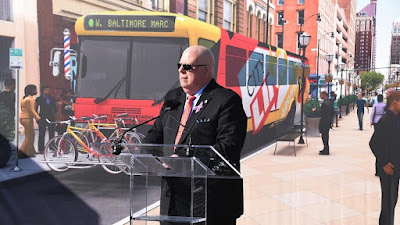
Hogan: The big bus failure

In all Baltimore spent a whopping 40 years on creating a disconnected and unloved transit system that most describe as dismal. 

How did the other cities fare that picked light rail as their future transit at the same time as Baltimore? Portland, Pittsburgh, Denver, Sacramento, San Diego all managed to build entire systems of 4-6 lines in that time, in most cases considered successes by the industry.

Baltimore's MTA not only sat on its hands for decades between completed lines, it also never nurtured the lines which in the beginning were well liked and used. Instead of cultivating a success story, the MTA presided over steady decline: The stations were neglected, signal priority on Howard Street never made it into reality and efforts of moving the stadium crowds after games soon faltered leaving fans stranded for hours. Instead of making the initial proof of concept project a stepping stone for success, it became a symbol for all that can go wrong. Even before Covid hit, riderships had fallen by 50%. Portland, by contrast supported its initial line with sound transit oriented development and careful design and soon got money for more.

When it came to the Red Line, again too much time had passed since the initial light rail line to see the project as part of the same system. Schafer's "do it now" urgency was sorely missing, culminating in the last minute relocation of an underground station which may have cost the project the critical six months which would have made it irreversible. 

Yes, MTA is a State agency and not run by the City, but before folks seek all fault at the State, the City and the County also failed to implement zoning and land use changes at the light rail stations that would have supported transit, something that was a key to Portland's light rail success. The initial success allowed TriMet to build four additional light rail lines that were followed by several Portland streetcar lines.

What makes failure and what success? Grand projects

Success can also be explained with some Baltimore projects that become national models: Had the Charles Center Development Corporation waited for a decade or more to plan for the Inner Harbor instead of meticulously designing Charles Center as a successful stepping stone for the Inner Harbor redevelopment, the Inner Harbor would never had happened. Just recall that the project was nearly derailed by a referendum of those who wanted to keep an open field at the water's edge.

Step by step but upwards

Had Housing Commissioner Henson waited  for a decade after successfully lobbying for HUD funds to implode the Lafayette public highrises, Lexington Terrace, Murphy Homes and Flag House, would never have happened because HUD funds would have long dried up. But the savvy Housing Commissioner acted fast and used each project as a stepping stone for the next project, learning and refining them at each step. Clearly the last project was far superior to the first, but no project was seen as a failure. 

Problem solving without stepping stones or "proof of concept" projects or initial projects that are half baked and unsuccessful is not only doomed to fail it also saps resources, ends with nothing to show and leaves project implementers or an entire city demoralized. 

The successful stepping stone approach can also be seen in Oliver, Barclay and the Greenmount West, communities that have seen systematic investments by Sean Closkey's companies. His approach all but eliminated vacant buildings in each target area. The once deeply disinvested communities are beginning to attract new folks, increasing the population and the viability of support services  Closkey is a strict follower and excellent explainer of the stepping stone theory in which a strategic approach brings success.  The stepping stone approach is vital wherever resources are limited, because it produces a system that after initial steps becomes a self supporting feedback loop. 
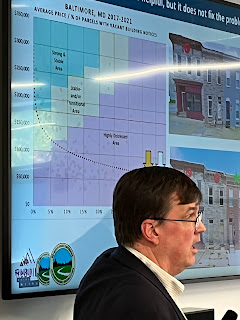
Closkey explaining the step up process

In summary: Success begets success. A larger multi-phase undertaking needs a successful beginning, a story to tell and resources to continue without delay. 

Success and failure are closer to each other than one would think. Often small missteps decide over an upward or downward trajectory, just as a ball resting on an apex can be tipped in either direction without much effort at all. 

The critical moment can be compared to phenomena known in physics:  Phase-transitions, for example from rain to snow, from water to ice, or from water to steam. Before you know it the milk rises from the bottom of the pot and boils over.  The shift to lasting success can come suddenly when a critical mass or energy is achieved, just like in physics. Phase transition can go both ways. Systems can collapse into a black hole that will swallow everything within its event horizon. But they can also burst out into sustained and potentially exponential growth of a sun. An urban example of such an upward explosion can be seen in Washington DC, a city which became so successful that many forget how much the capital struggled just some 25 years ago with a mayor who was arrested in a crack sting. (The Fall and Rise of DC). 
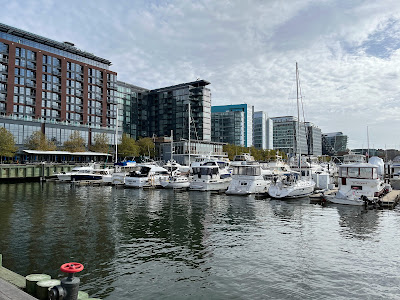
DC Wharf: The capital's newest development
Make no mistake, success has as much to do with capital infusion, investment and resources as with organization. But it is important to understand tat money is not all that is needed. Also necessary is good planning, good governance, urgency and the strategic use of resources. Smaller investments need to leverage larger ones. 

DC built systematically on two catalytic grand projects, the new arena and the new convention center, but it also systematically invested in schools, neighborhhoods and economic development, all activities Baltimore is engaged in as well. Two DC mayors with well functioning departments attracted talent to work for them. In Baltimore a lack of focus, unstable governance, too many competing actions at once and a often hostile governor made success elusive. 

To turn Baltimore's downward spiral into one of success becomes harder the more half baked projects devour resources and the more projects are abandoned midway in favor of the next shiny thing. For the 36 years I have observed success and failure in this city, I had many moments when I thought that the final break thorough was right around the corner, just as it had been in Philadelphia, Cincinnati, Nashville or Pittsburgh. 

On the horizon

Many big projects are still largely in the pipeline. Those include the redevelopment of Pimlico and Park Heights, a new Penn Station rail hub, a new Amtrak tunnel under West Baltimore, and a fully refurbished Middle Branch shore line. The governor elect has promised to bring the Red Line back. All this bears promise and each could become a "game changer". 

I have not given up hope that eventually a competent administration will stack the pieces up so they won't tumble any longer and Baltimore could break free towards its potential. The stars are aligned, but I have abandoned any attempt of a prognosis.

Klaus Philipsen

Related articles on my blogs: