Thursday, January 19, 2017

Old Baltimore on fire

Sooner or later the vacant vestiges of Baltimore's presumably more glorious past catch fire. The next step: demolition, hot demolition some call it.
320 N. Eutaw Street in flames

I have written about how this fate hit the vacant historic New Academy Hotel and the Mayfair Theater at the corner of Franklin and Howard which were only the more recent examples of the many vacant structures burning towards their demise. Last Saturday another proud structure on the Westside went up in flames (SUN article).

Officials said the fire started at 6:31 p.m. Saturday at a vacant six-story building in the 300 block of North Eutaw Street. Crews arrived within minutes and saw heavy smoke coming from the second and third floors. The fire was not officially put under control until 3:30 p.m. Sunday.
"We've gone into strictly exterior operations due to the possibility that the building may collapse. We've also established a collapse zone at this time, so that if it does go, no one will be injured," Baltimore City Fire spokesman Chief Roman Clark per WBAL.
Clark confirmed Sunday that there was indeed a collapse inside the building, which has been condemned by the building inspector. 
Well preserved and ornate: A over 100 year old building

The building began its life around 1900 as a furniture retail store and remained a furniture store for over sixty years until 1962. It later became the Maran Building,a six-story office building with 76,662 square feet of space and 25 on-site parking spaces. In 1992 the Maran real estate company and printing company put the fully leased building up for sale for $1.95 million when it wanted to move its own operations elsewhere.
The building was shuttered in 2002 when the Tunnel nightclub was closed for code violations and deemed a center for violence. According to real estate records the properties since changed hands in 2007 for over $9 million and in 2009 for over $3 million, if correct, those numbers would indicate a significant collapse in real estate but also a steady decline of a vacant structure itself. In 2011 the entire row 312-322 N. Eutaw Street was up for auction. Even at that point the building was in solid condition with a roof that didn't leak and floors that were almost ready for move-in, far better than most of the vacant buildings along Howard Street. 320 and 322 N Eutaw Street share a common elevator and were usually marketed together with their 8,000 and 4,400 sf floor plates offering what modern users usually want to see. The buildings are deep and have a second face on the wets side at the alley.
Pretty but vacant and apparently unwanted

Hard to imagine that the building still has a value in the millions after Saturday's fire. The roof collapsed and maybe the top floor as well. 22 hours of fire will most likely have ruined everything that was functional in the building and potentially even weakened the structural integrity.

The building is a historic structure listed on the Westside must preserve list. The original furniture retail building was known as the the Gomprecht and Benesch building. It is a good example of an early 20th century retail store building which looks similar to the Bernheimer Brothers building on West Fayette Street, suggesting that both buildings were designed by the same architect, Charles E. Cassell. Gomprecht and Benesch and its predecessor company, Eutaw Furniture Company, were businesses in Baltimore from 1883 until 1962. 

This storied history of a very solid building that is a six story landmark on Eutaw Street, shows that preservation is not sentimental nostalgia. Instead, preservation of key structures is instrumental for the revitalization of the Westside. The fact that even a sturdy tall structure with large floor plates had trouble to find a decent user in decades (apparently for most of the time after 1992) speaks to the difficult situation of Baltimore's downtown real estate market but it may also sheds a light on the lack of strategic action to revive at least the most significant buildings.  The next fire may gut the old Stewart's building or any of the other structures huddling as hulls and testimony to the failed Superblock or the generally depressive state of Howard Street. Any use would be better than vacancy. 
Large open floors, 13' ceilings (here the mezzanine)

Time to think about populating especially City-owned buildings with temporary uses. The Downtown Partnership's pop-up storefront use program a few years back was a good start for privately owned properties like the former Tunnel night Club on Eutaw Street (that particular project did not participate)..

It is time to take action against speculators that sit on vacant buildings dragging down a neighborhood in the hopes that somebody else's investment will one day present them with a nice windfall profit. One way to counter that kind of speculation is to tax vacant properties higher than occupied ones or tax land higher than buildings. (Split rate taxes). 

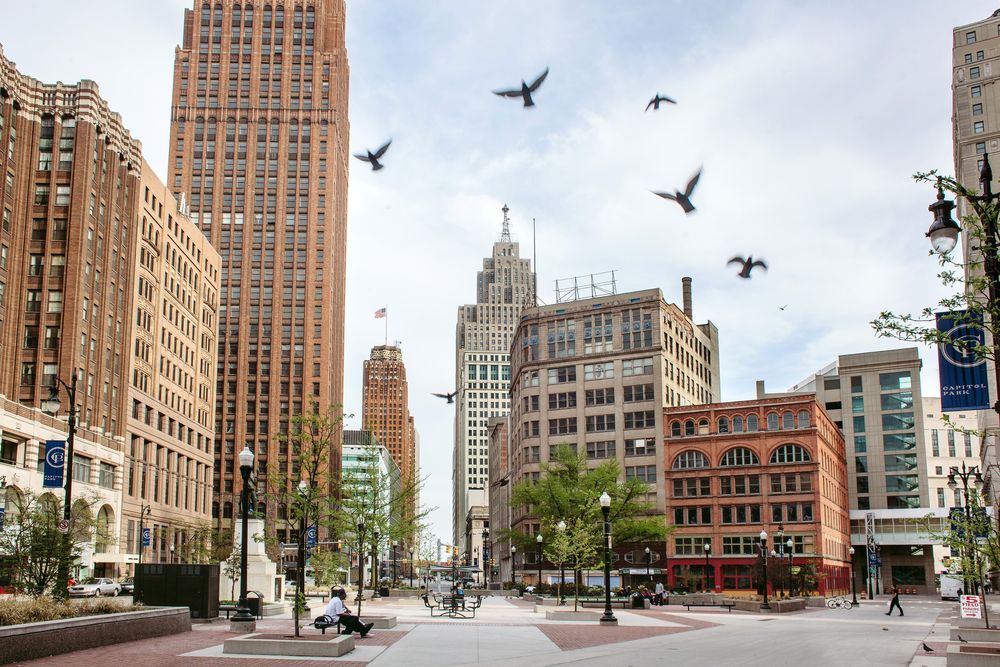
Billionaire Dan Gilbert's (Quicken) downtown Detroit investments came from a very rich individual. But they also prove that revitalization is possible and that the ghosts of yesterday's downtowns can have a different future than being fuel for spectacular fires.
a massive assembly of mostly vacant structures at Eutaw
and Mulberry Street

Klaus Philipsen, FAIA

Baltimore Heritage Facebook page.

The furniture store in 1910


Downtown Detroit: Revitalized Capitol Park


Wednesday, January 18, 2017

Trash cans for a better Baltimore

Few items can elicit heated debates like trash in the city can. Baltimore is usually considered a pretty dirty city when it comes to trash blowing around, all efforts for a "greener and cleaner" city notwithstanding. In many ways trash is an indicator for some of the many pathologies that plague Baltimore from abandonment to drug abuse and poverty. Dan Rodricks recently advocated for another "keep your city clean" campaign.
Baltimore gets new trash cans. Summer 2016
The city — the whole region, really — needs a new campaign to get people to stop littering. That message was common 50 years ago, but it has lost steam since then and virtually disappeared from the public consciousness. (Dan Rodricks)
Today's SUN article about the success of Baltimore's $9 million trash can project comes as a welcome relief, anecdotal as it may be. One big central action that made a difference. As one of the major programs of 2016, previous Mayor Rawlings Blake had distributed 170,000 big green rolling trash cans to Baltimore households and made their use mandatory. As the SUN article repeats, there were plenty folks who didn't like the program for its cost, its logistics or for the difficulty of managing the big containers in a small rowhouse. The hand-wringing was typical, as it is for pretty much any program that anybody resolves to do around here, even if it only repeats what has been a long proven practice elsewhere.  Such as trash cans. Or red line cameras, or protected bikeways.
Trash in bags makes the City filsthy

The usual argument against adopting best practices or acting as if they were brand-new ideas is that Baltimore is different. More likely the issue is just an unwillingness to accept change or look beyond the own borders for a solution. In the case of those standardized trash cans, the advantage of not placing trash in plastic bags, boxes or random containers out on collection day seems obvious. With a sturdy can neither wind nor beast can drag the trash through the alleys and streets. With a sturdy can that gets lifted into the back of a truck it is also much less likely that trash gets dropped, forgotten or dropped out of the bottom of ripped bags.
I don't know, but I simply love these trash cans. One of the best things city government has done for us in the 13 years I have lived in Baltimore (Richard Chambers, attorney)
Many cities have discovered those advantages for decades. In the case of my hometown, the town implemented mandatory standardized trash cans more than half a century ago sametime around 1963. Then the cans were out of steel, had no wheels and were very heavy. I was in charge of taking the family trash can out to the curb and it was a pretty long hike to get there. The bins for the two family house in the city sat in the basement. Like in Baltimore the cans are now made from plastic and they have wheels.   I never saw a rat even though I lived right in the city, I never saw anybody put their trash into anything but the cans and the sanitation workers wouldn't have taken it anyway.
Baltimore trash truck with lift
I had to lug it up the stairs, out the front door, down the front steps and about a 100' yards to a place to where the truck could back up to. I hated the system. The trash men loved it: they didn't have to pick the cans up any longer but hooked them to a a steel arm at the back of the truck which lifted the can and turned it upside down into an opening just the size of the can. The operator could rattle the can with this mechanism so it would empty properly, lower it and unhook it. Two workers could do two cans at once.  This type system is still in place all over Europe.
Baltimore trash cans reporting for duty (Bluewater Baltimore)

So now here we are in 2017, Baltimore has completed the issuance of the 170,000 chip coded green cans of which 2,000 have already been stolen or lost. Not a huge number if expressed in % but still a significant loss. Hard to imagine where these all went. China, Mexico?

People are generally convinced that the program is successful in cleaning up the alleys, no matter that storing the clunky containers has become a headache for those in rowhouses that do not back up to an alley through which a truck can go. It would be interesting to find out if there was even an uptick in the amount of trash picked up. Can CitiStat answer that?

It will be important to keep the green can program alive, have replacements and cans for new residents at hand and set aside the funds to make this pick-up system sustainable. If this was just a one time effort, the $9 million were wasted. In fact, the collection method should be expanded to recycling which should also happen in closed containers (instead of those open yellow bins) so that all the paper, plastic and aluminum cans don't blow around in alleys either.
European trash truck with lift

Denver trash can brochure
Now after we implemented this best practice that has been proven successful elsewhere, along with parking kiosks and bike-share, why stop there? Mayor Pugh is working with Bloomberg's consultants to identify best practices and innovation across the country so it can be brought to Baltimore. Lets re-install our red traffic camera program to monitor excessive speeds and red light running, lets install an electronic guide system that shows folks entering downtown by car where  parking garages with available spaces are, let's be creative with a district for autonomous vehicles. The MTA should introduce cash-free transit like London has implemented for many years already. Once we are open to adopting best practices, the City might become so attractive that people just won't litter anymore because they are so proud of the place.

Klaus Philipsen, FAIA

Bluewater Baltimore about the trash can success
NextCity about a Dallas trash app
Denver curbside collection rules

Tuesday, January 17, 2017

The changing colors of the MTA

There is little continuity in the way how Baltimore buses have been painted over time. Under the old local transit company streetcars and buses had the same two tone solid green scheme. When the MTA was created the brand color switched to blue and looked very similar to New York's MTA. The blue was also used on the subway cars and on light rail. Bus Stop signs were blue and so were the pylons signifying the Metro stops. Not a very striking theme, but it tied all the modes together.

New  MTA Local Link bus wraps: The Maryland flag motif
Then things went on an ever more rapidly changing cycle of new schemes that were randomly applied to buses and light rail vehicles without much consideration of the brand identity of the overall system or overhauling the service instead of the colors.

The buses lost their blue and were just white with black stripes and a waving Maryland flag slapped above the rear wheel wells. Then that still somewhat plausible scheme went by the wayside as well to give way to a completely generic scheme of blue and green waves that had no local connection.
New MTA City Link bus wraps

Now all of this goes out the window for Baltimore Link which comes in two flavors, one for City Link and one for Local Link. Of the total of 750 buses about 250 will be colored as City Link, the premier routes that will be color coded with 12 different colors. The bus wraps are manually applied by a vendor in the bus maintenance shops which takes a bus out of service for a minimum of 12 hours. The about 6,500 bus stop signs also will get a color coordinated make-over. Some of the new signs have already been mounted with a temporary "bag" sign covering the new signs up with the current route info. The colors for light rail vehicles are yet to be applied. I suppose that will come as part of the midlife overhaul that the trains are undergoing. The design of the new Metro cars has not been presented.

The new buses look livelier and less dull than the mostly white designs before, but the vinyl wraps applied over top of the white paint somehow lack the crispness of real paint and don't quite stack up with the new MTA buses in New York, the new WMATA bus colors or those in Seattle, all of which use large splashes of strong identifiable colors.
Baltimore bus company buses


How much color can brand a transit system is known from London's red buses. They have been this way and pretty much remained that way, in spite of silly black "eye patches" that showed up on recent models.

The matter of bus branding looks simple enough, but it isn't. A really convincing graphic design needs first rate professional designers, it can't be done by committee.


In the end, though, what will matter most is whether the new Link bus system will run more efficiently, more on-time and with more predictability after the new system will go into effect during the night of June 17, 2017.

Klaus Philipsen, FAIA

Baltimore streetcar colors: Matching mode branding


MTA buses in the seventies: Blue fronts and stripes


MTA blue stripe buses lasted for decades


The last MTA high floor buses with the flag emblem over the rear wheel


The generic blue-green waves, the most recent overhaul before Link


new bus colors WMATA

New bus colors London

Forever yellow: Stuttgart's transit picking up State and City flag colors

New NYC MTA buses


Sunday, January 15, 2017

Can Retail cubes on Pratt create a "Magnificent Mile"?

The experimentation on how to fix Pratt Street, Light Street and the public spaces around the Inner Harbor continues.

The concrete fountain that has now been flattened with the TransAmerica
Tower in the back
Now that the modernist concrete elements of the McKeldin Fountain have been leveled by weeks of demolition the intersection of Pratt and Light is even more car centric and devoid of "place-making" elements. Architect and urban designer Fred Scharmen who is a professor at Morgan State University says "that whole intersection looks like it's in Rockville or Towson now". I agree that the detractor's of the beton brut fountain never understood how the massive sculptural fountain held the vast spaces together as a vertical anchor.

The new idea: Add modernist cubes to the north side of Pratt on the plaza land that is the block of Charles, Light, Pratt and Lombard Street on which Baltimore's tallest building sits, the Transamerica Tower which was originally built as the US&G Tower.
Site Plan with new retail development (COPT)
Its vast windswept Plaza was already a thorn in the eye of architect David Benn in 1986. When I started working in his firm he asked me to prepare some sketches on filling the plaza and direct pedestrians from the HarborPlace to Charles Street and vice versa. (At the time Charles Street was still considered Baltimore's premier downtown street). I came up with a triangular shaped pavilion along Light Street that guided folks in an angle from the northwest corner of the plaza to the southeast one. But it would take 30 years before there was a taker for the extra space, COPT and its line of cubes.
vast spaces around the tower building (current condition)

COPT's cubes are lining Pratt Street on the south side of the Transamerica Tower, a building by the same development company. The cubes are a refinement of the concept with which COPT beat out two other proposers who had submitted ideas for the extra wide sidewalk space south of the tower last year. COPT's proposal included  a two-story, 23,000-square-foot development with 14,650 square feet of retail space at the ground floor level and an about 9000-square-foot “rooftop” restaurant with a terrace and a rooftop plaza. The City picked the concept in which the developers offered to pay $400,000 for the city land. Construction is anticipated this fall.

The cube concept design was before UDARP last week. The last cube comes with a literal twist, it is rotated 45 degrees. Whether this, too, is a nod to the diagonal direction from HarborPlace to Charles or is just a formal gesture by BCT Architects, I don't know. The cube retail  pretty much blocks a literal diagonal walk line, though.
proposed line of retail cubes: Michigan Avenue? (Rendering BCT architects)

UDARP's Gary Bowden suggested last week to turn that cube in line with the others, a bad idea, from how I see it. The cubes are generic and bland enough, that twist added at least a bit of tension and dynamic. BCT successfully made them heavy enough so they don't get visually "blown away" in the drafty setting surrounded by the clunky seventies concrete architecture. But instead of those attributes retail architect and BCT Principal Bryce Turner spoke, according to the BBJ,  of Michigan Avenue, alluding to Chicago's premier mile of glitz. Not clear, how the cubes get us to that level, but hey, I am all for courageous  aspirations! In the real world smallish retail floors are hard to market and especially those which have no "back of house" space and have to look good on all four sides, instead (service can probably happen through the garage under the tower plaza).


Shopping in Chicago: more people during one light cycle than on Pratt in a day


With just "bump-outs" as the medicine, car-centric Pratt Street will have a really hard time to ever approach the flair of Chicago's "Magnificent Mile".

Klaus Philipsen, FAIA
updated with additional graphics and corrected for image caption for Chicago image

BBJ Nov 17, 2016 about the COPT agreement
BBJ Jan 12, 2017 about UDARP review


Ground level plan (COPT)

Thursday, January 12, 2017

State offices at Metro West?

After the Governor pulled the plug on the State Office redevelopment project it didn't take Caves Valley long to publicly float the idea of putting the State Offices into the currently vacant former federal office building, initially used by Social Security, a complex known as Metro West. Last year Caves Valley bought the 1.1 million square feet behemoth at public auction. The 11 acre Metro West could almost swallow the entire State Center office complex with its three buildings and about 1.2 million sf on 28 acres.
Metro West: 1.1 million square feet of heated vacant space (SUN photo)
Caves Valley also thinks to attract the Circuit Court of Baltimore. The court in its current downtown home in the Court House East has monumental charm and history but is regularly the topic of complaints how it isn't up to the task of running a modern court operation.

To put the 3,000 to 4,000 State employees stuck in increasingly obsolete buildings in what is known as State Center into the nearby Metro West is quite obvious. After the Governor sued to sever from the development team that had proposed a $1.5 billion mixed use redevelopment with new offices for the State workers one has to wonder, in fact, if this idea hasn't been already behind Cave Valley's  bid last year since it was already apparent then that Hogan lacked enthusiasm for the State Center development concept he had inherited, even though fellow Republican Bob Ehrlich had originally initiated it in an effort of a public private partnership that would make best use of the two existing State assets of land and subway in one place (TOD).
State Center Office building 1

Le roi est mort, vive le roy, is a pragmatic thought for a developer that sits on a huge complex in search of a use. Already Catherine Pugh is zooming in more on retaining the State workers in the City than on a specific place for this to happen, carefully navigating treacherous waters. Either way, the City could see a major investment and the removal of a large "dead-zone". In the case of Metro West the vacant complex is really dead, in the case of State Center the area is pretty dead even with the three main buildings occupied because with 28 acres so much of the land remains unused.

What is somewhat curious, though, is that Caves Valley's first investment in Metro West appears to be a new parking garage about which the SUN reported already in June of last year. The developer reportedly asked the architecture firm Design Collective to design it. One should think that the underutilized giant Lexington Market garage could easily meet the parking needs of Metro West, just as they did for Social Security workers. I suppose urban planners just have to realize that the market hasn't bought yet into the concept of a post-car Baltimore with shared autonomous fleet cars and millennials who don't want to drive everywhere, no matter that the trend seems to heading that way and new parking garages could be investment ruins before they will be amortized.
State Center, Health and Human Services

With the State calling the shots and being so set against the State Center plan that the Gov isn't fearing litigation, the question whether Baltimore would benefit more from a new State Center than from a revived Metro Center isn't even on the table any more. If one takes the Governor's assurance that the Stadium Authority has been ordered to look for alternatives to the State Center project on face value, both properties, Metro West and State Center could be in play, even though MSA certainly can't simply pull a new concept for State Center out of some hat, not even Peter Franchot's old Arena hat.
State Center: Office building #2

Those who never believed that Baltimore could sustain new office space at State Center without killing downtown (Peter Angelos never tired of that claim and is largely responsible for the delay on the project that dragged it beyond O'Malley's term) will certainly not buy into the notion that Metro West should be added to the mix.  Clearly, the driver for the large private investment in State Center was driven by the guarantee that the State would bring over 3,000 users from day one. If those folks settle into the catacombs of Metro West, what would be the economic engine for State Center? Metro West as the home for State workers would just make it even  more likely that the communities around State Center will stare into even "deader" 28 acres for a long time to come, not to mention that the subway station will then be entirely isolated: TWD (transit without development).

Klaus Philipsen, FAIA


Wednesday, January 11, 2017

Green space for urban regeneration

Cities have a rich history of using green spaces strategically for value creation, although the Olmsted brothers or General Oglethorpe wouldn't have it described that way when they planned urban parks in many US cities (Olmsted) or the 22 green squares in Savannah (Oglethorpe).

D center event poster designed by Zoe Clarkwest
Today green space in the city doesn't just have to look good or provide a romantic connection to nature, it also needs to leverage economic development, enable equity, provide food in food deserts, be a place for education and innovation and enable urban regeneration. This is such a tall order that most of reality has little to do with these lofty goals: More often than not, urban green spaces are leftover spots with no strategic import other than hiding disinvestment in impoverished communities as little fig leaves. Those spaces are the result of neglect or demolition, not planning.

As part of their successful series of "Design Conversations" D center brought together a panel of individuals in Conversation #79, each proving what green spaces can do in spite of the fact that so many of them were created more by accident than by design.
Each panelist shed light on the role of open spaces from a different angle and with a different perspective.

Design Conversations had sagged in recent months. To entice folks to give the Conversations another chance, D center provided free first drinks and snacks at the venue at WindUp Space in Station North, a gallery and event space run by Russell de Ocampo, one of the original pioneers turning Station North around.

All panelists emphasized their goal of strengthening the local, disenfranchised communities they work in by employing jobless people or those on re-entry after incarceration, by providing healthy food in food deserts, by growing skills that can be used right in the community and by eliminating blight.
Design Conversation #79 (photo: Philipsen)

Elder CW Harris, also known as the "Mayor of Sandtown", a spiritual leader who works in many ways on the transformation of Sandtown spoke first. He assists and leads in a multitude of non-profits under the umbrella of Clergy United for the Transformation of Sandtown and Intersection of Change, a group of which includes Martha’s Place, a transitional house for women, Jubilee Arts, a program that teaches arts and dance to people of all ages, and Strength to Love 2, an urban farming program. The farm program helps re-entries to become productive with 16 greenhouses erected on demolition lots on 2 acres of land in the middle of Sandtown.
Elder Harris told the audience that the urban farm includes a facility for rain collection, that it is trying to eliminate what he calls food blight and that his operations are totally open and still largely free of vandalism. The one time a "hoop house" (The plastic sheets covered green house) was burnt down by someone, 75 people showed up the next day to rebuild it.
Elder CW Harris at the Sandtown Hoop Farm
(photo: Philipsen)

 J.J. Reidy, Founder and CEO of Urban Pastoral who started out as a history Major, founded the development firm Urban Pastoral in 2014 as an entrepreneur, global food activist and social entrepreneur who has collected experience internationally in places like Milan, Italy, Ethiopia. His work on developing urban food ecosystems has been recognized at the World Expo, Bon Appétech, and Food Tech in Stockholm.
Reidy said that Urban Pastoral wants to employ principles of symbiosis and plant design in social systems. They partner in Baltimore with Humanim which built their headquarters in East Baltimore in the former brewery on the hill, has received an Abell grant for proof of concept. Reidy explained the concept of hydroponic plant growth in nutrient rich water that is also employed by the Sandtown hoop farm. This way Urban Pastoral  can produce 100 pounds of produce a week, even in winter and provide food for a winter CSA (Community Supported Agriculture). From his international background Reidy concluded that  "in the US we don't use our land efficiently because we don't have to". bringing derelict land back into use in East Baltimore is a test. for being more careful with the land. Urban Pastoral is selling food to Hopkins, restaurants in what he called a symbiotic network of businesses. His most recent foray is a 700 sf restaurant in the Remington R House that created created 13 jobs. (His operation also provide salads to try out at the event).
The next step for the company will be to bring the farm up to the next level. He sees a large market in the city where 90% of produce comes from outside the market. As an example of an integrated eco-system he showed a sketch of an envisioned operation in conjunction with the Peabody Brewery where he would use the brewery byproducts. " Food deserts are more about job creation than food" he said and described his approach as one of urban regeneration. He thinks that lots of countries are looking at Baltimore and how we are solving our problems here. 

Richard May, expanded further on the aspects of urban regeneration and economic inclusion. May is Chairman of Innovation Village Baltimore, a multi-sector partnership anchored by the
Maryland Institute College of Art (MICA), Coppin State University, City of Baltimore, and State of
Maryland which seeks to revitalize West Baltimore through economic inclusion, equitable access to
opportunities, job creation, entrepreneurship, and small business.
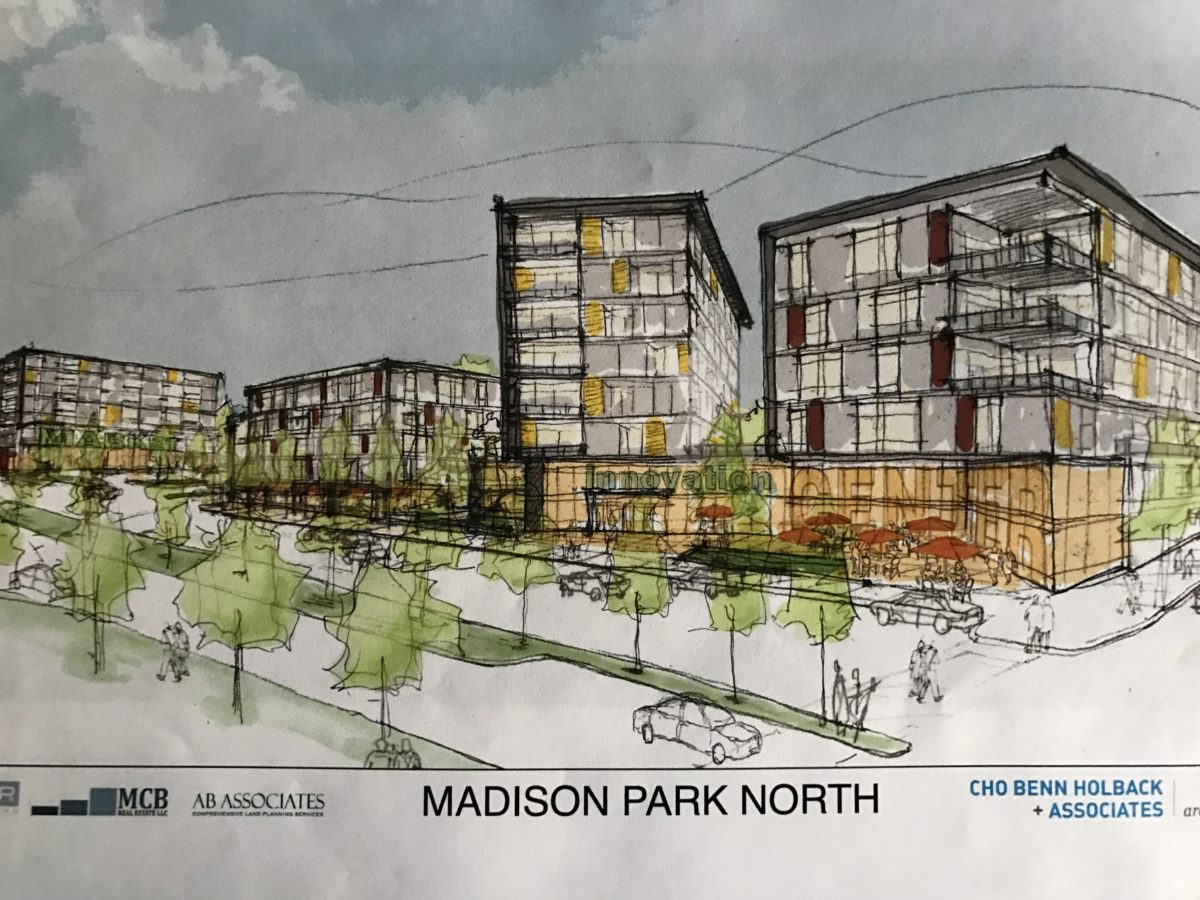
Innovation Hub at Madison Park North (Rendering: CBH Architects)
Innovation Village is Baltimore’s 1st innovation business district and covers over 1200 acres of "culturally rich and historic neighborhoods" in West Baltimore. Richard comes from the private sector where he had been with Deloitte, the world’s largest consulting firm, providing business and IT advisory expertise to global technology firms. He is also has been supporting startups with equity. The Mount Royal Community Development Corporation Board of Directors is currently the official anchor of Innovation Village. May asked "What the hell does innovation district mean?" and explained that "we have all the talent in the area. We want a better community and we want to do it together. This city has more creative talent per square mile than any other city, hands down." He talked about the "peanut butter and jelly" approach how to include include everybody, the so called "white L" of Baltimore (where the wealth is concentrated) and asked "do our investments benefit the majority of people most of the time?".  May still has his hands full trying to convince the many organizations active in West Baltimore for years, that he is not just an interloper. With the rebuild of the former "murder mall" complex as Madison North  with a 50,000sf  innovation hub real tangible progress will be the proof that Innovation Village is truly a path forward.

Finally, China Boak Terrell spoke about the much discussed new Food Hub in East Baltimore to which she came only in June of last year. She is CEO of American Communities Trust (ACT) and, like Richard May, comes with a blend of community and corporate experience. Boak Terrell has served as a corporate lawyer leading multi-million dollar transactions, as business developer, liaison and advisor to agency heads, elected officials, and corporate leaders. She was also General Counsel for the District of Columbia's legislative committee on human services. In her first 100 days of  joining American Communities Trust she raised $2 million for the continuation of the Baltimore Food Hub project, still not enough money as she said, but construction could finally begin in September '16 after she closed on the property acquisition.  ACT has issued nearly $50k in low-cost performance-based loans to local food entrepreneurs. ACT is planning to launch the next phase of its strategic planning.
China Boak Terrell speaks about the Food Hub
(Photo: Philipsen)

China described the location of the food hub north of the Amtrak tracks as a place "where Johns Hopkins owns nothing" and where the hub "will bring the energy of south of the track to the north." The purpose of the "the Baltimore Food Hub is ... to bring the Maryland Food economy to Baltimore". She said  "JJ [Reid] is digging in where poor people are. By having job opportunities that target people with disabilities and below the poverty line the food economy makes it easier to enter the market." She came back to Baltimore  because "every time we came to Baltimore we had so much fun. My husband is such a foody" she explained. "We are not about aggregation and distribution. We are not a Food hall. What are doing is co-locating food businesses from farm to table."  She said food access is also about learning what choices to make". Referring to the title of the event, she stated that "the common space is outside". The Food Hub "site was owned by the city for over a 200 years and degraded severly. We are giving it back to the community as a green space". She acknowledged that the project was stuck for a long time because "the numbers don't make sense. Who is going to fund it". She says the project almost entirely depends on grant dollars.

Robbyn Lewis, a community activist, invited to be part of the panel, could not attend because the event fell on the day where she was sworn in as a delegate in Annapolis.
Russell de Ocampo

Event organizers Zoe Clarkwest and Lori Rubeling are hopeful that this Design Conversation can be the rejuvenation of the popular D center event series at the Windup Space. Owner Russel de Ocampo was happy with the energy in the room. A conversation about transportation is planned for the first Tuesday in February.

Klaus Philipsen, FAIA

I am a co-founder of D-center and a continuing board member of the non-profit.


Tuesday, January 10, 2017

Where is the Baltimore retail district?

Every time Jacques Kelly describes in the Sun how in his youth Baltimore turned festive for holiday shopping  at its great cluster of department stores at Howard and Lexington, today's absence of a retail district becomes more obvious. Looking at those old pictures of  bustling street-life on Lexington Street, one could become outright nostalgic.
 Lexington Street 1942

Living in Baltimore one comes to believe that great walkable shopping streets with tons of people crowding the sidewalks and glorious bright storefronts lining them have gone the way of the typewriter thanks to big box retail, malls and online shopping.

Until travels to San Francisco, New York, Chicago or even smaller peer cities like Pittsburgh prove otherwise: Hey, downtown shopping still exists, even in America!  Even nearby DC's K Street feels like Paris compared to the mostly empty sidewalks of downtown Baltimore. What is going on?

The Downtown Partnership's just released its most recent Nielsen report (with 2014 numbers). It is very positive: More people live downtown old and young, more money is made downtown, more jobs more businesses, All, just not more retail.
Lexington Street 2015

The report also shows that the percentage of people living downtown (42,000 total in an area 1 mile around Pratt and Light Streets) and working in the City has even declined from 51% in 2009 to 48% in 2014. So much for the notion that more housing downtown would mean that people live where they work. Only 32% of all people who work downtown actually live in the City, that also slightly down from 34% in 2009.

With its 42,000 downtown residents Baltimore compares well with other cities, more residents than Boston, Denver and San Diego in 2011 for example, although as much housing as those cities build downtown, they may have caught up by now. A similar comparison of retail area between cities isn't readily available, but it is obvious that Baltimore is lagging compared to all the cities in the chart maybe with the exception of Charlotte.

It is hard to say where the Baltimore downtown retail scarcity comes from in a country that is "over-retailed" like no other in the world. Even the suburban shopping options out west (Westview Mall, Security Mall) or East (Eastpoint Mall) are troubled places, only Towson to the north and White Marsh far out to the northeast seem to be doing well. Baltimore's own mall, Mondawmin is grossing
Large Cities: Downtown population 2011
more than any other mall in the region, I was told, but in spite of recent face-lifts it is still a place of limited shopping options. Even the HarborPlace pavillions are going through a rough time and the Gallery at the Harbor constantly fights with vacancies. Attempts of making Pratt Street a vibrant shopping street repeatedly got thrown back when places like Best Buy and Filene's Basement came and went. Beginnings of a new Pratt Street seem to emerge with DPoB's strategy of added retail in front of the old office buildings such as the Shake Shack at 400 East Pratt.  The most successful places, though, are eateries and not retail.
Fashion Show Harbor East

Harbor East is the closest thing to a vibrant retail district and it may also be the answer why the traditional retail areas have such a hard time. Few cities have shifted their downtown to the extent Baltimore has done it. As a result of those transformations the Westside and the old financial district still need to find a new identity and brand when it comes to retail. They should take a lesson from Hampden's Avenue, Federal Hill's Light Street and Highlandtown's Eastern Avenue which have remarkable come-backs as neighborhood retail streets. Of course retail re-makes are also occurring from whole cloth with plenty of shopping in brand new large developments such as the Rotunda, Canton Crossing/Brewers Hill, and McHenry Row.
400 East Pratt

Small main-street type retail can be seen in the old Westside on Saratoga Street and on parts of West Baltimore Street. But none of this is really enough for a city of 600,000 residents which is the center of a vibrant and stioll growing metro area with 2.7 million.

Shops and an active street-life just have to be part of an authentic urban experience. For a city of neighborhoods, quirky and vibrant neighborhood shopping districts, are a valuable asset not to be underestimated but we still need a downtown with viable stores.

Klaus Philipsen, FAIA

Downtown Report 2016
BBJ article about the 2016 report
Nielsen Peer City Report 2011 for Seattle

Monday, January 9, 2017

Nick's Oyster bar got the boot

Nick's Oyster Bar has been in the Cross Street Market since 1972. So when Caves Valley, the Developer that has received the development rights for the Baltimore Market on Jan 1 terminated Nicks' lease a few days later, it drew a lot attention. Caves gave as the official reason that Nicks had received violation notices from the Baltimore City Health Department, among other things about rodents. Some smell a rat.


Nick's Oyster Bar during a fundraiser fro Council President Young in 2013
Cross Street Market has existed in one form or another since 1846. Nick's heydays in the Cross Street Market may have been when Bill Struever's development and construction company was riding high  and the developer held his annual holiday party at the eastern end of the market at Nick's Oyster Bar and pretty the surrounding vendors in the western half of the market. Struever had started his construction and development activities with rowhouse rehabs in the day of the dollar house and the revival of Federal Hill where he developed Grindall's Yard. For the parties the Market was mobbed way beyond capacity because the parties were essentially uncontrolled and even hobos streamed there for free beer and oysters. Struever, famous for boisterous parties didn't seem to mind, floating in the center of the mob extending cheers and holiday wishes. The company with his name grew soon too big for parties at the Market and then in the recent financial crisis crashed and went under. The Market went into a long, slow decline.


Early concepts (2015, BCT)
Caves Valley is a different type developer. Having been a well known entity in Towson for some time (Towson City Center, Towson Row, the much contested Royal Farm gas station dubbed Towson Gateway), partners Arthur Adler and Arsh Mirmiran set their eyes on Baltimore City pivoting to more urban development. Caves Valley became a partner in the Horsheshoe Casino deal and goes about additional investments in a strategic way. The apparent goal: bridging the gap between flourishing Federal Hill and the Casino on Warner Street. Caves bought industrial lots in Sharp Leadenhall, a historic African American community which had been amputated by the construction of I-395 and is squeezed in between prosperous Federal Hill and the industrial area that sprawls in the areas between I-395 and South Baltimore. The first phase of the $250 million dollar 650 unit housing complex called Stadium Square with 300,000 sf of office and 80,000 sf of retail is nearing completion on Cross Street, the remaining phases are well underway as well. From there, it made good sense for Caves Valley to look at the ailing nearby Cross Street Market.

Caves Valley - War-Horse original proposal: Green roof

Rendering: Brown Craig and Turner Architects
The Cross Street Market is close to the boundary of Federal Hill and Sharp Leadenhall its decline in recent years a bit a mystery with all the restaurants flanking it that had turned Cross Street into party town rivaling Fells Point.

Caves Valley teamed up with Scott Plank's War Horse Development and suggested to the City that they could fix the market in a private public partnership in which the private side fixes the market up, operates it and the City maintains ownership and collects rent and a share of whatever profits.  The City, facing problems with its markets on many fronts, welcomed the overture with open arms. Struever, never one to give up easily, had since opened a new business under the name Cross Street Partners was part of the deal as well, as a manager of the completed the Market. That was in 2014 and 2015, but then nothing happened for a long time until in April 2016 it became known that Scott Plank's War Horse and Struever had dropped out of the team. Mirmiran told me it was a friendly parting and that War Horse couldn't see a way to make any money with that Market. Meanwhile, War Horse was developing a food hall in San Francisco's Tenderloin District and was mentioned by Baltimore's Market chief Robert Thomas as a potential partner for another Baltimore market P3. Struever is involved with the conversion of several old industrial buildings in East and West Baltimore such as the Hoehn Lithograph building and the Lion Brothers building.

Finally, in November of last year, a new, smaller $6.5 million Cross Street proposal became the accepted deal between City and Caves Valley for which the developer received the "exclusive negotiation rights". The proposal includes $2 million public funds for improvements, 50/50 profit sharing (after developers cost and fees) and a lease in which the developer pays rent to the City.


Caves Valley proposal 2016: "Baltimore's Ferry Terminal Market" (Mirmiran)
Needless to say that the long time of uncertainty hasn't helped the businesses in the market to turn the corner. The termination of the lease with Nicks, one of the more successful and long lasting tenants, will do nothing for merchants to feel any safer.

The future of the Cross Street Market should be of interest to all who care about Baltimore's public markets, whether they are in East Baltimore, Fells Point, on Hollins Street, on Pennsylvania Avenue or it is the flagship market on Eutaw Street itself. All of the them, except the Eastern Market that was recently renovated, seem to be in some type of limbo. With food halls and private markets such as Belvedere Market and Mount Vernon Market all the rage in Baltimore, and across America, one should think that Cross Street Market which is located in an affluent part of town, shouldn't be so hard to figure out. Along those lines, Caves Valley hired Cana Development to configure spaces and market the project, the same company that also did this for the Mt Vernon Market.

According to the BBJ, during the renovation merchants are given the option to relocate to another City market or to nearby City owned properties, not a comforting prospect for some who have large equipment in the current market.

Some speculate that the powers on the Cross Street Market Advisory Board may steer the Market into a direction that may not be in the interest of the neighborhood and wonder aloud why merchants aren't included on that Board and are, instead, left guessing what will happen next.  Recently re-elected councilman Eric Costello said in a Facebook discussion about the Market and who is on the Board:  "Horseshoe Casino and Downtown Partnership as well as the Waterfront Partnership and Visit Baltimore (the City’s quasi-governmental tourism agency) are represented as well, along with the Downtown Baltimore Family Alliance and Senior Class President at Digital Harbor High School. I asked Baltimore Public Markets Corporation to include the first four because I believe they have constituencies that could contribute to the neighborhood economy."

As is often the case in Baltimore, it is hard to untangle the twisted web. Nicks Fishhouse in Port Covington and Nicks Oyster Bar were once in the hands of the same person. Since then, though, the Port Covington restaurant has changed hands: One of the new partners: Demien Costa of Kevin Plank's Sagamore Development.

One can hope that the future of the 170 year old Market doesn't hang on some kind of urban fad that lasts only a few years but that the Market remains a vital "commons" of South Baltimore that serves all segments of the population and keeps the authenticity that Nick's presented so well.

Klaus Philipsen, FAIA


The SUN about the agreement between City and Caves Valley

BBJ about the agreement for the Cross Street Market

The SUN about ownership change at Nick's Fish House

BBJ with details of the agreement: